
How to Prepare for Flash Flooding as a Student
Flash floods are the deadliest thunderstorm hazard in the US, yet most college students are never taught what to do. This student-focused safety guide covers the essential steps to prepare, pack, and react before, during, and after a flash flood — tailored for dorm and off-campus living.
Updated:
Flash flooding is not the dramatic weather hazard most students picture first, but it is the thunderstorm hazard most likely to kill in the United States. NOAA’s storm-safety material puts the 30-year average at 88 flood deaths per year, higher than tornadoes, hurricanes, or lightning, and notes that nearly half of flash flood fatalities are vehicle-related. The part worth writing on a sticky note: 6 inches of fast-moving water can knock an adult down, and 12 inches can carry away most cars.[1]
That matters differently when you are a student. A flash flood warning may hit while you are in a basement apartment with a laptop on the floor, in a chemistry lab with your phone on silent, at work across town, walking back from a late event, or trying to decide whether the water across the road is shallow enough to drive through. The right answer is rarely “wait and see.” NOAA’s flood-safety message is blunt for a reason: Turn Around Don’t Drown.[2]
This guide is for college and university students, not families with garages, pantry shelves, and a car full of supplies. Your version of flash flood preparedness has to fit in a dorm closet, a backpack, a shared apartment, a commuter routine, and a semester that will not pause just because your documents, medications, or laptop got wet.
Start Before the Weather App Turns Red
The best time to prepare for flash flooding is not when water is already pooling outside the residence hall. It is before the semester gets busy, before storm season, or during the first week you move into a new place. This is especially true if you are new to the region. A student from a dry climate, a first-year student in a low-lying dorm, and a commuter who crosses flood-prone roads all have different weak spots.
Start with alerts. Sign up for your campus emergency notification system, and make sure it can reach you by more than one route: text, email, app notification, or phone call if available. Do not assume your university email is enough. If you are in lab, at work, asleep, gaming with headphones on, or walking home in rain, one notification channel can fail quietly.
Then add local alerts outside the campus system. Ready.gov recommends knowing your flood risk, following local officials, and preparing for evacuation or sheltering based on instructions where you are.[3] Campus alerts may tell you what is happening on university property, but your off-campus apartment, bus route, grocery run, internship site, or road home may sit under a different local warning.
- Save campus police, residence life, your RA or hall desk, local emergency management, your landlord or property manager, and one out-of-area family contact.
- Check whether your dorm, apartment, parking lot, usual bus stop, or commute crosses low-water roads, creeks, drainage channels, or underpasses.
- Ask your housing office or landlord where residents are expected to go during flooding: upper floors, another building, a designated shelter area, or away from the property.
- Turn on emergency alerts for the county or city where you actually sleep, not only the county where your campus mailing address sits.
- Tell roommates what notification system you use, and ask whether they are signed up too. The person who gets the alert first should not have to improvise the whole plan.
Pack a Kit That Fits Student Life
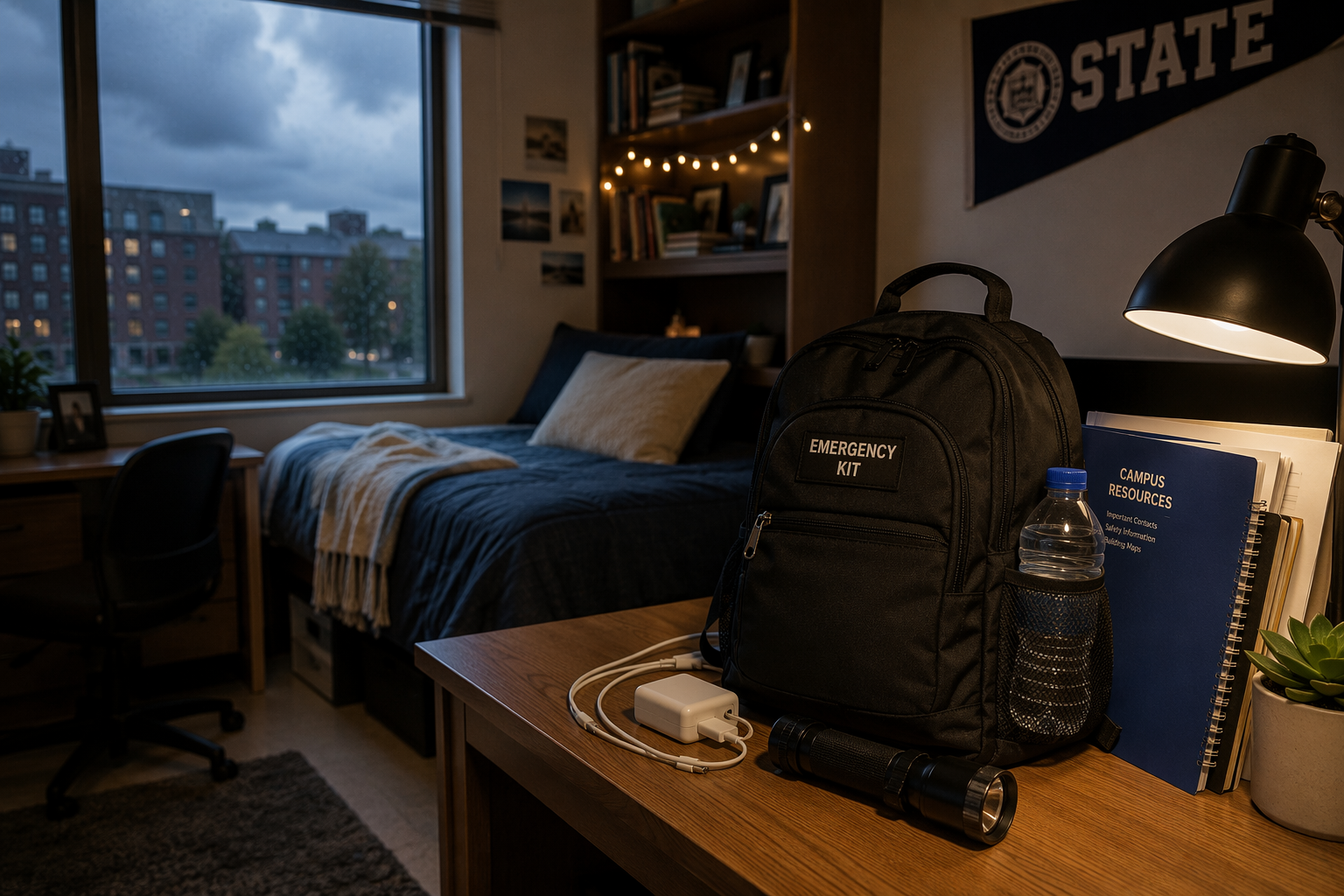
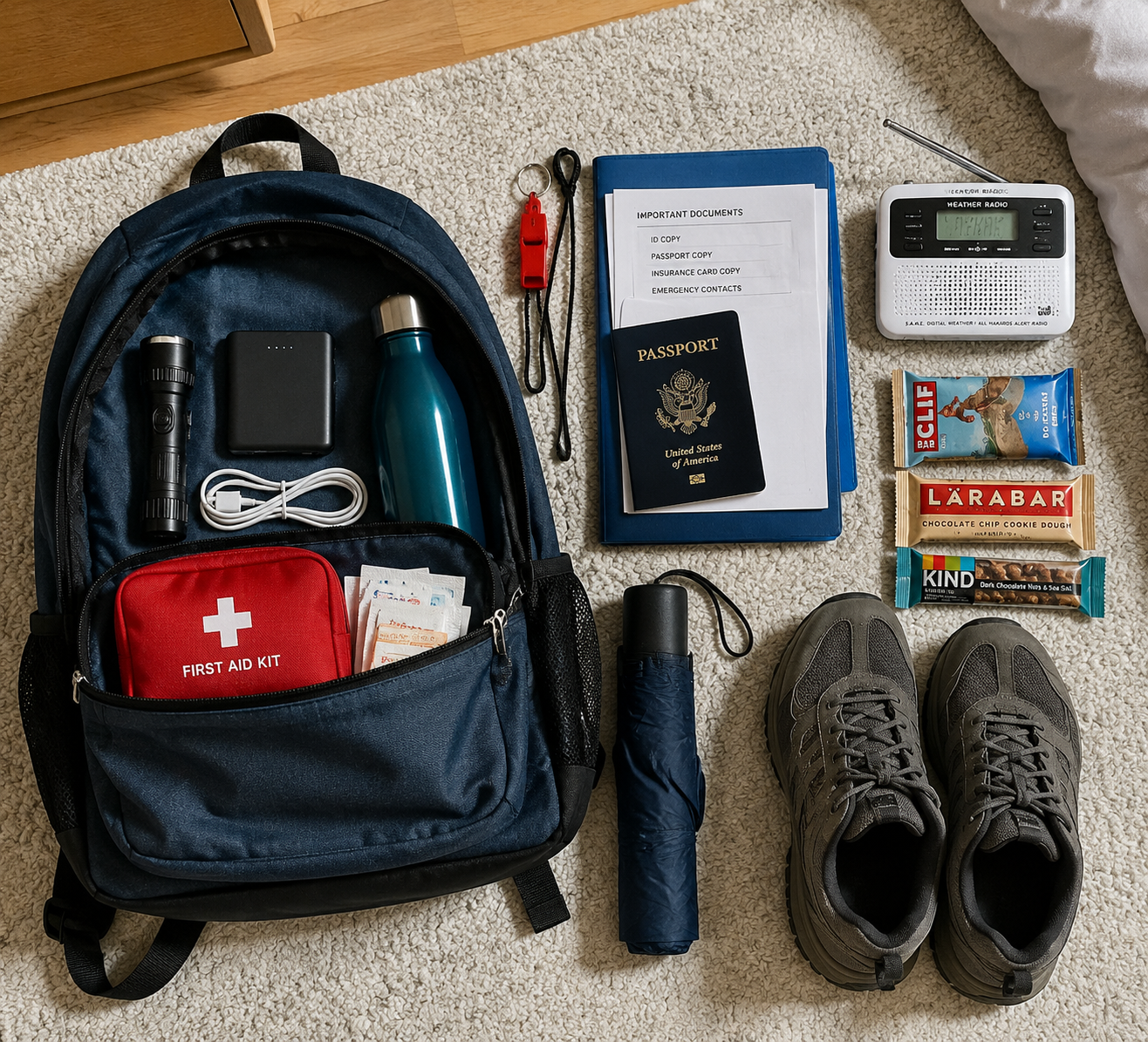
A student emergency kit should not require a storage bin you do not have. Syracuse University’s Department of Public Safety gives the more realistic model: an emergency dorm kit that can fit in a backpack and be grabbed quickly.[4] Cal OES also frames preparedness for college students around small, practical supplies and planning instead of a household-scale stockpile.[5]
Keep the kit where you can reach it in the dark. If you live off campus, do not store everything in a basement closet that could take on water first. If you commute, keep a smaller version in your everyday bag or car, but do not treat car supplies as your only plan; flash flood guidance is very clear that vehicles are a major danger zone.[1]
| Put in the backpack | Why it matters for students |
|---|---|
| Flashlight or headlamp | Power outages turn stairwells, parking lots, and apartment hallways into obstacle courses. |
| Portable phone charger and charging cable | Your phone is your alert device, map, ID backup, and roommate check-in tool. |
| Water bottle and small ready-to-eat snacks | You may be waiting in a shelter area, upper floor, campus building, or traffic delay. |
| Basic first aid supplies and personal medications | A minor cut, asthma inhaler, or prescription refill becomes harder to manage when roads close. |
| Whistle | It is small, cheap, and useful if you need to signal from a room, stairwell, or dark area. |
| Copies or photos of important documents | Student ID, driver’s license, passport, insurance card, lease, financial aid papers, and immigration documents can be hard to replace mid-semester. |
| Plastic zip bag or waterproof pouch | Protects IDs, medication labels, cash, and a small notebook from rain and splash. |
| Sturdy shoes | Flip-flops and soaked sneakers are a bad match for stairs, debris, and evacuation routes. |
| Small hygiene items | Contacts, glasses, period products, hand sanitizer, and a mask can matter more than another gadget. |
Do the document part before you think you need it. Put paper copies in a zip bag, and keep secure digital copies somewhere you can access if your laptop is damaged. At minimum, protect your student ID, government ID, health insurance card, prescription information, emergency contacts, lease or housing assignment, and any documents tied to financial aid, work authorization, or international student status.
Make a Roommate Plan That Does Not Depend on Everyone Being Home
Roommate plans fail when they assume a normal evening. During a flash flood threat, one person may be in class, one at work, one asleep, and one ignoring a group chat because the phone is charging across the room. Keep the plan short enough that people will actually remember it.
- Pick one group chat for emergency check-ins, and name it clearly.
- Agree on a quick status format: “safe in library,” “leaving work,” “need pickup,” or “sheltering upstairs.”
- Choose one out-of-area contact who can receive updates if local calls or texts get messy.
- Decide who will move electronics, documents, and medications off the floor if there is time and it is safe.
- Set a hard rule that nobody drives through water to rescue property, save a parking spot, or get back for a charger.
If you are the organized roommate, resist becoming the only emergency plan. Put the information where others can use it: taped inside a cabinet, shared in the chat, or saved in a note everyone can find. During a warning, you should not be the only person who knows the landlord’s number or where the flashlight is.
Know What to Do When a Watch Becomes a Warning
A flood watch means conditions are possible; a flood warning means flooding is happening or expected soon in the warned area. Ready.gov’s flood guidance treats these alerts as action signals, not background noise.[3] For students, the difference is the gap between getting ready and moving now.
| Alert or situation | Student action |
|---|---|
| Flood watch | Charge your phone and power bank, check your route home, move valuables off the floor, confirm roommate locations, and avoid starting trips through flood-prone roads. |
| Flash flood warning | Act immediately. Move to higher ground or a safer area as directed. Do not wait to see whether water reaches your door. |
| Campus alert | Read the full message. It may name a building, road, parking lot, shelter location, class change, or evacuation instruction. |
| Local evacuation order | Leave if you can do so safely and by the route officials provide. Take your backpack kit, documents, medications, phone, and charger. |
| Shelter-in-place instruction | Get above flood level if possible, stay away from floodwater, keep alerts on, and wait for official updates. |
The most dangerous student instinct is trying to finish the normal plan. Finishing the shift, making it back to your own bed, moving the car, crossing campus because the dining hall is still open, or walking through water because the apartment is “right there” can turn a weather alert into an emergency. NOAA’s vehicle-related fatality warning is not abstract; it is about exactly these decisions.[1]
If You Are in a Dorm
Dorms usually have staff, alert systems, and designated procedures, but that does not mean every resident hears the message at the same time. If a flash flood warning is issued, check the official campus alert, follow residence life or public safety instructions, and avoid elevators if there is any flooding or power instability. If you are told to move, take the backpack kit, phone, charger, medications, room key, ID, and shoes.
If you live on a lower floor, keep laptops, power strips, documents, and laundry baskets off the floor during heavy rain. Do not spend warning time rearranging the whole room. Move the irreplaceable items first, then leave or shelter as instructed. Furniture can wait; IDs and medication cannot.
If You Are in an Off-Campus Apartment
Off-campus housing is where students can be most exposed and least supervised. Basement bedrooms, garden-level units, first-floor apartments near creeks, and houses with poor drainage need a faster trigger. If water is rising near the building, do not wait for it to enter your room before moving to a higher floor or leaving by a safe route if officials tell you to evacuate.
If you rent a basement or ground-floor room, prepare as if the floor can get wet. Keep the power strip elevated, store documents high, avoid leaving your laptop bag on the floor overnight during heavy rain, and know the fastest indoor path to higher ground. If your only exit is already blocked by water, call for help rather than stepping into moving water.
Also know what your lease does not solve. A landlord may handle repairs later, but they will not protect your passport, prescription, homework drive, or class notes at 2 a.m. The first safe hour before a storm is when you move those items, not the minute water is under the door.
If You Are in Class, Lab, Work, or a Campus Building
Do not leave a safer building to get to a less safe one just because your backpack, car, or apartment is elsewhere. If a warning arrives while you are in class or at work, check the alert, listen for building instructions, and stay away from lower levels that could flood. Campus buildings may have staff who know shelter locations or closures before your group chat catches up.
For labs, studios, kitchens, gyms, and performance spaces, follow the person responsible for the room. Secure only what you can secure quickly and safely. A wet project is frustrating; being caught in a flooded stairwell or parking lot is worse.
If You Are Driving or Walking
This is the section to take personally. Nearly half of flash flood fatalities are vehicle-related, and 12 inches of water can carry away most cars.[1] You cannot judge water depth, road damage, or current strength from the driver’s seat, especially at night. If water covers the road, turn around. If barricades are up, do not go around them. If a friend says the car can make it, be the person who says no.
Walking is not automatically safer. Six inches of fast-moving water can knock an adult off their feet.[1] Floodwater can hide missing pavement, open drains, sharp debris, electrical hazards, and contamination. Do not walk through moving water to reach a dorm, party, bus stop, parking lot, or apartment building.
- If you are driving and see water over the road, turn around and find another route or stop in a safe place.
- If your car stalls in rising water and you can safely get out, leave the vehicle and move to higher ground.
- If water is moving fast around the vehicle, call emergency services and follow dispatcher instructions.
- If you are walking and water crosses your path, backtrack to a higher, dry route or shelter in a safe building.
- If transit is delayed, wait somewhere safe rather than attempting a flooded shortcut.
Protect the Semester, Not Just the Room
Flooding can derail school even when students are not physically injured. A Natural Hazards Center case study of the 2016 Louisiana floods reported that about 400 enrolled students at Southern University did not return after 20 inches of rain fell in 3 days and more than 55,000 homes were destroyed.[6] That is one university case, not a national estimate, but it shows the kind of disruption students understand immediately: housing, transportation, family obligations, money, documents, and course progress can all break at once.
Before a storm, back up active coursework to cloud storage or another protected location. Keep financial aid, employment, insurance, and immigration documents out of flood-prone storage. If you rely on campus equipment, medication refrigeration, disability accommodations, or a job schedule, know which office you would contact first after an emergency. Waiting until everything is wet makes every email harder to write.
After the Water Recedes
Do not rush back because the rain stopped. Floodwater can leave damaged roads, contaminated surfaces, unstable buildings, electrical hazards, and blocked exits. Ready.gov advises returning only when authorities say it is safe, and CDC flood guidance warns people to avoid floodwater because it can contain sewage, chemicals, sharp objects, and other hazards.[3][7]
- Wait for official clearance before returning to a dorm, apartment, parking lot, or campus building.
- Do not touch electrical equipment if it is wet or if you are standing in water.
- Photograph damage before moving items if it is safe; you may need records for housing, insurance, aid, or landlord communication.
- Throw away food, drinks, and porous items that contacted floodwater unless official guidance says they can be cleaned safely.
- Tell instructors, supervisors, residence life, and financial aid offices early if flooding affects attendance, housing, transportation, books, or technology.
If you feel fine physically but cannot get to class, cannot replace a laptop, or cannot sleep in your room, that is still an emergency impact. Ask the university which office coordinates temporary housing, emergency funds, meal access, counseling, technology loans, and academic flexibility. After a flood, the student who reports the problem early usually has more options than the student who disappears for two weeks and tries to explain later.
A Short Readiness Check
You are reasonably prepared for flash flooding as a student when these things are true: campus and local alerts can reach you, your roommate or closest friend knows how to check in, your documents and medications are protected, your kit fits in a backpack, your phone has a backup charge plan, you know whether your housing is flood-prone, and you have already decided that you will not drive or walk through floodwater.
References
- Severe Weather 101: Floods, NOAA National Severe Storms Laboratory, https://www.nssl.noaa.gov/education/svrwx101/floods/
- Turn Around Don't Drown, National Weather Service, https://www.weather.gov/safety/flood-turn-around-dont-drown
- Floods, Ready.gov, https://www.ready.gov/floods
- Emergency Dorm Kits, Syracuse University Department of Public Safety, https://dps.syr.edu/emergency-management/for-students/emergency-dorm-kits/
- Preparedness for College Students, Cal OES, https://www.caloes.ca.gov/office-of-the-director/operations/planning-preparedness-prevention/individuals-families/preparedness-for-college-students/
- The 2016 Louisiana Floods and Their Impact on Southern University Students, Natural Hazards Center, 2021, https://hazards.colorado.edu/quick-response-report/the-2016-louisiana-floods-and-their-impact-on-southern-university-students
- Floodwater After a Disaster or Emergency, Centers for Disease Control and Prevention, https://www.cdc.gov/floods/safety/index.html
Comments
Join the discussion with an anonymous comment.