
Master The Odyssey with This Summary and Analysis Guide
Learn how to study Homer's The Odyssey effectively with a breakdown of its non-linear narrative, major themes, character foils, and cultural context, plus strategies for exams and essays.
Updated:
If you searched for the odyssey summary and analysis for studying, you probably need two things at once: enough plot order to stop feeling lost, and enough analysis to write about the poem without sounding as if you only read the recap. SparkNotes, LitCharts, and CliffsNotes can help you find out what happens. The harder job is turning that information into a study method: noticing why Homer begins after the Trojan War, why Telemachus gets so much attention before Odysseus dominates the poem, and why homecoming in The Odyssey is never just a man sailing back to his house.
Start with the summary, but do not stop there. A student who can list Cyclops, Circe, Sirens, Scylla, Calypso, and the suitors may still miss the design of the poem. A better study plan asks what each episode tests: hospitality, loyalty, self-control, identity, divine favor, or the difference between brute force and intelligence.
The Fast Plot Summary You Actually Need
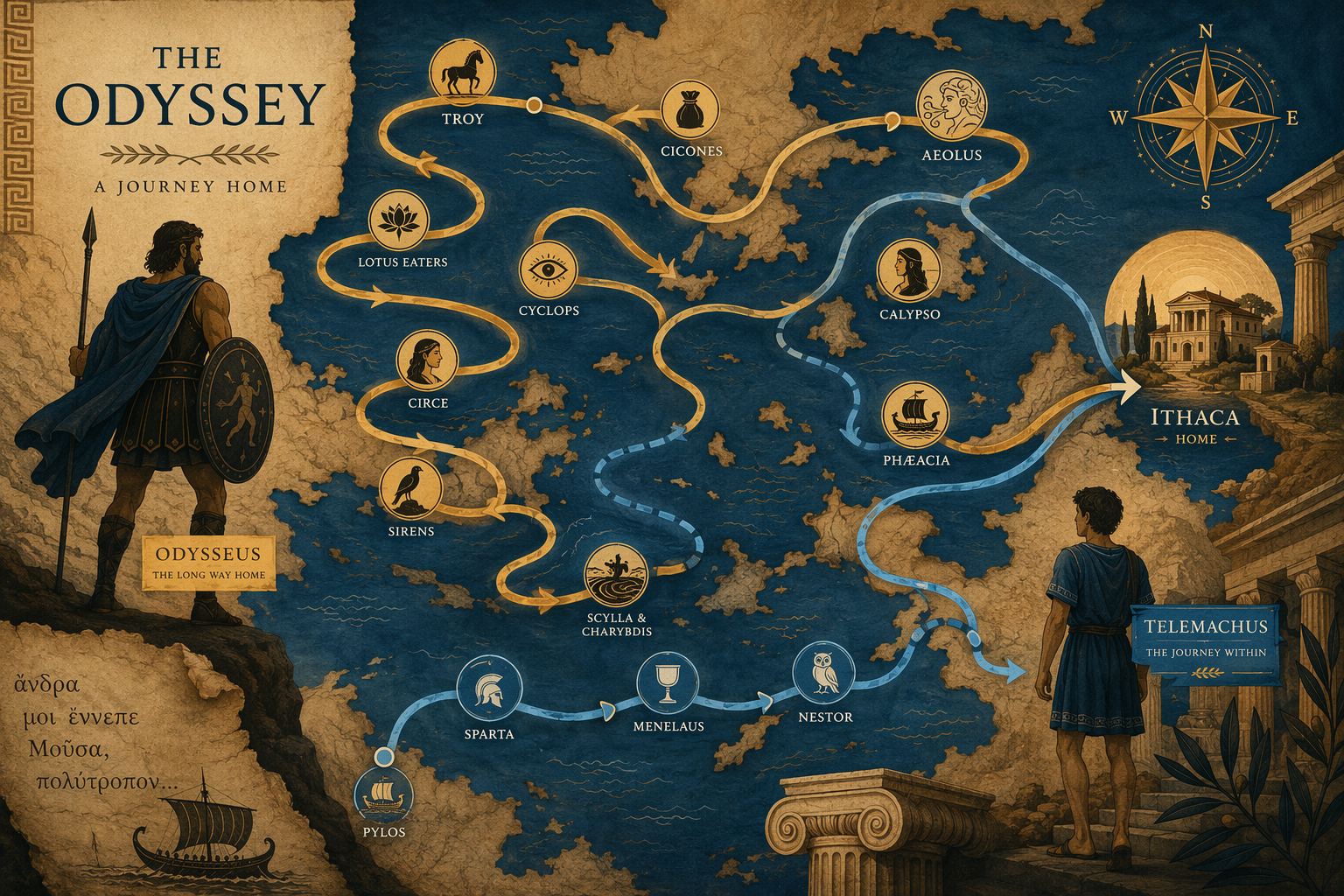
The poem does not begin with the Trojan War ending and then march neatly through every stop on Odysseus’s voyage. It opens in medias res—in the middle of things—when Odysseus has already been gone for years and is trapped on Calypso’s island. SparkNotes’ plot analysis emphasizes that the story begins near the end of Odysseus’s wandering rather than at the chronological beginning, which is why first-time readers often feel as if they entered through the side door of the poem.[1]
| Part of the poem | What happens | What to study |
|---|---|---|
| Books 1–4 | Telemachus faces the suitors in Ithaca and travels to hear news of his father. | His growth, the disorder in Odysseus’s household, and the father-son parallel. |
| Books 5–8 | Odysseus leaves Calypso, survives another wreck, and reaches the Phaeacians. | Divine intervention, suffering, reputation, and the need for a listener. |
| Books 9–12 | Odysseus tells his own wanderings after Troy. | Cunning, temptation, bad leadership, and the cost of poor self-control. |
| Books 13–24 | Odysseus returns to Ithaca in disguise, tests allies, kills the suitors, and restores his household. | Recognition scenes, justice, loyalty, and whether homecoming repairs social order. |
That table is enough for a first quiz review. For an essay, it is only the floor. The major mistake is to treat Books 9–12—the famous adventure sequence—as the whole poem. Those books matter, but Homer frames them with Ithaca, Telemachus, Penelope, the suitors, other returns from Troy, and the gods’ arguments about justice.
Why the Poem Starts in the Middle
The non-linear structure is not a trick added to make the assignment harder. It changes what the reader pays attention to. If the poem began with Troy and proceeded island by island, Odysseus would look mainly like an adventurer. By beginning with his absence, the poem makes the first problem a damaged household: suitors consume his property, pressure Penelope, and treat Telemachus as someone who can be ignored.
That is why Telemachus matters before Odysseus returns to center stage. Books 1–4 are not a long delay before the “real” story. They show what Odysseus must come home to, and they let the poem compare a son learning how to act with a father who must eventually prove who he is. SparkNotes identifies this paired structure as central to the plot: Telemachus’s search for news and Odysseus’s struggle to return run beside each other before converging in Ithaca.[1]
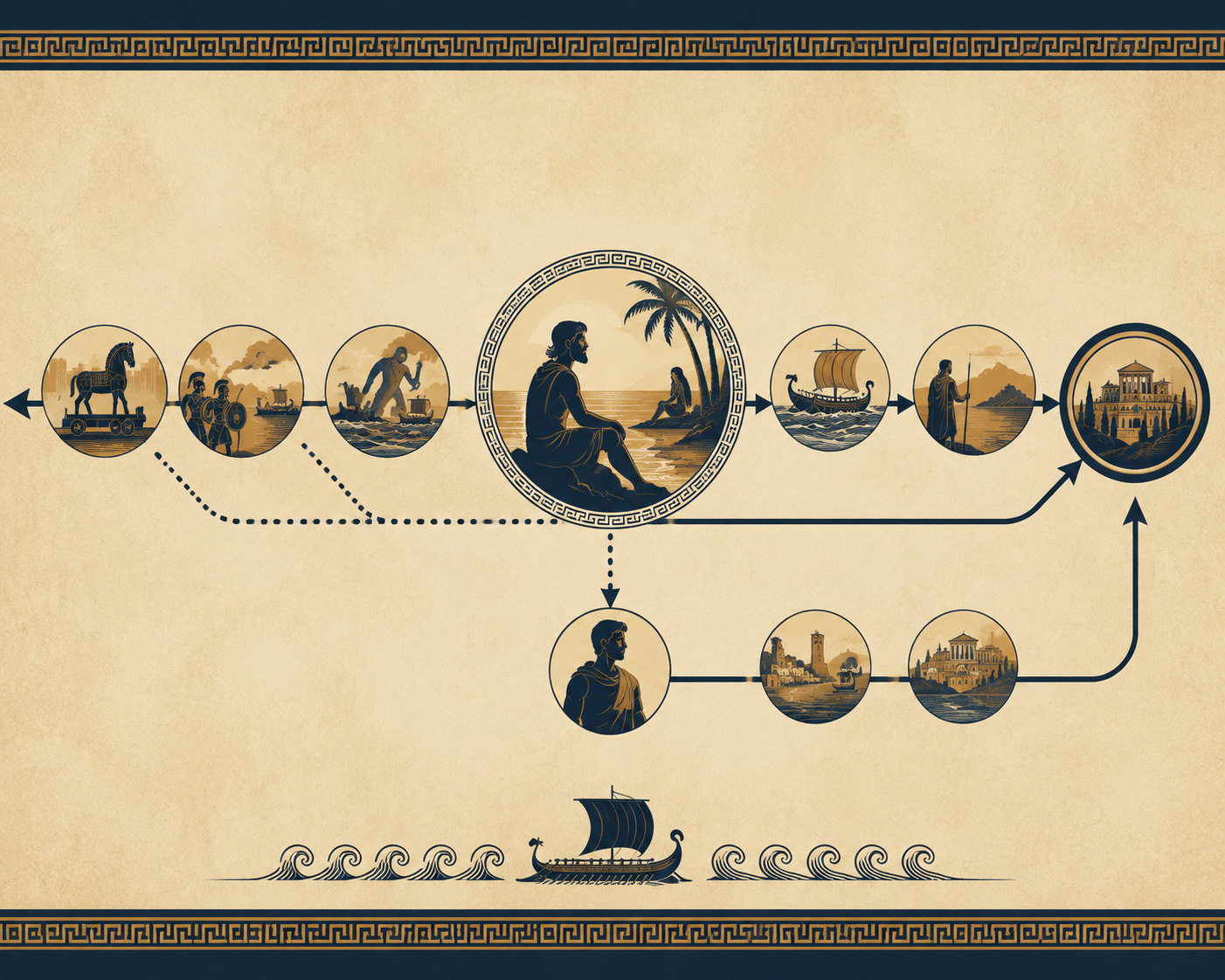
When Odysseus narrates his wanderings to the Phaeacians, the poem also changes who controls the story. For several books, Odysseus is not merely a character being described; he becomes the teller of his own suffering, cleverness, and losses. That matters for analysis because his reputation depends partly on narrative skill. He survives with strategy, but he also survives by making others understand who he is.
Study the Structure as a Set of Comparisons
A workable study guide for The Odyssey should make you ask comparison questions. Odysseus is not the only man returning from Troy. Telemachus is not the only young man being judged by his father’s reputation. Penelope is not the only wife placed under pressure. Ithaca is not the only household where loyalty, power, and revenge matter.
The Agamemnon-Clytemnestra-Orestes story is especially useful here. In the poem’s world, Agamemnon returns from Troy and is murdered by Clytemnestra and her lover; Orestes later avenges his father. This comparison appears repeatedly because it sharpens the stakes of Odysseus’s return: a homecoming can end in restoration, but it can also end in betrayal, murder, and a son’s revenge.[1]
- Odysseus and Agamemnon: two Greek leaders return from Troy, but their households receive them very differently.
- Penelope and Clytemnestra: two wives become measures of loyalty, though the poem is much more interested in Penelope’s intelligence than in simple passivity.
- Telemachus and Orestes: two sons must respond to threats against the father’s household, but Telemachus’s task is to mature before he can help restore order.
- Odysseus and the suitors: one guest-stranger tries to reclaim rightful order; the others abuse hospitality and mistake temporary power for legitimacy.
This is the difference between knowing a reference and using it. “Agamemnon is mentioned” is a detail. “The Agamemnon story makes Odysseus’s homecoming look morally and politically fragile” is the beginning of an essay claim.
Four Themes Worth Tracking Scene by Scene
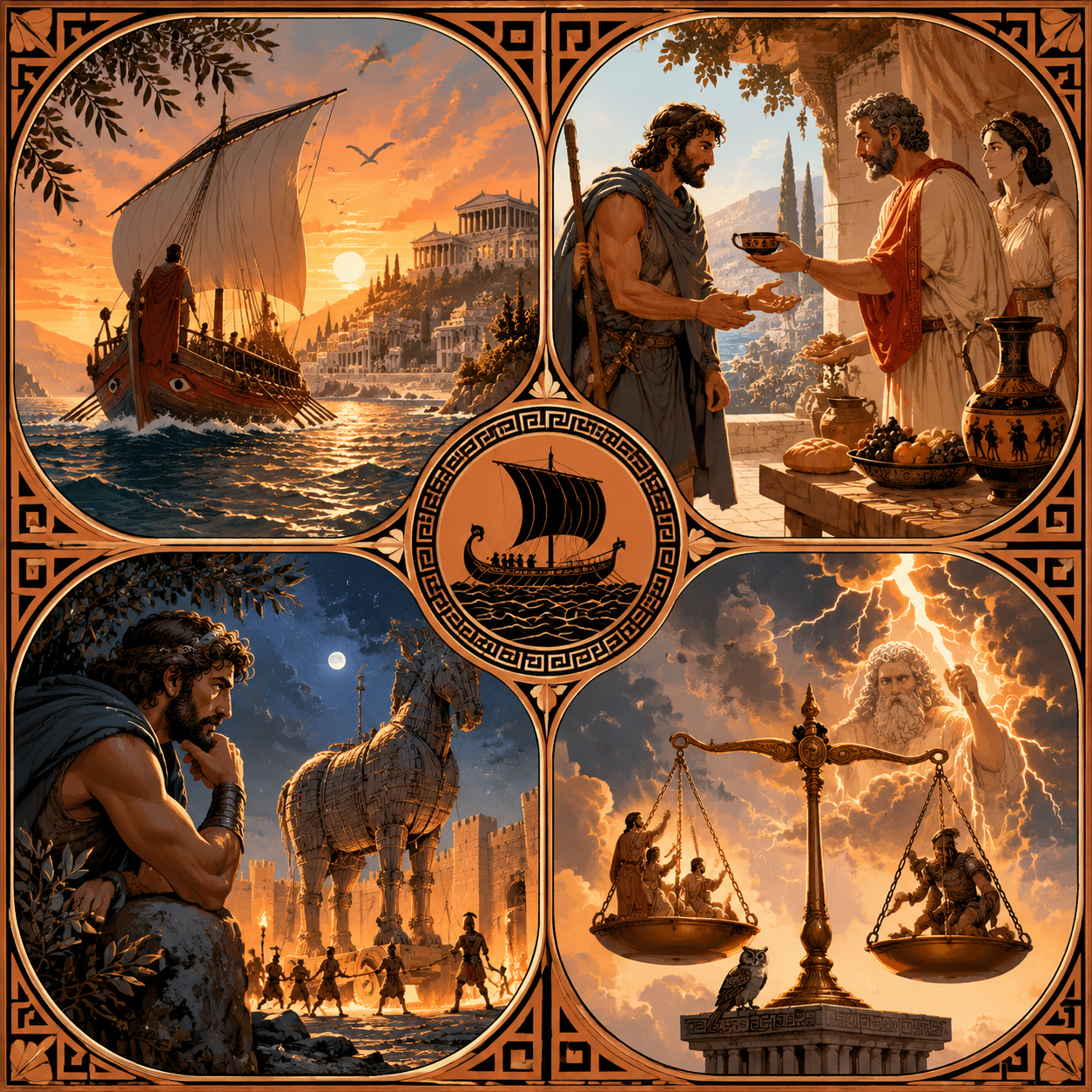
Theme notes often fail because they turn into vague morals: “family is important,” “be loyal,” “don’t anger the gods.” Those are too flat for The Odyssey. SparkNotes identifies major themes including homecoming, hospitality, cunning, and justice; the useful study move is to attach each theme to scenes, choices, and consequences.[2]
Nostos: homecoming as a test, not a destination
Nostos means homecoming, but in this poem it is not satisfied by physical arrival. Odysseus reaches Ithaca before he can openly become master of his house again. He must learn what has happened, disguise himself, test servants, coordinate with Telemachus, and wait for the right moment. Homecoming becomes a process of recognition and restoration, not a travel itinerary.
Track where the poem delays recognition. Penelope does not simply run into Odysseus’s arms because the plot needs suspense. Her caution belongs to the poem’s moral world: after years of deception, pressure, and false reports, knowing whom to trust is part of survival.
Xenia: hospitality with consequences
Xenia, the guest-host relationship, is one of the easiest themes to use well because it appears in sharply different scenes. Good hosts feed, shelter, question carefully, and honor the stranger. Bad hosts exploit, trap, devour, or insult guests. Bad guests consume what is not theirs and refuse limits. The suitors are not merely rude young men; they are a long-running violation of household order.
For studying, make a two-column note whenever a stranger enters a house or island space: What does the host do? What does the guest do? That simple chart will help with quizzes and with essays because it connects scene detail to social meaning.
Cunning vs. strength: why Odysseus keeps winning indirectly
Odysseus is a warrior, but the poem repeatedly values metis—cunning intelligence, planning, adaptability, and verbal skill. The Cyclops episode is the cleanest example for many students: Odysseus survives not by overpowering Polyphemus, but by lying, timing the escape, and using the Cyclops’s own assumptions against him. The same pattern matters later in Ithaca, where disguise and restraint become more useful than immediate violence.
Do not reduce this theme to “brains beat brawn.” The poem also shows that cunning can become dangerous when joined to pride. Odysseus’s self-revelation to Polyphemus brings consequences that follow him across the sea. A stronger essay claim would say that The Odyssey praises intelligence when it serves survival and justice, but tests it when it turns into self-display.
Divine justice: the gods are not decoration
The gods in The Odyssey are not background mythology sprinkled onto a human adventure. Athena protects, advises, disguises, and tests; Poseidon obstructs Odysseus after the blinding of Polyphemus; Zeus weighs larger questions of punishment and order. SparkNotes’ theme discussion treats divine justice as one of the poem’s major organizing concerns, especially in the punishment of those who violate moral and social obligations.[2]
For exams, name the god and the action. “The gods intervene” is too general. “Athena’s support helps Telemachus speak and travel” or “Poseidon’s anger extends Odysseus’s suffering after Polyphemus” gives you something a teacher can actually credit.
Characters to Study as Foils, Not Isolated Profiles
Character charts are useful until they become storage bins. Odysseus: clever. Penelope: loyal. Telemachus: growing up. Athena: helper. That is a start, but it will not carry an analysis paragraph. The better method is to study characters in pairs because the poem itself keeps asking readers to compare households, returns, and kinds of intelligence.
| Pair | Useful contrast | Possible essay use |
|---|---|---|
| Odysseus / Telemachus | Experienced strategist and untested son learning public confidence. | The poem makes homecoming depend on both the father’s return and the son’s maturation. |
| Penelope / Clytemnestra | Cautious loyalty and destructive betrayal. | Penelope’s intelligence helps define what a restored household requires. |
| Odysseus / suitors | Controlled disguise and reckless consumption. | The suitors fail because they misread both hospitality and power. |
| Athena / Poseidon | Protection and obstruction. | Divine action turns human choices into consequences rather than random adventure. |
| Odysseus / Polyphemus | Cunning speech and brute force. | The Cyclops episode shows both the power and danger of Odysseus’s intelligence. |
Cultural Context Without Turning Your Notes into a History Lecture
Britannica identifies The Odyssey as one of the two great ancient Greek epic poems attributed to Homer, alongside The Iliad, and places it in the ancient epic tradition surrounding the aftermath of the Trojan War.[3] For most literature assignments, that is the amount of context you need before returning to the text. You should know that the poem belongs to an oral heroic tradition and that its world values reputation, household order, guest-host obligations, and divine power. You do not need to settle every scholarly debate about Homer to write a competent class essay.
If your class is also covering the Trojan War, use that context to understand why Odysseus is famous before the poem begins. His problem is not becoming a hero from scratch; it is returning from heroic war into a domestic world that has been rotting in his absence. For a focused refresher, see Historical Evidence for the Trojan War and Achilles.
Symbols and Devices That Are Worth Remembering
Literary devices are useful when they help you notice repeated patterns. ThoughtCo’s discussion of The Odyssey highlights major themes and devices including disguise, storytelling, symbolism, and the importance of recurring objects and situations.[4] In your own notes, keep this practical: do not make a separate symbol list unless the symbol helps explain a scene.
- Odysseus’s scar: useful in recognition scenes because identity is proven through the body, memory, and shared history.
- The marriage bed: useful for Penelope and Odysseus because it joins household, marriage, rootedness, and secret knowledge.
- Disguise: useful because Athena and Odysseus both use hidden identity to test people before revealing truth.
- Feasting: useful because meals reveal whether a household honors hospitality or abuses it.
- Storytelling: useful because Odysseus repeatedly survives by shaping how others understand him.
The marriage bed is a good example of how not to flatten a symbol. It is not just “love.” It is built into the house, known intimately by husband and wife, and impossible to move without changing what it means. That is why Penelope’s test matters: she is not being coy; she is asking for knowledge only the real Odysseus should have.
Translation Choice: Make the Poem Readable Enough to Study
Use the translation your teacher assigns. If you are allowed to choose, Robert Fagles is often a strong first-time option because it keeps energy and narrative movement. E. V. Rieu can be friendlier for students who are struggling to follow basic action. Treat that as practical reading advice, not as a scientific ranking of translations. The best translation for studying is the one you will actually read closely enough to mark patterns, not merely the one someone praises as beautiful.
If the language feels dense, read a short summary before the assigned book, then read the actual lines with a pencil. That order is not cheating; it is scaffolding. The mistake is letting the summary replace the lines where the poem does its work.
A Study Plan for Quizzes and Essays
Teachers do test details. The Practical English Teacher’s free unit on The Odyssey includes book-specific reading quizzes and essay prompts, which matches what students usually face: you need to remember who did what in a particular book, and you need to turn those details into claims about theme, character, and structure.[5]
Use two layers of notes. The first layer is for recall. The second is for interpretation.
| Study task | What to write down | Why it helps |
|---|---|---|
| Book-level recall | Main location, major characters, one conflict, one result. | Prepares you for quizzes and prevents plot confusion. |
| Theme tracking | One scene for nostos, xenia, cunning, or divine justice. | Gives you evidence for paragraphs instead of vague theme claims. |
| Character contrast | One foil or comparison connected to the book. | Helps you move from description to analysis. |
| Quote or moment | A short passage, recognition scene, test, speech, or choice. | Gives essays something specific to interpret. |
| Question for class | One thing that confused you about motive, order, or consequence. | Turns confusion into something answerable. |
If you already build study materials from class documents, connect this poem-specific method to How to Create a Study Guide from Your Syllabus in 5 Steps. Put quiz dates, assigned books, essay prompts, and theme notes in the same place. The Odyssey becomes much easier when you stop keeping plot, themes, and deadlines in separate mental piles.
How to turn a scene into an essay claim
A weak paragraph says, “Hospitality is important in The Odyssey.” A usable paragraph names a scene, explains the behavior, and connects it to order or disorder. For example: the suitors’ feasting in Ithaca shows that xenia can be violated by guests as well as hosts; their consumption of Odysseus’s household turns private misconduct into a public crisis that must be judged and corrected.
That claim is stronger because it can be proven. You can point to the suitors’ actions, Telemachus’s lack of authority at the beginning, Penelope’s pressure, and Odysseus’s disguised testing after he returns. One theme now connects plot, character, and structure.
Common Misreadings to Avoid
- Do not treat Books 1–4 as optional setup. Telemachus’s plot teaches you what is broken in Ithaca before Odysseus arrives.
- Do not treat the gods as decorative. Their actions shape delay, punishment, protection, and recognition.
- Do not call every stop on the journey a random adventure. Ask what each place tests.
- Do not confuse the Trojan War with the plot of The Odyssey. The war is background; the poem focuses on return.
- Do not insert Sinon into Homer’s Odyssey. If that confusion came from Trojan Horse material, see Why Sinon of Greek Mythology Is Not in Homer’s Odyssey.
What About the 2026 Film?
A film adaptation can be useful after you know what your class is assigning, but it is not the assigned text unless your teacher says so. If renewed interest in Christopher Nolan’s 2026 adaptation brought you here, keep the categories separate: Homer’s poem is what you quote, analyze, and cite for a literature class. For adaptation context, use How Nolan Changed Homer’s Characters in The Odyssey 2026 only after you can explain the poem’s own structure and character contrasts.
The Route Through the Poem
Read summaries to get your bearings. Then read the assigned books for structure: Telemachus before Odysseus, Ithaca before the wanderings, disguise before recognition, comparison before judgment. Track nostos, xenia, cunning, and divine justice through actual scenes. Use foils—especially Agamemnon, Clytemnestra, and Orestes—to explain why Odysseus’s return matters as more than a successful trip home.
That is the study route that holds up under quizzes and essays: know the plot well enough not to get lost, but learn to see the design instead of merely surviving the storyline.
References
- The Odyssey: Full Poem Analysis, SparkNotes.
- The Odyssey: Themes, SparkNotes.
- Odyssey, Britannica.
- The Odyssey Themes and Literary Devices, ThoughtCo.
- Free Unit for The Odyssey, The Practical English Teacher.
Comments
Join the discussion with an anonymous comment.