
Economic Impact of Endangered Species Act Changes for Students
A data-driven overview of how the 2025–2026 Endangered Species Act rule changes create economic trade-offs, with clear costs, benefits, and who bears them. Designed for students writing essays or preparing for debates on environmental policy.
Updated:
To understand the economic impact of Endangered Species Act changes, start with four moving parts, not one headline. The 2025–2026 rule changes would let officials consider economic effects when deciding whether to list a species, remove automatic protections for newly listed threatened species, narrow how critical habitat is designated, and rescind a habitat-based definition of “harm” that had treated some habitat modification as unlawful take. The last of those, the harm-definition change, was finalized on July 14, 2026; several other pieces remained under review or in litigation as of July 2026.[1][2][3]
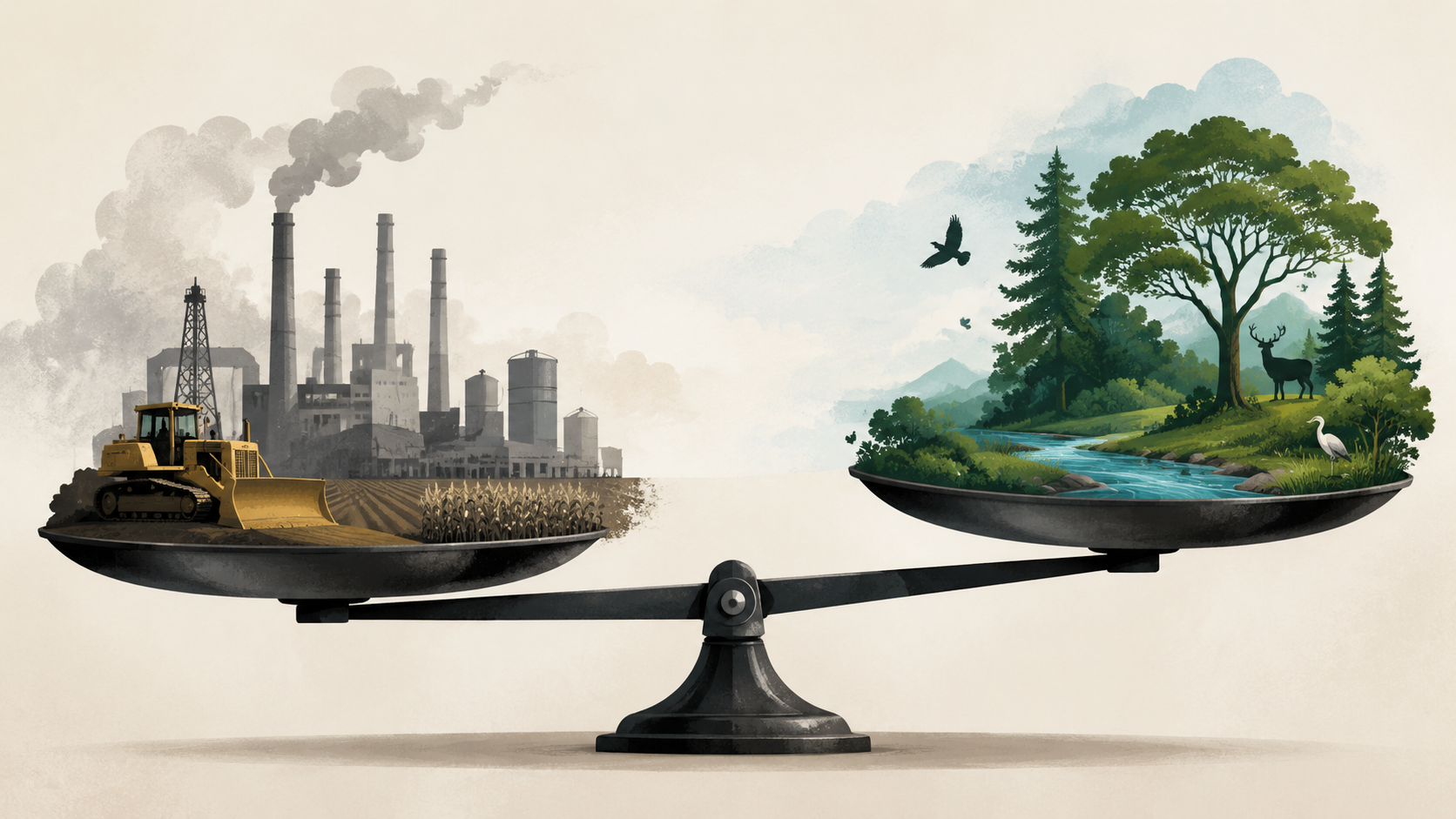
That makes this a trade-off problem. Developers, energy companies, farmers, ranchers, and some private landowners may face lower compliance costs or less permitting uncertainty. The public may also lose some protection for species and habitats that produce benefits people do not usually pay for at a checkout counter: flood control, clean water, pollination, recreation, and future recovery options. If someone tells the story as pure deregulation or pure environmental damage, they are skipping the ledger.
| ESA change | What it does economically | Likely near-term beneficiaries | Who absorbs the downside |
|---|---|---|---|
| Allow economic considerations in listing decisions | Makes listing less insulated from projected costs to land use, infrastructure, energy, and agriculture | Regulated industries and local governments facing project delays or restrictions | Species that may wait longer for protection; public users of ecosystem services |
| Remove automatic blanket protections for threatened species | Reduces default compliance duties unless species-specific rules are written | Landowners, builders, farmers, ranchers, and energy operators in affected areas | Threatened species during the period before tailored protections exist |
| Restrict critical habitat designations | Limits areas that trigger federal review and mitigation costs | Projects near proposed or potential habitat, especially where land values are high | Species recovery plans that depend on currently unoccupied or degraded habitat |
| Rescind habitat-based “harm” definition | Narrows when habitat modification counts as prohibited take | Land users whose activities alter habitat without directly killing animals | Species whose decline is driven by habitat loss rather than direct killing |
The First Side of the Ledger: Lower Compliance Costs
The clearest economic gain from the rule changes is not mysterious: fewer automatic restrictions can mean fewer surveys, fewer consultants, fewer redesigns, fewer mitigation payments, and fewer months waiting for agency review. For a student essay, that is the practical meaning of “regulatory certainty.” It does not mean every project becomes cheap. It means some projects face fewer ESA-related checkpoints before construction, drilling, grazing, logging, or farming decisions move forward.
Critical habitat is where the money often becomes visible. A Competitive Enterprise Institute study highlighted agency estimates for several habitat designations, including roughly $532 million for the Alameda whipsnake, about $1 billion for vernal pool species, and about $4.6 billion for the California gnatcatcher.[4] Those figures are useful because they show why local governments and property owners care. A habitat line on a map can change the expected value of land, the timing of a project, and the bargaining power of everyone involved.
But the same study should not be treated as a clean national price tag for the ESA. Its broader “hundreds of billions” framing aggregates agency analyses that used different scopes, time horizons, and discount rates.[4] That is not useless, but it is not the same thing as one consistent cost-benefit estimate. If a debate partner treats it as the final number, ask what years are being counted, what costs are included, and whether the same method was used across examples.
The same caution applies in the other direction. A project delay is not always a social loss equal to the developer’s private cost. Sometimes a delay prevents damage that would have been shifted onto downstream communities, future taxpayers, or other land users. Sometimes it only adds paperwork. The economic question is which one is happening in a particular case.
The Other Side: Ecosystem Services Are Real, but the Big Number Needs Care
The strongest benefit-side number often cited is about $1.6 trillion per year in ecosystem services from U.S. lands protected under the ESA.[5] That figure is huge, and it points to a real economic issue: habitats do work. Wetlands store floodwater. Forests filter air and water. Insects pollinate crops. Healthy rivers support recreation and fisheries. These benefits are spread across people who may never know which species or habitat rule helped preserve them.
Still, the $1.6 trillion figure should not be written as “the ESA saves $1.6 trillion every year.” The estimate comes from a 2011 study and is broader than ESA-attributable benefits alone.[5] It helps students see the scale of ecosystem services at stake, but it does not prove that any single 2025–2026 rule change will erase a specific dollar amount. The honest version is narrower: weakening habitat and species protections can put very large ecosystem-service values at greater risk, but the exact loss from these rule changes is not currently calculable.
That distinction matters because environmental policy arguments often smuggle in certainty where the evidence only supports direction. A lower compliance burden is immediate and easier to invoice. A lost flood-control function, a reduced pollinator base, or a slower species recovery may show up later, across many people, and without an ESA label attached. The fact that those benefits are hard to price does not make them imaginary. It does make them easier to ignore.
Annual Spending Shows the ESA Is Also a Budget Problem
The ESA is not only a fight over private projects. It is also a public spending system. Federal and state ESA-related spending was about $1.26 billion in fiscal year 2020, according to U.S. Fish and Wildlife Service testimony.[6] That number includes real taxpayer money, but it is small compared with the much larger ecosystem-service values often invoked in benefit arguments.
The recovery side is underfunded even before the new rule changes are counted. Defenders of Wildlife and the Center for Conservation Innovation estimated that more than $1.5 billion per year would be needed to recover all listed species.[7] That recovery gap matters because weaker protections can shift costs into the future. If habitat is easier to alter now, later recovery may require more public spending, more aggressive intervention, or acceptance that some species will not recover.
This is where slogans start to fail. A rule change that saves a project money this year may reduce a private cost without reducing the total social cost. It may simply move part of the bill from a developer’s permitting budget to a future agency recovery budget, a local flood-risk budget, or a community that loses recreation and water-quality benefits. That does not mean every ESA restriction is efficient. It means “cost saving” is not complete analysis unless the question is: saving for whom?
Why Private Landowners Feel the Burden First
The distribution problem is the emotional center of the ESA economics debate. A classic Journal of Economic Perspectives article by Gardner Brown Jr. and Jason Shogren noted that private land hosts about 90% of listed species, which means private owners often bear disproportionate conservation costs.[8] That one fact explains a lot of the anger. The public wants species protection, but the habitat may sit on a ranch, timber parcel, farm, or future subdivision site.
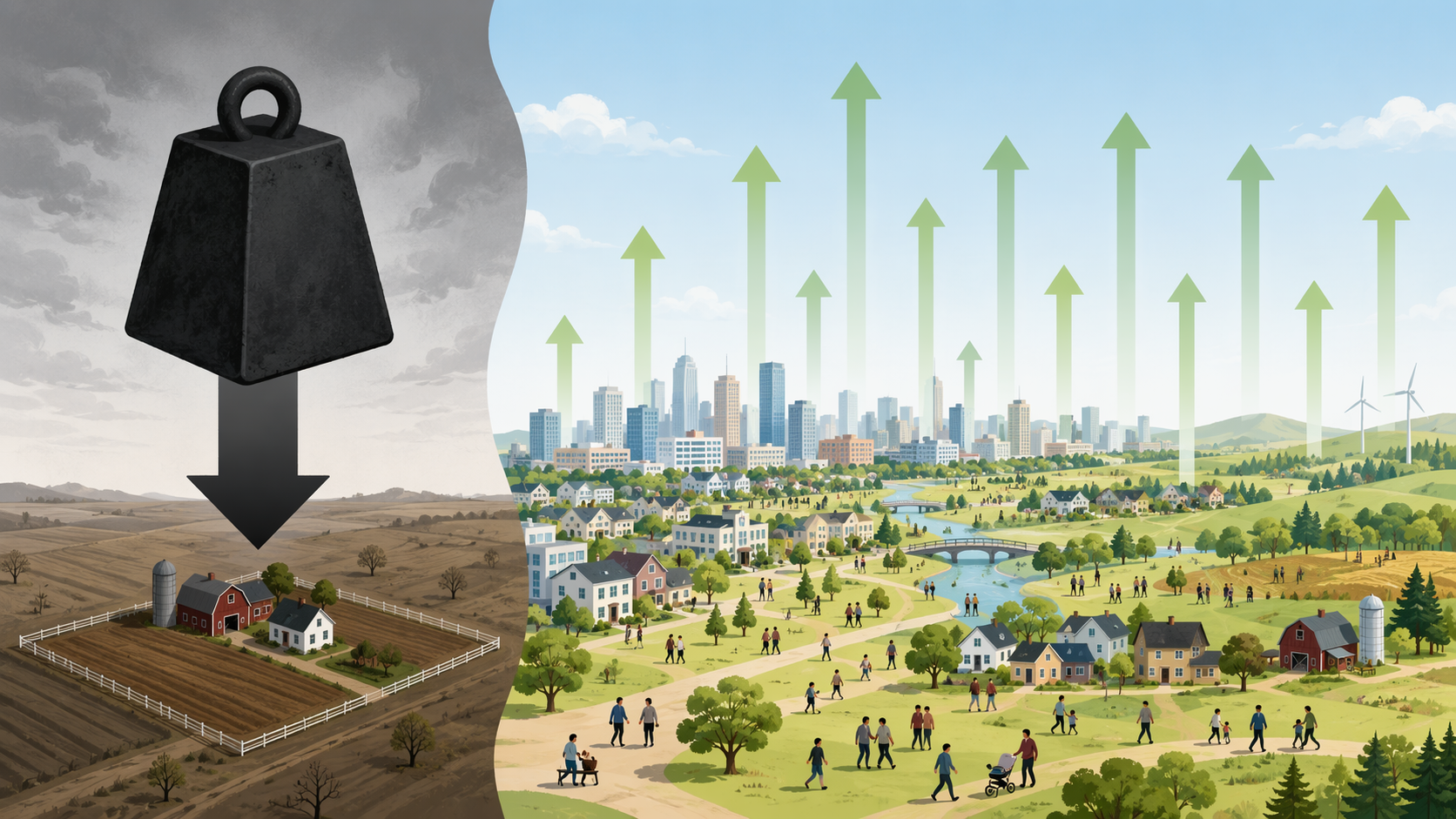
That does not make landowners villains. If a species listing lowers the development value of a parcel, requires habitat management, or creates legal risk around ordinary land use, the cost is not theoretical. It may arrive before any public compensation does. A household with land-rich but cash-poor assets can experience a species protection rule very differently from a voter who likes biodiversity but will never host protected habitat.
At the same time, not every avoided rule is a pure economic gain. If habitat loss increases flood risk, reduces water quality, or makes species recovery more expensive, then the private saving has a public shadow. The distribution question cuts both ways: landowners should not be asked to quietly bankroll national conservation goals, and industries should not get to call a shifted cost a disappeared cost.
What the Four Changes Mean in Practice
Economic considerations in listing decisions
Under the traditional ESA structure, listing decisions were supposed to turn on biological status, while economic impacts were considered more directly in areas such as critical habitat designation. Allowing economic considerations into listing changes the timing of the cost conversation. Industries and local governments get a chance to bring projected economic burdens earlier into the process. Species with expensive implications may face a harder path to protection.
For students, the key distinction is between information and weighting. It is reasonable for policymakers to know the economic effects of a listing. The controversial part is whether those costs should influence whether a species receives legal protection in the first place. If a listing decision becomes partly economic, the ESA moves closer to a cost-benefit model and farther from a science-first triage model.
Ending automatic blanket protections for threatened species
Threatened species are not yet endangered but are likely to become so. Automatic blanket protections have mattered because they create a default rule while agencies develop species-specific regulations. Removing that default can reduce immediate restrictions for land users. It can also leave gaps if agencies lack time or staff to write tailored rules quickly.
Staff capacity is not a side issue here. Reporting based on Center for Biological Diversity FOIA data found that the U.S. Fish and Wildlife Service lost 18% of its staff between 2024 and May 2025.[9] If agencies are expected to replace blanket protections with case-by-case rules, staffing levels affect whether that promise is realistic. A tailored rule is only better than a blanket rule if someone can write, enforce, and update it.
Restricting critical habitat
Critical habitat rules are economically sensitive because they attach conservation review to place. Once land is designated, federally funded, permitted, or carried-out actions may face additional scrutiny. Restricting designations can lower costs for projects near habitat, especially where land prices or infrastructure needs are high.
The trade-off is that recovery often needs more than the places where a species barely survives today. If habitat rules focus too narrowly on occupied or pristine areas, species that need restored, connected, or climate-resilient habitat may have fewer recovery options. That is an economic loss too, even if it does not appear on the same spreadsheet as a subdivision delay.
Rescinding the habitat-based harm definition
The July 14, 2026 rescission of the habitat-based “harm” definition narrows one of the ESA’s enforcement pathways.[2] Economically, that can reduce legal risk for activities that alter habitat but do not directly kill or injure an animal in an obvious, immediate way. For land users, that is a meaningful change. A forest clearing, wetland modification, or construction plan may look different legally if habitat alteration is less likely to count as prohibited take.
For conservation, the concern is just as direct: habitat loss is often the mechanism by which species decline. If law treats only direct killing as the core harm, then the economic system may undercount the damage done by removing the conditions a species needs to survive. Litigation filed the same day as the final rule means the practical effects were not settled when the change took effect.[3]
The God Squad Exemption Is a Boundary Marker, Not the Whole Story
In March 2026, the ESA exemption committee often called the “God Squad” granted an exemption for Gulf drilling, and the committee had convened only four times in 48 years.[3][10] That is a dramatic fact, so it tends to pull attention toward itself. For the economic question here, it is better understood as a signal that the pressure between species protection and energy development had reached an unusually formal conflict point.
The exemption does not prove that ESA protections usually block nationally important projects. It also does not prove that exemptions will become routine. Its longer-term significance depends on litigation and how agencies use emergency, national-security, or high-priority project arguments in future cases. Students can mention it as evidence that the economic stakes are active in 2026, not as proof that the whole ESA system has already changed in one direction.
What Has the ESA Bought So Far?
A cost-benefit discussion should include outcomes, not just restrictions. Research cited by the Center for Biological Diversity and published in PeerJ estimated that the ESA helped prevent roughly 300 extinctions, and more than 100 species have been delisted due to recovery.[11] Those numbers do not tell us whether every dollar was spent efficiently. They do show that the ESA is not merely symbolic regulation. It has produced measurable conservation results.
The harder question is whether the same or better outcomes could be produced with less conflict. Economists have argued for decades that species protection often creates perverse incentives when landowners fear that discovering habitat will reduce land value.[8] If regulation punishes people for hosting species, some owners may avoid conservation-friendly behavior. That is not an argument for pretending habitat does not matter. It is an argument for designing policy so the people carrying the cost are not treated as an afterthought.
A Student-Friendly Cost-Benefit Ledger
| Economic category | What can improve under the changes | What can worsen under the changes | Best student wording |
|---|---|---|---|
| Private compliance costs | Lower permitting, mitigation, delay, and legal-risk costs for some projects | Savings may reflect costs shifted onto ecosystems or future recovery programs | The changes likely reduce near-term private compliance costs. |
| Public budgets | Agencies may spend less time reviewing some activities | Weaker protection can increase later recovery needs; recovery already faces a funding gap | Budget effects are uncertain and may move costs across time. |
| Ecosystem services | Some land uses may generate more immediate market output | Habitat loss can reduce services such as water filtration, flood control, pollination, and recreation | Large public benefits are at risk, but exact losses from the new rules are not yet measurable. |
| Distribution | Private landowners and regulated sectors may receive relief | Benefits of species protection are broadly shared, while costs are often locally concentrated | The debate is partly about fairness, not only efficiency. |
| Uncertainty | Developers may see clearer limits in some areas | Litigation and unfinished rulemaking make final impacts uncertain | The 2025–2026 changes are still a moving target. |
This ledger is more useful than a single answer because the ESA does not affect “the economy” as one person. It affects a rancher differently from a city water utility, a homebuilder differently from a birdwatcher, a future taxpayer differently from a current permit applicant. The controversy survives because those people are not imagining their stakes. They are looking at different columns.
Glossary
- Endangered species: A species in danger of extinction across all or a significant portion of its range.
- Threatened species: A species likely to become endangered in the foreseeable future.
- Critical habitat: Areas considered essential for a listed species’ conservation and recovery.
- Blanket rule: A default protection that applies automatically to threatened species unless replaced by a species-specific rule.
- Harm definition: ESA enforcement language that can determine whether habitat modification counts as prohibited take.
- Ecosystem services: Benefits people receive from nature, such as clean water, flood control, pollination, recreation, and climate regulation.
- God Squad: The ESA exemption committee that can allow certain projects to proceed despite species impacts under rare conditions.
Discussion Questions
- If private land hosts most listed species, should landowners receive more compensation for conservation duties? Who should pay?
- Should economic costs influence whether a species is listed, or only how protections are implemented after listing?
- When a rule reduces compliance costs for a project, what evidence would show whether the cost disappeared or was shifted to the public?
- How should policymakers compare immediate private costs with long-term ecosystem-service benefits that are difficult to price?
- Does removing automatic protections for threatened species make regulation more precise, or does it create gaps that underfunded agencies cannot fill?
A careful answer for an essay or debate is therefore limited but solid: the 2025–2026 ESA changes reduce near-term compliance costs and legal uncertainty for some development, energy, agriculture, and land-use interests. They also weaken protections tied to large, widely shared ecosystem benefits, while recovery funding is already short and private landowners carry a disproportionate share of species-protection burdens. The economic issue is not whether the ESA is simply good or bad. It is how much cost society is willing to shift away from regulated parties, how much ecological risk it accepts in return, and whether the people paying and benefiting are being named honestly.
References
- Administration Revises Endangered Species Act Regulations to Strengthen Certainty, U.S. Department of the Interior, link
- Department of the Interior Restores Clear ESA Enforcement by Rescinding Misguided Harm, U.S. Department of the Interior, link
- Endangered Species Act Regulations, Harvard Law School Environmental & Energy Law Program, link
- Whatever the Cost of the Endangered Species Act, It’s Huge, Competitive Enterprise Institute, link
- The Trump Administration Is Making Changes to the Endangered Species Act. Here’s What That Means, TIME, link
- ESA @ 50: The Destructive Cost of the ESA, U.S. Fish and Wildlife Service, link
- ESA Recovery Costs, Defenders of Wildlife Center for Conservation Innovation, link
- Economics of the Endangered Species Act, Journal of Economic Perspectives, link
- How Proposed Changes to the Endangered Species Act Could Further Threaten the Country’s Imperiled Species, Inside Climate News, link
- Endangered Species Act Changes Explained, National Geographic, link
- Science Loses Ground to Economics in New Endangered Species Act Rules, Audubon, link
Comments
Join the discussion with an anonymous comment.