
Teach Kids Entrepreneurship with a Farm Stand
A practical guide for parents to teach entrepreneurship through a farm stand: age-appropriate product ideas for ages 2–17, the business skills kids actually learn, how to handle money and failure, and how a simple stand can scale into a real enterprise.
Updated:
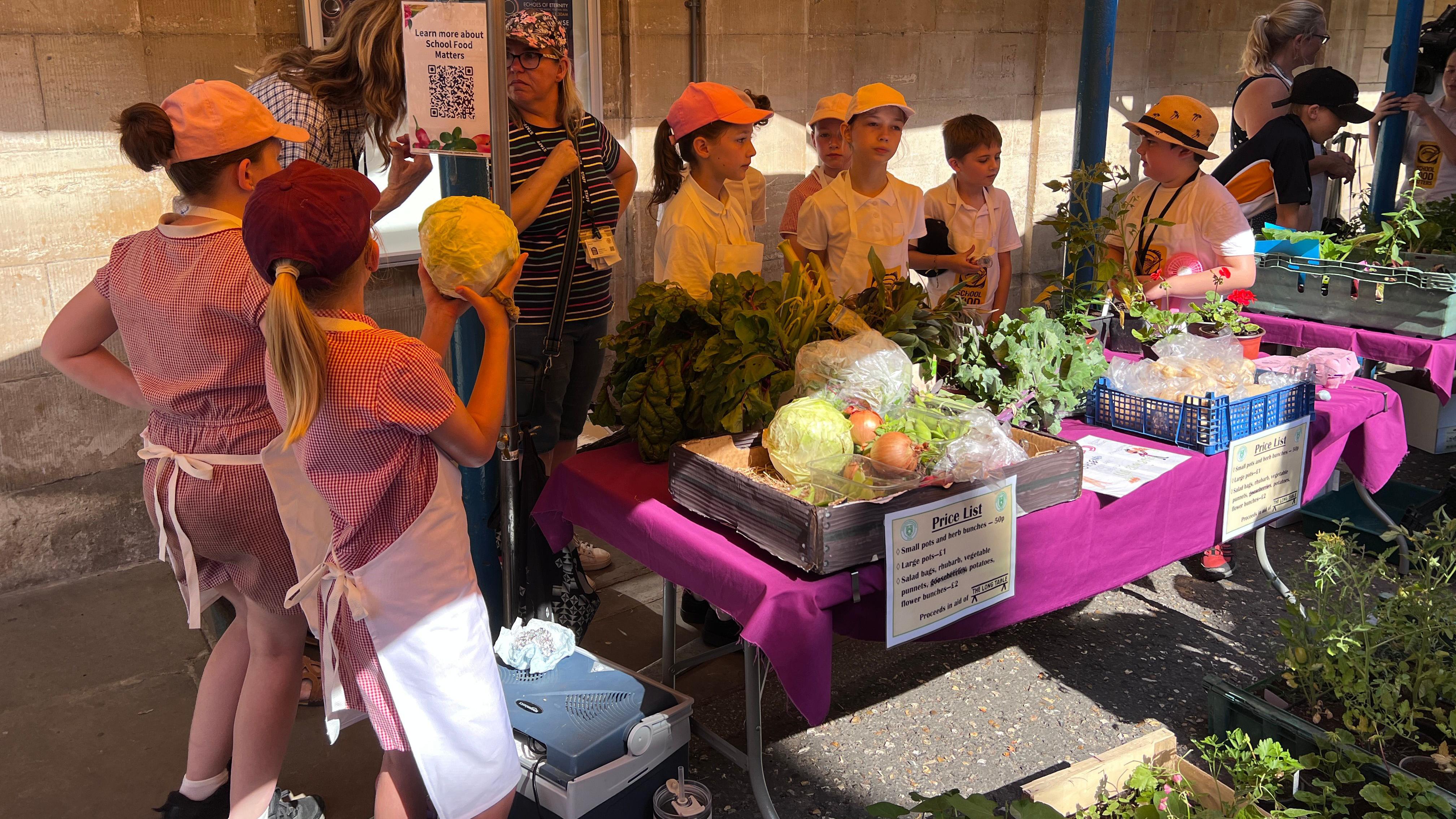
A farm stand sounds simple until Saturday morning arrives. Someone has to decide what to sell, find a table, write prices people can read, keep the popsicles from melting, answer the first customer without hiding behind a parent, take money, count what is left, and decide whether the whole thing was worth doing again.
That is exactly why it works as a way to teach kids entrepreneurship. The stand gives children a full business loop they can see with their hands: make or gather something, offer it to real people, exchange it for money, compare what came in with what went out, and make a next decision. The parent's job is not to make the stand charming. It is to protect safety, legality, and basic kindness while leaving the child enough ownership to learn from the crooked sign, the slow hour, the sold-out basket, and the customer who asks a question they did not expect.
Start With What the Child Can Actually Own
The fastest way to ruin a kid-run stand is to choose a product the child cannot meaningfully help with. A toddler can proudly hand a bundle of herbs to a neighbor; they cannot manage jam sterilization. A teenager can test whether a bundle price sells better than single items; they do not need an adult rewriting every label.
Age suggestions are useful as starting points, not permission slips. Food Gardening Network lists seedlings and plants for ages 2+, fresh juices or popsicles for ages 3+, fresh produce and herb bouquets for ages 3+, pies for ages 5+, and jams or pickles for ages 8+.[1] Those bands help parents picture the work, but supervision, temperament, food safety, local rules, and the child's attention span matter more than the number attached to the idea.
| Age range | Farm stand ideas | What the child can own | What the adult quietly holds |
|---|---|---|---|
| Ages 2-4 | Seedlings, herb bundles, a few washed vegetables, simple flower cups | Placing items on the table, handing a product to a customer, choosing between two signs, saying hello or thank you | Road safety, pricing, money handling, hygiene, customer explanations |
| Ages 5-7 | Popsicles, lemonade, produce cups, herb bouquets, simple baked goods where allowed | Decorating signs, sorting coins, greeting customers, counting inventory before and after, noticing what sold first | Food preparation, permits or cottage food rules, making change for larger bills, time limits |
| Ages 8-11 | Jams, pickles, pies with supervision, seedlings, produce bundles, recipe kits | Choosing a product mix, writing prices, tracking costs, making small change, restocking, asking customers what they liked | Heat processing, legal compliance, allergen labeling, online promotion, larger cash amounts |
| Ages 12-14 | CSA-style baskets, herb subscriptions, market-day bundles, garden starts, seasonal preserves where legal | Comparing prices, testing bundles, keeping a sales log, calculating profit, planning what to change next time | Transportation, vendor applications, insurance questions, tax guidance, safety boundaries |
| Ages 15-17 | Farmers-market booth, neighborhood delivery, seasonal passes, preorders, value-added products where permitted | Budgeting, supplier choices, marketing copy, customer follow-up, reinvestment decisions, basic recordkeeping | Contracts, banking setup, formal compliance, liability, mentoring without taking over |
For very young children, the stand may last twenty minutes and still be real. If a 3-year-old puts basil bunches into cups, watches three neighbors choose one, and helps count the empty cups afterward, they have met the shape of commerce: we prepared something, people wanted some of it, and now we have fewer bunches than before.
By early elementary age, the child can begin to carry the social work. This is where the lesson often becomes uncomfortable in the best way. A child who can explain, "These are mint and basil, and they are one dollar each," is doing more entrepreneurial work than a child standing beside a perfect adult-designed display. The words may come out too quietly the first time. That is part of the lesson.
Older kids need fewer decorations and more decisions. They can compare two price points, decide how many jars to make, choose whether to discount the last hour, and notice that the prettiest product was not necessarily the best seller. Their ownership should move from helping with tasks to making tradeoffs.
Run the Whole Business Loop, Even If It Is Tiny
A farm stand teaches entrepreneurship only when the child sees the loop close. If adults buy supplies, set prices, sell to friends, pocket the change, and later announce that it was a success, the child has mostly watched a themed family errand. Keep the loop small enough that the child can follow it from beginning to end.
- Choose or make the product: What do we have, what can we make safely, and who might want it?
- Prepare the stand: Where will the table go, what sign is needed, and how will customers know the price?
- Set the price: What did it cost us, what feels fair, and what happens if no one buys?
- Sell to real people: Who greets, who explains, who bags, and who says thank you?
- Handle the money: Who takes cash, who gives change, and where does the money go?
- Count what happened: What sold, what did not, what did we spend, and what is left?
- Decide the next move: Spend, save, share, reinvest, change the product, or stop.
The Survival Mom describes 13 business skills that can show up in a child-run stand, including product identification, pricing, marketing, customer service, salesmanship, handling money, making change, inventory management, and evaluating results.[2] Those skills are easier to teach when they appear at the moment they are needed. Inventory is not a vocabulary word; it is the child counting 18 cucumbers before the sale and 7 after. Customer service is not a lecture; it is looking up when someone approaches the table.
Before the Sale: Product, Cost, and Quantity
Before anything goes on the table, ask the child to name the product in one clear sentence. "We are selling basil bundles." "We made peach popsicles." "These are tomato seedlings." If they cannot explain it, they are not ready to sell it without help.
Then make costs visible. With younger children, that may mean putting the empty seed packet or popsicle-stick box beside the product and saying, "We had to buy this first." With older children, write down the actual inputs: jars, sugar, fruit, labels, market fee, or gas. Do not turn the first stand into a bookkeeping exam. Just refuse to let "we sold ten" masquerade as "we earned everything in the cash box."
Quantity is the first gentle encounter with risk. If a child makes too few, they learn about missed sales. If they make too many, they learn that leftovers are not theoretical. For perishable items, the adult may need to set the upper limit. A child can own the decision between 10 and 20 popsicles; the parent should own the freezer space, safe handling, and the rule that melted food does not get sold.
At the Stand: Let the Awkward Parts Teach
The first customer is often the moment adults want to rescue. A neighbor walks up, the child freezes, and the parent starts narrating: "Tell Mrs. Lee what you made! Tell her the price! Say thank you!" Some prompting is fine, especially with young children, but the stand becomes more powerful when the child has room to recover.
Try rehearsing one sentence before the stand opens, then stepping half a pace back. For a 6-year-old, that sentence might be, "Hi, these herbs are one dollar." For a 10-year-old, it might be, "The small jars are four dollars, or two for seven." For a teen, it might include growing method, flavor, bundle options, or preorder pickup.
Making change deserves its own patience. The Survival Mom notes that counting back change from a $20 bill is the skill that gets the most compliments.[2] That detail rings true because it is public competence. A child has to stay calm, count accurately, and hand money back to an adult who is waiting. If the line is long or the child is new, the parent can stand close. But whenever possible, let the child do the counting out loud.
After the Sale: Count Before You Celebrate
The after-sale count is where many families accidentally skip the lesson. Everyone is tired, the table is sticky, and the child wants to run off with the cash. Take ten minutes anyway. Count the starting inventory, the ending inventory, the money collected, and the costs that need to be paid back.
For younger children, use physical piles: sold, left, money, supplies. For older children, use a notebook or spreadsheet with four lines: starting quantity, sold quantity, revenue, cost. A teen can add profit, average sale, best-selling item, and one change to test next time.
This is also where disappointment becomes usable. If only two bundles sold, the child does not need a speech about resilience. They need help noticing possible causes: Was the price confusing? Was the table hard to see? Did we choose a time when no one was walking by? Did we make something people did not want today? The answer may be simple bad luck, too. One slow morning should not become a moral lesson.
Money Makes the Stand Real
Children can play store without caring whether the coins matter. A farm stand changes that because the money came from someone else's choice. A customer looked at the table, decided the product was worth the price, and handed over cash. That is a different lesson from receiving allowance.
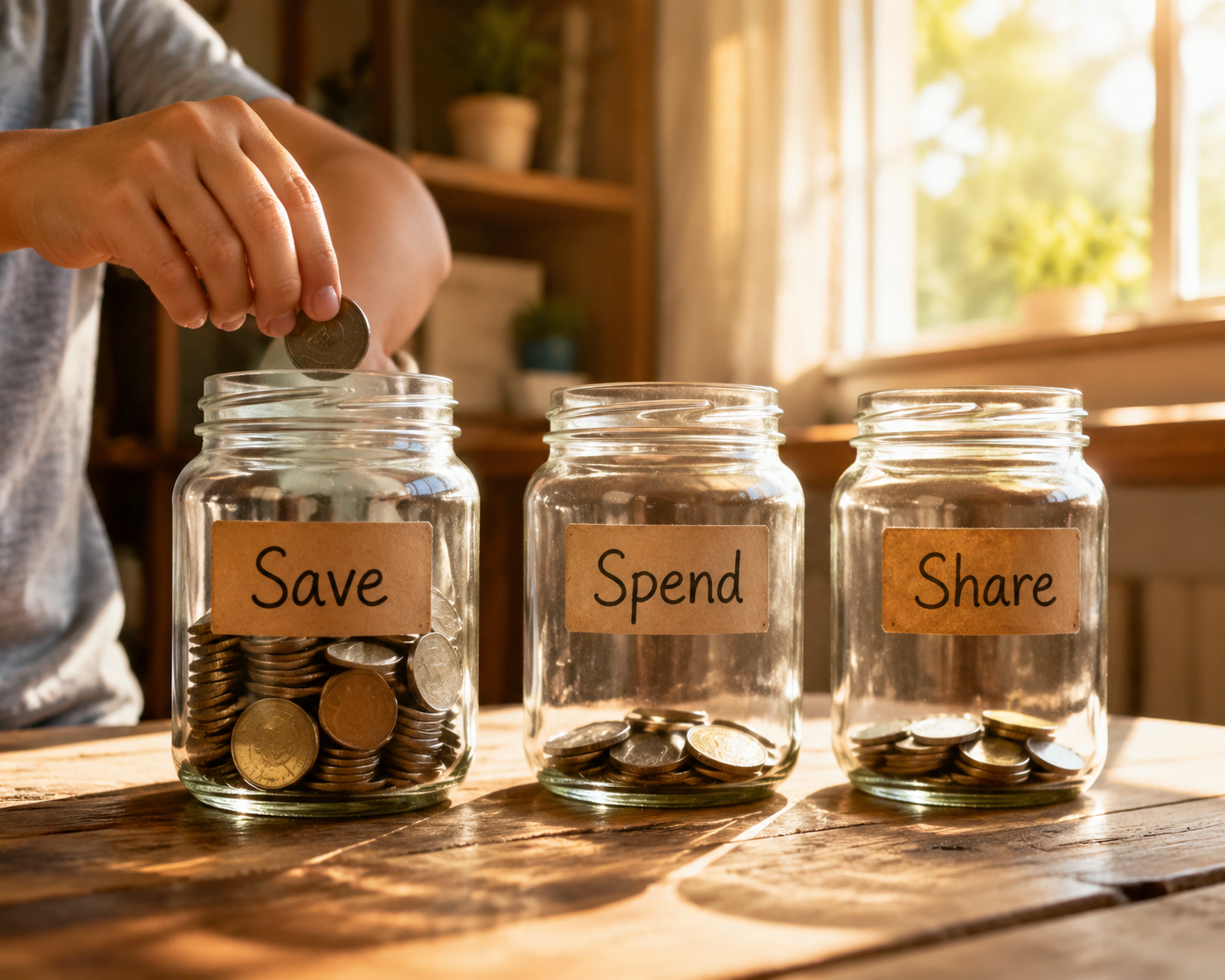
PBS NewsHour cites certified financial planner Liz Frazier Peck recommending a three-bank system: Save, Spend, and Share. In that framing, the child divides earnings into money for later, money for current wants, and money to give.[3] The strength of the system is that it turns the cash box into decisions instead of a trophy.
Opportunity cost does not need a formal definition at the table. It can sound like this: "If you put eight dollars in Spend, you can buy the toy today. If you put five of those dollars in Save, the toy waits, but you are closer to buying the bigger thing you said you wanted." The point is not to make the virtuous choice automatic. The point is for the child to feel that choosing one use for money means not choosing another.
For young children, divide only the profit they can understand. If grandparents bought the jars and sugar, the adult can either treat those as a gift or say plainly, "This time the supplies were our contribution." For older children, especially middle and high schoolers, pay back costs first. If they spent $14 on supplies and collected $30, the conversation starts with the $16 left after costs, not the full cash pile.
The Save, Spend, Share jars are enough for many children. Older students who are ready for broader personal finance can connect the stand to budgeting, banking, and longer-term planning through resources such as How to Build Financial Literacy as a Student Without Overwhelm. The farm stand gives them a small set of real numbers to bring into those larger money habits.
The Parent's Role Is Scaffolding, Not Stage Management
A parent should intervene quickly for safety, honesty, and legality. Hot sugar, sharp tools, allergens, road traffic, spoiled food, local cottage food rules, permits, and cash security are adult responsibilities. So is making sure a shy child is not pushed into a public performance that feels humiliating.
Outside those boundaries, let the child carry visible responsibility. The sign can be uneven if people can read it. The table can look like a child arranged it. The price can be simple rather than optimized. The greeting can be quiet. A stand that looks child-run but actually functions is usually a better classroom than one that looks like a brand launch.
| Moment | Helpful parent support | Taking over |
|---|---|---|
| Choosing a product | Offer two or three safe options the child can help make | Pick the most impressive product and assign the child small tasks |
| Pricing | Ask what supplies cost and help test a simple price | Set every price while the child decorates the sign |
| Customer greeting | Practice one sentence before opening | Answer every customer before the child can try |
| Making change | Stand nearby and slow the moment down | Grab the cash box whenever the math gets awkward |
| Evaluating results | Ask what sold, what remained, and what to change | Announce the lesson before the child has looked at the numbers |
One useful rule is to ask, "Can the child do the next smaller version of this?" If they cannot price five products, let them price one. If they cannot make change from a $20 bill, let them handle exact-change sales under supervision. If they cannot explain jam safety, they should not be the person responsible for that product yet.
This is especially important for homeschoolers, unschoolers, and educators who are tempted to turn the stand into a polished unit study. The learning is already there. Writing, math, planning, public speaking, food science, design, and reflection all appear because the stand demands them. The adult's restraint keeps those subjects attached to a real purpose.
When You Want a More Formal Path
Some families and classrooms need more structure than a weekend table. GrowNYC offers a Farmstand Business Curriculum with 12 standards-aligned lessons, which can help educators turn selling produce into planned work on business, food systems, and community markets.[4] That kind of curriculum is most useful after children have some concrete experience to attach it to.
School garden programs can also extend the model beyond one family. The National Farm to School Network has documented programs such as Spartan Urban Farm Fellowship, where students receive stipends while learning agriculture and business skills.[5] A stipend program is not the same as a child-run card table in the driveway, but both make the same important move: students do work that other people value, then have to understand the responsibilities attached to that value.
PBS NewsHour also reports that Lemonade Day has had more than 1 million participants across North America since 2007, based on the organization's figures.[3] That number is useful as a sign that many families and communities see value in small youth-run sales projects. It should not be stretched into proof that every child who runs a stand becomes more entrepreneurial in adulthood.
Let Scaling Belong to the Child
Some stands should stay small. A child may run one herb table, divide the earnings, and be done. That is not a failed business. It is a completed loop.
When a child keeps asking for the next level, the stand can grow in credible ways. Wes Bricker wrote that his son Sam began at age 6 with a crayon business plan for Super Stand, then moved from $2 cups to a $10 season pass, bundle deals, and eventually a compliant, insured, taxed farmers-market business.[6] That story is powerful because the progression is concrete. The child did not leap from lemonade to empire; he met one new business problem at a time.
A scaling path might look like this: first, sell from one table to neighbors. Next, track which products sell out. Then test a bundle. Then take preorders. Then consider a community market. At the market level, the adult background work grows: applications, insurance, taxes, labeling, transportation, and compliance cannot be waved away because the seller is young.
Sam's example should not become a promise parents place on their own children. It is evidence that a small stand can become a real enterprise when the child continues choosing the next layer of responsibility. The more useful question is quieter: after this sale, does the child know what happened, and do they want to try one change?
A farm stand succeeds when the child can say what they made, what it cost, what sold, what did not, what they did with the money, and what they would change next time. If they can do that and still feel the work was theirs, the lesson has landed.
References
- 8 Educational Farm Stand Ideas for Kids, Food Gardening Network, https://foodgardening.mequoda.com/articles/educational-farm-stand-ideas-for-kids/
- 13 Business Skills Kids Learn Running a Produce Stand, The Survival Mom, https://thesurvivalmom.com/kids-learn-business/
- Want your kids to learn the power of money? Start a lemonade stand, PBS NewsHour, https://www.pbs.org/newshour/economy/want-your-kids-to-learn-the-power-of-money-start-a-lemonade-stand
- Farmstand Business Curriculum, GrowNYC, https://grownyc.org/resources/farmstand-business-curriculum/
- Developing Young Entrepreneurs in School Gardens, National Farm to School Network, https://www.farmtoschool.org/news-and-articles/developing-young-entrepreneurs-in-school-gardens
- Six lessons I learned from my son's lemonade stand, LinkedIn, https://www.linkedin.com/pulse/six-lessons-i-learned-from-my-sons-lemonade-stand-wes-bricker
Comments
Join the discussion with an anonymous comment.