
Are Dirty Rain and Wildfire Smoke the Same Thing?
Wildfire smoke and dirty rain are causally linked but very different in how they affect your health. This article explains the science connecting them and why smoke is the real threat.
Updated:
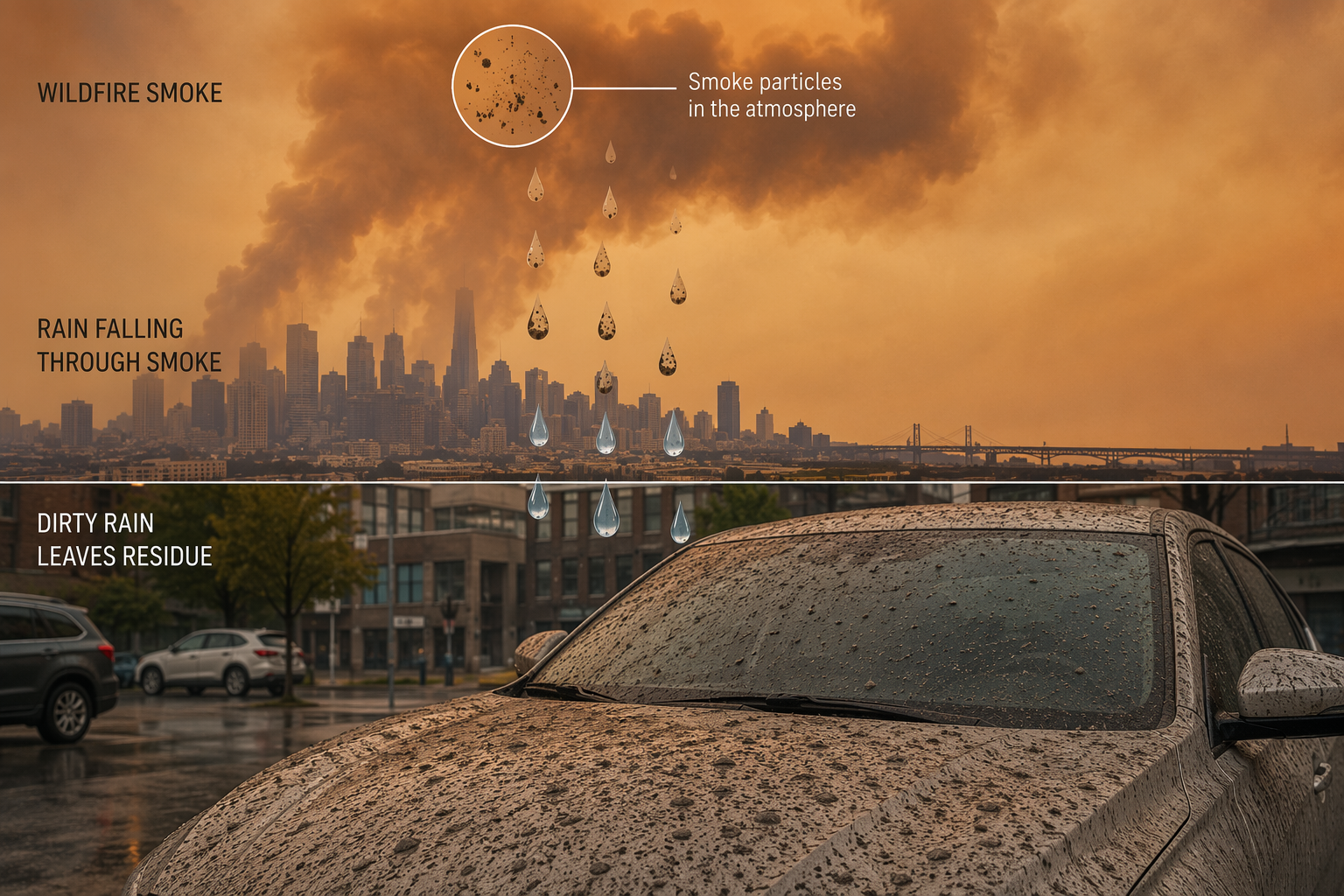
A July 2026 Baltimore Sun report about dirty rain in Maryland shows why this question keeps coming up during wildfire season [1]. The short answer is that dirty rain and wildfire smoke are connected, but they are not the same thing: dirty rain is what falls after raindrops sweep up particles, while wildfire smoke is the airborne pollution those particles came from [2][3].
Dirty rain is a residue, not a new kind of rain
The National Weather Service uses dirty rain for raindrops that collect airborne dust, soot, or smoke and leave spots on cars, windows, and sidewalks [3]. That is also why it is not acid rain. Wildfire smoke by itself does not produce the sulfur- and nitrogen-heavy chemistry that makes acid rain a separate problem [7]. Dirty rain can come from smoke, but it can also come from Saharan dust or local soil dust, so the residue tells you that the air recently carried particles, not that the rainwater has become a special hazard [3].

How a raindrop cleans the air
The link is coagulation: as a drop falls, it collides with suspended particles and grabs them. MIT researchers reported that a single falling raindrop can attract tens to hundreds of aerosols [2]. That is why a raindrop can look like a tiny moving collector. The particles end up concentrated on the drop and then on your windshield, instead of staying spread through the air [2][3].
That visible grime is unsettling because it is immediate and physical, but it is still mostly a surface trace. The drop did the work of pulling particles out of the air; the mess it leaves behind is the evidence.
| Aspect | Dirty rain | Wildfire smoke |
|---|---|---|
| What you are looking at | Raindrops that picked up dust, soot, or smoke on the way down [2][3] | Airborne fine particles, especially PM2.5, hanging in the air you breathe [4] |
| Main concern | Mostly residue on surfaces and a clue that polluted air was recently overhead [3][7] | Respiratory exposure from inhaling tiny particles [4][6] |
| What to watch | Spots on glass and cars | AQI, smoke alerts, and how long the haze lingers [1][6] |
Why the health ranking is lopsided
The health difference comes down to particle size. An expert quoted in the Baltimore Sun described wildfire PM2.5 as about 30 times smaller than the width of a human hair, small enough to slip past the body's front-line defenses and reach deep into the lungs [1]. In a Nature Communications study, a 10 microgram per cubic meter increase in wildfire-specific PM2.5 was associated with a 1.3% to 10% increase in respiratory hospital admissions, compared with 0.67% to 1.3% for non-wildfire PM2.5 [4].
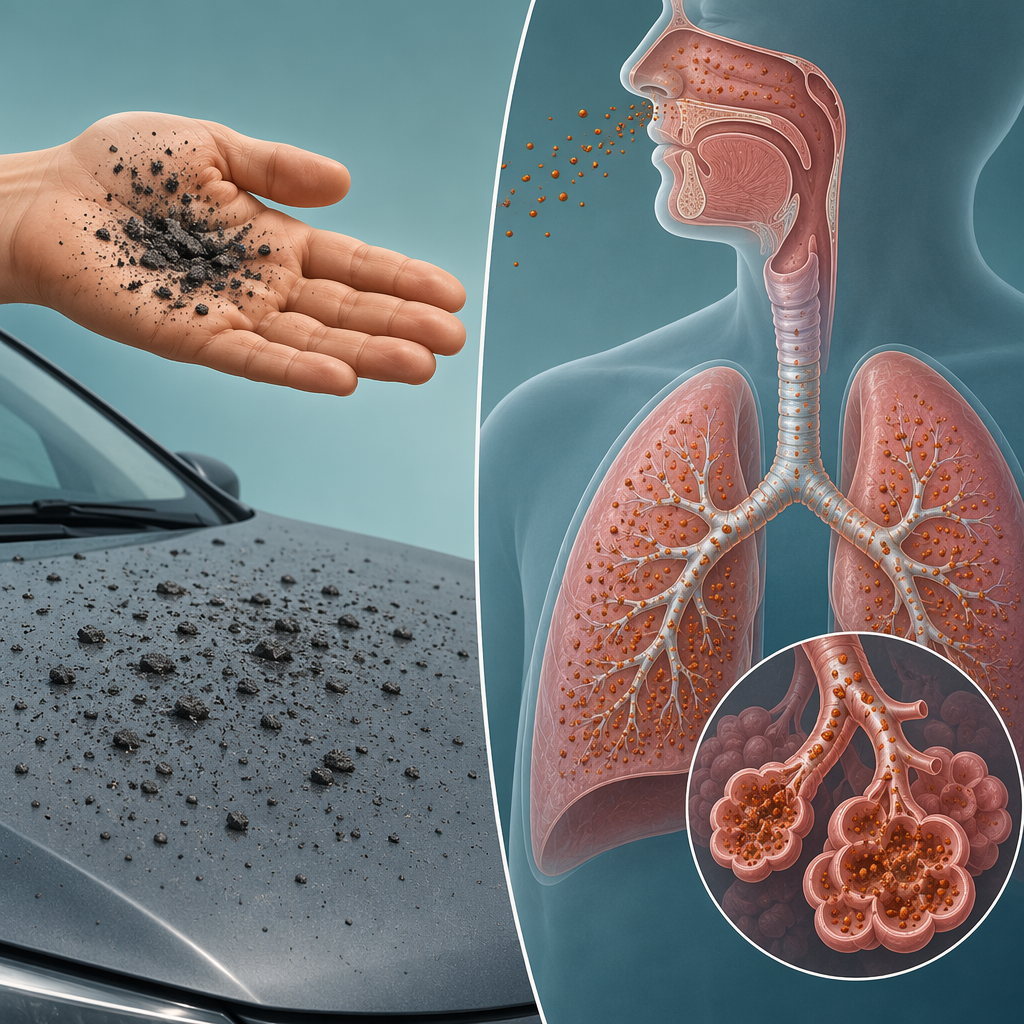
That comparison matters because it separates a visual nuisance from a proven exposure. Dirty rain leaves residue on the outside. Wildfire smoke keeps the dangerous particles in the air you breathe, and that is the part students should treat as the real risk [1][4].
Rain clears smoke, but smoke can also slow rain
Rain does help by washing particles out of the air, but the effect is often local and short-lived. A CBS meteorologist noted that scattered showers may improve conditions briefly, while a larger storm system or a wind shift does the deeper clearing [6].
The catch is that smoke can also interfere with the rain that would clear it. Research summarized in the brief found that smoke-heavy conditions can produce many more cloud droplets, but smaller ones that are less able to fall, and NASA reported about a 20% precipitation drop during smoke-heavy fire seasons in central Africa [5]. Those findings are region-specific, not a universal rule for every smoke event, but they show why "rain will fix it" is too simple [5].
For a student deciding whether to bike across campus, sit by an open window, or ignore the alert, the practical ranking is simple: dirty rain is mostly a sign that pollution was recently overhead, while wildfire smoke is the exposure to monitor and avoid [1][3][4][6]. If the car is spotted, that is annoying; if the air is smoky, that is the thing that can reach your lungs.
References
- Dirty rain a possibility as wildfire smoke harms Maryland air quality, expert says - Baltimore Sun, July 17, 2026
- Rain drops attract aerosols, clean air - MIT News, 2015
- Dirty Rain - National Weather Service, March 15, 2025
- Wildfire smoke PM2.5 and respiratory hospital admissions - Nature Communications, 2021
- More Smoke Can Mean Less Rain - NASA Earth Observatory, 2015
- How does rain affect smoke in the air from Canadian wildfires? - CBS News New York
- Wildfire and Rain - WFCA
Comments
Join the discussion with an anonymous comment.