
Inside Peter Thiel's End-Times Theology
A structured, sourced overview of Peter Thiel's end-times theology — its Christian eschatology, Girardian and Schmittian roots, and the internal contradictions that define his apocalyptic vision.
Updated:
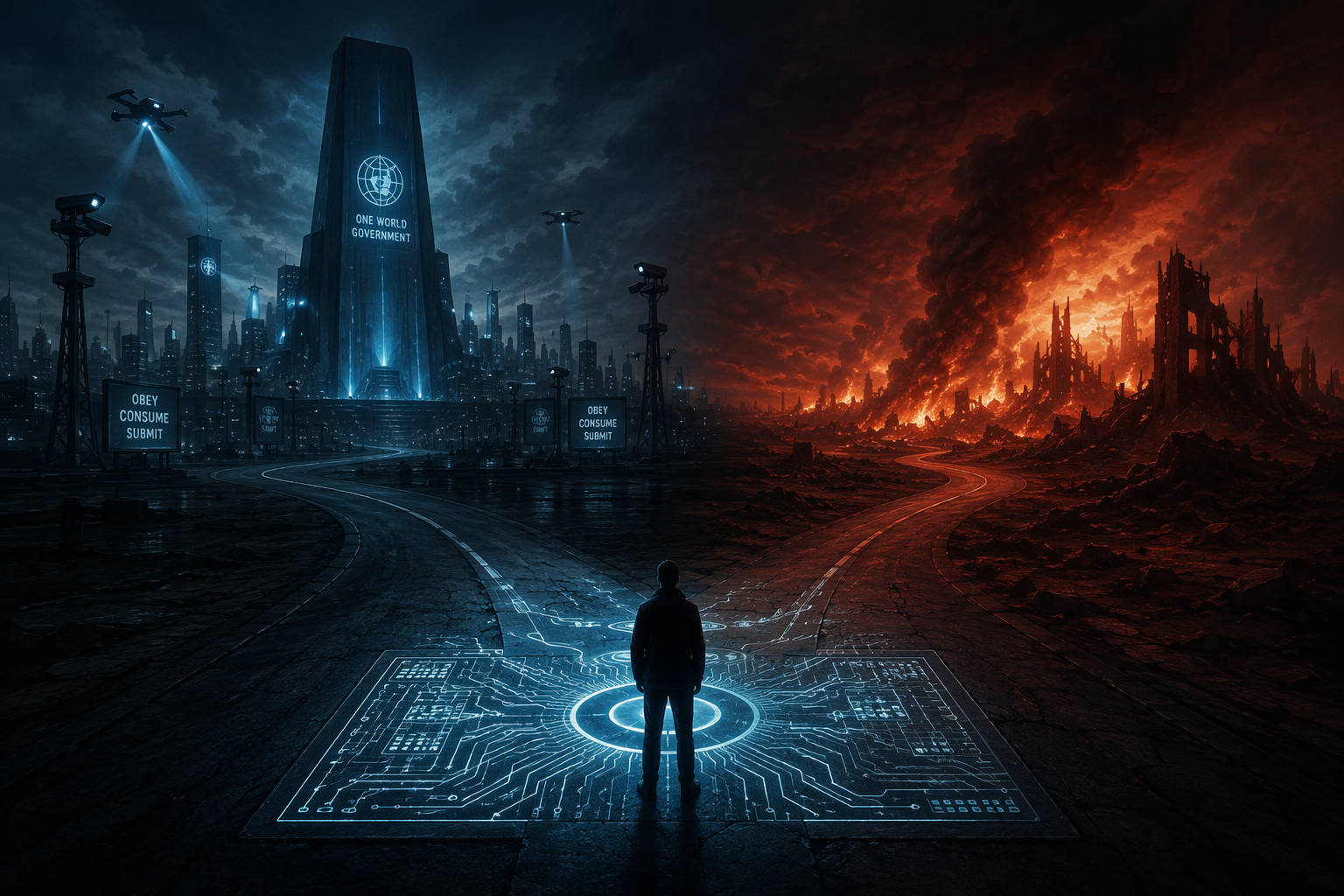
Peter Thiel's end-times theology is easiest to misunderstand if it is treated as a strange private hobby. The more revealing question is not whether he talks about the Antichrist, but what his system asks that figure to explain. In the account that emerged from his off-the-record San Francisco lectures in 2025, the Antichrist is not only a character in Christian eschatology. He becomes a name for a political technology: a world state that promises peace and safety by organizing humanity around fear of catastrophe.[1]
The reporting on those lectures deserves a clean caveat at the beginning. The events were off the record; public knowledge depends on leaked recordings and attendee accounts. That does not make the material unusable, but it does mean the analysis has to distinguish reported argument from confirmed doctrine, and Thiel's own emphasis from the interpretation of people listening from outside the room.[1]
The Choice: Antichrist or Armageddon
The Guardian's account of the four-lecture sequence supplies the central architecture. Thiel reportedly framed modern history as a narrowing choice between two disasters: the Antichrist, understood as a one-world political order that prevents catastrophe by suppressing freedom, and Armageddon, understood as catastrophic annihilation if humanity fails to control nuclear war, ecological collapse, artificial intelligence, or other existential dangers.[1]
That binary matters because it turns familiar contemporary anxieties into theological signs. Nuclear weapons are not merely a security problem. Climate politics are not merely a dispute about energy and regulation. AI risk is not merely a technical debate about alignment, acceleration, or model control. In Thiel's reported framing, each can become evidence for a deeper political temptation: fear of destruction creates demand for unified planetary management, and that demand prepares the way for the Antichrist.[1]
The most arresting detail in the lectures is not the use of apocalyptic vocabulary by itself. It is the placement of living public figures inside the drama. Thiel reportedly identified Greta Thunberg, Eliezer Yudkowsky, and Nick Bostrom as "legionnaires of the Antichrist," grouping environmental activism and AI-risk thought as different versions of the same political impulse: catastrophe prevention that could legitimate global control.[1]
This is where the theology becomes operational. The category does not merely describe a future tyrant. It sorts present actors by the role they play in making world government seem necessary. A climate activist, an AI theorist, and a philosopher of existential risk are not being accused of sharing an institution or a party program. They are being placed in the same eschatological function: warning of dangers so large that only a planetary sovereign appears adequate to manage them.[1]
| Term in the system | What it does in Thiel's reported framework |
|---|---|
| Antichrist | Names the peace-making global power that promises safety through centralization. |
| Armageddon | Names the catastrophic alternative: nuclear, technological, or civilizational destruction. |
| Existential risk | Supplies the fear that can make one-world governance appear necessary. |
| Technology | Becomes the decisive terrain because progress may avert catastrophe, while control of progress may empower the wrong sovereign. |
The system is not incoherent. It has a grammar. The danger is that ordinary political disagreement is redescribed as participation in an end-times mechanism. Once that happens, the burden of proof changes. A proposal for international coordination no longer has to be judged only by its institutional design, democratic legitimacy, or practical effects. It can be read as a sign.
Why Girard Comes First
The first source behind this structure is René Girard, the literary critic and theorist of mimetic desire whose work shaped Thiel's intellectual formation. Wired's investigation emphasizes that Thiel's engagement with Girard is not decorative. It gives him a theory of history in which human beings imitate one another's desires, rivalry escalates, communities stabilize themselves through scapegoating, and Christianity exposes the innocence of the victim at the center of that mechanism.[2]
Girard helps explain why Thiel sees modernity as both enlightened and dangerously unstable. If Christianity reveals the scapegoat mechanism, then older forms of sacred violence lose their power to contain conflict. The world becomes morally clearer and politically more volatile. Violence is no longer hidden inside myth as easily as before, but rivalry has not disappeared. It has become more conscious, more global, and more technologically armed.[2]
That Girardian inheritance also explains why apocalypse, in this system, is not simply a prediction about the future. It is a diagnosis of unveiled violence. The end times are not only what arrives after history; they are what history looks like once its violent foundations can no longer remain concealed. This is the part of Thiel's worldview that is easy to miss if the lectures are treated as eccentric prophecy rather than as a theory of social order.
The difficulty is that Girard's own Christian reading tended toward anti-violence, while Thiel's political conclusions move into a harsher register. Wired reports on Wolfgang Palaver, a Girard scholar whose work became important to Thiel's thinking, and Palaver's anxiety that his scholarship may have supplied Thiel with something like a political roadmap. That fear is not a minor academic complaint. It names the hinge in the whole system: a theory built to expose sacred violence can be repurposed into a theory for identifying enemies within an apocalyptic political field.[2]
Schmitt Turns Eschatology Into Sovereignty
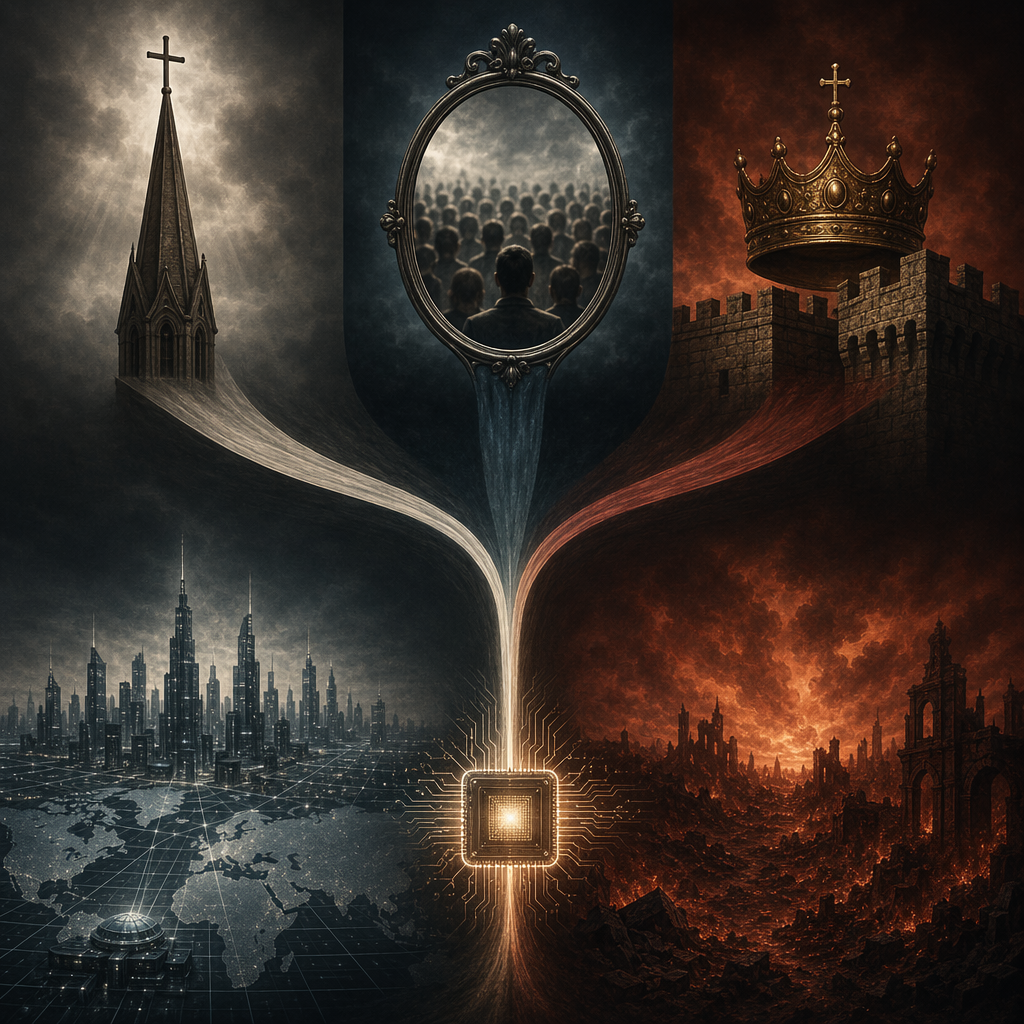
Carl Schmitt supplies the second pressure point. Schmitt's political theology is interested in sovereignty, emergency, and the friend-enemy distinction. In the Tysm essay's account of Thiel's framework, Schmitt helps convert an apocalyptic diagnosis into a theory of world order: the decisive political question is who can act in the exception, who restrains chaos, and who defines the enemy when normal procedures fail.[3]
The key term here is the katechon, the restrainer. In Christian political theology, the katechon is associated with the force that holds back lawlessness or the final outbreak of evil, though the concept is deeply contested. In Thiel's orbit, the question becomes politically explosive: what restrains apocalypse without becoming Antichrist? A world government may claim to restrain destruction. A technological civilization may claim the same. A sovereign exception may be defended as necessary because the alternative is chaos.[3]
This is where Girard and Schmitt do not sit comfortably together. Girard's Christian drama exposes the victim and undermines the sacred legitimacy of violence. Schmitt's realism accepts that politics is structured by decision, conflict, and the identification of enemies. Thiel's end-times theology draws on both: it fears the violent unanimity of the crowd, but it also depends on sharp distinctions between forces that preserve freedom and forces that prepare the Antichrist.[2][3]
The Tysm essay also connects Thiel's imagination of the Antichrist to Vladimir Solovyov's "Short Tale of the Antichrist," a text in which the Antichrist appears not as a crude monster but as a brilliant, humanitarian, peace-making figure. That matters for Thiel because the Antichrist becomes most dangerous when he looks benevolent: a manager of peace, unity, and survival. The same account notes a parallel with a Newman sermon tradition in which deception works through moral and religious plausibility, not open wickedness.[3]
The limitation is important. The Solovyov and Newman materials are being mediated through secondary accounts here, and the relevant source traditions are not equally accessible in English. The responsible claim is not that these texts determine Thiel's theology in a simple line of influence. It is that they help clarify the kind of Antichrist he appears interested in: not the anti-religious barbarian, but the universal peace-maker whose solution may be spiritually catastrophic.[3]
Why Technology Becomes the Deciding Terrain
Technology enters this theology through Thiel's long-standing concern with stagnation and his preference for what David Perell describes as "definite optimism": the belief that the future can be made better through planned, ambitious action rather than passively awaited or merely feared. Perell's account also notes Thiel's religious formation and the ambiguity of his denominational self-description, including tensions between Lutheran, evangelical, and heterodox identifiers.[4]
That ambiguity is not incidental. Thiel's public religious language often operates less like confessional catechism than like a theory of history. Technology becomes the practical test of whether humanity is moving toward life or death. If progress stalls, the world remains trapped with nuclear weapons, ecological pressure, political rivalry, and technological powers it cannot safely govern. If progress accelerates under centralized control, it may help build the Antichrist's administrative machinery.
Fortune's 2026 coverage of Thiel's more recent public comments reinforces this link between apocalypse and the end of modernity. In that account, Thiel connects the Antichrist and apocalypse to a crisis of modern progress, not merely to a narrow prediction about church doctrine or biblical chronology.[5]
The result is a severe burden placed on technological progress. It must do enough to prevent annihilation, but not so much through centralized command that it ushers in the Antichrist. It must be powerful enough to escape Armageddon, yet politically dispersed enough not to become the infrastructure of one-world rule. That is not an easy criterion to satisfy, and Thiel's reported system does not make clear who has authority to judge when the line has been crossed.
The Theology Is Real, but It Is Not Ordinary Orthodoxy
Bonnie Kristian's theological clarification is useful because it slows down a vocabulary that popular debate tends to flatten. Antichrist, Armageddon, apocalypse, and end-times speculation do not all mean the same thing. In Christian usage, "apocalypse" means unveiling or revelation before it means disaster; Armageddon refers to an eschatological battle; Antichrist traditions vary across biblical interpretation and later theological imagination.[6]
Thiel's usage draws from recognizably Christian materials, but it should not be mistaken for a settled account of Christian doctrine. His framework is selective and synthetic. It moves from scripture and Christian tradition into Girardian anthropology, Schmittian sovereignty, venture-capital futurism, AI-risk politics, and anti-stagnation arguments. That does not make it fake. It does make it a constructed system rather than a simple expression of inherited orthodoxy.
This distinction matters because the public argument often gets trapped between two lazy readings. One says the whole thing is billionaire mysticism and therefore not worth interpretation. The other treats any invocation of Antichrist language as self-evidently Christian. Neither reading can explain why the system has force. Thiel's theology works precisely because it is legible enough to borrow the emotional gravity of Christian eschatology while flexible enough to assign modern institutions, activists, theorists, and technologies to roles inside its drama.
The Contradictions Do the Most Work
The first contradiction is fear. Thiel's reported argument warns that fear of catastrophe can empower the Antichrist. Yet the argument itself depends on catastrophic fear. It asks listeners to see climate governance, AI-risk discourse, nuclear anxiety, and global coordination through the possibility that they may culminate in a spiritually totalizing world state. Fear is criticized as the Antichrist's instrument and then redeployed as the system's own interpretive engine.
The second contradiction is violence. Girard's Christian insight weakens the sacred logic by which communities justify victims. Schmittian politics hardens the line between friend and enemy. Thiel's synthesis wants the diagnostic power of the first and the decisiveness of the second. It wants to expose the crowd's violence while still sorting contemporary actors into apocalyptic roles that make ordinary disagreement morally charged.[2][3]
The third contradiction is technology. Thiel's system treats technological stagnation as dangerous because it leaves humanity vulnerable to catastrophe. But it also grants technological power a near-salvific role. Technology is asked to save modernity from Armageddon without becoming the Antichrist's tool of administration. The problem is not that this concern is irrational. The problem is that the framework magnifies the stakes while leaving the criteria for judgment unstable.
The fourth contradiction is ecclesial authority. Thiel invokes Christian eschatology, but his denominational commitments remain deliberately difficult to pin down, and secondary accounts describe his self-presentation as heterodox or inconsistent.[4] That ambiguity gives the system room to move. It can claim Christian seriousness without submitting very clearly to a particular church's doctrinal discipline.
What the Critics See
The strongest critiques become more useful after the system has been reconstructed, because they are not merely objecting to the presence of religious language in politics. Jacobin's criticism is that Thiel's apocalyptic worldview turns the fear of centralized political control into a justification for unchecked technological power. In that reading, the Antichrist warning does not restrain domination so much as relocate trust away from democratic governance and toward private tech elites.[7]
Seen & Unseen approaches from a different theological angle but identifies a related danger: Thiel's framing can make technological acceleration appear like the faithful alternative to Antichrist politics. The concern is not simply that he is wrong about a doctrine. It is that his use of doctrine may bless the very kind of power it claims to resist, especially when the public is asked to choose between centralized global management and privately directed technological escape.[8]
These critiques converge in an uncomfortable place. If global governance is suspected because it may become Antichrist, and technological stagnation is feared because it may lead to Armageddon, then the actors positioned to move fastest outside public constraint acquire a strange moral aura. They become, if not saviors, then possible restrainers. That is a large theological burden to place on people whose power is not primarily accountable through theological, democratic, or ecclesial structures.
How the System Assigns Moral Roles
A useful way to read Thiel's end-times theology is to watch how it assigns roles rather than how it answers a single doctrinal question. Global governance becomes suspect not only because it may be inefficient, coercive, or undemocratic, but because it resembles the peace-making universality of the Antichrist. Existential-risk politics becomes suspect not only because its claims may be disputed, but because fear of annihilation can generate consent for that universality. Technological progress becomes necessary not only because it creates wealth or capability, but because it may be the route away from catastrophic closure.
This assignment of roles explains why the framework is more than a set of opinions about AI, climate change, or geopolitics. It is an interpretive machine. It tells its user what kind of spiritual meaning to attach to political centralization, what kind of suspicion to bring to humanitarian universalism, and what kind of urgency to attach to technological acceleration.
It also explains why the system is risky as a guide to public judgment. Once a political actor is read as a legionnaire of the Antichrist, the normal work of evaluating claims becomes harder. One may still ask whether an AI-risk argument is technically sound, whether a climate policy is effective, or whether an international institution is legitimate. But those questions now sit beneath a larger suspicion: that the policy field itself may be spiritually compromised.
That does not mean every fear inside Thiel's system is baseless. Catastrophic technologies are real enough to demand governance. Global institutions can become coercive. Humanitarian language can hide domination. Technological stagnation can carry costs. The problem is the compression of all these judgments into an apocalyptic binary that does not tell us who, in practice, has the authority to distinguish prudent restraint from Antichrist preparation, or necessary progress from reckless acceleration.
Thiel's apocalypse is therefore not just a private belief about the end of history. It is a framework that turns political centralization, technological acceleration, and existential risk into theological signs. It is coherent enough to analyze, sourced enough to take seriously, and contradictory enough to distrust as a guide to public judgment. Its unresolved question is the one it cannot avoid: who gets to decide which danger is Antichrist and which danger is Armageddon?
References
- Inside tech billionaire Peter Thiel's off-the-record lectures about the antichrist, The Guardian, Oct 2025.
- The Real Stakes, and Real Story, of Peter Thiel's Antichrist Obsession, Wired.
- The Political Theology of Peter Thiel, Tysm.
- Peter Thiel's Religion, David Perell.
- Peter Thiel warns the Antichrist and apocalypse are linked to the end of modernity, Fortune, Feb 2026.
- Why Peter Thiel is talking about the Antichrist and Armageddon, Bonnie Kristian.
- Peter Thiel's Apocalyptic Worldview Is a Dangerous Fantasy, Jacobin.
- Peter Thiel and the Antichrist, Seen & Unseen.
Comments
Join the discussion with an anonymous comment.