
Study the Menorca Shipwreck Discovery with Digital Flashcards
Learn how to build an effective flashcard deck to study the details of the Menorca sacred relic shipwreck discovery. This guide uses the 2026 find as a case study to teach a transferable workflow for retaining archaeological facts with spaced repetition.
Updated:
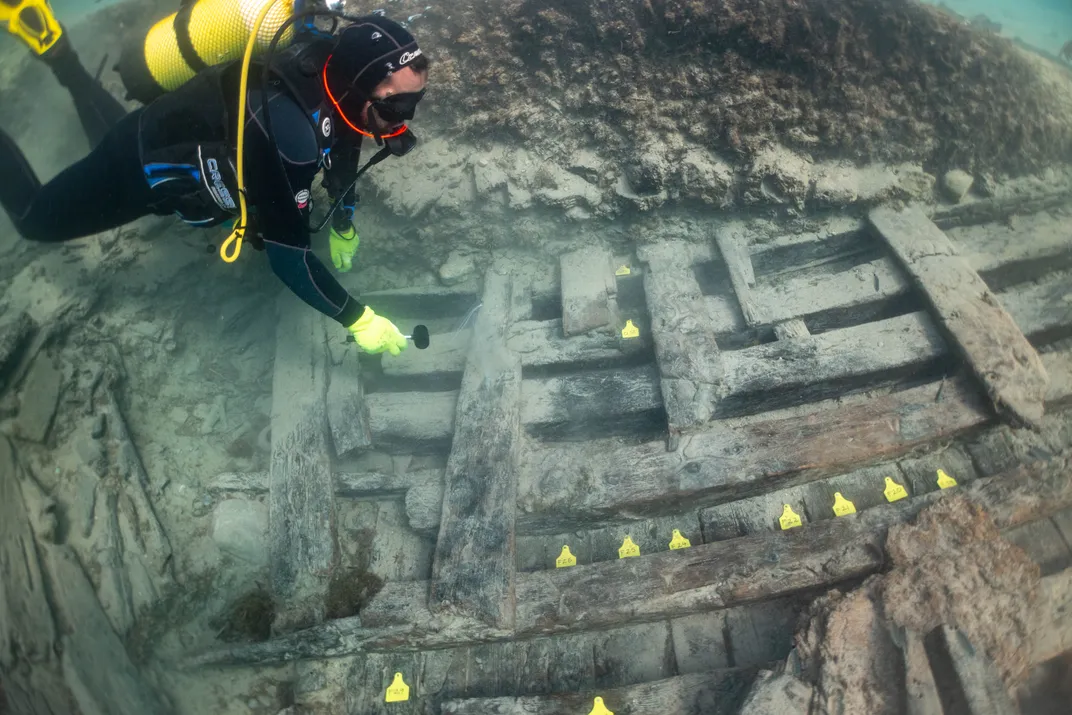
Three medieval ships went down together off Menorca in the 1240s, in a place now called Cala de la Cova dels Misteris, the Cove of Mysteries. The proposed culprit is not a sea monster, thank heavens, but a rissaga: a locally known meteotsunami that can make harbor water rise and fall violently. Among the material recovered from the wrecks is a sealed encolpium, a small Christian reliquary worn around the neck, now undergoing desalination at the Museum of Menorca before researchers can open it or analyze its contents further.[1]
That is the sacred relic shipwreck discovery worth studying. Not because it sounds dramatic, though it does. Because it gives you a nearly perfect archaeological memory problem: date range, place, cause, artifact, preservation history, and historical context all packed into one case. If you try to remember it as “that medieval relic wreck thing,” it will dissolve by next week. If you split it into clean retrieval units, it becomes usable.
Start with the evidence trail, not the headline
The Menorca case has a tidy headline shape: medieval wrecks, mysterious cove, sealed reliquary. Fine. Now put the headline down before it starts doing damage. The useful study object is the evidence trail: three wrecks known as Busquets I, II, and III; a 13th-century date range; a simultaneous sinking; a rissaga explanation; a sealed encolpium; and a preservation history that depended partly on what looters did not see.[1]
The preservation detail is especially good flashcard material because it is the kind of fact students skip and exam questions love. The ships carried wooden barrels rather than amphorae, which made the sites less tempting to looters searching for recognizable ceramic cargo. The later modern harbor also developed on the opposite side of the island, leaving these wrecks less disturbed than they might have been.[1]
The encolpium needs careful wording. It is a Christian reliquary, and archaeologist Xavier Aguelo Mas called it the island’s “artifact of the decade,” but it has not yet been opened. Its contents are not known. A bone? Parchment? Something else? The honest card says “sealed and under desalination,” not “contains a saint’s relic.” Archaeology is allowed to be exciting without pretending the lab has already finished its work.[1]
Turn one discovery into a small deck
A good deck for this discovery does not need fifty cards. In fact, fifty cards would probably mean you are copying sentences instead of studying. Start with the facts that would let you reconstruct the case aloud without drifting into fog.
| Card target | What the card should test | Why it matters |
|---|---|---|
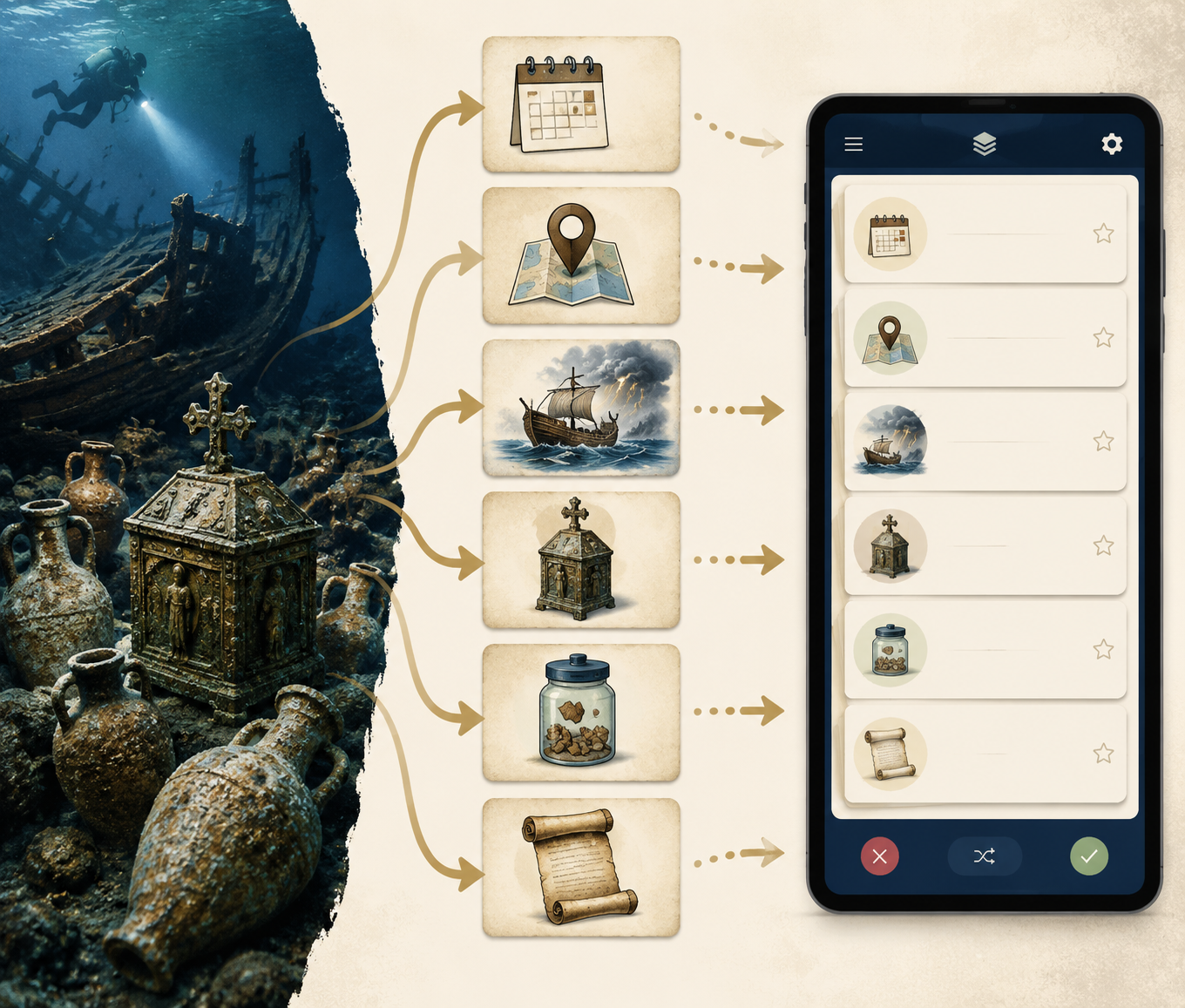
| Date | The three Menorca wrecks are carbon-dated to the 1240s CE. | Keeps the find anchored in the 13th century rather than a vague “medieval” blur. |
| Location | The wrecks were found in Cala de la Cova dels Misteris, the Cove of Mysteries, off Menorca. | Prevents the case from becoming just another Mediterranean wreck. |
| Cause | The ships are thought to have sunk during a rissaga, or meteotsunami. | Gives the discovery its distinctive local mechanism. |
| Artifact | The key object is an encolpium, a Christian reliquary worn around the neck. | Separates the artifact type from guesses about its contents. |
| Preservation | Wooden barrels and harbor development patterns helped protect the sites from looting and disturbance. | Explains why evidence survived. |
| Context | Artifacts linked to Christian and Moorish communities point to interconnected trade during the Reconquista. | Moves the find from object trivia into historical interpretation. |
Notice the discipline here. Each card asks for one thing. A single card that says “Describe the Menorca shipwreck discovery” is not a flashcard; it is a tiny essay prompt wearing a false mustache. Save broad synthesis for later, after the factual pieces can actually be retrieved.
A starter set that earns its space
- Front: What three ships make up the Menorca medieval wreck discovery? Back: Busquets I, Busquets II, and Busquets III.
- Front: When did the three Menorca wrecks sink? Back: In the 1240s CE, based on carbon dating.
- Front: Where were the wrecks found? Back: Cala de la Cova dels Misteris, the Cove of Mysteries, off Menorca.
- Front: What natural event is thought to have sunk the ships? Back: A rissaga, or meteotsunami.
- Front: What is the encolpium from the Menorca wrecks? Back: A sealed Christian reliquary worn around the neck, now undergoing desalination.
- Front: Why is it inaccurate to say the reliquary’s contents are known? Back: The encolpium has not yet been opened, and analysis is ongoing.
Those six cards already do more work than a highlighted article. They force the date out of the sentence, the place out of the atmosphere, and the artifact out of the myth-making machinery. Add more only when the new card tests a new distinction.
Choose the right card type for the fact
Digital tools are useful here, but they are not magic cauldrons. Anki, Quizlet, and Brainscape can all hold this deck. Anki gives you especially fine control over scheduling and card formats; Quizlet is fast for simple sets; Brainscape’s confidence ratings can help when you want a lighter structure. Pick one and stop fiddling. The wreck will not memorize itself while you compare button colors.
For this case, use different card formats because the facts behave differently. A date does not need the same treatment as an artifact image. A sequence does not need the same treatment as a caution about unknown contents.
| Fact type | Best card format | Example |
|---|---|---|
| Single factual anchor | Basic front/back | Front: What decade are the Menorca wrecks dated to? Back: The 1240s CE. |
| Ordered details | Cloze deletion | The Menorca study trail is: {{c1::location}}, {{c2::date}}, {{c3::cause}}, {{c4::artifact}}, {{c5::preservation}}, {{c6::context}}. |
| Artifact recognition | Image occlusion | Cover the reliquary or ship-timber area in an image and test identification from visual evidence. |
| Uncertainty boundary | Basic front/back | Front: What is not yet known about the Menorca encolpium? Back: Its contents; it remains sealed during desalination and analysis. |
| Historical interpretation | Short answer | Front: Why do Christian and Moorish-linked artifacts matter? Back: They point to interconnected trade during the Reconquista. |
Image occlusion is the one format worth pausing over. If you have a photograph of the wreck site or an artifact image from a reliable source, hide one visible feature and ask yourself what it is. This is not just for art history students. Archaeology often asks you to recognize material evidence before you can explain it. A student who can identify hull timbers, cargo traces, or a reliquary form has a better chance of discussing the find without leaning on vague adjectives.
Cloze cards are useful for the ordered study trail, but do not abuse them. A sentence with eight blanks becomes a ransom note. Use cloze deletion for compact sequences: “The Menorca wrecks were found at {{c1::Cala de la Cova dels Misteris}} and dated to the {{c2::1240s CE}}.” That is enough.
Keep uncertainty as a card, not a footnote
Students often treat uncertainty as something to ignore until the exam asks for “limitations.” Bad habit. In a current discovery, uncertainty is part of the evidence. The Menorca team’s fuller research publication is not expected until spring 2027, so some available details come from press coverage and project reporting rather than a final peer-reviewed paper. That does not make the case unusable. It means your deck should say what kind of knowledge each card contains.
- Known: Three wrecks, Busquets I, II, and III, were found in the Cove of Mysteries.
- Known: The wrecks are dated to the 1240s CE.
- Interpreted: A rissaga is the proposed cause of the simultaneous sinking.
- Known: The encolpium is sealed and undergoing desalination.
- Unknown: The contents of the encolpium.
- Historically significant: The wrecks are reported as the first 13th-century shipwrecks found in Menorca, with material linked to Christian and Moorish communities.
That little known/interpreted/unknown distinction is not pedantry. It is how you avoid turning archaeology into gossip. It also makes exam answers sharper. “The encolpium may contain a relic” is weaker than “the encolpium is a sealed Christian reliquary whose contents remain unknown because conservation work is still underway.” The second answer tells the grader you know both the artifact and the status of the evidence.
Use spaced repetition before the story cools off
The best time to build the deck is immediately after reading the article, while the scene is still vivid but before the details have fused into sludge. Make the first version small. Review it the same day, then let your app schedule the next reviews. The point is not to admire your deck. The point is to be interrupted by the question “What is a rissaga?” three days from now and answer it without opening a tab.
Do not mark a card correct because it “felt familiar.” Familiarity is how students lose dates. A correct answer should retrieve the tested fact clearly enough that you could say it in a sentence: “The three Menorca ships sank in the 1240s CE, probably during a rissaga.” If you only remembered “medieval storm,” fail the card. Kindly, but fail it.
For the first week, review the deck in two modes. First, run the cards normally. Second, close the app and reconstruct the case in order: place, date, cause, artifact, preservation, significance. Retrieval should move both ways. You need the single fact when prompted, and you need the whole evidence chain when writing an exam paragraph.
Add a comparison only when it teaches a distinction
Once the Menorca deck works, you can add a comparison wreck. Keep it brief. In 2024, researchers reported a 3,300-year-old deep-sea shipwreck carrying Canaanite amphorae about 55 miles off Israel and roughly 5,900 feet below the Mediterranean surface. The find mattered because it challenged assumptions about how far ancient mariners traveled from visible coastlines and how they may have used celestial navigation.[2]
That wreck belongs in the same “landmark shipwrecks” deck only if it helps you contrast evidence types. Menorca gives you a medieval coastal case with a sealed reliquary, simultaneous wrecking, and preservation shaped by looting patterns. The deep-sea wreck gives you a Bronze Age cargo case, extraordinary depth, and a navigation argument. Do not mash them together as “old ships found underwater.” That is not a category; that is a puddle.
| Study contrast | Menorca wrecks | 2024 deep-sea wreck |
|---|---|---|
| Period | 13th century, dated to the 1240s CE | About 3,300 years old |
| Setting | Cove of Mysteries off Menorca | About 55 miles off Israel |
| Depth or environment | Coastal underwater site | Roughly 5,900 feet deep |
| Key material | Sealed encolpium and mixed cultural artifacts | Canaanite amphorae |
| Main study value | Evidence boundaries, preservation, medieval trade context | Ancient navigation and deep-sea preservation |
Move from flashcards to an exam answer
Flashcards are not the final product. They are the drill. The transfer happens when you can use the cards to build a short explanation without staring at them. Try a five-sentence answer after three review sessions.
A solid answer might run like this: The Menorca discovery consists of three 13th-century wrecks, Busquets I, II, and III, found in Cala de la Cova dels Misteris. They are dated to the 1240s CE and are thought to have sunk together during a rissaga. The most discussed artifact is a sealed Christian encolpium, but its contents remain unknown while conservation work continues. The wrecks were unusually well preserved partly because wooden barrels attracted less looting than amphora cargo and because modern harbor development occurred elsewhere on the island. The site matters because it links maritime archaeology to trade and contact between Christian and Moorish communities during the Reconquista.
That paragraph is not elegant literature. Good. It is a controlled reconstruction of evidence. Once you can produce it, you can polish style later. Students often try to write beautifully before they can remember accurately, which is like decorating a trench before checking whether it has walls.
NOAA’s maritime archaeology education materials treat shipwrecks as evidence-rich sites for investigating human activity, technology, trade, and environment.[3][4] That is the point of building cards from a discovery instead of memorizing a flattened headline.
Use the same pattern on the next discovery: one card for when, one for where, one for what was found, one for how it was preserved, one for what scholars think it means, and one for what they still do not know. That is how a sealed reliquary in a Menorcan cove becomes more than a striking news item. It becomes a method you can carry to the next wreck, artifact, or historical event.
References
- Take an Exclusive Look at Three Newly Discovered Medieval Shipwrecks in Menorca’s Cove of Mysteries, Smithsonian Magazine, July 2026.
- World’s Oldest Deep-Sea Shipwreck Discovered a Mile Beneath the Mediterranean Sea, Smithsonian Magazine.
- Maritime Archaeology: Exploring and Discovering Shipwrecks, NOAA.
- Shipwreck Lesson Plans, NOAA.
Comments
Join the discussion with an anonymous comment.