
Study Soccer Tactics by Analyzing World Cup Finals
Learn a repeatable framework for analyzing soccer tactics by studying two contrasting World Cup finals — 2022 Argentina-France and 2026 Spain-Argentina. Discover how formations, phases, player roles, and transitions reveal the tactical story of a match.
Updated:
The first time you try to analyze a World Cup final, the match usually defeats your vocabulary before it defeats your attention. You write “possession,” then realize that does not explain why one team keeps the ball safely and another keeps the ball dangerously. You write “counterattack,” then notice that some breaks start from pressure, some from a clearance, and some from a midfielder receiving on the half-turn before anyone has adjusted. You write “substitution changed the game,” which may be true, but still leaves the important part blank: changed which space, which matchup, which rhythm?
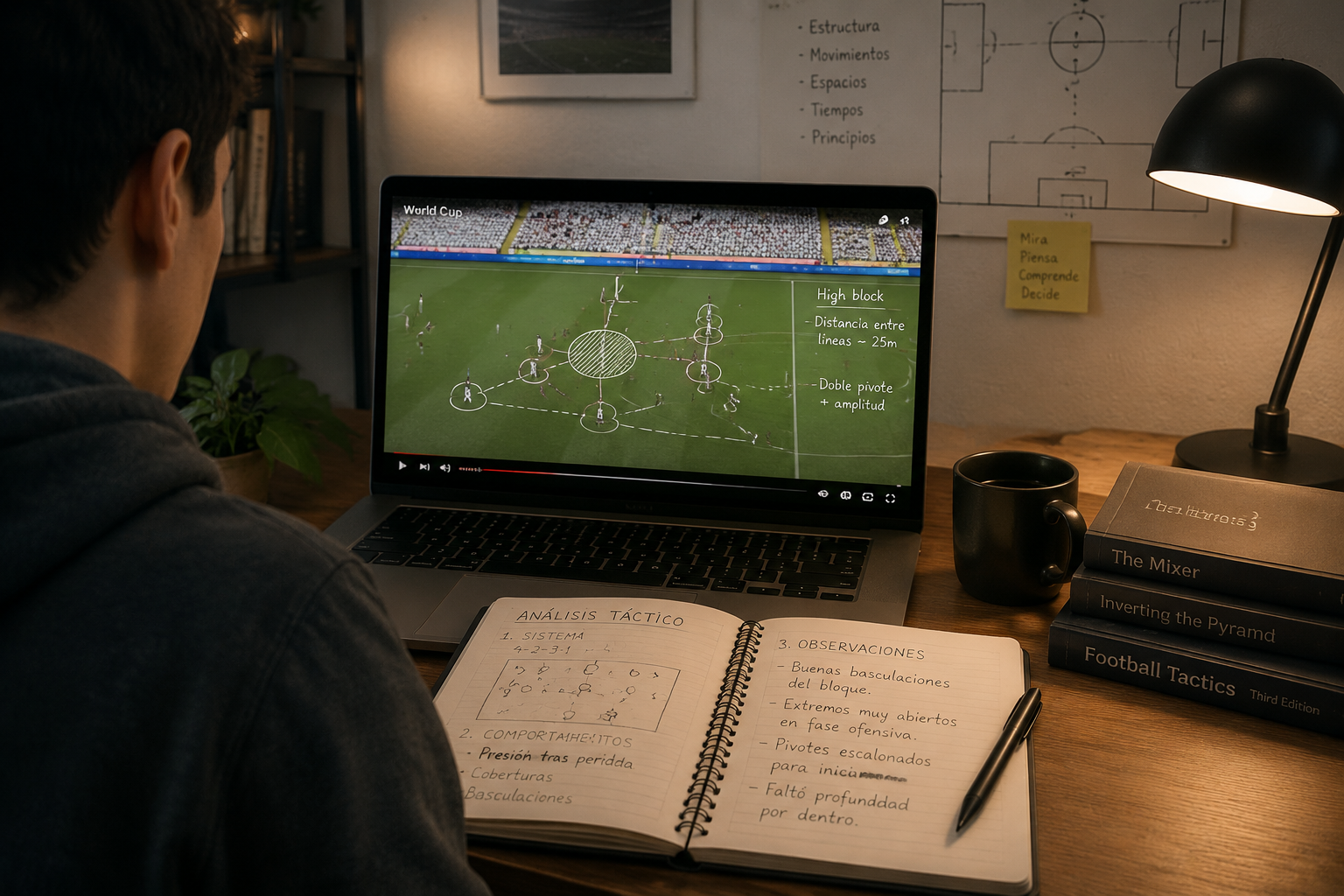
That is why World Cup final tactics soccer analysis is best learned as a viewing routine, not as a hunt for one clever explanation. A final is too dense for instant certainty. The useful move is slower: freeze the game, name what you can actually see, compare one phase with another, then revise the first label when the match shows you more.
Start With a Viewing Routine, Not a Verdict
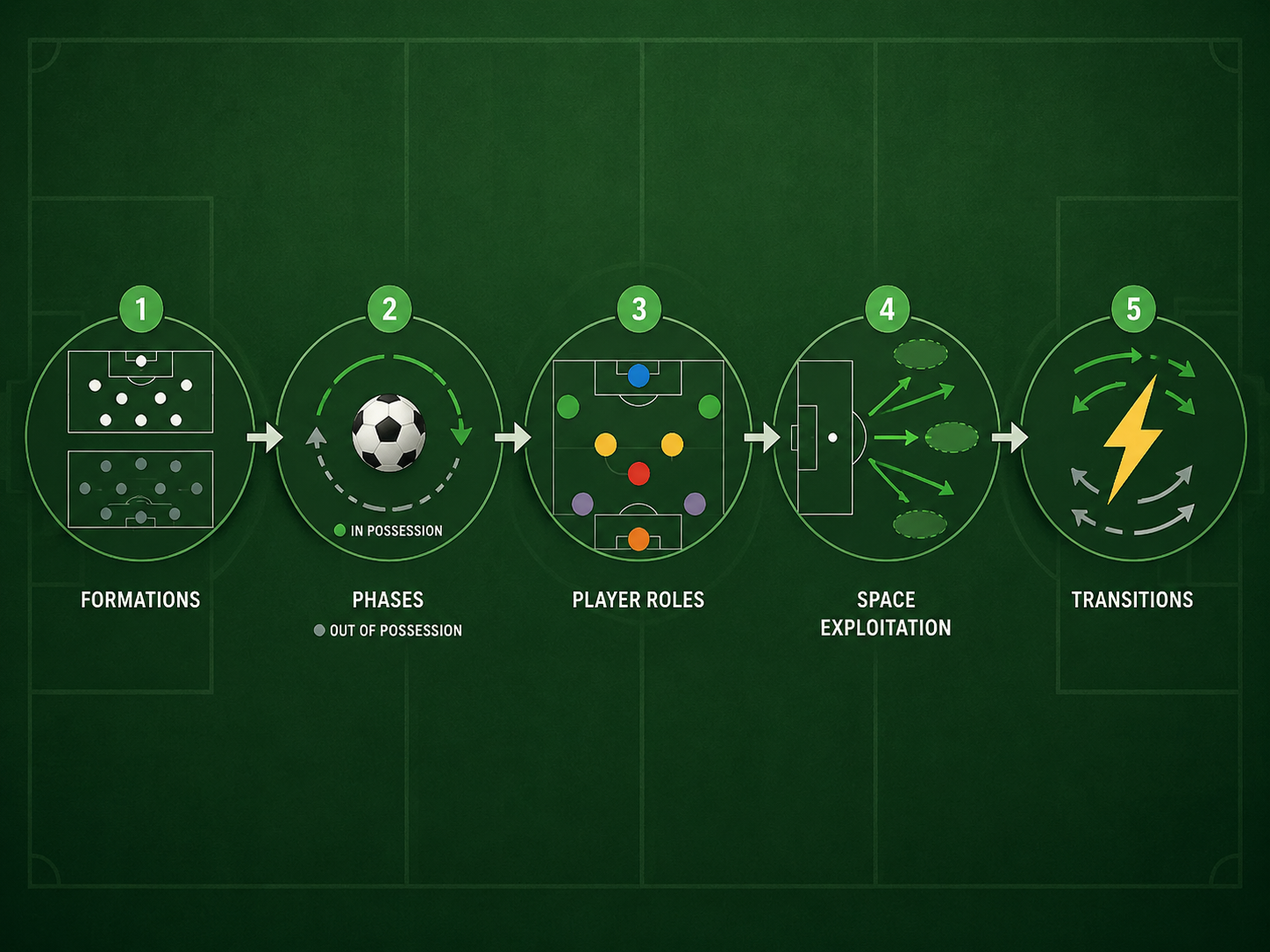
A practical tactical analysis begins with a sequence: identify the starting formations, separate in-possession and out-of-possession phases, study player roles, look for how space is created or protected, and then judge transitions after the ball changes hands. Modern Soccer Coach’s guide to analyzing World Cup matches uses that kind of progression, and it works because it forces the viewer to move from shape to behavior instead of treating the lineup graphic as the answer.[1]
Use the formation as the first sketch. It tells you where players are expected to begin, not where the match will live. A team listed in a back four may build with three. A winger may defend as a midfielder. A striker may spend half the match screening a pivot rather than chasing center backs. If you stop at “4-3-3 versus 4-4-2,” you have drawn the cover of the book and skipped the chapters.
| Viewing question | What to look for on screen |
|---|---|
| What is the starting shape? | Kickoff structure, first defensive set, full-back height, midfield line spacing |
| What changes in possession? | Build-up shape, rotations, occupation between lines, wide overloads, rest defense |
| What changes without the ball? | Pressing height, midfield distances, back-line depth, protected central spaces |
| Which roles matter most? | The player receiving under pressure, the runner stretching the line, the defender covering behind |
| What happens after loss or recovery? | Counter-pressing, first forward pass, recovery runs, defensive line breaks |
That table is deliberately plain. It gives you a way to keep watching when the match gets noisy. The trick is not to fill every box with a grand conclusion. Some observations will be small: a full-back stops advancing after the first twenty minutes; a midfielder starts receiving closer to the center backs; a forward presses only when the pass goes wide. Those small notes are often where the real analysis begins.
Case Study One: Argentina-France 2022
The 2022 final is a useful first case because the scoreboard was wild while the early tactical pattern was unusually readable. Argentina and France drew 3-3 before Argentina won 4-2 on penalties, and Coaches’ Voice described the match through Argentina’s mid-block discipline and counter-attacking quality against France’s possession game.[2] That contrast gives a learner something concrete to test: when France had more of the ball, what exactly were Argentina controlling?
Formation Is Only the Opening Note
Begin by watching the first settled defensive sequence, not just the kickoff. Argentina’s shape mattered less as a static label than as a set of distances: the back line connected, the midfield compact enough to make central progression uncomfortable, and the forward line positioned to influence France’s first passes. Calling that a mid-block is useful only if you then inspect the block: how close are the midfielders to one another, when does the nearest player jump, and what pass is Argentina willing to concede?
France’s possession game should be watched with the same patience. Possession is not one thing. There is possession that moves an opponent, possession that waits for a lane, and possession that simply circulates in front of a compact block. In this match, the useful viewing question is whether France’s possession was breaking Argentina’s lines or being held outside the most valuable spaces.
The Mid-Block as a Study Object
To study Argentina’s mid-block, pause when France’s center backs or midfielders have controlled possession. Look at four details in the same frame: the height of Argentina’s back line, the gap between midfield and defense, the nearest pressing angle, and the weak-side winger’s position. If those four details stay connected, the defending team can look passive while still guiding the opponent into lower-value options.
The next question is what Argentina did after recovery. A mid-block without an exit can become a waiting room. Argentina’s threat came from turning defensive organization into forward movement quickly enough to make France defend while facing its own goal. This is where “counterattack” needs more precision: who makes the first secure pass, who carries, who runs beyond, and who arrives as the second wave?
Tournament-level data from FIFA’s Technical Study Group helps explain why those moments deserve attention. In its 2022 technical overview, winning teams completed far more ball progressions in counter-attack phases than losing teams, 73 versus 27, and more defensive unit line breaks in transition, 68 versus 35.[3] Those numbers do not prove why Argentina won this final by themselves. They do justify slowing down whenever possession changes, because elite matches often tilt in the few seconds when the old attacking shape has not yet become a defensive one.
Player Roles Make the Shape Legible
Once the team patterns are visible, zoom in on roles. Do not start by asking who was “good.” Ask what job each key player was performing. One midfielder may be responsible for blocking access into the striker’s feet. Another may jump only when the ball travels wide. A wide attacker may be less important for dribbling than for pinning a full-back deep enough to open a passing lane inside.
In a replay, this is the part where pausing helps. Let the ball carrier wait. Look away from the ball for three seconds. The best clue may be a defender checking over his shoulder, a midfielder pointing before the pass is made, or a forward starting a curved run that removes one passing option while inviting another. Tactical analysis becomes easier when you stop treating the ball as the only sentence on the page.
Case Study Two: Spain-Argentina 2026
The 2026 final needs a slightly different kind of honesty. Spain beat Argentina 1-0 on July 19, 2026, but because the match was played only yesterday, a mature post-match tactical literature is not yet available. The safest analysis uses what is already supported: FIFA’s pre-final tactical preview of Spain’s possession patterns against Argentina’s low-block structure, plus tournament trend reporting that gives context for Spain’s defensive strength, recovery speed, and substitute impact.[4][5]
That does not make the match unanalyzable. It changes the level of certainty. Instead of pretending to know every adjustment from one viewing, use the same framework and mark some judgments as provisional. The question becomes: how did Spain’s possession game meet Argentina’s defensive organization, and which moments broke the match away from the expected stalemate?
Spain’s Possession: Circulation With a Purpose
When studying Spain, the first trap is to praise possession before asking what it produced. Good possession is not just pass volume. Watch how the center backs and midfielders circulate the ball, where the full-backs stand, who occupies the space between Argentina’s midfield and defensive lines, and how quickly Spain reacts when a pass is lost.
The FIFA preview framed the final as a matchup between Spain’s possession patterns and Argentina’s low-block structure.[4] That matchup gives the viewer a clean assignment. On every long Spain possession, pause when the ball enters the middle third. Are Argentina’s midfielders close enough to screen central passes? Is Spain pulling a defender out of line, or merely moving the ball around the block? Are the wide players receiving with space to attack, or receiving with the touchline acting as an extra defender?
Spain’s tournament record adds weight to the defensive side of this possession story. The Athletic reported during the tournament that Spain had conceded only one goal, allowed the fewest shots on target of any team with 11, and had the joint-second-fastest ball-recovery time.[5] Those are not aesthetic numbers. They point to the less glamorous half of possession football: the spacing behind the ball, the counter-press after loss, and the speed with which a team prevents an opponent’s first pass from becoming a counterattack.
Argentina’s Low Block: What It Protects and What It Gives Up
A low block is easy to name and easy to misunderstand. It is not just “defending deep.” It is a set of choices about which spaces matter most. Argentina’s low-block structure, identified in FIFA’s preview, should be studied through the back line, the midfield screen, the pressing triggers, and the spaces Argentina was willing to leave less protected.[4]
On replay, the useful pause point is not when Spain has already shot. Pause earlier, when Spain is circulating just outside the block. Check whether Argentina’s midfield line is flat or staggered. Check whether the nearest forward is blocking the pass into midfield or saving energy for a counter. Check whether the far-side winger is tucked in to protect the middle or wide enough to prepare an exit. A low block survives not by covering everything, but by making the opponent’s best option difficult to reach.
This is also where the viewer should avoid moral language. Deep defending is not automatically cowardly, and possession is not automatically brave. The tactical question is cleaner: did Argentina’s structure reduce the quality of Spain’s access, and when Spain did enter dangerous areas, which movement or pass changed the geometry?
The Final Was Decided From the Bench, but Not by Magic
Mikel Merino scored the winner 1 minute 56 seconds after coming on, a detail that turns “substitutes matter” from a vague lesson into a specific viewing task.[5] When a substitute enters, do not only write the player’s name. Write the tactical problem he is being asked to solve. Is he adding height in the box, fresh pressing legs, a new receiving angle, a different occupation of the half-space, or simply more security after possession is lost?
The broader tournament context makes the moment less surprising without making it predictable. The Athletic reported that substitutes scored 43 goals in the group stage alone, part of a clear 2026 tournament trend.[5] That statistic does not mean every late substitute is a tactical masterstroke. It means the bench is now part of the match’s structure, especially when tired defensive distances create spaces that were not open in the first half.
For a learner, the key is to watch the five minutes before and after the change. Before the substitution, identify the stuck point. After it, watch whether the same pass becomes available, whether the defensive line drops earlier, whether second balls are contested differently, or whether the substitute changes the timing of runs rather than simply adding energy.
Transitions Are Where the Two Finals Speak to Each Other
The 2022 and 2026 finals look different on the surface. Argentina-France gave us a dramatic 3-3 match that ended on penalties. Spain-Argentina gave us a 1-0 final shaped by possession, a low block, defensive control, and a decisive substitute. But as study cases, they meet in the same place: the ball changes hands, and both teams suddenly have to become something else.
In 2022, the transition question is how Argentina moved from mid-block defending into forward threat against France’s possession. In 2026, the question is how Spain protected itself after losing the ball while trying to move Argentina’s low block. The tournament trend reporting reinforces why this matters. Planet Soccer reported during the 2026 World Cup that winning teams recovered possession four seconds faster than losing teams, underscoring the importance of counter-pressing and recovery speed.[6]
Again, be careful with the claim. Faster recovery does not, by itself, explain every result. It tells you where to look. After a turnover, count the first few actions: the nearest pressure, the second defender’s cover, the first forward passing option, and the recovery run from the far side. If a team wins the ball back quickly, ask whether it did so because of individual effort or because the previous possession had placed players close enough to react.
How to Rewatch a Final With a Notebook
A full-match replay is more useful than a highlight package because tactics often live in the possessions that do not end in a shot. The pass backward that resets pressure, the winger who holds width without touching the ball, the midfielder who blocks a lane for ten seconds: highlights usually cut those details away.
- Watch the first 10 minutes once without pausing. Write only the apparent shapes and the main territorial pattern.
- Rewatch the same segment and pause during settled possession for each team. Note build-up shape, full-back height, and central occupation.
- Rewatch turnovers only. Track the first pass after recovery, the nearest pressure after loss, and the recovery runs.
- Choose two players whose roles seem important but unclear. Follow them off the ball for five minutes.
- After substitutions, compare the same zone before and after the change. Do not judge the change only by whether a goal follows.
If you want a comparative exercise, use the same notebook categories for both finals. Put Argentina’s 2022 mid-block beside Argentina’s 2026 low block. Put France’s possession beside Spain’s possession. Put Argentina’s 2022 counter-attacks beside Spain’s 2026 counter-pressing and recovery. SkillCorner’s interactive explorer of recent World Cup finals can also help a viewer compare how different finals unfolded without pretending that one pattern explains all of them.[7]
The point is not to become less emotional about a final. It is to become less helpless in front of it. “Spain dominated possession,” “Argentina sat deep,” “France had the ball,” and “the substitute changed it” are acceptable first labels. They are not analysis yet. Analysis begins when you can point to the screen and say what each team was trying to control, what it was willing to risk, and what changed when the ball changed hands.
References
- How To Tactically Analyze Any World Cup Match — Modern Soccer Coach
- World Cup final 2022 tactical analysis: Argentina 3 France 3 (4-2 on pens) — Coaches’ Voice
- FIFA Training Centre technical overview from 2022 — FIFA Training Centre
- Spain v. Argentina: A tactical preview ahead of the final showdown — FIFA Training Centre
- World Cup tactical trends: Defensive delight, attacking full-backs, set pieces (again) and errors — The Athletic, June 28, 2026
- These tactical trends have defined the 2026 World Cup — Planet Soccer Substack, July 1, 2026
- How the Last Five World Cup Finals Unfolded: An Interactive Explorer — SkillCorner
Comments
Join the discussion with an anonymous comment.