

The SCOTUS Originalism Debate Explained for Law Students
An exam-ready explainer on the SCOTUS originalism debate: what original public meaning originalism claims, how it has shaped landmark rulings from Heller to Trump v. United States, and the strongest scholarly critiques every law student should know.
Updated:
If originalism is supposed to fix constitutional meaning at the time of enactment, why does it now produce both confident historical rulings and sharp accusations of selective history? That is the practical version of the SCOTUS originalism debate explained for law students: not whether “old meaning” beats “modern values,” but what kind of originalism a court is invoking, what historical materials count, and whether the method is doing the same work from case to case.
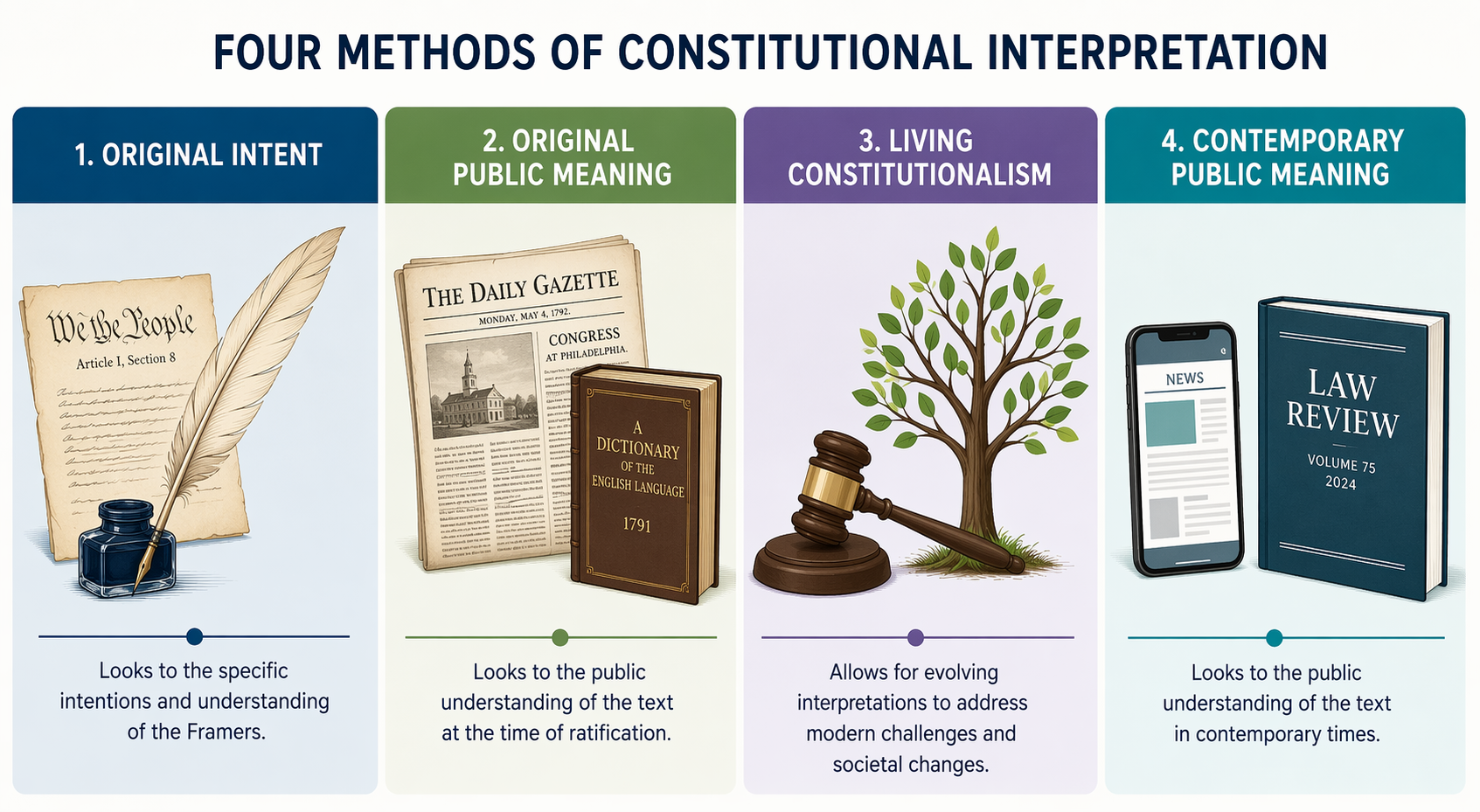
The exam-ready starting point is this: modern Supreme Court originalism usually means original public meaning originalism. It asks how the constitutional text would have been understood by the public at the time of ratification, not what James Madison, a particular framer, or a later judge privately hoped the text would accomplish. The National Constitution Center’s white paper treats that public-meaning focus as central to contemporary originalist theory, while distinguishing it from older versions centered on original intent.[1]
That definition matters because students often attack the wrong target. If an exam answer says “originalists just ask what the framers personally wanted,” it will miss the version most current defenders actually claim. If it says “living constitutionalists just ignore text,” it will caricature the rival approach too. The UIC Law Review overview frames the classic contrast more carefully: originalists worry that living constitutionalism gives judges too much discretion, while living constitutionalists argue that constitutional meaning must be applied in light of changed social and legal conditions.[2]
The Distinctions That Keep Students From Freezing
Originalism is not the same thing as textualism. Textualism is usually a statutory-interpretation method that asks what enacted words mean, often without resort to legislative purpose. Originalism is a constitutional-interpretation method that asks what constitutional language meant when adopted. The two can overlap, especially because both emphasize text over judicial policy preference, but they answer different questions in different legal settings. Pacific Legal Foundation’s explainer is useful here because it separates originalism, textualism, and living constitutionalism instead of treating them as interchangeable conservative and liberal labels.[3]
| Method | Exam-useful question | Common student mistake |
|---|---|---|
| Original intent | What did particular framers or ratifiers subjectively intend? | Treating this as the dominant modern version of originalism. |
| Original public meaning | How would the constitutional words have been publicly understood when adopted? | Assuming public meaning always produces one obvious answer. |
| Textualism | What does the enacted legal text mean, usually in statutory interpretation? | Using it as a synonym for constitutional originalism. |
| Living constitutionalism | How should broad constitutional principles apply under changed conditions? | Reducing it to judges updating the Constitution whenever they want. |
There is also a difference between interpretation and construction. Interpretation asks what the text means. Construction asks how legal actors should implement that meaning when the text is underdeterminate. That gap is where much of the real fight hides. An originalist may say the public meaning is fixed, then still need a doctrine, test, level of generality, analogy, or burden rule to decide a modern dispute.
That is why “the Court is originalist” is too blunt for a good exam answer. Since 2020, originalism has become the dominant interpretive rhetoric of the 6–3 conservative Court, especially in major constitutional cases. But sources differ on how many individual justices should be called originalists, and some justices move between text, structure, precedent, tradition, functional consequences, and historical practice depending on the issue. The safer move is to describe the method used in the opinion before labeling the justice.
How Originalism Behaves In The Cases Students Actually Read
The cleanest way to understand the debate is not to memorize abstract definitions. Track what happens when the Court uses history to decide rights, powers, and limits. Heller, Dobbs, Bruen, Rahimi, and Trump v. United States show different versions of the same pressure point: originalism promises constraint, but constitutional litigation forces judges to choose sources, analogies, baselines, and levels of generality.
Heller: The Modern Template
District of Columbia v. Heller is the case students usually meet first as modern originalism in action. The Court read the Second Amendment to protect an individual right to possess a firearm for lawful purposes such as self-defense, relying heavily on founding-era text, dictionaries, legal commentary, and historical practice. For exam purposes, Heller matters because it models the move from text to founding-era meaning to modern doctrinal consequence.
It also shows why historians and lawyers can talk past each other. A lawyer may ask whether the majority has enough historical evidence to justify a constitutional rule. A historian may ask whether the Court has flattened a messy legal culture into a usable litigation narrative. Jonathan Gienapp’s Stanford History interview treats Heller as part of a broader problem: originalists, in his view, can project modern assumptions about constitutional language and legal authority backward onto the 18th century.[4]
On an exam, that critique should not become “Heller is wrong because historians disagree.” It is sharper to say: the majority claims to recover original public meaning, while critics argue that its source selection and assumptions about founding-era constitutionalism make the historical inquiry less neutral than it appears.
Dobbs: Originalism Against Substantive Due Process
Dobbs v. Jackson Women’s Health Organization moved the debate from method to consequence. The Court used a historically grounded approach to conclude that the Constitution does not protect a right to abortion, overturning Roe v. Wade and Planned Parenthood v. Casey in 2022. The majority asked whether the claimed right was deeply rooted in the nation’s history and tradition and implicit in ordered liberty; the answer, in its view, was no.[5]
The Brennan Center critique by Alexander Keyssar and Wilfred Codrington III argues that this kind of originalism strips away historical context, especially in Reconstruction-era cases. Their objection is not simply that the Court looks backward. It is that the Court can choose a historical frame that excludes the very political and social transformations that made the Fourteenth Amendment necessary.[5]
That is an exam-useful distinction. The originalist defense of Dobbs is that courts should not constitutionalize rights absent a historical and textual warrant. The critique is that the relevant history is not just whether a particular practice was protected at a specific moment, but how the Reconstruction Amendments changed constitutional status, citizenship, equality, and liberty. Those are different arguments about the level of generality at which original meaning should be described.
Bruen: History And Tradition Becomes A Test
New York State Rifle & Pistol Association v. Bruen turned Heller’s historical style into a more demanding doctrinal test. In 2022, the Court rejected means-end scrutiny for Second Amendment claims and required the government to justify firearm regulations by showing consistency with the nation’s historical tradition of firearm regulation.[5]
For students, Bruen is where originalism becomes procedural. The question is no longer only “what did the Second Amendment originally mean?” It becomes “what historical analogues are close enough to support this modern law?” That shift matters because modern gun regulations often respond to technologies, social conditions, and public-safety problems that do not map neatly onto founding-era regulations.
The Brennan Center piece notes that lower courts have struggled with Bruen’s workability, including judges describing the required historical inquiry as difficult to administer.[5] The important point is not that difficulty proves invalidity. Courts administer difficult tests all the time. The exam point is that a history-and-tradition test shifts discretion into the choice of analogues: how old, how numerous, how similar, and at what level of abstraction?
Rahimi: The Court Pulls Back From The Most Rigid Version
United States v. Rahimi tested Bruen almost immediately. In 2024, the Court upheld a federal firearm restriction as applied to people subject to domestic-violence restraining orders, rejecting the idea that the government needed a founding-era twin for the modern statute. The decision suggested that historical analogy can be more flexible than a search for identical regulations.
Justice Kavanaugh’s Rahimi concurrence framed the choice as one between history and policy judgment. Gienapp criticizes that dichotomy as false, arguing that historical interpretation itself requires judgment about context, categories, and meaning.[4] That critique is useful because it targets a common exam oversimplification. Even when a court says it is using history instead of policy, the legal question is still mediated by judicial choices about which history counts and how analogy works.
Trump v. United States: The Missing Originalism Problem
Trump v. United States is irritating in exactly the way a good exam issue-spotter should notice. In 2024, the Court recognized broad presidential immunity from criminal prosecution for official acts. The controversy for originalism is not just the outcome. It is that the majority did not appear to rely on the same kind of founding-era originalist analysis that had been central in cases like Dobbs and Bruen. Justice Sotomayor’s dissent charged that “history matters to this Court only when it is convenient.”[6]
That sentence should not be converted into the lazy answer “originalism is fake.” The stronger answer is narrower and more lawyerly: when the Court uses originalist history to narrow unenumerated rights or evaluate gun regulations, but relies more heavily on structure, consequences, and functional concerns in a presidential-immunity case, critics can argue that the method is unevenly applied. Defenders may respond that separation-of-powers cases legitimately require structural reasoning, not only clause-bound historical analysis.
| Case | What originalism/history does | Exam pressure point |
|---|---|---|
| Heller | Uses founding-era materials to identify an individual Second Amendment right. | Are the historical sources and assumptions doing more work than the opinion admits? |
| Dobbs | Uses history and tradition to reject constitutional protection for abortion. | What is the proper level of generality for Fourteenth Amendment liberty? |
| Bruen | Turns historical tradition into the governing Second Amendment test. | How should courts choose analogues for modern regulations? |
| Rahimi | Allows a more flexible analogy-based use of history after Bruen. | Is the Court applying history or making judgment calls through history? |
| Trump v. United States | Does not foreground originalist analysis in the same way. | Is originalism being applied consistently across constitutional domains? |
The Strongest Critiques Are Methodological, Not Just Political
The weakest critique of originalism says only that conservative justices use it to reach conservative results. Sometimes that may be part of a litigant’s argument, but it is not enough for a constitutional-law exam. The stronger critiques explain where discretion enters a method that claims to constrain discretion.
- Selective history: the Court may emphasize some founding or Reconstruction sources while minimizing others.
- Stripped context: historical rules may be detached from the broader legal and social world that gave them meaning.
- Anachronism: modern assumptions about law, rights, sovereignty, or interpretation may be projected onto earlier periods.
- Hidden construction: judges may present a result as interpretation even when they are choosing among several plausible implementing doctrines.
- Workability: lower courts may struggle when told to decide modern cases through historical analogy.
Keyssar and Codrington’s Brennan Center argument belongs in the selective-history and stripped-context categories. They argue that the Supreme Court’s originalism often does not engage deeply with history as historians understand it, particularly when the Court extracts a narrow rule while ignoring the surrounding historical struggle.[5] Because the Brennan Center has its own institutional perspective, it should be treated as a serious critique, not a neutral umpire.
Gienapp’s critique is slightly different. He argues that originalists can be anachronistic even while quoting old sources, because they may assume that 18th-century constitutional actors understood text, law, and interpretation in the same way modern lawyers do.[4] That is a deeper objection than “the Court cited the wrong dictionary.” It challenges the background assumptions that make the dictionary relevant.
The Harvard Law Review Blog’s 2024 thought experiment presses another limit: whether originalism can function as a methodology if judges must keep making contestable choices about the level of generality, the relevant historical community, and the bridge from old meaning to modern doctrine.[7] The point is not that every choice is lawless. The point is that originalism’s constraint claim depends on how openly it accounts for those choices.
How To Argue The Other Side Without Sounding Naive
Originalism has serious defenses, and students should be able to state them before critiquing them. The basic defense is democratic legitimacy: judges should enforce the Constitution that was adopted, not revise it under the cover of interpretation. The related rule-of-law defense is constraint: fixed public meaning limits judicial discretion better than open-ended moral reasoning. The predictability defense is institutional: if constitutional meaning changes with judicial values, constitutional law becomes too dependent on who is wearing the robe.
A strong originalist exam paragraph might say that original public meaning gives courts an external reference point, especially when the text is old and democratically entrenched. It can also explain why some disputes should be resolved through Article V amendment or ordinary politics rather than judicial updating. That is the best version of the argument; it is not a cartoon about worshiping the past.
The response is not that judges should simply prefer modern values. The response is that original public meaning often underdetermines modern outcomes, and the act of selecting history, choosing analogies, and setting the level of generality can recreate the discretion originalism promised to avoid. That response is especially strong when the Court applies historical rigor in one line of cases but relies on a different mode of reasoning in another.
Newer Labels You May See But Do Not Need To Overwrite Your Outline
The debate has not stopped at originalism versus living constitutionalism. In April 2026, Edward B. Foley argued at SCOTUSblog for “contemporary public meaning” as an alternative: courts would ask how the Constitution’s words are publicly understood today, rather than freezing meaning at ratification.[8] That is commentary, not a Supreme Court holding or peer-reviewed empirical study, but it is useful because it offers a named alternative to both old-style living constitutionalism and conventional original public meaning originalism.
Other labels may appear in class or scholarship. Common good constitutionalism criticizes both originalism and liberal legalism from a different normative direction. Progressive originalism tries to use originalist premises to support rights-protective or egalitarian outcomes, rather than conceding originalism to conservatives. Original law originalism, associated in the literature with scholars such as William Baude and Stephen Sachs, asks about the law of the founding that remains legally operative unless changed.[6]
Do not let those labels make the exam harder than it is. Use them when they help identify a real move in an argument. If the question is about Bruen, the central issue is historical analogy and workability. If the question is about Dobbs, the central issue is the history-and-tradition treatment of substantive due process and the level of generality for liberty. If the question is about Trump v. United States, the central issue is consistency: why is founding-era history central in some constitutional domains and less visible in another?
A Compact Exam Frame
When an exam asks about originalism, start with the claimed method before moving to the critique. A useful paragraph can do four things in order: define original public meaning, identify the historical evidence or tradition the opinion relies on, explain the doctrinal consequence, and then test whether the method is determinate and consistently applied.
- Name the version: original public meaning, original intent, history-and-tradition review, structural reasoning, or something else.
- Locate the source base: text, founding-era practice, Reconstruction history, precedent, tradition, structure, or functional consequence.
- State the doctrinal effect: the right expands, the right contracts, the government’s burden changes, or the court replaces one test with another.
- Add the critique precisely: selective history, anachronism, level of generality, hidden construction, workability, or inconsistent application.
- Give the best response: constraint, democratic legitimacy, administrability, constitutional settlement, or the need to avoid judicial policy judgment.
For extra practice turning doctrine into usable exam paragraphs, it can help to compare this method with other law-school issue-spotting exercises, such as an analyze settlement case study problem. The subject is different, but the discipline is the same: identify the governing frame before arguing about the result.
Originalism is now central to understanding the Supreme Court, but it is not a magic answer key. A strong law-school answer asks what kind of originalism is being invoked, which history has been selected, what modern doctrinal move follows from that selection, whether the method is applied consistently, and what alternative interpretive move remains available.
References
- On Originalism in Constitutional Interpretation, National Constitution Center
- Constitutional Interpretation: An Overview of Originalism and Living Constitutionalism, UIC Law Review
- Originalism vs. Textualism vs. Living Constitutionalism, Pacific Legal Foundation
- Why is the Supreme Court obsessed with originalism?, Stanford History, 2024
- The Supreme Court’s Originalism Doesn’t Have Much to Do with History, Brennan Center for Justice, 2023
- Originalism, Wikipedia
- A Thought Experiment: Does Originalism Make Sense?, Harvard Law Review Blog, 2024
- An actual alternative to originalism, SCOTUSblog, April 2026
Comments
Join the discussion with an anonymous comment.