
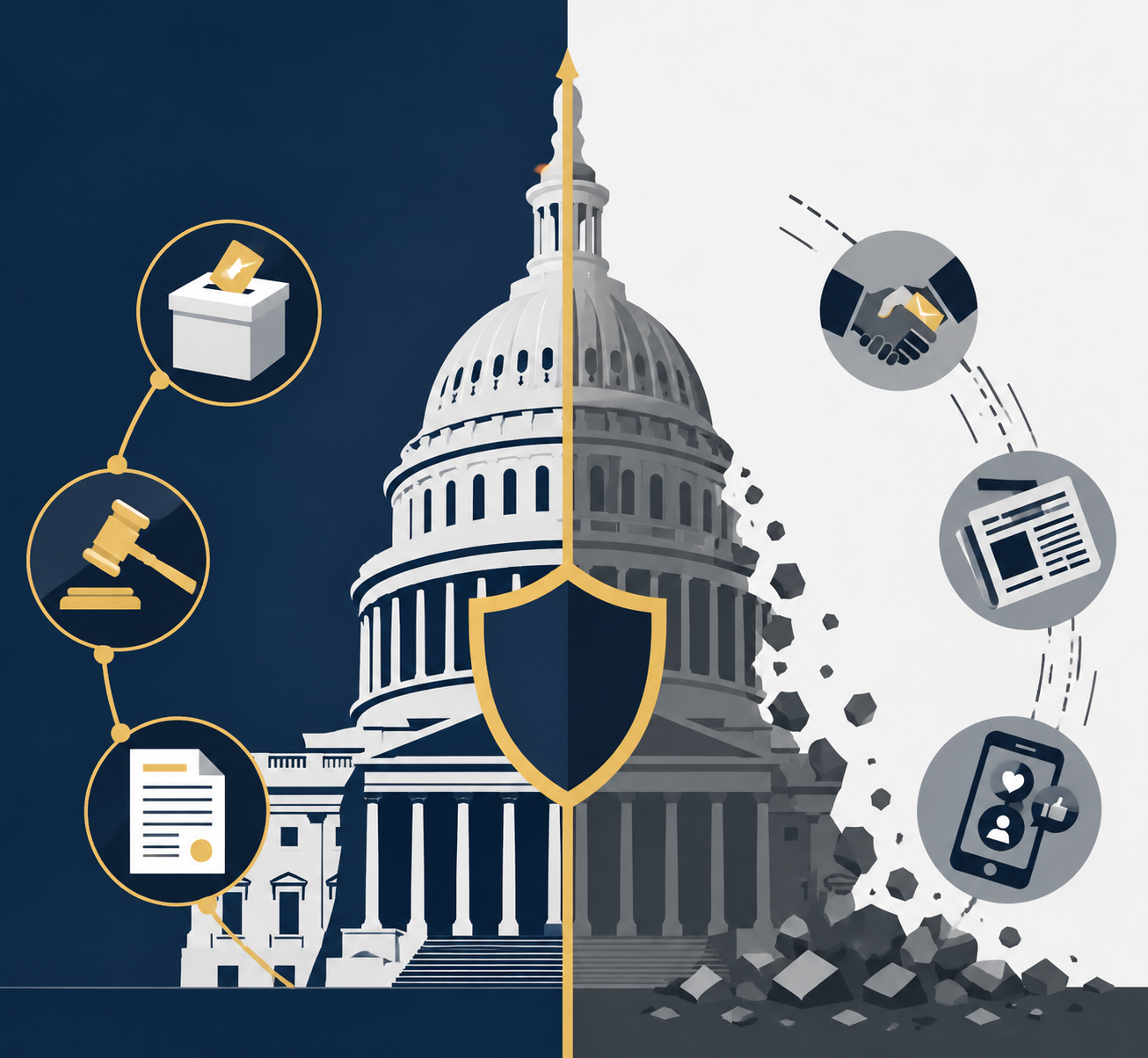
Legislative Privilege Explained for Law Students
Understand the origins, scope, and limits of legislative privilege under the Speech or Debate Clause. This guide explains core protected activities, key exceptions, and emerging issues for constitutional law and bar exam prep.
Updated:
On an exam, legislative privilege usually becomes hard at the exact moment the facts become ordinary. A senator votes. A representative tells a reporter what happened. An aide copies documents. A committee issues a subpoena. A prosecutor wants to mention a floor statement. The useful first question is not, “Is this person a legislator?” It is: what act is the court being asked to examine?
For federal legislators, the source is Article I, Section 6, Clause 1: “for any Speech or Debate in either House, they shall not be questioned in any other Place.” The modern rule is broader than literal speeches and debates, but not limitless. The Clause protects Members of Congress for acts within the “sphere of legitimate legislative activity,” a formulation tied to the Clause’s separation-of-powers purpose and its roots in the English Bill of Rights of 1689.[1]
That purpose matters because it keeps the doctrine functional. The Clause is not a character reference for legislators. It is a protection against courts, prosecutors, and private litigants using lawsuits or evidence demands to intimidate or second-guess legislative work. Once the act is genuinely legislative, the immunity is absolute. Before that point, the word “absolute” should stay capped in your marker.
The Line: Legislative Function, Not Legislative Status
A protected legislative act is an act that is part of the process by which Congress considers, debates, investigates, and enacts legislation. Voting, debating, preparing committee reports, introducing resolutions, and conducting authorized investigations can fall inside the protected sphere. Committee subpoenas can also be protected when they are part of a legitimate legislative inquiry.[2]
Everything near Congress is not therefore inside the Clause. Political errands, press outreach, newsletters, constituent service, campaign activity, bribe-taking, and private republication of legislative materials sit on the other side unless the specific act itself performs a legislative function. The exam trap is to let the actor do all the work. Courts do not.
| If the fact pattern gives you | Ask this | Likely treatment |
|---|---|---|
| Floor speech, vote, committee report, resolution | Is the court questioning the Member about legislative deliberation or action? | Core protected activity |
| Committee subpoena or investigation | Was it issued as part of a legislative inquiry? | Often protected when within legitimate legislative activity |
| Aide conduct | Would the act be protected if done by the Member personally? | Protected only when assisting legislative work |
| Bribe, promise, campaign help, constituent favor | Is the prosecution targeting agreement or corruption rather than the legislative act itself? | Not protected as a legislative act |
| Press release, newsletter, public post | Is this internal legislative work or public communication outside Congress? | Not automatically protected |
Build the Answer in the Right Order
Use a sequence. It prevents the common mistake of jumping straight from “Member of Congress” to “immune.”
- Identify the actor: Member of Congress, congressional aide, state legislator, private party, prosecutor, civil plaintiff, or court.
- Identify the act: vote, speech, report, subpoena, promise, publication, constituent service, social media post, or evidentiary use.
- Classify the function: is the act part of legislative deliberation, investigation, or voting, or is it political, public-facing, administrative, or corrupt?
- Name the protection being claimed: immunity from suit, immunity from prosecution, exclusion of evidence, aide protection, waiver, or state legislative privilege.
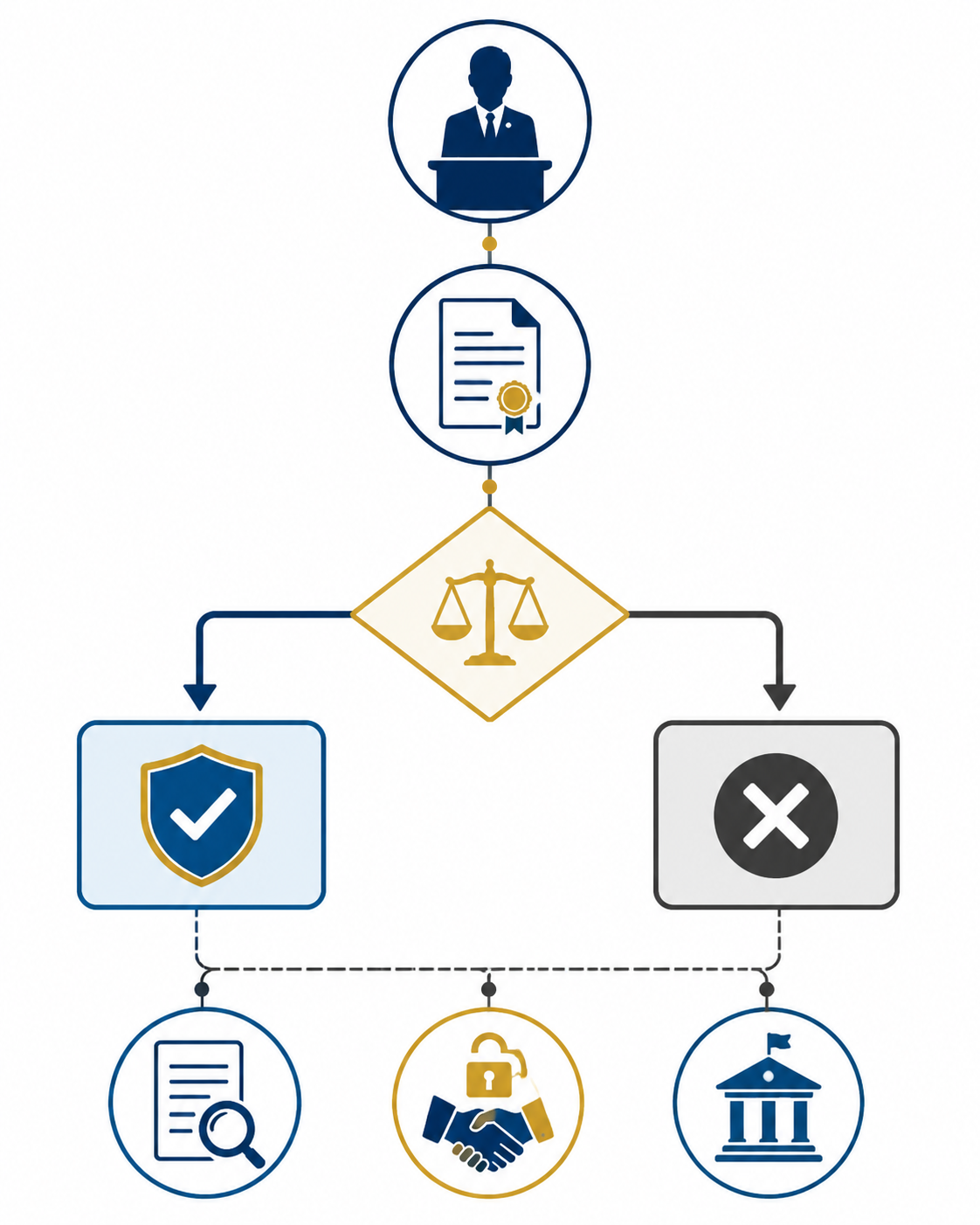
That fourth step matters. The Clause can block a lawsuit or prosecution based on legislative acts, but it can also operate as an evidentiary rule. Sometimes the government is not charging the vote itself; it is trying to use the vote, speech, or committee work as proof. Helstoski is the case to remember for that problem.
The Protected Side: Kilbourn, Eastland, and Gravel
Kilbourn Starts the Modern Exam Conversation
Kilbourn v. Thompson is usually treated as the Supreme Court’s first major interpretation of the Speech or Debate Clause. The case recognized that legislators could not be questioned elsewhere for legislative acts, even though the case also contained language suggesting there might be “extraordinary circumstances” outside the privilege.[3]
Do not turn that dictum into a standard exception. For exam purposes, the real work is still classification. If the act is legislative, the protection is extremely strong. If the act is not legislative, you do not need an extraordinary-circumstances escape hatch.
Eastland Protects the Committee Subpoena
Eastland v. U.S. Servicemen’s Fund is the clean subpoena case. A Senate subcommittee issued a subpoena as part of an investigation, and the Court treated the subpoena as protected because it fell within the sphere of legitimate legislative activity.[3]
That does not mean every demand for documents by someone connected to politics is protected. Eastland works because the subpoena was part of Congress’s investigative function. Investigation can be legislative when it is tied to Congress’s information-gathering role. The protected act is not “asking for papers” in the abstract; it is issuing a committee subpoena as part of legislative inquiry.
Gravel Extends Protection to Aides, Then Stops
Gravel v. United States is the aide case, but the rule is narrower than students often make it. The privilege can extend to congressional aides because Members need aides to perform legislative work; the aide is protected when the aide’s conduct would be protected if performed by the Member. Gravel also held that private republication of the Pentagon Papers outside the legislative process was not protected by the Clause.[2]
So the sentence you want is not “aides are immune.” The sentence is: aides share the Member’s protection when they are assisting protected legislative acts. That phrasing keeps the function in view.
The Boundary Side: Brewster, Helstoski, and Hutchinson
Brewster: A Bribe Is Not a Legislative Act
United States v. Brewster is the bribery case, and it is one of the easiest cases to state badly. The Court did not say prosecutors may inquire into legislative acts whenever corruption is alleged. It said taking a bribe is not itself a legislative act. The agreement or promise can be prosecuted without making the court inquire into how the Member later voted or performed legislative work.[2]
The promise-versus-performance distinction is the point. A prosecutor may target the corrupt promise: money in exchange for an agreement to be influenced. The prosecutor may not prove the case by asking the jury to judge the protected legislative performance itself if doing so would question the Member for legislative acts. Brewster lets corruption prosecution proceed because bribery is outside the legislative function; it does not erase the evidentiary and immunity protections around actual legislative acts.
Helstoski: Legislative Acts May Be Excluded as Evidence
United States v. Helstoski adds the evidentiary rule students forget. The government charged a former Member in a bribery-related prosecution, but the Court held that evidence of past legislative acts could not be introduced against him. The Clause bars not only liability for protected acts, but also use of those acts as evidence when that use would require questioning the legislative act.[4]
On an exam, separate the charge from the proof. A bribery charge may be outside the Clause after Brewster. But if the prosecution proves the bribe by introducing speeches, votes, or committee acts as evidence of motive or agreement, Helstoski becomes a serious problem.
Hutchinson: Publicity Is Not Floor Debate
Hutchinson v. Proxmire is the press-release-and-newsletter case. The Court held that the Speech or Debate Clause did not protect a senator’s allegedly defamatory statements in press releases and newsletters, even though those communications discussed matters connected to congressional work.[2]
This is where “informing the public” becomes too broad if you are not careful. Legislators regularly explain, defend, and publicize their work. That does not make every public communication part of the legislative process. Hutchinson draws a practical line between internal legislative acts and external republication to the public.
What Counts as Protected and Unprotected Conduct
A compact map helps, but only if the categories are tied to function rather than labels.
| Usually protected when legislative in function | Usually outside the Clause |
|---|---|
| Voting on legislation | Accepting or agreeing to accept a bribe |
| Floor speech and debate | Campaign activity |
| Committee reports and resolutions | Constituent service |
| Authorized congressional investigation | Press releases and newsletters |
| Committee subpoenas within legislative inquiry | Private republication of legislative materials |
| Aide work that would be protected if done by the Member | Public social media communications, at least under the 2025 district court treatment discussed below |
The hardest entries are not the dramatic ones. Bribery is easy to spot. The pressure points are communications that look related to legislative work: newsletters, press statements, interviews, public posts, and constituent explanations. Those acts may be politically important. They may even be part of a Member’s job in the ordinary civic sense. But the Speech or Debate Clause protects the legislative function, not every part of being an elected official.
Waiver: Possible, But Not Casual
Waiver is worth a short answer, not a detour. Courts require an “explicit and unequivocal renunciation” of the Speech or Debate Clause privilege. That is a high standard. Ordinary cooperation, public discussion, or participation in litigation will not usually amount to waiver.[4]
If a fact pattern raises waiver, look for unmistakable language giving up the privilege. If the facts merely show that the Member talked about the issue publicly or engaged with the process, be cautious. Publicity may take a communication outside the Clause under Hutchinson, but that is a classification problem, not necessarily a waiver of privilege for protected legislative acts.
State Legislative Privilege Is a Different Problem
Do not collapse federal and state legislative privilege. The federal Speech or Debate Clause is constitutional text that protects federal legislators for covered legislative acts. State legislative immunity has a different foundation. Tenney v. Brandhove recognized state legislative immunity as a matter of federal common law, and state constitutional speech-or-debate clauses may also matter depending on the jurisdiction.[5]
Because state legislative immunity is not the federal Speech or Debate Clause itself, Congress may abrogate it when legislating under valid authority, but courts require the necessary clarity. In Cushing v. Packard, the First Circuit sitting en banc held in 2022 that the ADA and Rehabilitation Act did not clearly abrogate state legislative immunity in the case before it.[6]
For a law-school answer, this usually needs only two moves: identify that the defendant is a state legislator, then explain that the immunity question is governed by federal common law and relevant state law rather than directly by Article I’s Speech or Debate Clause.
The Social Media Edge
The modern version of Hutchinson is social media. A 2026 Congressional Research Service Sidebar discusses a 2025 federal district court decision applying Hutchinson to X/Twitter posts and treating those posts as outside protected legislative acts. The CRS report also notes the issue remains unsettled because no federal court of appeals or the Supreme Court has resolved the constitutional question for social media posts.[7]
That is the right level of certainty. Do not write that all social media posts by legislators are categorically unprotected as a Supreme Court rule. Do write that public-facing social media communications look much more like Hutchinson’s press releases and newsletters than like floor debate, committee reports, votes, or subpoenas. The forum is not decisive by itself, but the function usually is doing the work.
Exam-Ready Synthesis
Legislative privilege is absolute only after the act is properly classified as legislative. Protect the legislative function: speech, debate, voting, reports, resolutions, legitimate investigations, subpoenas, and aide work that assists those acts. Use Eastland for subpoenas, Gravel for aides and the republication boundary, Brewster for bribery, Helstoski for evidentiary exclusion, and Hutchinson for public communications.
Then stop overclaiming. Bribery is not legislating. Constituent service is not floor debate. A newsletter is not a committee report. A public post does not become constitutionally immune merely because a legislator typed it. The Clause protects Congress’s legislative work from being chilled or questioned elsewhere; it does not turn every public act by a legislator into a protected legislative act.
References
- Speech and Debate Privilege | U.S. Constitution Annotated — Cornell Legal Information Institute.
- Activities to Which Speech or Debate Clause Applies | U.S. Constitution Annotated — Cornell Legal Information Institute.
- Speech and Debate Clause — First Amendment Encyclopedia, Middle Tennessee State University.
- Congressional Immunity — Co-Equal.
- legislative immunity | Wex | LII — Cornell Legal Information Institute.
- Speaking of the Speech or Debate Clause: Revising State Legislative Immunity — Notre Dame Law Review.
- A Tale of Two Immunities: Constitutional Protections for Members of Congress and Presidents When Speaking to the Public | CRS (Feb. 2026) — Congressional Research Service, Feb. 2026.
Comments
Join the discussion with an anonymous comment.