
Congress War Powers Explained for Students
Understand how Congress's constitutional war powers work, how they interact with presidential authority, what the War Powers Resolution actually does, and why the U.S. has fought major conflicts without formal declarations of war. This guide connects constitutional text to real-world practice for civics and government students.
Updated:
A student can memorize the basic civics rule in one line: Congress declares war, and the president commands the military. The trouble starts five minutes later, when the same student notices that the United States has fought major conflicts since World War II without formal declarations of war. Korea, Vietnam, Afghanistan, Iraq, Libya, and the 2026 Iran conflict do not disappear from history just because they do not fit neatly into the declaration box.
So the better question is not simply “Who has the war power?” It is: how does the constitutional rule work after presidents act quickly, Congress authorizes indirectly, funding continues, courts hesitate, and the War Powers Resolution tries to impose deadlines that presidents often resist?
The Constitutional Rule Is Real, But It Is Not the Whole System
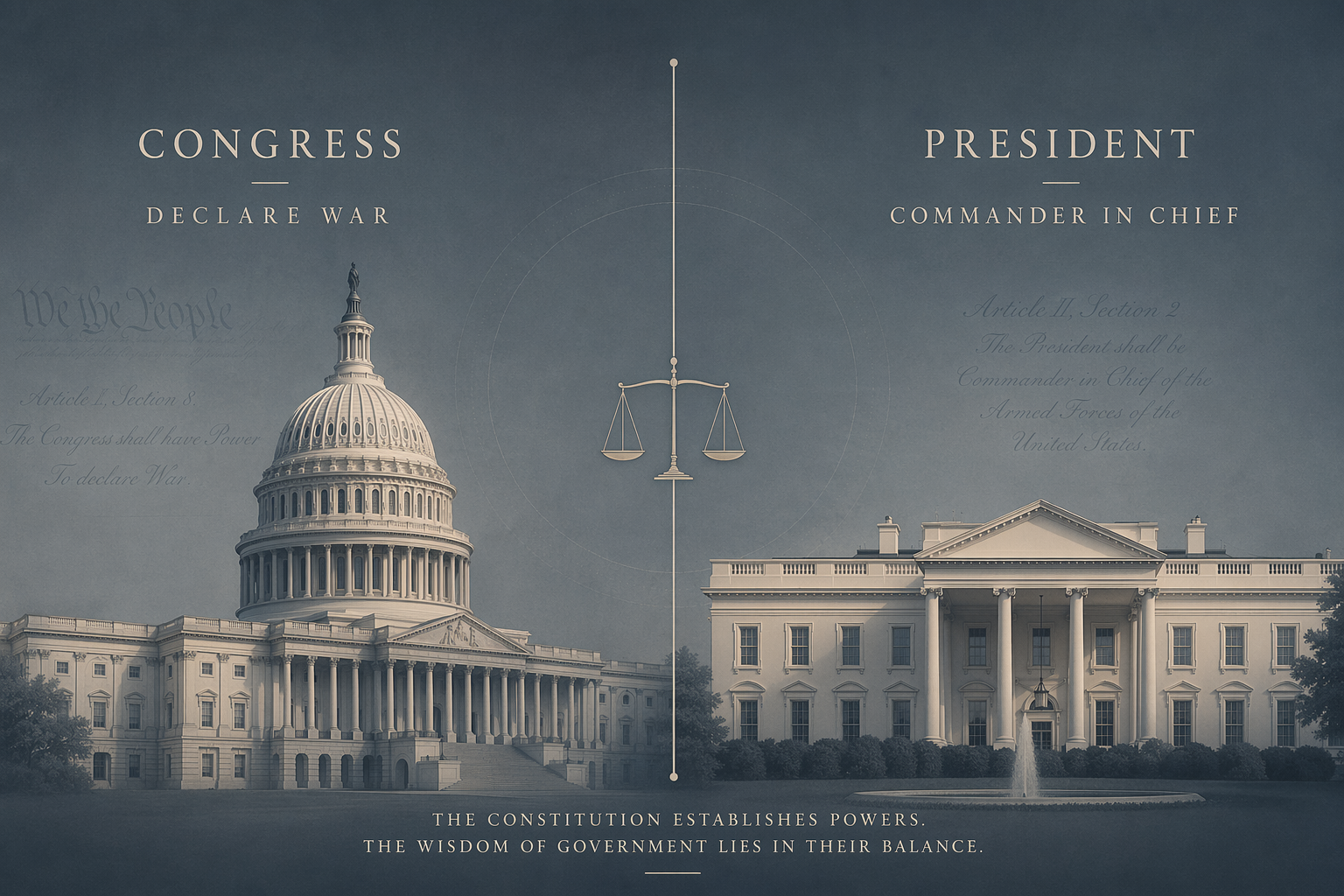
The starting point is Article I, Section 8. It gives Congress the power to declare war, raise and support armies, provide and maintain a navy, make rules for the armed forces, and control military funding. Article II, Section 2 makes the president commander in chief of the Army, Navy, and state militias when called into federal service.[1]
That division was deliberate. At the Constitutional Convention, James Madison moved to change Congress’s power from “make war” to “declare war.” The point was to leave the president able to repel sudden attacks while reserving the decision to begin war for Congress.[2]
For class notes, that gives you a clean first rule:
- Congress decides whether the nation enters war through its declaration, authorization, funding, and military-organization powers.
- The president directs military operations as commander in chief once U.S. forces are in action.
- The hardest disputes happen when the president uses force first and Congress has not clearly declared or refused war.
That last bullet is where most modern war-powers arguments live. A formal declaration of war is only one way Congress can act. It is the most dramatic way, and the one textbooks usually teach first, but it is not the only legal tool Congress has used.
Formal Declarations Became Rare After World War II
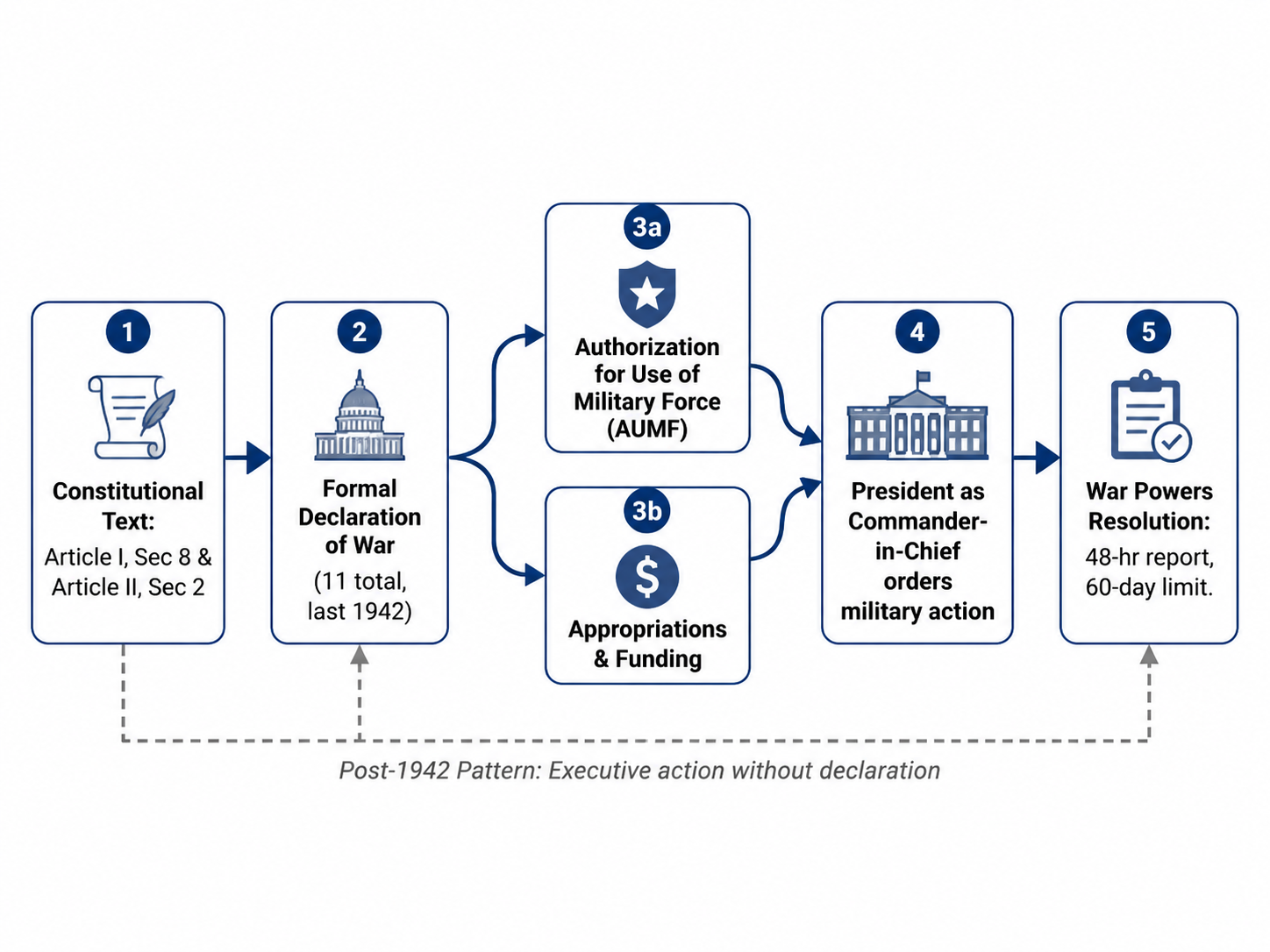
Congress has formally declared war 11 times, across five wars. The last formal declarations came on June 4, 1942, against Romania, Bulgaria, and Hungary during World War II.[3]
That number surprises students because it feels too small. It does not include Korea. It does not include Vietnam. It does not include the Persian Gulf War, Afghanistan, Iraq, Libya, or later conflicts. The United States still used military force in those conflicts, but the legal route usually ran through some combination of presidential claims, congressional authorization, United Nations or coalition framing, and appropriations.
| Tool | What it does | Why it matters for students |
|---|---|---|
| Declaration of war | Congress formally recognizes a state of war | Rare after 1942, but constitutionally important |
| Authorization for Use of Military Force | Congress permits force for a defined purpose or against defined targets | Modern conflicts often rely on this instead of declarations |
| Appropriations | Congress funds or refuses to fund military action | Funding can support, limit, or pressure a conflict |
| Commander-in-chief action | The president directs forces and may claim authority to respond to crises | Often where undeclared conflicts begin |
| War Powers Resolution process | Requires reporting and sets a deadline for unauthorized hostilities | Designed to check presidential action, but weakly enforced |
The table is not a list of equal powers. It is a map of the path modern conflicts often take. A declaration is constitutionally clear but historically uncommon in the modern period. Authorizations and funding votes are less tidy, but they are where Congress has often made its choices.
How Undeclared Wars Still Get Legal Cover
Korea is the classic early example. President Harry Truman sent U.S. forces into the Korean War without asking Congress for a formal declaration and framed the action as a United Nations-backed “police action.” That did not make the war small for the soldiers fighting it, but it did change the legal and political label used at home.[4]
Vietnam followed a different route. Congress did not issue a formal declaration of war, but the Gulf of Tonkin Resolution gave President Lyndon Johnson broad authority after reported attacks involving U.S. naval vessels. The lesson is not that authorization and declaration are identical. The lesson is that Congress can authorize force without using the formal words “declare war,” and that broad wording can matter long after the vote.[4]
The same pattern appears in more recent form with Authorizations for Use of Military Force, usually called AUMFs. After the September 11 attacks, Congress passed the 2001 AUMF. Congress later passed the 2002 Iraq AUMF. These were not declarations of war, but they became central legal authorities for military operations. The Secure Families Initiative, an advocacy organization, says the 2001 AUMF has been used to justify at least 41 military operations in 19 countries; that count should be checked against current Congressional Research Service materials because the exact total can change depending on methodology and updates.[5]
Appropriations add another layer. Congress may object to a president’s military action in speeches, hearings, or resolutions, but funding decisions are often where institutional power becomes practical. Continuing to fund an operation does not always mean every member approves of the policy. It does mean Congress has not used one of its strongest tools to stop it.
The War Powers Resolution Was Supposed to Force the Question
The War Powers Resolution of 1973 was Congress’s attempt to respond to the growth of presidential war-making, especially after Vietnam. Congress enacted it over President Richard Nixon’s veto.[6]
Its basic design is simple enough to put on a classroom timeline. If the president introduces U.S. forces into hostilities or situations where hostilities are imminent, the president is supposed to report to Congress within 48 hours. If Congress has not declared war or otherwise authorized the action, U.S. forces generally must be removed within 60 days, with a limited additional withdrawal period.[6]
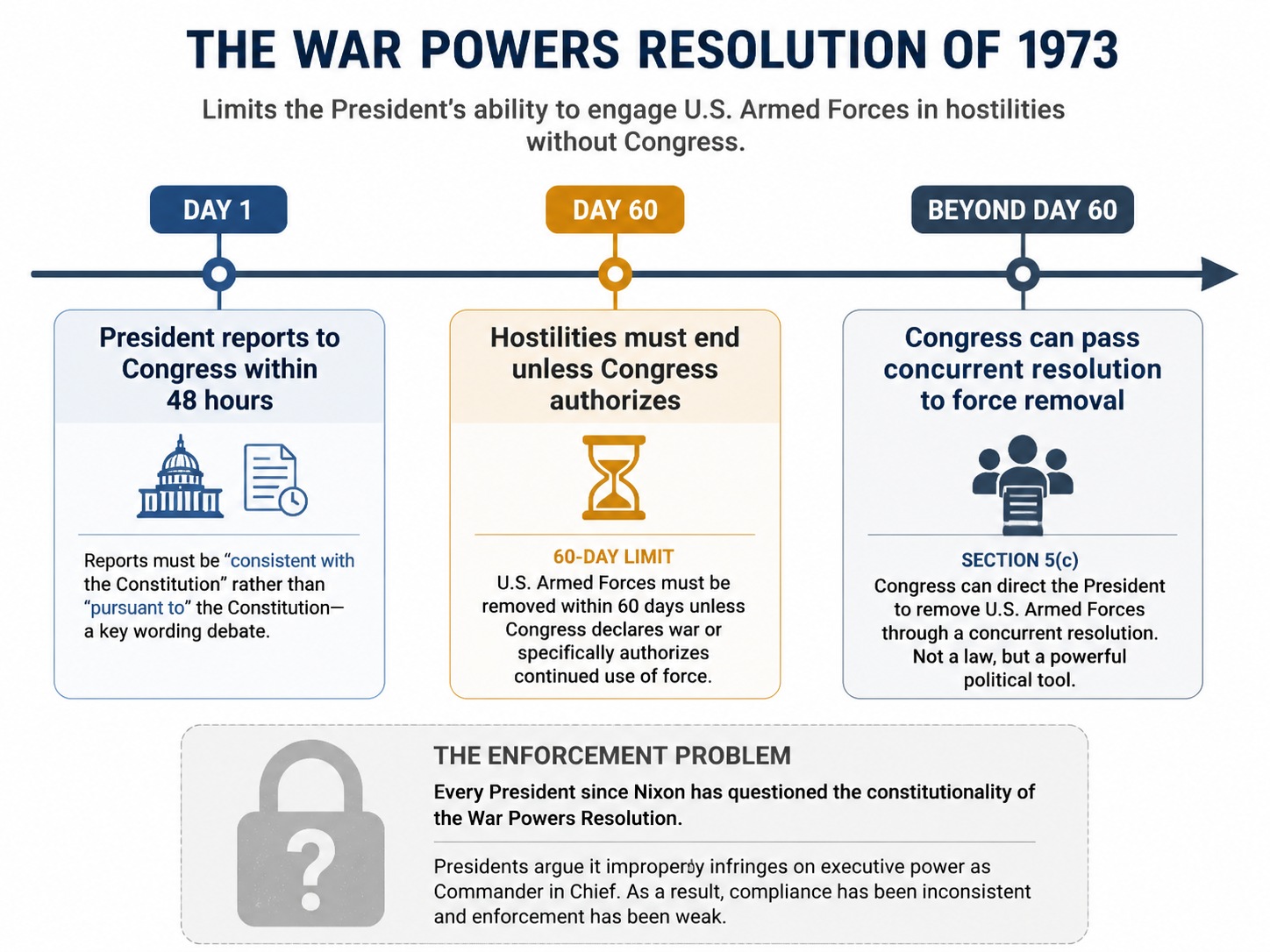
That sounds stricter than it often works in practice. Presidents have regularly treated the War Powers Resolution as constitutionally questionable. They also often submit reports “consistent with” the resolution rather than “pursuant to” it. That wording is not just decorative. It can signal that the administration is informing Congress without conceding that the statute controls the president’s constitutional authority or starts the legal clock in the way Congress intended.[6]
The 60-day rule also creates a problem students should notice. A law meant to restrain presidents can be read by critics as giving them a practical window to use force first and seek permission later. The president may act, report, argue over whether the situation counts as “hostilities,” and wait to see whether Congress can gather enough agreement to stop or authorize the operation.
The Libya Example Shows Why One Word Can Carry a Lot of Weight
Libya in 2011 is a useful example because the dispute turned on whether U.S. operations counted as “hostilities” under the War Powers Resolution. The Obama administration argued that the 60-day clock did not require withdrawal because the U.S. role did not amount to hostilities in the statutory sense. Critics disagreed.[4][6]
For students, the point is not to memorize Libya as a one-word trick. The point is to see how modern war-powers fights often move from the big constitutional question to narrower arguments over classification: Is this war? Is it hostilities? Is it support? Is Congress informed, or has Congress authorized? Those labels can determine whether a legal deadline matters.
What Courts Have and Have Not Settled
The Supreme Court has not been absent from war-powers history, but it has not given students a simple answer that solves modern initiation disputes. In the Prize Cases during the Civil War, the Court upheld President Abraham Lincoln’s blockade after Southern states had already taken hostile action. In Youngstown Sheet & Tube Co. v. Sawyer, the Court rejected President Truman’s seizure of steel mills during the Korean War.[1]
Youngstown is especially important because Justice Robert Jackson’s concurrence gave a lasting framework: presidential power is strongest when the president acts with Congress, weaker when Congress is silent, and weakest when the president acts against Congress. That framework helps students analyze the branches together instead of treating presidential and congressional powers as separate quiz cards.[1]
Still, courts often avoid deciding war-initiation fights directly, including through doctrines such as the political question doctrine. In plain classroom terms, courts may decide some related legal questions while leaving the central fight between Congress and the president unresolved.[1]
The 2026 Iran Conflict Is a Current Stress Test, Not a Settled Answer
The 2026 Iran conflict matters for this topic because it puts the old question into current form: what happens when military action moves faster than congressional consensus? In June 2026, both chambers of Congress passed a concurrent resolution under Section 5(c) of the War Powers Resolution directing the president to remove U.S. forces from hostilities connected to Iran.[7]
That development should be handled carefully because it is current, contested, and still unfolding as of July 20, 2026. It is not a final Supreme Court answer. It is also not proof that the War Powers Resolution now works exactly as written. Section 5(c), the part involving a concurrent resolution to force removal, has long carried constitutional uncertainty after the Supreme Court’s 1983 decision in INS v. Chadha limited legislative veto mechanisms. The Iran resolution is important precisely because it tests a mechanism that looked stronger on paper than it has often been in practice.[7]
The cautious student answer is this: Congress was asserting a statutory and constitutional role, but the long-term legal effect depends on how the branches respond and whether courts treat the issue as justiciable. That is less satisfying than a clean yes-or-no answer, but it is more accurate.
A Practical Way to Read Any War-Powers Example
When a teacher gives you a war-powers scenario, do not start by asking only whether Congress declared war. Start there, but keep going. The modern system usually requires a sequence of questions.
- Did Congress formally declare war? If yes, the constitutional basis is unusually clear.
- If not, did Congress pass an AUMF or another statute authorizing force?
- Has Congress funded the operation, limited funding, or tried to cut it off?
- What authority is the president claiming: commander in chief, self-defense, protection of U.S. personnel, treaty or coalition obligations, or prior authorization?
- Did the president file a War Powers report, and did the report say “pursuant to” or merely “consistent with” the resolution?
- Has the 60-day period become relevant, and is there a dispute over whether the operation counts as “hostilities”?
- Is Congress acting as an institution, or are individual members objecting without enough votes to change the legal situation?
That last question is easy to miss. “Congress” is not the same as a press conference by several members of Congress. For Congress to use its strongest powers, it usually needs votes, procedures, deadlines, and enough agreement across both chambers to matter. Presidents often benefit from that difficulty, especially during fast-moving crises.
The Answer Students Should Keep
Congress has the constitutional power to declare war, raise and regulate the military, and control military funding. The president is commander in chief and directs military operations. That division remains the constitutional baseline.
Modern practice is messier. Since World War II, the United States has often fought through authorizations, appropriations, presidential action, coalition operations, and disputed War Powers Resolution procedures rather than formal declarations. The War Powers Resolution tried to force presidents back toward Congress through reporting and deadlines, but presidents have questioned it, Congress has enforced it unevenly, and courts have often avoided the central fight.
So the strongest student answer is not “Congress controls war” or “the president controls war.” It is that the Constitution gives Congress the decision to initiate war and major tools to authorize, fund, or stop military action, while modern presidents often act first and make Congress decide whether it can respond with more than objection.
References
- War Powers, Cornell Law School LII
- Interpretation: Declare War Clause, National Constitution Center
- About Declarations of War by Congress, U.S. Senate
- Congress hasn't officially declared war since WWII..., PBS NewsHour
- War Powers 101, Secure Families Initiative
- War Powers Resolution, Wikipedia
- War Powers, Brennan Center for Justice
Comments
Join the discussion with an anonymous comment.