
Your Free Speech Rights When a School Bans You from Social Media
If a school official has blocked you on social media after you criticized the school, you may have First Amendment protections. This guide explains the Supreme Court's test for when blocking violates your rights and what steps you can take.
Updated:
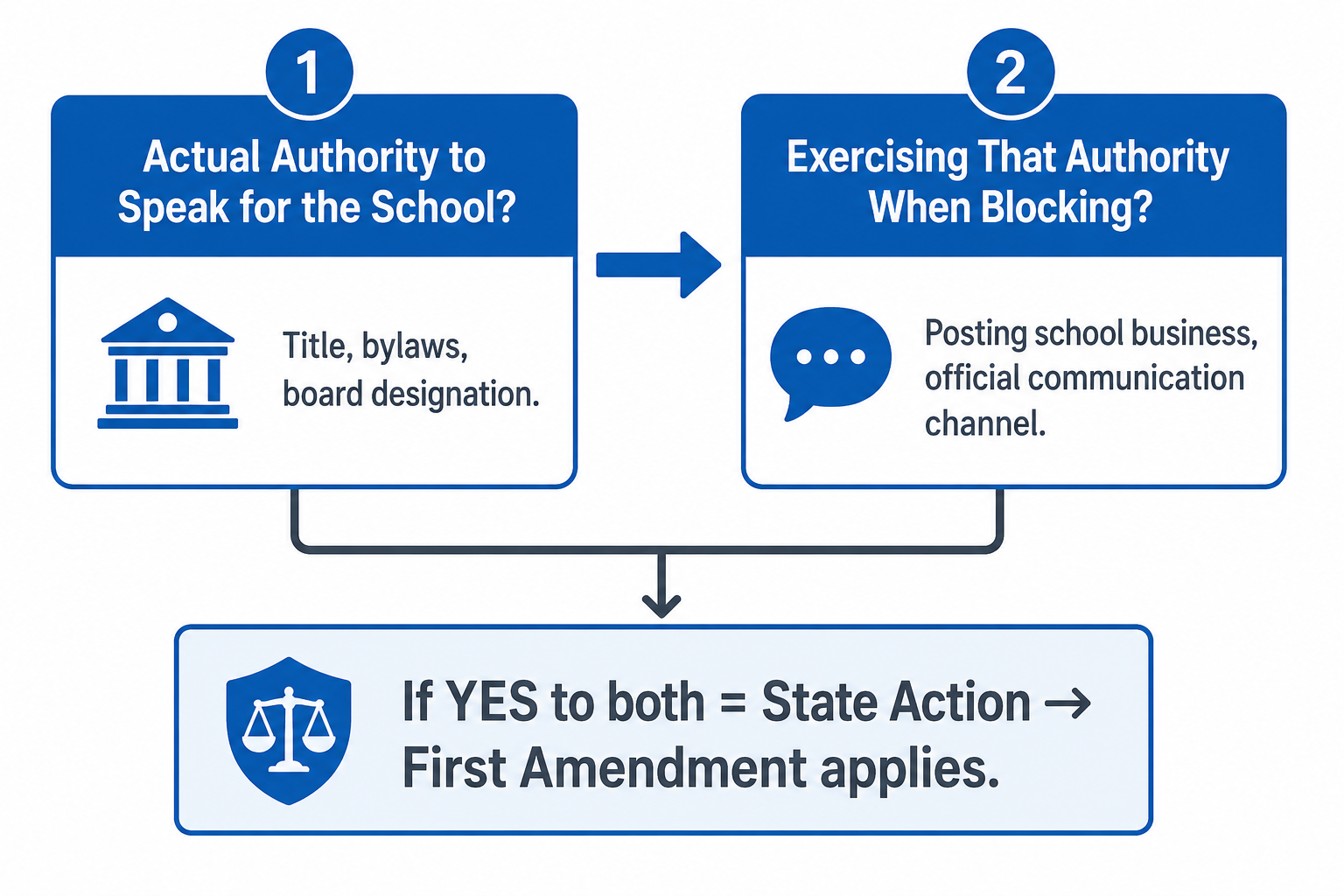
Last updated July 19, 2026. This is general information, not legal advice. If a school official blocked you after you criticized the school, start by separating two very different things people call a social media ban: a state law aimed at minors, or a school official blocking a parent from a page tied to school business. This guide is about the second one. The Supreme Court's March 2024 rule in Lindke v. Freed and O'Connor-Ratcliff v. Garnier asks two questions: did the official have actual authority to speak for the school, and was that authority being exercised when the block happened? [1]
What the Court is really looking for
The labels the official uses are not the whole story. A page can be called personal and still function like a school channel if the person is posting as a board member, using a government title, and talking about school business. The facts that matter are usually the boring ones: the title on the profile, board bylaws or another official designation, whether the page carries school announcements, meeting notices, or policy talk, whether there is a disclaimer, and whether the page has been used as a regular way to communicate with the public. That is the test parents can actually check. [1][2]
- Screenshot the profile page, the official's title, and any posts that show school business.
- Save the block notice, the date and time, and the post or comment that came right before the block.
- Capture bylaws, board rules, or anything that shows who was allowed to speak for the school. [2]
- Note whether the page had a disclaimer, whether comments were open to the public, and whether the account was used for announcements, meetings, or other official communication. [1][2]
- Keep the page as it looked on the day of the block, even if the official later changes the description or deletes posts.
Why the 2025 remand matters
The clearest school-specific example in the research is the Ninth Circuit's 2025 remand involving a California school board president. The court treated the page as official enough to create First Amendment problems because the board bylaws named her as the spokesperson and her social media pages were used almost exclusively for school business. That is the kind of record that moves a case from angry to actionable. [2]
By contrast, if the account really was personal, stayed personal, and never operated as a school communication channel, the claim gets weaker fast. Courts are not required to turn every rude block into a constitutional case.
Other cases show the same pattern
The school-social-media issue sits inside a broader rule: parents do have First Amendment protection when they criticize school officials, so long as the speech is not threatening, harassing, or genuinely disruptive. In McElhaney v. Williams, the Sixth Circuit said a coach-related criticism could not be silenced by an informational sheet banning discussion of playing time. [3]
The same theme appeared in Moms for Liberty v. Brevard Public Schools, where the Eleventh Circuit struck down board policies that let schools silence parents for 'abusive' or 'personally directed' comments at meetings. And in Hartzell v. Marana, the Ninth Circuit said a district could not ban a parent from school property for speech that was merely offensive or inappropriate; there still has to be substantial disruption under Tinker. Hartzell is not a pure social-media case, but it warns against retaliatory bans dressed up as discipline. [4][5]
What to do now
- Preserve screenshots of the page, the block, and the posts that triggered the conflict.
- Write down the official's title, the school business posted on the page, and the timing of the block.
- Look for bylaws, board rules, or other documents showing whether the person had authority to speak for the school. [2]
- Check for disclaimers and posting patterns; a truly personal account usually looks personal all the way through, not just after criticism starts.
- If the page looks official enough, ask counsel about a preservation request or possible First Amendment claim. If it looks genuinely personal, the better move may be to document it and use other school channels.
References
- EdWeek: When Blocking Social Media Critics, School Officials Have Protections, Supreme Court Says (March 2024)
- Franczek: Federal Appellate Court Finds That School Board President Violated First Amendment in Restricting Followers on Social Media (2025)
- Ennis Britton: Sixth Circuit Sides With Parent In Free Speech Case (2023)
- Institute for Free Speech: Moms for Liberty and Florida Parents Win First Amendment Victory Against School Board Censorship (2024)
- AALRR: Hartzell v. Marana (2025)
Comments
Join the discussion with an anonymous comment.