
A Film Student's Toolkit for Period Horror Analysis
This guide equips film students with a structured mise-en-scène framework — setting, costume, lighting, and staging — to analyze period horror films using The Witch and Crimson Peak as key case studies. Learn to decode historical world-building for stronger essays and exam responses.
Updated:
For film students, the common problem in period horror analysis is not noticing too little. It is noticing plenty and then not knowing what to do with it. A student can see the candles, the old house, the rough clothes, the formal speech, the muddy fields, and the restrained performances. The essay still weakens if those details sit on the page as atmosphere: “creepy,” “authentic,” “Gothic,” “immersive.” Those words may be true, but they do not yet make an argument.
A stronger question is simpler and harder: which design choices are carrying meaning in this film, and how can that be proved on the page? Period horror is useful for practicing that question because its historical world is not just a backdrop. Space, fabric, light, and bodily behavior often decide what kind of fear the film can produce.
The label “period horror” should be handled lightly. It is a classroom-friendly description for horror set in an earlier historical world, not a sealed subgenre with fixed borders. It overlaps with Gothic film, folk horror, and historical horror; Gothic film in particular has long used old houses, family secrets, stylized interiors, and historical settings as part of its visual grammar.[1] The point is not to win a taxonomy argument. It is to ask how a film’s pastness is made visible and what that visibility does.
A Four-Part Lens That Keeps the Essay Grounded
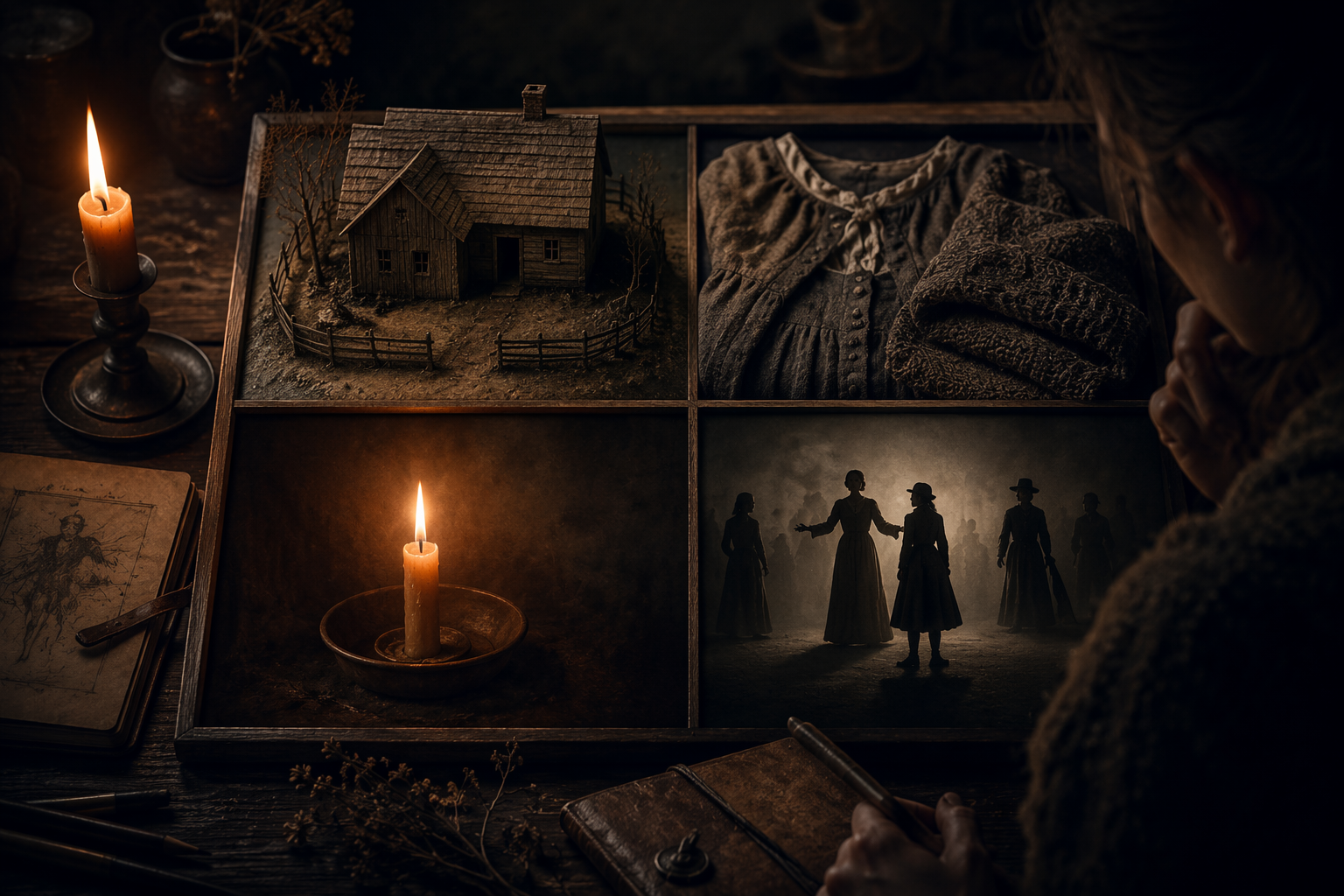
Mise-en-scène is often introduced through categories such as setting, props, costume, makeup, lighting, staging, and performance. For period horror, those categories can be compressed into four working questions:
- Setting and props: What kind of world has been built, and what does that world allow or forbid?
- Costume and makeup: How do clothing, hair, skin, and bodily presentation place characters within class, belief, labor, gender, or vulnerability?
- Lighting: What can be seen, what remains uncertain, and how does the historical light source shape fear?
- Staging and performance: How do bodies, voices, gestures, spacing, and movement make the historical world feel governed by rules?
This is not a checklist to march through in equal paragraphs. In one film, lighting may carry the argument. In another, the house may matter more than the clothing. A good essay identifies the component doing the heaviest work and then connects visible detail to theme, power, belief, isolation, or narrative pressure.
| Observation | Weak Essay Move | Stronger Analytical Move |
|---|---|---|
| The film uses candlelight. | This creates a creepy atmosphere. | The restricted light makes knowledge partial, so fear comes from what characters cannot verify. |
| The characters wear rough clothing. | The costumes look authentic. | The fabric makes labor, discomfort, and social discipline visible on the body. |
| The house is old and isolated. | The setting is Gothic. | The architecture limits escape, concentrates family conflict, and turns domestic space into a threat. |
| The actors speak formally. | The dialogue sounds old-fashioned. | The speech pattern shows that belief, authority, and fear are expressed through a different social code. |
The Witch: When Historical Design Becomes the Horror Mechanism
Robert Eggers’ The Witch is the cleanest teaching case because its period design is unusually legible. The film’s 1630s New England farmhouse was reconstructed with period-correct timber and thatch; its costumes used rough wool and linen made with historically accurate techniques; its lighting depended on natural light and candlelight after testing by cinematographer Jarin Blaschke; and its dialogue and accents drew on early modern English and primary Puritan materials.[2] Those facts are not impressive by themselves. They become useful only when they explain how the film thinks.
Setting and Props: A Farmhouse That Cannot Protect Its Family
The family’s farm is small, exposed, and bordered by a forest that the film treats as both physical edge and spiritual threat. The farmhouse matters because it is not the cozy center of a rural idyll. It is a fragile structure built by people who have separated themselves from a larger community and now must make authority, food, faith, and discipline hold together on their own.
That is the paragraph-level move students often miss. Do not write, “The setting is isolated and therefore scary,” and stop there. Write what the isolation changes. It reduces witnesses. It makes ordinary family conflict harder to interrupt. It turns the father’s authority into something the whole household must live inside. It means that when the crop fails, when a child disappears, or when suspicion moves through the family, there is no neutral social space where the pressure can be released.
The props work in the same way. Tools, animals, fences, household objects, and religious materials should not be listed as “period detail.” They make the family’s world practical and severe. The horror gains force because the setting is not merely old; it is a system of survival in which every failure looks material and moral at once. A damaged crop is not just bad farming. In this world, it can be read as judgment, temptation, or evidence that the family’s spiritual order has cracked.
Costume and Makeup: Fabric as Discipline
The rough wool and linen in The Witch are worth more than a sentence about authenticity. Clothing presses historical life onto the actors’ bodies. It restricts movement, absorbs labor, and keeps the characters visually close to a world of work, weather, and religious restraint. The bodies in the film do not look costumed for display; they look managed by fabric, climate, and doctrine.
This is where costume analysis can become thematic without becoming vague. Thomasin’s body is watched and interpreted by her family before she can fully control what that interpretation means. Clothing participates in that process. It helps produce a community where modesty, suspicion, maturity, and sin are not abstract ideas but ways of reading a person’s body. The costume does not “symbolize Puritanism” in a decorative sense. It helps stage the social conditions under which Thomasin becomes legible as a problem.
Makeup and bodily presentation also matter because the film does not glamorize historical hardship. Faces, hair, and skin belong to a household under strain. The point is not that the film looks dirty enough to be serious. The point is that the body becomes evidence of pressure: work, hunger, fear, sleep loss, weather, and accusation.
Lighting: Candlelight as Evidence, Not Decoration
Students like writing that candlelight is atmospheric. It is, but that is the least useful thing to say. In The Witch, natural and candlelit illumination limits what can be seen and when it can be seen.[2] This matters because horror often depends on uncertainty, and a pre-electric world provides uncertainty without requiring characters to behave foolishly. Darkness is not an aesthetic overlay. It is part of the available technology of perception.
A candlelit interior changes the ethics of looking. Faces emerge unevenly. Corners resist certainty. A character may be present without being fully readable. In an essay, that can become a claim about knowledge: the film’s historical lighting does not simply make the past visible; it makes visibility unreliable. The family’s theological fears are matched by a visual world in which confirmation is always incomplete.
The same logic applies outside. Natural light ties the film to weather, time of day, and the exposed geography of the farm. Instead of treating lighting as a decorative mood layer, read it as a rule. What does this light source permit? What does it withhold? Who gets seen clearly? Who remains half-known?
Staging and Performance: Speech as World-Building
The film’s period-inflected speech and Northern British accents are easy to mention and hard to analyze well. The danger is to write that the dialogue “sounds authentic” and then move on. The better move is to ask what the speech does to relationships. Formal religious language shapes how characters confess, accuse, plead, command, and submit. It gives fear a grammar.
Performance follows from that grammar. The family does not behave like modern people wearing old clothes. Their gestures and vocal rhythms belong to a world where patriarchal authority, spiritual terror, and household obedience are constantly being negotiated. A pause before speaking, a lowered gaze, a formal address, or a sudden verbal accusation can carry social weight because the film has established rules for conduct.
An exam paragraph on The Witch can therefore move from detail to claim in three steps: name the visible component, describe its immediate effect, then connect it to the film’s larger fear. For example: the candlelit farmhouse restricts visibility; restricted visibility makes evidence unstable; unstable evidence intensifies a religious household’s tendency to convert uncertainty into accusation. That is analysis. It does not require a long plot summary, and it does not leave the detail stranded as “mood.”
Crimson Peak: Why Accuracy Is Not the Same as Good Design
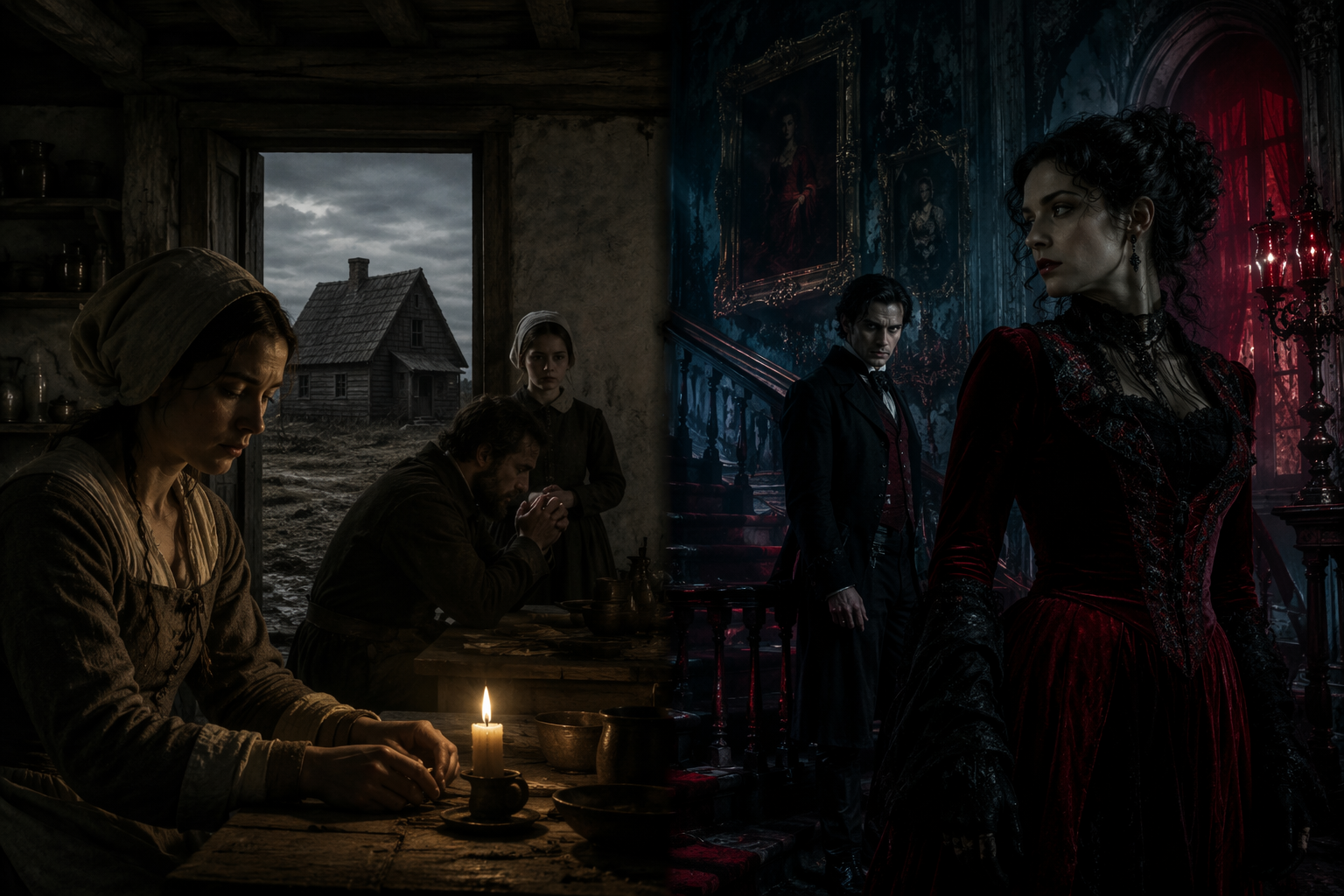
Crimson Peak is useful after The Witch because it prevents a lazy lesson from forming. The lesson is not “the more historically accurate, the better.” Guillermo del Toro’s film uses period design strategically rather than submitting to museum correctness. Its costume design includes deliberate historical inaccuracies, including anachronistic silhouette choices and strong color alignment: ghost-like pale blue against warmer reds.[3]
That changes the essay question. With The Witch, a student might ask how historical constraint produces fear. With Crimson Peak, the better question is how stylization organizes feeling and moral alignment. Color, texture, and silhouette guide the viewer through a Gothic world where emotion is often louder than plausibility. The costume is not failing because it departs from strict accuracy; it is doing a different job.
Allerdale Hall makes the point even more clearly. The decaying mansion functions as an active threat rather than neutral scenery.[3] It is not only where danger happens. Its architecture, decay, and atmosphere help generate the danger. A student writing on the setting should therefore avoid the thin phrase “the house is Gothic” unless the next sentence explains how the house behaves: it traps, leaks, displays family ruin, and turns inheritance into a physical environment.
The comparison with The Witch is valuable because the two films use period design for different kinds of pressure. The Witch narrows the world until belief and survival become indistinguishable. Crimson Peak expands design into melodrama, color coding, and architectural excess. Both are analyzable through mise-en-scène, but the standard of judgment changes. Ask whether the design choice serves the film’s logic, not whether it would satisfy a costume historian.
When the Same Lens Moves to Nearby Traditions
The four-part lens travels well, but it should not flatten every film into the same answer. The Lighthouse, Hammer Gothic, and folk horror show why the method works best when students first decide which component carries the most weight.
The Lighthouse extends the lighting question. Its black-and-white cinematography, use of Orson Welles-era Mitchell BNC cameras, Nova Scotia’s Cape Forchu location, and period-authentic Fresnel lens lighthouse technology make pre-electric visual constraint central to the film’s design.[4] The point for an essay is not to admire the technical difficulty. The point is to ask how optical restriction, harsh contrast, and maritime isolation make perception unstable.
Hammer Film Productions’ Gothic cycle of the 1950s and 1960s points in another direction. Its lavish Technicolor sets, sweeping Victorian costumes, and expressionistic lighting often prioritize emotional and visual force over strict historical accuracy.[1] That tradition is a useful warning against treating “period” as a synonym for realism. Sometimes the past in horror is a stage for saturated desire, theatrical threat, and visual excess.
Folk horror adds a further adjustment. In films associated with the tradition, including Witchfinder General, The Wicker Man, and The Blood on Satan’s Claw, landscape can become the dominant mise-en-scène element. Adam Scovell’s “Folk Horror Chain” is often summarized through landscape, isolation, belief system, and supernatural presence or suggestion.[5] That is not a replacement for mise-en-scène analysis. It is a way to sharpen it when fields, villages, roads, crops, ruins, and open air matter more than interiors or costumes.
A film class discussion of folk horror can therefore begin with space before it moves to plot. Who is isolated, and from what? What belief system governs the setting? Does the landscape merely surround the characters, or does it seem to organize what can be known, feared, and punished? Those questions keep the analysis concrete even when the film relies on suggestion rather than explicit supernatural display. Critical discussions of horror films in film-class contexts regularly return to these titles because they make belief, environment, and social order unusually visible.[6]
Turning Notes Into an Essay Paragraph
The practical difference between a notebook observation and an essay claim is the verb. “The film has candlelight” is an observation. “The candlelight restricts evidence” is already closer to analysis. “The candlelight restricts evidence, so the family’s religious interpretation of uncertainty becomes more frightening” is a defensible claim.
Use a simple progression when writing under pressure:
- Identify the mise-en-scène component: setting, costume, lighting, or staging.
- Describe the visible detail without overloading the sentence with research.
- Name the immediate effect on space, body, vision, or behavior.
- Connect that effect to fear, power, isolation, belief, or historical world-building.
- If comparing films, explain the difference in function rather than ranking accuracy.
That last point matters. A comparison between The Witch and Crimson Peak should not end with one being “more accurate.” It should explain that The Witch uses reconstructed material conditions to make Puritan belief and family discipline feel inescapable, while Crimson Peak uses stylized Gothic design to externalize emotion, inheritance, and decay. The comparison becomes sharper because the same category, mise-en-scène, leads to different judgments.
Research belongs in the paragraph only when it becomes evidence for interpretation. If the fact that The Witch used period-correct materials helps explain the farmhouse as a fragile social and spiritual enclosure, use it. If a production fact merely proves that someone worked hard, leave it out. Film analysis is not a display cabinet for trivia.
The strongest period horror analysis identifies the design component carrying the most weight in a specific film and follows its consequences. Sometimes that component is a house. Sometimes it is wool. Sometimes it is candlelight. Sometimes it is an accent, a posture, a field, a corridor, or a color. The task is to show how the historical world has been built, then show what that world does to the people trapped inside it.
References
- Gothic film, Wikipedia, https://en.wikipedia.org/wiki/Gothic_film
- Air, Atmosphere, Environment: Film Mood, Folk Horror and The VVitch, Screening the Past, https://www.screeningthepast.com/issue-43-dossier-materialising-absence-in-film-and-media/air-atmosphere-environment-film-mood-folk-horror-and-the-vvitch/
- Horror Film Series: Behind the Mise-en-scène, By Arcadia, https://www.byarcadia.org/posts/horror-film-series%3A-behind-the-mise-en-sc%C3%A8ne
- Period Horror Films to Watch While You Wait For The Pale Blue Eye, Collider, https://collider.com/period-horror-movies/
- Cursed Earth: Landscape and Isolation in Folk Horror, Folk Horror Revival, https://folkhorrorrevival.com/2021/05/21/cursed-earthlandscape-and-isolation-in-folk-horror-an-essay-by-andy-paciorek/
- Horror films that deserve to be analyzed in your film class, Stage and Cinema, 2024, https://stageandcinema.com/2024/08/20/horror-films-that-deserve-to-be-analyzed-in-your-film-class/
Comments
Join the discussion with an anonymous comment.