
What Journalism Students Can Learn from the NBC Guard Firing
This case study uses the NBC Today show security breach and same-day guard firing to help journalism students analyze tensions between organizational accountability signaling and due-process fairness in crisis discipline. Drawing on July 2026 reporting, it explores proportional discipline, hate crime context, and the limits of swift employer action.
Updated:
The NBC News security guard firing begins with a hard fact pattern for journalism students: a man reportedly entered an unauthorized area at the Today show, confronted Craig Melvin and Al Roker, and used a racial slur; a security guard was fired the same day; and the firing itself has been reported through anonymous sources rather than a public NBC explanation.
That is enough to make a newsroom move quickly. It is not enough, by itself, to tell students that the discipline was fair, unfair, necessary, symbolic, or scapegoating. The point of studying the incident is not to choose a team before the record is developed. It is to ask when rapid accountability after a serious breach becomes a due-process problem for the person at the bottom of the chain of command.
The Sequence Matters More Than the Outrage
USA Today reported that the breach happened at 8:57 a.m. on July 16, 2026, and that the suspect was arrested at 9:19 a.m. The charges reported at that stage were burglary as a hate crime, menacing as a hate crime, criminal trespass as a hate crime, and harassment as a hate crime; USA Today also noted that the suspect had not yet been arraigned at the time of its reporting.[1]
Those timestamps are useful because they keep the class from floating into abstractions too quickly. In a live broadcast environment, a little more than twenty minutes can contain a security failure, a threat to high-profile employees, a police response, frightened staff, managerial calls, legal consultation, and the beginning of an internal inquiry. It can also contain mistakes made in haste.
Page Six reported later on July 16 that NBC News had fired a security guard over the incident, citing anonymous sources and describing staff as “sad” about the dismissal and the guard as “well-liked.”[2] TMZ independently reported the same day that NBC had fired a guard after the intruder reached Melvin.[3] Entertainment Weekly later reported the colleague reaction as well, including the same broad picture of a guard whose dismissal upset some staff members.[4]
For students, the first ethical task is to separate the confirmed public event from the reported employment consequence. The arrest and charges were attributed through law-enforcement reporting. The firing was not announced by NBC in a public statement. The fired guard was not publicly identified. The worker’s employment status, union status, role description, supervisor instructions, prior discipline history, and access to an HR review were not public as of the July reporting.
The One-Fired, One-Not-Fired Detail Is the Teaching Problem
The New York Daily News added the detail that makes this more than a story about a fast employer response. It reported that two guards were on duty: one allegedly stepped away, while another allegedly missed the intruder. According to that account, only one guard was terminated.[5]
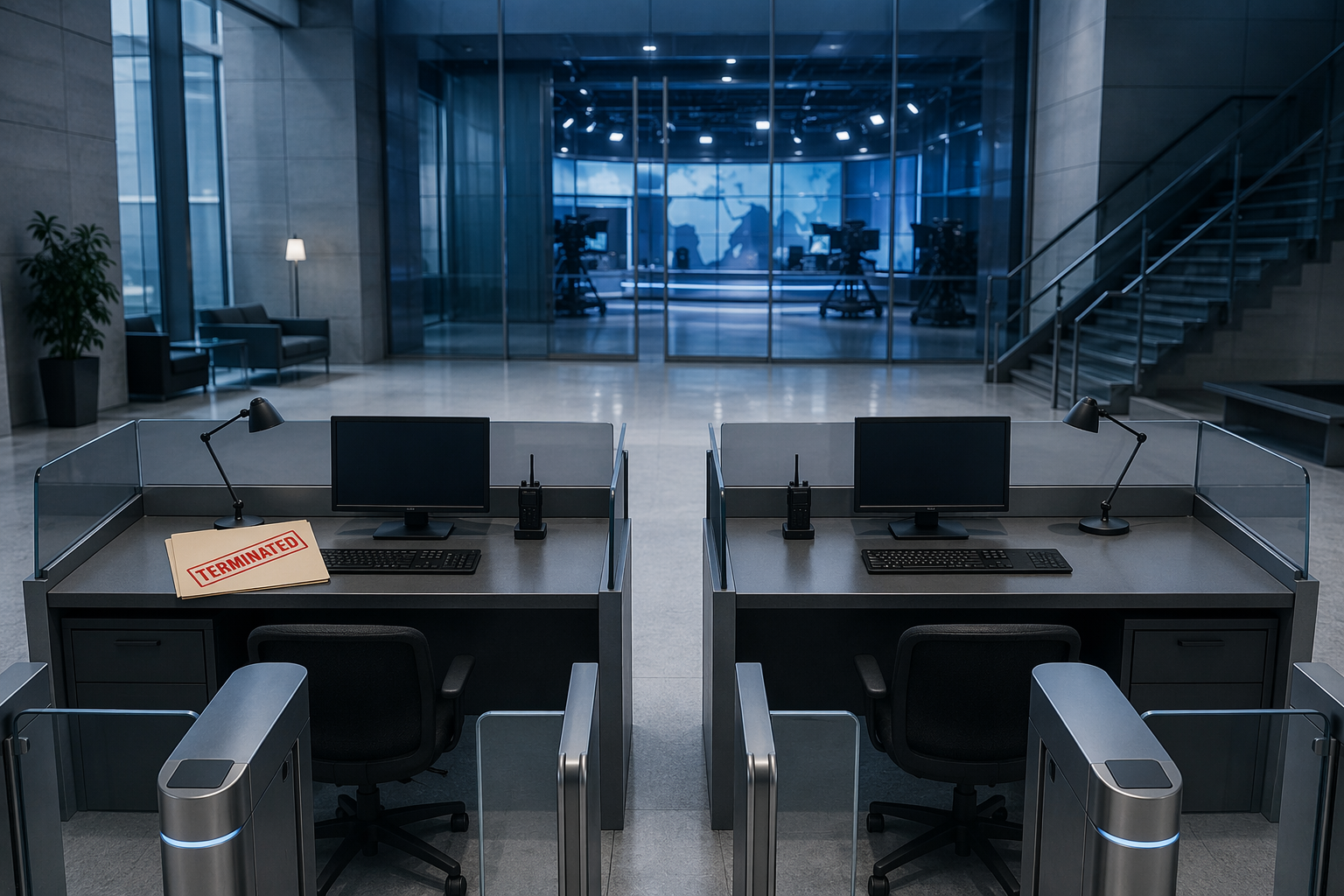
That does not prove unfairness. It does create a proportionality question. If two people were assigned to the checkpoint or relevant post, what distinguished the fired guard’s conduct from the guard who remained employed? Was one guard responsible for the precise access point? Did one violate a written post order while the other made a lesser mistake? Did one leave without authorization? Did one have a supervisory role? Did the employer have video, badge logs, or witness statements that made the distinction clearer internally than it appears publicly?
Those questions matter because proportional discipline is not the same thing as visible discipline. A firing can be justified. A firing can also become the institution’s quickest way to show seriousness while leaving larger system failures unexplained. Students should be asked to hold both possibilities open until the evidence narrows them.
The unnamed worker’s popularity with colleagues is not a defense to a serious security lapse. A well-liked guard can still make a fireable mistake. But that detail is not meaningless either. When staff members describe the fired employee sympathetically, it signals that the human cost of the institution’s response did not disappear behind the word “accountability.” It also reminds students that employment-discipline stories can harm people who have little power to answer publicly.
Anonymous Sourcing Is Not Automatically Weak, but It Is Not Enough to Stop Asking
This case is especially useful because the reporting is neither empty rumor nor fully transparent documentation. Page Six broke the firing story with anonymous sourcing; TMZ reported its own confirmation; Entertainment Weekly and other outlets followed the story; the New York Daily News added the two-guard account.[2][3][4][5] That convergence gives the firing report weight. It does not give readers the procedure behind the firing.
In a student newsroom, this is where I would slow the room down. A reporter can say, “Multiple outlets report that a guard was fired.” A reporter should be more careful before writing as if NBC has publicly explained why that one guard, and not another, deserved termination. The difference is small in wording and large in fairness.
| What appears supported by July 2026 reporting | What remains unclear |
|---|---|
| An unauthorized person reached an area connected to the Today show and confronted Melvin and Roker. | The full route the intruder took through NBC security. |
| The arrest occurred after the reported 8:57 a.m. breach and before the reported 9:19 a.m. arrest time. | What NBC managers knew at each decision point that morning. |
| Multiple outlets reported that one security guard was fired the same day. | Whether NBC completed any formal HR, vendor, union, or supervisory review before termination. |
| The New York Daily News reported that two guards were on duty and only one was fired. | Why the two guards were treated differently. |
| NBC had not publicly explained the firing in the reporting summarized here. | Whether later filings, statements, or labor actions will change the account. |
The discipline story also shows students why “confirmed” can be an imprecise word. TMZ’s independent confirmation strengthens the fact that a firing occurred.[3] It does not independently confirm every internal reason for the firing. The New York Daily News account deepens the proportionality issue.[5] It does not give the fired guard’s side, NBC’s disciplinary file, or the written procedures for that post.
The Hate Crime Context Cannot Be Treated as Background Noise
A fair-process analysis should not flatten the danger faced by Melvin and Roker. The reported confrontation included a racial slur, and the charges reported by USA Today included hate-crime counts.[1] That matters in the workplace. A broadcast company does not only protect equipment, buildings, and access points. It protects people who are visible, identifiable, and sometimes targeted because of who they are.
Roker’s public response made that human dimension plain. Entertainment Weekly reported his statement: “You come after one of us, you come after all of us.”[6] Melvin addressed the incident on air the next day, July 17, in a composed response that acknowledged the seriousness of what had happened without turning the segment into a prolonged spectacle.[7]
Students should notice what those responses do and do not answer. They help establish the emotional and ethical stakes for the employees targeted. They do not answer the employment question: whether the fired guard received a fair process, whether the discipline matched the guard’s specific conduct, or whether NBC also examined supervisory and structural failures.
NBC Was Already in a Heightened Security Moment
CNN’s reporting complicates any easy accusation that NBC simply overreacted. Employees were described as shocked by the breach because of the level of security already in place, including multiple badge swipes. CNN also reported that NBC had an existing security review underway since February 2026 after the Savannah Guthrie family abduction case.[8]
That context makes speed more understandable. If an organization has already been reviewing security after a frightening incident involving a high-profile employee’s family, then a new breach involving racial threats toward on-air talent is not just another workplace mistake. It lands inside a recent history. Managers may feel pressure to show staff that the system will respond immediately and to show potential intruders that failures have consequences.
But heightened security also cuts the other way. If the organization had multiple badge swipes, an ongoing review, and a security structure already under scrutiny, then the class should ask whether the failure can fairly be located in one worker’s conduct alone. The more complex the system, the more carefully an employer should explain why discipline stops at a particular person.
That does not require NBC to publish a personnel file. It does require journalists to avoid letting institutional silence become a substitute for institutional proof. A company can have good reasons not to discuss an employee’s termination publicly. Reporters can still write with precision about what the company has not said.
How Students Can Analyze the Case Without Pretending to Be HR
The Society of Professional Journalists Code of Ethics gives students a practical vocabulary here: seek truth and report it, minimize harm, act independently, and be accountable and transparent.[9] Those principles can be applied to the media coverage of the firing, to NBC’s public silence, and to the way students discuss an unnamed worker in class.
- Seek truth: distinguish the reported firing from NBC’s official position, and separate the criminal allegations from the employment decision.
- Minimize harm: avoid naming or speculating about an unnamed guard, especially when the person has not publicly responded.
- Be accountable: state what is unknown, including the guard’s job classification, written duties, review process, and appeal rights.
- Be transparent: explain why anonymous sourcing is being used and what it can and cannot establish.
A useful classroom exercise is to assign students different roles without asking them to perform outrage. One group can write the most cautious news brief possible. Another can draft questions for NBC. Another can identify what would be needed before writing an editorial. Another can evaluate whether the one-fired, one-not-fired detail changes the story’s frame.
The Center for Media Engagement’s case-study teaching guidance emphasizes using cases to support discussion, analysis, and application rather than simple answer-hunting.[10] That approach fits this incident. The record is too incomplete for a verdict, but complete enough for students to practice disciplined judgment.
Questions Worth Putting on the Board
- What language should a reporter use when a firing is reported by multiple outlets but not confirmed by the employer?
- Does the alleged hate-crime dimension justify faster discipline, harsher discipline, or only faster communication with staff?
- If two guards were on duty, what facts would make firing one guard and not the other proportionate?
- How should coverage protect the unnamed guard from unnecessary harm while still reporting a serious workplace consequence?
- What would NBC need to disclose to reassure staff without violating employee privacy?
The Careful Conclusion Is the Honest One
Based on the July 2026 reporting, the guard’s firing should not be treated as obviously right or obviously wrong. The breach was serious. The racialized threat to Melvin and Roker was not incidental. NBC’s heightened security posture after the Guthrie family abduction case makes a rapid institutional response easier to understand.[8]
At the same time, the public record leaves a visible fairness problem. One guard was reportedly fired, another guard was reportedly also on duty, NBC had not publicly explained the discipline, and the fired worker remained unnamed and unable to answer in the coverage summarized here.[2][3][5] That is exactly the kind of incomplete, high-pressure case students need to learn how to read.
The unresolved tension is the lesson: a live broadcast organization has to protect staff, respond seriously after a racist security breach, and still preserve fair process for the worker who becomes the visible consequence.
References
- Today show intruder arrested after confronting Craig Melvin, USA Today, July 16, 2026
- NBC News fires security guard over Today show fiasco where intruder confronted Craig Melvin with racial slur, Page Six, July 16, 2026
- NBC Fires Security Guard After Today Show Intruder Reaches Craig Melvin, TMZ, July 16, 2026
- NBC News fires security guard over Today intruder incident, Entertainment Weekly
- Today show guard fired after Craig Melvin, Al Roker intruder incident, New York Daily News, July 17, 2026
- Al Roker breaks silence after Today show intruder, supports Craig Melvin, Entertainment Weekly
- Craig Melvin responds after Today show intruder incident, USA Today, July 17, 2026
- Today show intruder security breach, CNN, July 16, 2026
- SPJ Code of Ethics, Society of Professional Journalists
- How to Use Case Studies in Class, Center for Media Engagement
Comments
Join the discussion with an anonymous comment.