
What the Porcelain Wreck Reveals About Research Methods
The Porcelain Wreck discovery off Norway provides a textbook example of interdisciplinary research, where underwater robotics, ceramic typology, DNA analysis, and archival detective work were all needed to piece together an 18th-century shipwreck.
Updated:
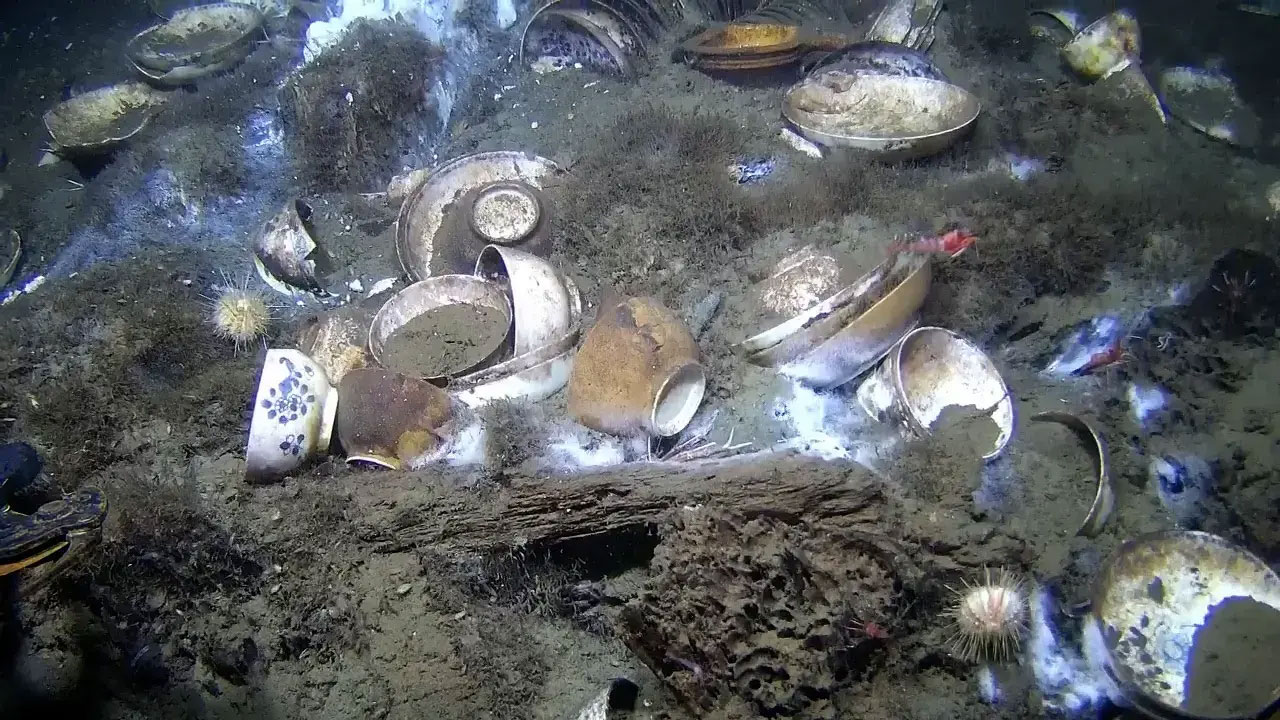
A useful study of the 18th-century shipwreck discovery in Norway does not begin with the porcelain. It begins with the constraint: the wreck lies about 600 meters down in the Skagerrak, in open-ocean conditions, and the Norwegian Maritime Museum describes it as the first archaeological project at this depth in Northern Europe.[1] That single fact changes almost every research decision. Divers cannot simply descend, lift objects by hand, sketch the site, and return the next morning with a slightly better trowel. At this depth, access is mediated by machines, time windows, weather, funding, image quality, and the risk of damaging the evidence before it has been understood.
The discovery itself also makes a good methods lesson because it did not start inside a university office. Espen Saastad, a watchmaker and operator of an ROV survey company, noticed something unusual during work in the Skagerrak and alerted the museum in September 2025.[2] That matters less as a heroic origin story than as a reminder that archaeological knowledge can begin when a trained observer, working outside formal archaeology, recognizes that an anomaly deserves expert attention.
The cargo gives the site its public drama: Chinese porcelain, chandeliers, crates still resting on the seabed, and the possibility of thousands of artifacts. But only about 40 artifacts have reportedly been recovered so far, while unopened crates remain below.[3] That is not a minor detail. It tells students exactly where the evidence currently stands. The wreck is rich, but the recovered sample is still small. Any responsible interpretation has to keep those two facts in tension.
Why one discipline cannot solve this wreck
The central research problem is deceptively simple: what ship was this, where was it traveling, what exactly was it carrying, and how did it end up on the seabed? No single method can answer that chain of questions. Robotics can reach the site, but it cannot identify a vessel in an archive. Ceramic typology can narrow date and cultural context, but it cannot name the crew. A brick stamp can point toward one material origin, but not necessarily the ship’s full route. Grain DNA analysis may eventually help with geographic origin, but it has not yet produced a published answer. Conservation can preserve recovered objects, but only after the choice to recover them has already altered their condition.
This is what makes the Porcelain Wreck more than a spectacular discovery. It is a clean case of method being forced by conditions. The site is too deep for ordinary underwater excavation, too fragile for careless recovery, too incompletely sampled for confident storytelling, and too historically unresolved for one artifact type to settle the matter.
| Method | What it can contribute | What it cannot yet settle |
|---|---|---|
| ROV fieldwork | Access to a 600-meter-deep open-ocean site and controlled recovery of selected objects | The ship’s identity, route, or crew fate |
| Photogrammetry | A 3D record of the wreck and artifact distribution based on ROV footage | The full contents of unopened crates |
| Ceramic typology | Dating and cultural context for porcelain such as Batavia ware and Blanc de Chine | The exact merchant network or named vessel |
| Material clues | A brick stamp linking the galley bricks to Lübeck production | Whether the whole ship was built, owned, or loaded there |
| DNA analysis of grain | Possible evidence for geographic origin of cargo or provisions | Any conclusion before results are published |
| Archival research | Possible matches in Sound Toll Records and other maritime documents | Certainty unless a convincing documentary match is found |
| Conservation science | Stabilization of recovered porcelain after centuries underwater | Information that was never documented before recovery |
Fieldwork starts with access, not interpretation
At 600 meters, the first archaeological instrument is not a brush. It is a remotely operated vehicle. The Porcelain Wreck work has involved an ROV connected by a cable about 1 kilometer long, because the vehicle has to transmit video, receive commands, and operate in a place no excavation team can physically occupy.[1] That cable is not a glamorous object, but it is part of the method. It determines how people see the site, how long they can work, how movement is controlled, and what counts as a safe recovery attempt.
The recovery problem is especially delicate because porcelain is both durable and vulnerable. It survived the wreck and centuries underwater, yet a manipulator arm built for industrial work could still crush, scrape, or dislodge it. The team therefore used a custom suction-cup arm built in France to lift porcelain more gently than a standard gripping tool would allow.[1] For a methods course, that detail is worth more than a dozen vague claims about “advanced technology.” It shows a specific tool answering a specific risk.
Limited recovery is not the same as lack of ambition. When only a small number of objects have been raised from a site that may contain thousands, the restraint itself becomes part of the research design.[3] Archaeologists need enough material to identify, date, conserve, and compare. They also need to avoid turning a still-unmapped site into a disturbed pile of impressive fragments. The unopened crates are not merely treasure waiting for a headline; they are sealed contexts whose value depends on future documentation.
Mapping before moving
Photogrammetry matters here because the wreck cannot be treated as a collection of isolated objects. ROV footage can be used to build a 3D model of the site, linking porcelain, timbers, crates, bricks, and other visible remains into a spatial record.[1] That record helps researchers ask better questions: whether objects are still close to where they were stowed, whether parts of the ship structure are exposed or buried, and which areas should not be disturbed until they are better documented.
A 3D model is not a neutral substitute for excavation. It depends on visibility, camera angles, lighting, ROV stability, and what remains exposed on the seabed. Still, it gives the team a way to return to the site analytically between field seasons. Students should notice the order of operations: image, map, select, recover, conserve, interpret. If those steps are reversed, the prettiest artifact can become the least useful evidence.
Conservation begins the moment an object leaves the seabed
Recovery is often described as the exciting part, but for fragile underwater material it also creates a new problem. Porcelain that has rested for centuries in a marine environment does not simply become museum-ready once lifted. It needs desalination, stabilization, and careful handling so that salts and environmental change do not damage it after recovery.[1] Conservation staff inherit the consequences of every field decision: which object was lifted, how it was supported, how quickly it was transferred, and how thoroughly its context was recorded before removal.
That is why conservation belongs inside the research design rather than at the end as a technical service. A poorly conserved artifact may lose surface detail, residue, or structural integrity. A well-conserved artifact can remain available for ceramic study, display, comparison, and future analytical techniques. In a deep-water project with limited recovery, every object that reaches the lab carries a larger burden of interpretation.
Ceramics narrow the date, but they do not name the ship
The porcelain is not just visually striking; it is one of the strongest chronological tools available so far. Art historians have identified types including Batavia ware and Blanc de Chine, and experts from the Jingdezhen Imperial Kiln Museum have dated the porcelain to the Qianlong period, around 1745 to 1760.[1] That narrows the wreck’s likely historical frame and places the cargo within Chinese porcelain production and long-distance trade.
This is also where students need to be precise. Ceramic dating can say that the cargo fits a particular production period. It does not automatically say when the ship sank, where it was loaded, who owned it, or which port it was trying to reach. Cargo can be stored, resold, transshipped, delayed, or mixed with goods from different origins. Typology gives a necessary constraint, not a complete biography.
Even so, the ceramic evidence is powerful because it reduces the field of possible explanations. A wreck carrying porcelain dated to the mid-18th century does not belong in a vague “Age of Sail” category. It belongs in a narrower world of Qing-era production, European demand, maritime toll systems, and merchant routes that can be checked against other evidence.
The Lübeck brick is a clue, not a conclusion
One of the most instructive clues is not porcelain at all. A brick stamp has been traced to Lübecker Ratsziegelei in Lübeck, Germany, a brickworks that operated from the 15th century until 1772.[4] The stamp appears to connect the ship’s galley bricks to a specific production source, giving researchers a concrete European provenance clue alongside the Chinese ceramic evidence.
It would be tempting to overread that stamp. A Lübeck brick does not prove that the ship was built in Lübeck, owned in Lübeck, crewed by Lübeck sailors, or sailing from Lübeck on its final voyage. Bricks can move through repair, supply, reuse, and trade. What the stamp does provide is a testable lead: a material link to a known production center and time range, useful when compared with ship construction, archival records, and cargo evidence.
This is the kind of clue that makes interdisciplinary work necessary rather than ornamental. The ceramic specialist, maritime archaeologist, historian, and materials researcher do not decorate one another’s conclusions. They keep each other from making the clue carry more weight than it can bear.
Laboratory science may add geography, but the results are still pending
Grain samples from the wreck have been sent for DNA analysis, with the hope that biological evidence may help clarify geographic origin.[1] The important word is “may.” Until results are published, DNA analysis is not evidence for a particular route or port. It is a pending method with the potential to add another layer to the reconstruction.
If the analysis succeeds, it might help distinguish between possible supply regions or cargo histories. If preservation is poor, contamination is high, or the results are too broad, it may answer less than hoped. That uncertainty should not be treated as failure. In research-methods terms, a pending or inconclusive laboratory result still teaches something about the limits of evidence under real field conditions.
Archival research has the largest search space
The ship’s name, origin, destination, and crew fate remain unknown. Maritime historians are searching digitized Sound Toll Records, a vast source covering about 1.8 million passages through the Danish straits from 1497 to 1857.[1] That archive is exactly the sort of source students imagine will solve the mystery quickly, until they confront the scale of the search and the ambiguity of historical naming, cargo descriptions, routes, and dates.
A promising archival match would need to fit several constraints at once: the mid-18th-century ceramic date, the presence of luxury goods, the Skagerrak location, any clues from ship structure and fittings, the Lübeck brick evidence, and whatever future laboratory results show. One matching word in a toll record would not be enough. Archival work becomes persuasive when independent clues begin to converge.
This is why the Porcelain Wreck should still be described as an ongoing investigation. The absence of a ship name is not an embarrassing gap to be smoothed over. It is the central historical question still being tested.
Funding and weather are part of the method
Research design is often taught as if the only constraints are intellectual. The Porcelain Wreck makes the material constraints visible. The Directorate for Cultural Heritage provided NOK 2.9 million, about $293,000, to support recovery and study, but the funding has been explicitly described as insufficient for a full excavation.[5] Further work depends on additional government funding and favorable weather.[5]
That does not merely affect the administrative schedule. It affects what can be known. Fewer field days mean fewer ROV passes, fewer opportunities to improve the photogrammetric model, fewer controlled recoveries, and more time before unopened crates or buried structural elements can be studied. Weather is not background atmosphere in an open-ocean project; it is a condition that decides when evidence can be reached at all.
How to use the Porcelain Wreck in a research-methods answer
For an exam or seminar discussion, the Porcelain Wreck works best if it is not presented as a solved mystery. Present it as a case where each method answers a different level of question.
- Start with the field constraint: 600 meters deep, open ocean, no ordinary diver-led excavation.
- Explain the access method: ROV work, cable control, video documentation, and a suction-cup arm for fragile recovery.
- Separate documentation from collection: photogrammetry records the site before objects are moved.
- Use ceramic typology as a dating and trade-context tool, not as proof of ship identity.
- Treat the Lübeck brick stamp as a provenance lead that requires comparison with other evidence.
- Mark DNA grain analysis and Sound Toll Records research as ongoing, not as completed answers.
- Include conservation because recovery creates preservation problems that shape what can be studied later.
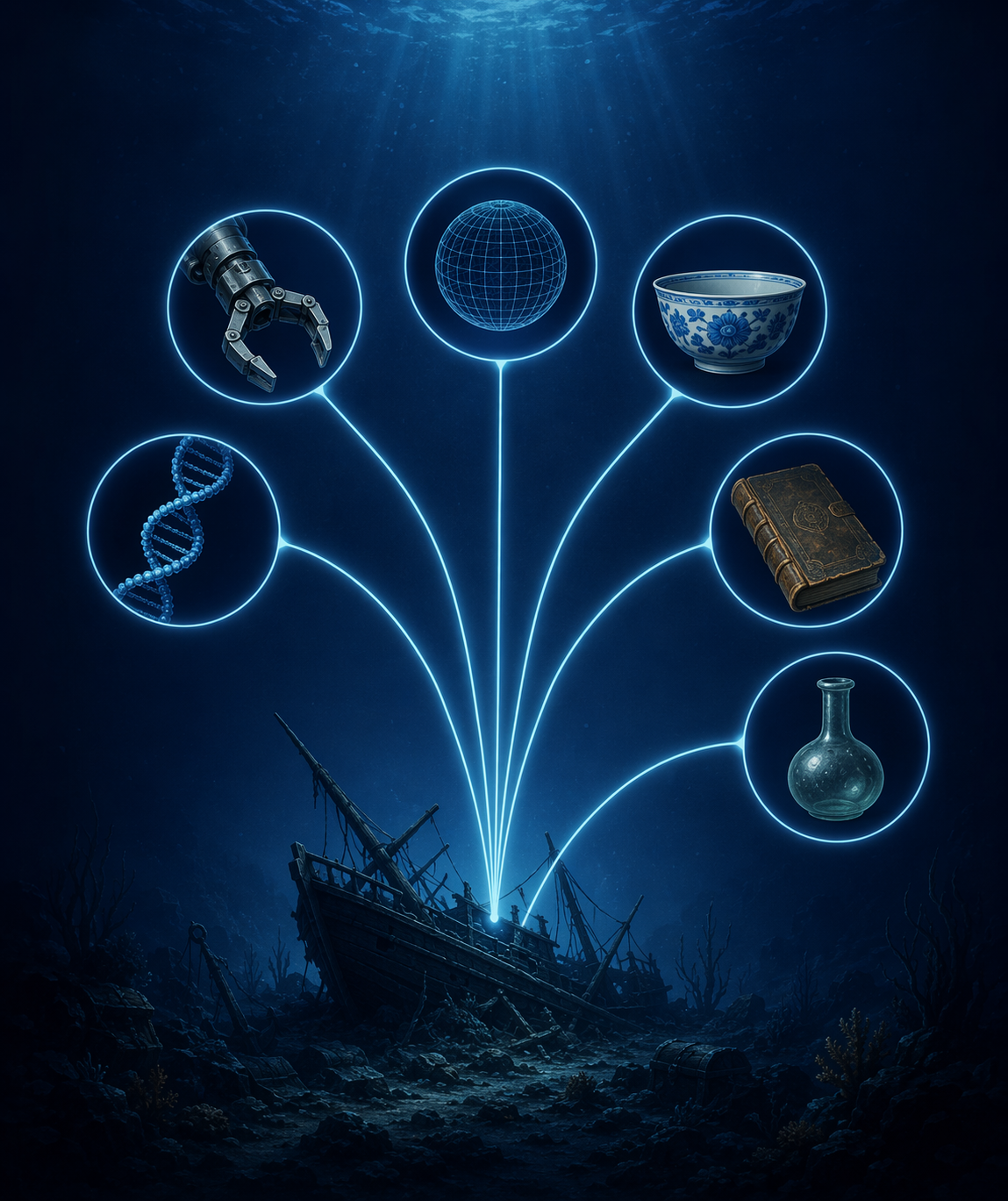
The strongest student answer would not say, “archaeology uses many disciplines,” and stop there. It would show why each discipline becomes necessary at a particular point in the chain. Robotics solves access. Photogrammetry solves spatial documentation. Ceramic expertise narrows date and production context. Material clues such as brick stamps create testable leads. DNA analysis may add biological geography. Archival research searches for documentary matches. Conservation keeps recovered evidence usable.
The Porcelain Wreck is valuable as a study case because it is not yet fully solved. Its unfinished state makes the method visible. Modern archaeology advances here through partial answers that have to be checked against one another, not through one spectacular object that explains everything. Students who want another case-based way to think about evidence can compare this with an engineering failure analysis such as the Tacoma Narrows Bridge collapse, or with a research evaluation problem such as wind turbine bird mortality studies.
References
- The Porcelain Wreck — Norwegian Maritime Museum
- Sensational shipwreck discovery off Norway: Intact Chinese porcelain and chandeliers at a depth of 600 metres — ScienceNorway
- A Shipwreck ‘Almost Beyond Belief’ Stunned Archaeologists in Norway With Its Cargo of Intact Porcelain Dishes and Luxury Goods — Smithsonian Magazine
- The Porcelain Wreck: Spectacular shipwreck discovery in the Skagerrak — Norwegian Directorate for Cultural Heritage
- Norway recovers porcelain, chandeliers from 18th century shipwreck — Reuters, June 1, 2026
Comments
Join the discussion with an anonymous comment.