
What Archaeological Evidence Reveals About the Trojan War
A clear, evidence-based overview for students researching the Trojan War: which archaeological finds at Troy support a historical conflict, what Hittite records confirm, and where scholarly disagreement remains.
Updated:
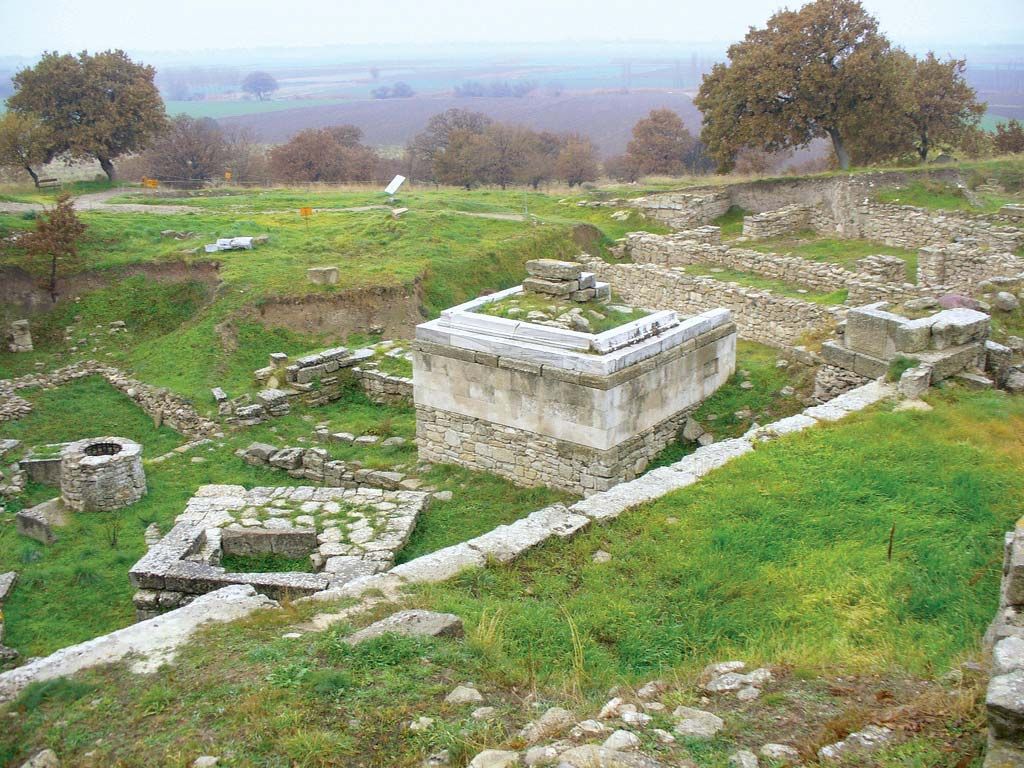
Archaeology gives students a better answer than either “the Iliad is history” or “the Trojan War is fiction.” At Hisarlik in northwest Turkey, excavators have found a real Late Bronze Age city with destruction evidence in roughly the right broad period for later Greek memories of Troy. The strongest material case centers on Troy VIIa, destroyed by fire around 1180 BC, with burnt deposits, sling bullets, arrowheads, and hastily buried skeletons consistent with a violent sack.[1] That is substantial evidence for conflict. It is not evidence that Achilles killed Hector, that Helen caused a ten-year siege, or that a wooden horse ended the war.
For an essay, the distinction matters. Archaeological evidence is strongest when it is used to identify a credible historical setting: a fortified city, Aegean contact, episodes of violence, and a political world in which western Anatolia and Mycenaean-linked powers could clash. It becomes weak when it is made to carry Homer’s whole plot.
Start With the Mound, Not the Myth
Hisarlik is not a single city frozen at the moment Homer imagines. It is a layered archaeological mound, or tell, containing nine superimposed settlements spanning from about 3000 BC to AD 1350.[1] That one fact prevents a great many bad paragraphs. A sword, wall, burned floor, or skeleton is never simply “from Troy” in the useful sense. It belongs to a layer, and that layer has a date.
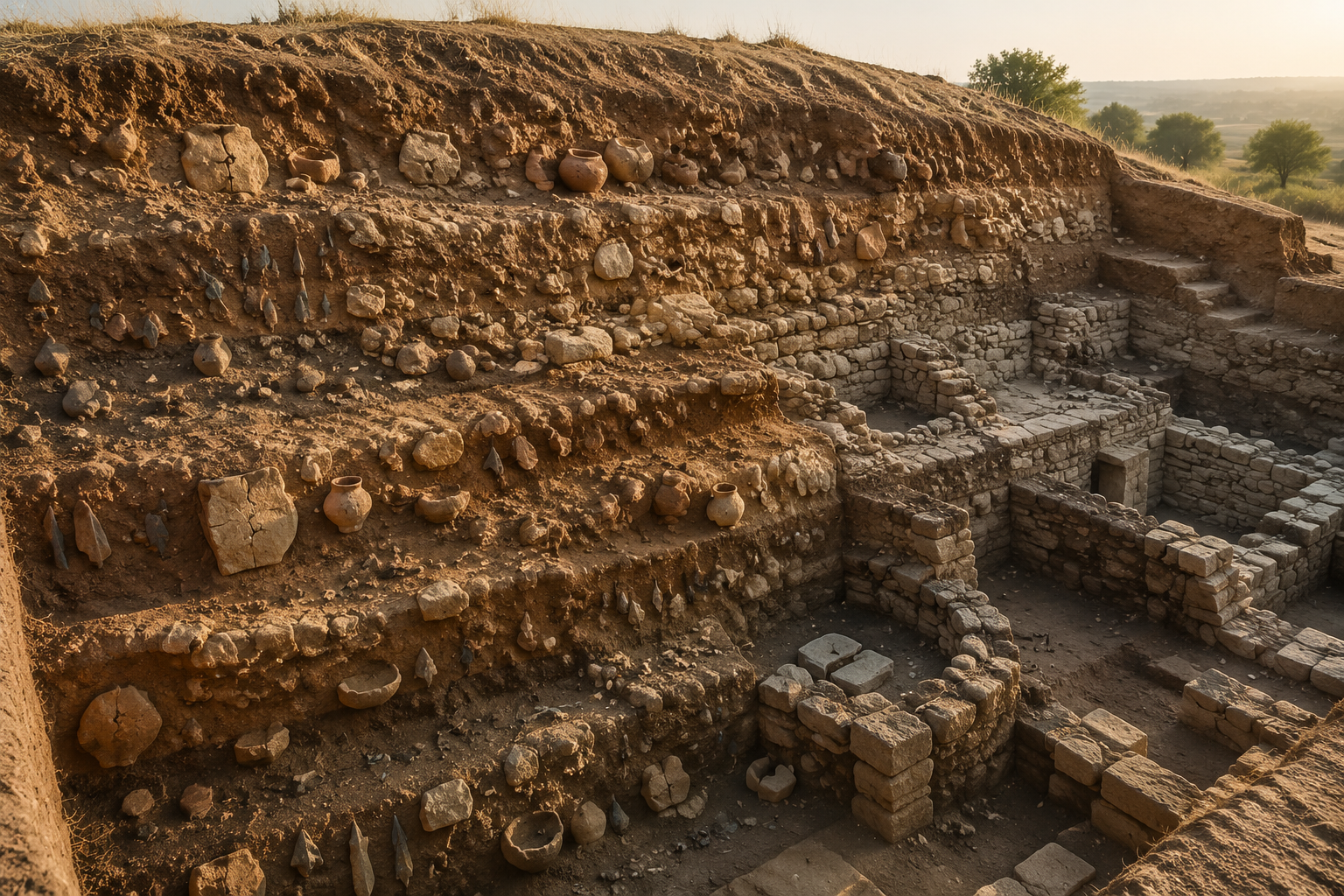
Heinrich Schliemann’s 1870s excavations made Hisarlik famous because he correctly pushed the search for Troy to this mound. His interpretation of the evidence, however, was badly off in one crucial way: he identified Troy II, dated roughly 2550–2300 BC, as Homer’s Troy. That layer is far too early for the Late Bronze Age world behind the Trojan War tradition. The serious discussion shifted instead to Troy VI and Troy VIIa.
Troy VI is important because it was a wealthy, strongly built Late Bronze Age settlement. Troy VIIa is important because its destruction horizon, around 1180 BC, has the kind of evidence students usually want when asking whether there was a real war: fire damage, weapons, projectiles, and human remains buried in haste.[1] Those finds do not narrate a battle scene. They do not name attackers. They do not tell us whether the conflict lasted a day, a season, or years. They do, however, make it difficult to dismiss Troy as a purely literary invention.
| Evidence | What It Can Support | What It Cannot Prove |
|---|---|---|
| Burned deposits in Troy VIIa | A destructive fire around c. 1180 BC | That Homer’s sequence of events happened |
| Sling bullets and arrowheads | Violence or military pressure at the site | The identity of the attackers |
| Hastily buried skeletons | A disruptive, possibly violent destruction context | The names or motives of those involved |
| Multiple settlement layers at Hisarlik | A long-lived city repeatedly rebuilt on the same mound | That every find belongs to the same “Trojan War” moment |
A careful student can therefore write that Troy VIIa shows evidence consistent with a violent sack around the period later associated with the Trojan War. A careful student should not write that archaeology has confirmed the Iliad. The poem is a work of epic tradition, shaped long after the Late Bronze Age events it may remember. Its power is not the same thing as its evidentiary precision.
The Hittite Records Move the Question Beyond Greek Storytelling
The archaeological mound matters more when it is read alongside the Hittite documentary trail. Cuneiform tablets from Hattusa refer to a place called Wilusa, widely connected with Ilios/Troy, as a Hittite vassal state; they also preserve the name Alaksandu, which resembles Alexandros, the alternative name of Paris in Greek tradition.[2] That resemblance is not a license to insert Paris into a Hittite archive. It is a clue that the world of Troy was not invented from nothing.

The same documentary world includes Ahhiyawa, often linked with Achaean or Mycenaean Greek powers, and records political-military tension involving Wilusa in the 13th century BC.[2][3] This matters because it gives independent Near Eastern evidence for a real place in western Anatolia caught in the diplomacy and conflict of the Late Bronze Age. Homer is no longer the only witness in the room.
Still, the Hittite texts are not a second version of the Iliad. They do not describe a ten-year siege. They do not mention Achilles, Hector, Helen, Agamemnon, or the wooden horse. Their value is narrower and, for historical work, more useful: they show that a city plausibly identifiable with Troy existed in a political landscape where Hittite authority, local rulers, and Aegean-linked powers could come into conflict.
Troy Was Not Too Small to Matter
One older objection to a historical Trojan War was that Troy seemed too small and insignificant to attract a major conflict. Manfred Korfmann’s excavations changed that part of the discussion. His work from 1988 to 2012 argued that Troy covered about 75 acres, roughly 15 times larger than previously thought.[4] That does not prove Homer’s war, but it removes a lazy objection: the site was not merely a tiny citadel unworthy of regional attention.
Size matters because it changes the kind of historical claim that is reasonable. A larger Troy could have controlled routes, resources, or local networks worth contesting. It fits better with the Hittite evidence for Wilusa as a politically meaningful place. But the correction should not be stretched into triumph. “Large enough to matter” is not the same as “besieged by a united Greek army under Agamemnon.”
The 2025 Sling-Stone Find Is Important, but Layer Comes First
The 2025 sling-stone discovery is exactly the sort of find that tempts overstatement. Turkish archaeologists led by Rüstem Aslan reported roughly 3,500-year-old sling stones and projectiles outside the palace walls at Troy VI, described as the strongest direct evidence in decades for a large-scale military assault on the citadel.[5][6] Aslan’s comment is usefully cautious: “The density of the sling stones is an indicator of either a great conflict, a desperate defense, or a full-scale attack.”[5]
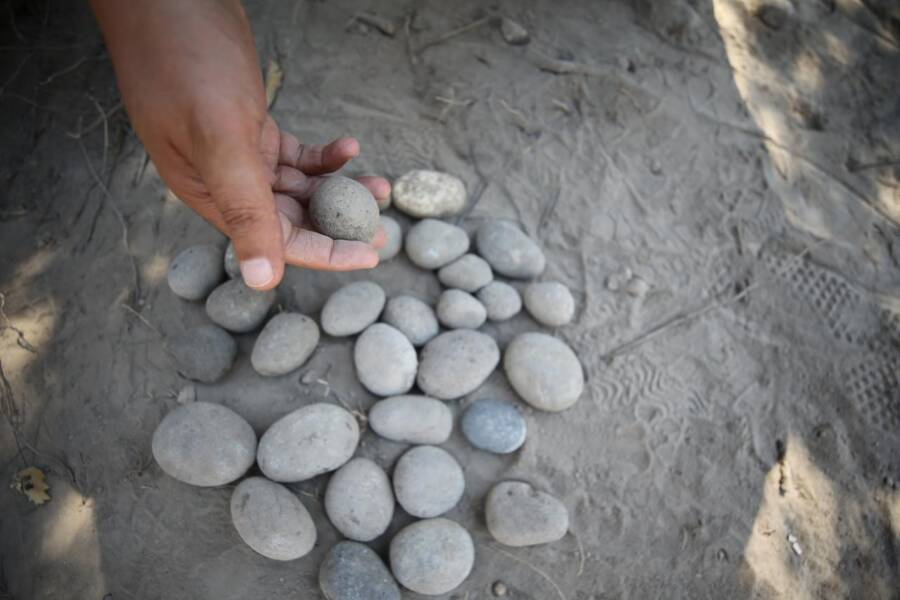
That is a strong piece of evidence for military pressure at Troy VI. It is not, by itself, proof of the later Troy VIIa destruction around 1180 BC. Troy VI is generally associated with an earlier destruction, around 1300–1250 BC, while the violent sack evidence most often connected with the Trojan War discussion belongs to Troy VIIa.[5][1] The difference is not a technical nuisance. It is the difference between using evidence and rearranging it to fit a story.
A good way to handle the 2025 find in an essay is to say that it strengthens the broader case for Late Bronze Age conflict at Troy, especially around Troy VI, while leaving the relationship between Troy VI and the later Troy VIIa destruction open. It shows that the site experienced military stress; it does not identify Homer’s Greeks or date the Iliad’s war.
Aegean Contact Is Real; a United Greek Expedition Is Harder
Finds of Mycenaean-style pottery and weapons in Troy VI–VIIa destruction contexts indicate Aegean contact or presence at Troy during the relevant period.[7][8] That is useful evidence if the question is whether Troy was connected to the Mycenaean world. It is weaker evidence if the claim is that a coordinated expedition of Greek kings attacked the city exactly as later epic remembered.
The chronology creates a real difficulty. The Mycenaean palace states had largely collapsed by around 1200 BC, which makes a neat, united Greek campaign in 1180 BC historically awkward. This does not make conflict impossible. It does make the Iliad’s political structure difficult to transfer directly into the Late Bronze Age. A student who notices that problem will usually write a better paragraph than one who simply lists Mycenaean objects and announces that “the Greeks were there.”
The safest phrasing is modest: Aegean material at Troy and Hittite references to Ahhiyawa support contact and possible conflict between Troy/Wilusa and Mycenaean-linked powers. They do not confirm the scale, command structure, motives, or duration described in Homer.
What Students Can Responsibly Claim
There is no single scholarly consensus that turns the Trojan War into either proven history or pure invention. Some scholars, including Korfmann, argued that historicity is more likely than not; others stress the gaps between archaeology, Hittite diplomacy, and Greek epic tradition.[4][9] That disagreement is not a failure of the evidence. It is what happens when different kinds of evidence answer different questions.
- Strong claim: Hisarlik was a real, long-lived settlement identified with ancient Troy, with important Late Bronze Age layers.
- Strong claim: Troy VIIa was destroyed by fire around 1180 BC, with evidence consistent with violent conflict.
- Strong claim: Hittite records place Wilusa/Troy in a real political world involving Anatolia and Ahhiyawa/Achaean-linked powers.
- Cautious claim: Later Greek epic may preserve memories of one or more Late Bronze Age conflicts around Troy.
- Weak claim: Archaeology proves Homer’s heroes, the ten-year siege, the judgment of Paris, Helen’s role, or the wooden horse.
The wooden horse belongs in a different kind of discussion. Students interested in that specific tradition can compare the evidence and theories in 5 Theories in the Trojan Horse Historical Debate, but it should not be smuggled into an archaeological argument as if it were a recovered object.
A defensible final judgment would read like this: archaeology and Hittite texts support a real Late Bronze Age Troy involved in conflict, possibly remembered in later Greek epic. The destruction of Troy VIIa around 1180 BC gives the historical core its strongest material anchor. Homer’s specific characters, speeches, divine interventions, decade-long siege, and narrative sequence remain poetic tradition rather than archaeologically proven history.
References
- Did the Trojan War actually happen?, BBC
- The search for the lost city of Troy, British Museum
- Trojan War: the archaeology of a story, The Past
- Was There a Trojan War?, Archaeology Magazine
- New evidence of violent conflict at ancient Troy uncovered, Jerusalem Post, July 2025
- New Evidence Alludes to Military Conflict at Ancient Troy, Archaeology Magazine, July 2025
- Trojan War, Encyclopaedia Britannica
- Trojan War, Wikipedia
- The Trojan War 1: Consensus, Kiwi Hellenist
Comments
Join the discussion with an anonymous comment.