

A Reproducible Framework for Political Commentary Analysis
This article introduces a five-dimension framework that teaches students how to systematically analyze political commentary as a credible academic source. Using Bill Maher's 30-year career as a case study, it covers bias identification, rhetorical strategies, evidence verification, and audience effects, making passive viewing an active analytical skill.
Updated:
A political commentary clip becomes useful for study only after you stop treating it as a thing to agree with and start treating it as a constructed object. In a Bill Maher political commentary analysis study, the first question is not whether Maher is correct, brave, offensive, liberal, conservative, or funny. The first question is simpler and harder: what exactly is the segment doing, and how can you show that from evidence inside and around the text?
That shift matters because commentary is not the same as a policy paper, a news report, or a campaign ad. It can make claims, perform disgust, invite laughter, cite data, mock opponents, flatten complexity, or open a real question. A student who writes “Maher is biased” has barely begun. A student who can show how a segment positions its bias, selects evidence, stages emotional permission, and changes meaning across platforms has an argument.
Why Maher Works as a Classroom Stress Test
Bill Maher is useful here not because he is uniquely important, but because his work gives students enough continuity and variation to test a method. He hosted Politically Incorrect from 1993 to 2002 and has hosted Real Time with Bill Maher from 2003 to the present, giving students a long record across changing media conditions, party coalitions, and audience expectations.[1]
That is enough biography for the task. A longer life story can become a way to avoid analyzing the clip in front of you. For academic writing, Maher’s career matters mainly because it lets you compare a monologue, a panel exchange, a CNN rebroadcast context, or a podcast conversation without pretending all political commentary works the same way.
The Five Dimensions
Use the framework as a viewing protocol before you use it as an essay structure. You do not need five equal body paragraphs. You need five checks that keep your analysis from collapsing into reaction.
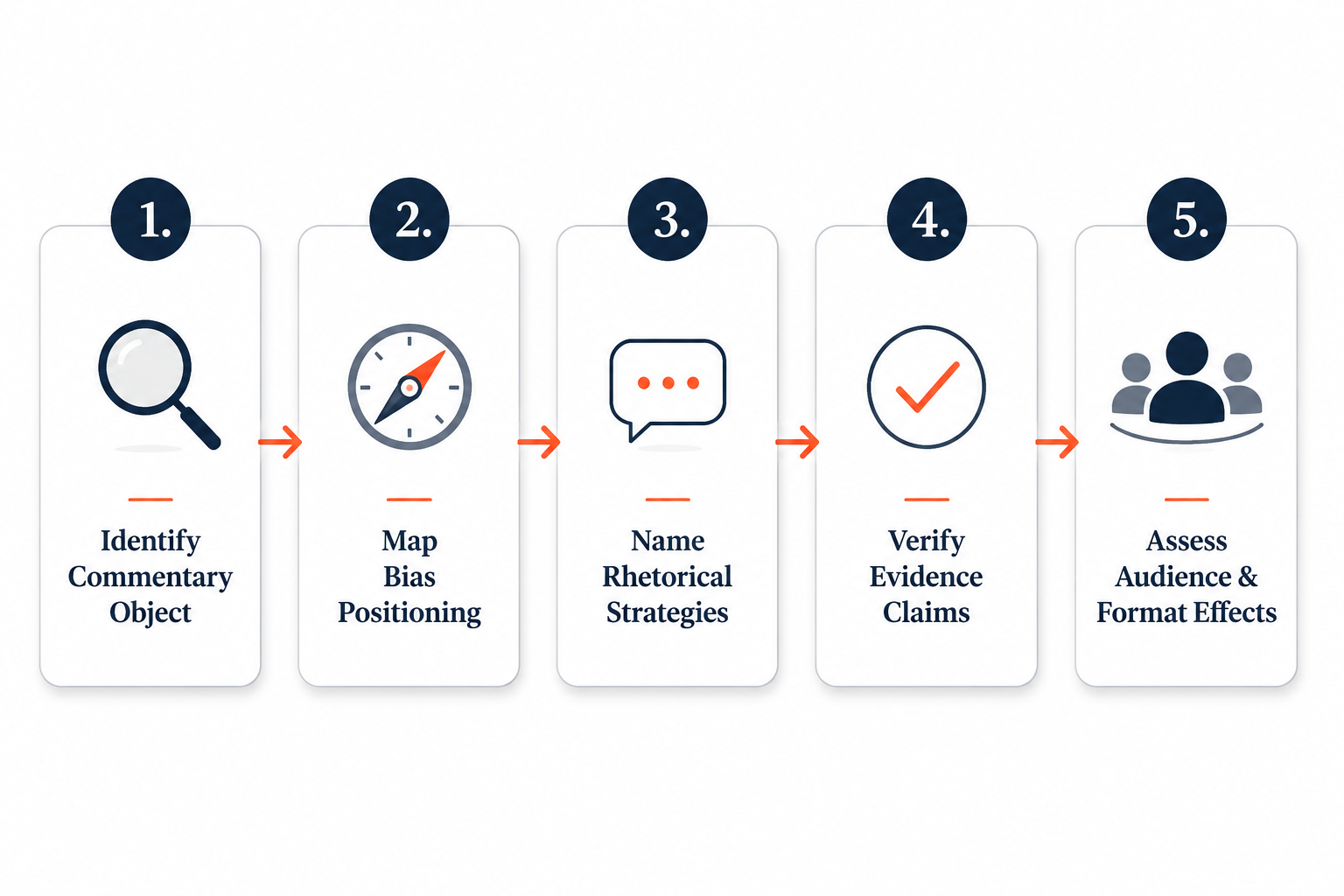
| Dimension | What to Record | What It Prevents |
|---|---|---|
| 1. Commentary object | Date, platform, segment type, topic, speaker role, and immediate target | Vague claims about “what Maher says” without a specific text |
| 2. Bias positioning | Declared values, recurring targets, strategic criticism, and outside bias ratings | Reducing bias to a one-word partisan label |
| 3. Rhetorical strategy | Jokes, shock, contrast, analogy, interruption, ridicule, framing, and tone shifts | Treating style as decoration instead of argument |
| 4. Evidence verification | Quoted claims, data sources, missing context, rebuttals, and uncertainty | Confusing a cited number with a settled conclusion |
| 5. Audience and format effects | Platform, audience expectations, editing, panel dynamics, rebroadcasts, and podcast intimacy | Assuming the same claim performs identically everywhere |
Start by Fixing the Object
Before judging a segment, identify the object. A monologue is not a panel exchange. A clipped social video is not the same object as the full HBO segment. A podcast conversation has different permissions than a studio performance. If your paper does not specify which version you studied, you have left too much room for convenient interpretation.
A usable note might read: “Real Time monologue, broadcast version, focused on education spending and school performance; Maher speaks as host-commentator, uses Mississippi as a contrast case, and frames California as the implied failure.” That sentence is not yet analysis. It is the guardrail that makes analysis possible.
Bias Positioning Is More Than a Label
Students often want bias to behave like a sorting hat: left, right, center, done. Maher is a useful case because the label does not end the work. AllSides rated Bill Maher as Lean Left as of May 2025, after previously rating him Center, and its reviewers noted that he often criticizes Democrats “because he wants them to win.”[2] That detail is not trivia. It changes the analytical question.
If a commentator attacks Democrats from a stated desire for Democratic electoral success, the criticism functions differently from an attack meant to discredit the party from the outside. The target may be the same. The political relationship is not. A paper that says “Maher criticizes Democrats, so he is not left-leaning” misses the possibility of strategic in-group criticism. A paper that says “Maher is Lean Left, so his criticism of Democrats is fake” makes the opposite mistake. Both replace analysis with category comfort.
For bias positioning, record three things separately: the values the commentator claims, the groups or ideas repeatedly targeted, and the political outcome the criticism appears to prefer. In Maher’s case, those lines may cross. A segment can mock progressive language norms, criticize Republican anti-intellectualism, defend liberal electoral strategy, and still operate from a recognizable ideological position. The point is not to rescue him from contradiction. The point is to describe the contradiction accurately enough that your judgment has something to stand on.
- Weak claim: “Maher is biased against both sides.”
- Better claim: “In this segment, Maher positions himself as a liberal critic of Democratic messaging, using internal criticism to argue that the party is damaging its own electoral prospects.”
- Stronger claim: “The segment’s bias is not evenly anti-partisan; it is organized around a preferred liberal outcome and treats some Democratic cultural positions as obstacles to that outcome.”
Notice the movement. The stronger version does not pretend to be neutral by refusing judgment. It earns judgment by naming the position, the target, and the implied political desire.
Name the Rhetorical Strategy Before You Praise or Condemn It
Political comedy often asks the audience to treat speed as intelligence. Sometimes speed really does reveal a pattern. Sometimes it hides a missing step. Your job is not to slow the joke until it dies; it is to identify what the joke lets the argument do.
Nicole Hemmer’s CNN essay on Maher offers a clean naming tool: Maher’s core technique is “to designate shock as a marker of truth.”[3] That phrase is useful because it describes a relationship between tone and authority. The shocking statement is not merely decorative. It tells the audience, “This sounds unsayable, therefore it must be honest.” A student can test that move in a segment without having to decide immediately whether the shock is brave or cheap.
Salon’s 2017 defense-and-critique of Maher identifies related strategies, including “biting wit” and cross-cultural juxtaposition.[4] Those are not verdicts either. They are tools. Biting wit compresses evaluation into ridicule. Juxtaposition places two examples side by side so the contrast appears to argue on its own. In a strong paper, the student shows where the compression happens and what gets lost or clarified by it.
A practical annotation might mark a segment this way: first, Maher states a broad frustration; second, he introduces a surprising comparison; third, he delivers a joke that licenses audience contempt; fourth, he attaches the joke to a policy claim or cultural diagnosis. That sequence may be effective. It may also shortcut causality. The analytic task is to locate the shortcut, not simply announce that the audience laughed.
Evidence Verification: Follow the Claim, Not the Vibe
Evidence verification is where many commentary essays become either fan notes or denunciations. A cited statistic feels solid, so the student stops. Or a commentator is polarizing, so the student assumes the statistic must be manipulative. Neither habit is analysis.
Take the Mississippi schools example. In June 2026, the Clarion Ledger reported that Maher cited Mississippi’s gains while criticizing California, including the claim that Mississippi moved from 49th to 9th in fourth-grade reading on NAEP and spent $13,049 per student compared with a $17,840 national average.[5] Those numbers are analyzable because they can be traced. The first move is not “Maher proved his point.” The first move is to ask what each number measures.
- Quote the claim exactly enough that another reader can find it.
- Identify the original data source behind the reported number.
- Separate rank movement from absolute performance.
- Check whether spending figures are adjusted, averaged, or limited to a particular year.
- Look for plausible alternative explanations before accepting the segment’s causal story.
Rank is especially tempting in commentary because it sounds dramatic. Moving from 49th to 9th is a large positional change, but a rank does not by itself explain what caused the change, whether all student groups benefited equally, or whether the comparison to California controls for relevant differences. Spending per student has the opposite temptation: it invites the audience to treat lower spending and higher rank as proof that money does not matter. That causal conclusion requires more work than the contrast itself provides.
The same verification habit applies when the topic shifts to higher education. Bryan Alexander’s “Bill Maher vs. higher ed” models an academic-style rebuttal by engaging commentary claims with data, including NAEP, NEA spending reports, and the Federal Reserve’s 2024 figure of $1.77 trillion in student debt.[6] The value for students is not that Alexander automatically wins the argument. The value is procedural: he treats the commentary as a set of claims that can be broken apart, sourced, contextualized, and challenged.
A balanced response can still be critical. Jeremiah O’Brian’s LinkedIn essay, “What Bill Maher Gets Right (and Wrong) About College and Creativity,” is useful as a point-by-point engagement model rather than as a final authority.[7] That distinction matters. A student can cite a public rebuttal to understand the debate, but should still verify the data behind both the commentator and the critic when writing an academic paper.
The basic evidence paragraph in a student essay should therefore have four layers: what the commentator claimed, what the cited or traceable source actually measures, what context is missing, and how that affects the strength of the argument. That structure keeps the paper from treating fact-checking as a decorative interruption.
Audience and Format Change the Argument’s Permissions
Once you have bias, rhetoric, and evidence under control, format becomes easier to analyze. HBO’s Real Time is built around performance, timing, guests, and a politically attentive audience. CNN’s retrospective notes that Real Time has been rebroadcast on CNN since 2023, extending the show beyond its original HBO setting.[3] That matters because a rebroadcast can place the same performance inside a different institutional frame. The joke is the same; the implied newsworthiness may not be.
Club Random, launched in 2022, gives students another comparison point: a looser podcast format with different pacing, guest dynamics, and expectations of intimacy.[3] A monologue rewards compression. A panel rewards interruption and alliance-building. A podcast rewards conversational drift and the appearance of candor. If a student quotes all three as if they were identical evidence, the paper loses precision.
Audience effects do not mean “the audience is manipulated,” which is usually too broad to prove from a single clip. A more defensible claim names the invitation. Does the segment invite viewers to feel smarter than an out-group? Does it invite relief that someone finally “said it”? Does it ask liberal viewers to accept internal criticism as tough love? Does it ask politically mixed viewers to enjoy contempt without declaring a party home? Those are analyzable effects because they are tied to observable choices in the segment.
Turning Notes Into an Academic Claim
The framework is not finished until it produces a claim that separates observation from evaluation. Observation identifies what is present. Interpretation explains how it works. Evaluation judges the consequence. Many weak papers jump straight to evaluation because that is where the writer’s opinion lives.
| Level | Example |
|---|---|
| Observation | Maher contrasts Mississippi’s reading gains with California’s education spending. |
| Interpretation | The contrast uses ranking and spending figures to frame educational success as evidence against a spending-centered explanation. |
| Evaluation | The argument is rhetorically efficient but requires additional context before it can support a causal claim about spending and school outcomes. |
A thesis built from that ladder might read: “In the segment, Maher positions himself as a liberal critic of Democratic governance, using shock and statistical contrast to turn Mississippi’s education gains into a broader argument about institutional failure; however, the segment’s reliance on rank movement and spending comparison leaves its causal claim underdeveloped.”
That sentence does not hide from judgment. It also does not pretend the judgment came first. Another student could test it against the clip, the cited numbers, and the rhetorical sequence.
Using the Same Method on Other Commentators
The method should travel. For Tucker Carlson, bias positioning might require attention to populist anti-elite framing and guest selection. For Rachel Maddow, it might require attention to narrative sequencing, document presentation, and institutional trust. For Jon Stewart, it might require attention to irony, clips as evidence, and the moral rhythm of comic exposure. The categories stay stable; the findings change.
Do not force every commentator into Maher’s pattern. The point of a reproducible framework is not to get the same answer. It is to make the route to your answer visible. A reader should be able to see what you watched, how you classified the speaker’s position, which rhetorical moves you named, which claims you checked, and how platform conditions shaped the performance.
A Portable Workflow
- Identify the commentary object: exact clip, date, platform, segment type, and topic.
- Map bias positioning: stated values, recurring targets, outside ratings, and strategic criticism.
- Name rhetorical strategies: shock, wit, juxtaposition, analogy, ridicule, interruption, or framing.
- Verify evidence: trace claims to sources, distinguish rank from performance, and separate correlation from causation.
- Assess audience and format effects: ask how HBO, CNN, podcasting, panels, or clips change the claim’s permissions.
- Write the claim in layers: observation first, interpretation second, evaluation last.
Maher is a good test case because his longevity, shifting formats, polarizing style, and verifiable claims put pressure on every part of the method. Students can use the same checklist on other commentators and other clips without changing the basic steps.
References
- Bill Maher, Wikipedia
- Bill Maher Media Bias Rating, AllSides, May 2025
- The evolution of Bill Maher, CNN Opinion, May 2024
- A defense of Bill Maher (that still criticizes the heck out of him), Salon, 2017
- Bill Maher cites Mississippi schools' gains while criticizing California, Clarion Ledger, June 2026
- Bill Maher vs. higher ed, Bryan Alexander
- What Bill Maher Gets Right (and Wrong) About College and Creativity, LinkedIn / Jeremiah O'Brian
Comments
Join the discussion with an anonymous comment.