
How the Bruen Ruling Changed Second Amendment Law
This case brief of NYSRPA v. Bruen provides law students with an IRAC-structured analysis of the landmark Second Amendment decision. It covers the facts, holding, reasoning, and post-Bruen developments needed for constitutional law exams.
Updated:
Exam-Ready Case Brief
If New York State Rifle & Pistol Association v. Bruen appears on a constitutional law exam, the usable answer starts here: the Supreme Court held, 6-3, that New York violated the Second and Fourteenth Amendments by requiring ordinary, law-abiding applicants to show “proper cause” before receiving a license to carry a handgun in public for self-defense. Justice Thomas wrote for the Court. The rule is that when the Second Amendment’s plain text covers an individual’s conduct, the Constitution presumptively protects that conduct, and the government must justify its regulation by showing consistency with the Nation’s historical tradition of firearm regulation.[1]
| Brief Element | Exam Answer |
|---|---|
| Case | New York State Rifle & Pistol Association v. Bruen, U.S. Supreme Court, 2022 |
| Issue | Whether New York’s proper-cause requirement for public handgun carry violated the Second and Fourteenth Amendments |
| Holding | Yes. The Second Amendment protects an individual right to carry a handgun publicly for self-defense |
| Rule | If the plain text covers the conduct, the government bears the burden of proving that the regulation is consistent with historical tradition |
| Doctrinal shift | Bruen rejected the two-step means-end framework lower courts had used after Heller and McDonald |
| Exam caveat | Shall-issue licensing regimes generally survive, but historical analogy, sensitive places, and the relevant historical benchmark remain contested |
That is the compact version. The important exam move is not merely saying “Bruen expanded gun rights.” The point is identifying what changed in the test, who now bears the burden, and what kind of reasoning a court is supposed to use.
The Facts That Matter
New York’s Sullivan Act made it a crime to possess a firearm without a license and required an applicant seeking an unrestricted license to carry a handgun in public to show “proper cause.” In practice, that meant more than a generalized desire for self-defense. Applicants had to show a special need distinguishable from that of the general community.[2]
The concrete facts are exam gold because they show the constitutional injury. Robert Nash and Brandon Koch applied for concealed-carry licenses. They cited self-defense and general crime prevention. New York officials denied unrestricted licenses because they had not shown a special need for armed self-protection.[2]
The plaintiffs sued, arguing that the proper-cause requirement violated the Second Amendment as applied to the states through the Fourteenth Amendment. The federal district court dismissed the complaint, and the Second Circuit affirmed. The Supreme Court granted review on the Second Amendment question and reversed.[2]
Notice what is not doing the work: the plaintiffs were not arguing for a right to carry anywhere, by anyone, under any conditions. The relevant conduct was public carry of a handgun by ordinary, law-abiding citizens for self-defense. That framing matters because Bruen’s first step asks whether the plain text covers the individual’s conduct.
The Old Test Bruen Rejected
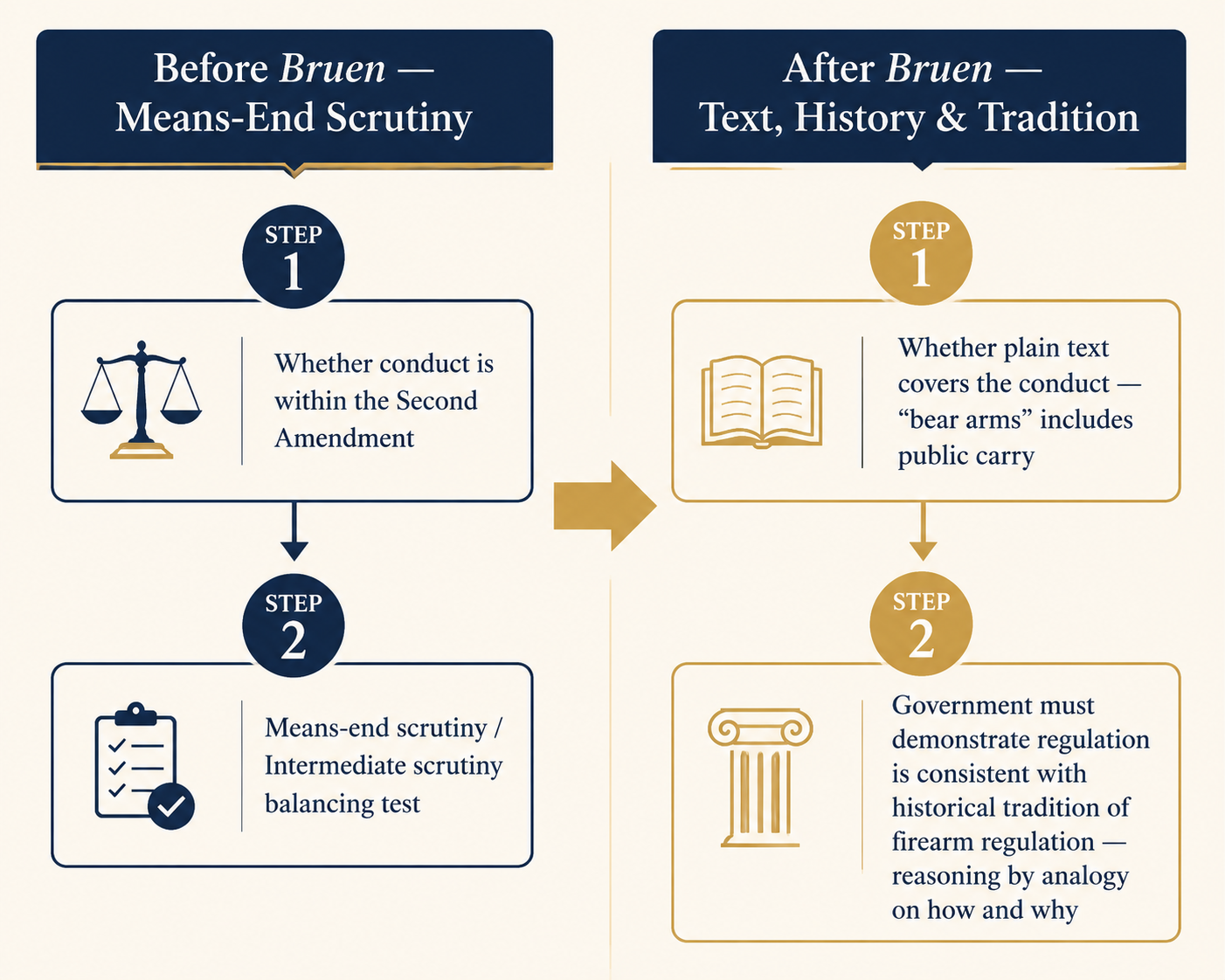
Before Bruen, many lower courts used a two-step framework after District of Columbia v. Heller and McDonald v. City of Chicago. At step one, courts asked whether the challenged law burdened conduct protected by the Second Amendment. At step two, if protected conduct was burdened, courts usually applied some form of means-end scrutiny, often intermediate scrutiny.[1]
Intermediate scrutiny let courts ask whether the law was substantially related to an important governmental interest, such as public safety. That is a familiar constitutional law move in other areas, but Bruen says it does not belong here. Justice Thomas read Heller as rejecting interest balancing in Second Amendment cases. Once the text covers the conduct, a court should not uphold a firearm regulation because it thinks the government’s public-safety justification is strong enough under a judge-made balancing test.[1]
For exam purposes, this is the displaced test: Bruen rejects the second step of means-end scrutiny. A student who writes only that “strict scrutiny applies” or “intermediate scrutiny applies” after Bruen is using the wrong doctrinal framework.
The Bruen Rule in IRAC Form
Issue
The issue was whether New York could condition a public-carry handgun license on an applicant’s showing of proper cause, when ordinary self-defense was not enough. More broadly, the issue was whether the Second Amendment protects carrying a handgun outside the home for self-defense.[1][2]
Rule
The Bruen rule has two steps. First, ask whether the Second Amendment’s plain text covers the individual’s conduct. If it does, the conduct is presumptively protected. Second, the government must affirmatively prove that its firearm regulation is consistent with the Nation’s historical tradition of firearm regulation.[1]
The analogy part is where exams become harder. Bruen does not require a historical twin. A modern regulation may be constitutional if it is relevantly similar to historical analogues. The Court focused the comparison on “how and why” the regulations burden the right: how severely the law burdens armed self-defense, and why the government imposed that burden.[1]
- Start with text: does “keep and bear Arms” cover the person’s proposed conduct?
- If yes, shift the burden: the government must justify the regulation.
- Do not apply intermediate scrutiny or balance the asserted public-safety benefits against the right.
- Compare historical analogues by burden and justification, not by looking for an identical old statute.
- State any unresolved methodological problem when the historical record is thin, contested, or from the wrong time period.
Application
At the text stage, the majority concluded that the right to “bear” arms naturally includes carrying arms outside the home. Heller had recognized an individual right to possess a handgun in the home for self-defense; Bruen extended the analysis to public carry by treating self-defense as not confined to the home.[1]
That moved the case to history. New York had to show that a proper-cause requirement fit within the Nation’s historical tradition of firearm regulation. The majority examined historical restrictions on public carry, including English and American materials, but found no comparable tradition allowing the government to deny ordinary citizens public carry unless they proved a special need. The Court noted that only three territorial or state laws before 1900 required a special need, and two of those were late nineteenth-century outliers.[2]
That is why New York’s law failed. The burden was not a routine condition on licensing; it gave officials discretion to decide whether an applicant’s self-defense reason was good enough. The justification was not aimed at a narrow, historically recognized sensitive place or a historically accepted category of dangerous conduct. It was a broad public-carry restriction on ordinary citizens who wanted to carry for ordinary self-defense.
Conclusion
New York’s proper-cause requirement was unconstitutional. The Second Amendment protects the right of law-abiding citizens to carry handguns in public for self-defense, and New York failed to identify a historical tradition that justified conditioning that right on proof of special need.[1][2]
Why Proper Cause Was Different From Ordinary Licensing
The most common exam trap is overreading Bruen to mean that all handgun licensing is unconstitutional. It does not. The target was a may-issue regime requiring a special showing of need, not every permit system.
Justice Kavanaugh, joined by Chief Justice Roberts, wrote separately to make that limitation explicit. Their concurrence emphasized that shall-issue licensing regimes using objective criteria such as background checks, fingerprinting, mental-health records checks, and firearms training were not necessarily unconstitutional. The concurrence noted that 43 states used shall-issue licensing systems, and it distinguished those systems from New York’s discretionary proper-cause requirement.[2]
On an exam, that concurrence is not decorative. If a fact pattern involves a licensing law with objective criteria, processing fees, training requirements, or background checks, Bruen is still relevant, but the answer should not jump straight to invalidity. The better answer asks whether the criteria are objective and ordinary, or whether they operate like a discretionary special-need requirement that denies public carry to typical law-abiding applicants.
Sensitive Places After Bruen
Bruen also preserved the idea that firearms may be prohibited in sensitive places. The Court repeated Heller’s examples, including schools and government buildings, and referred to other locations such as courthouses and polling places. But it rejected the idea that New York could treat all of Manhattan, or urban areas generally, as sensitive places simply because they are crowded and present public-safety concerns.[2]
That distinction is easy to state and hard to administer. A courthouse ban looks historically familiar. A ban covering a broad public area because many people gather there raises a Bruen problem. A modern place with no obvious Founding-era equivalent forces the court back into analogy: how burdensome is the restriction, why is the place being regulated, and what historical locations are close enough to matter?
Separate Opinions Students Should Actually Use
Kavanaugh and Roberts: Shall-Issue Regimes Are Not Automatically Invalid
The Kavanaugh-Roberts concurrence is the most exam-useful concurrence because it narrows the decision’s reach. It tells the reader not to confuse New York’s discretionary proper-cause system with licensing regimes that use objective, neutral criteria. When a professor writes a licensing hypothetical, this concurrence gives you the distinction.
Barrett: Which Historical Moment Controls?
Justice Barrett’s concurrence flags a methodological problem Bruen does not resolve: should courts focus on 1791, when the Second Amendment was ratified, or 1868, when the Fourteenth Amendment made the right applicable against the states? Barrett also cautioned that post-ratification history may inform constitutional meaning but should not be allowed to define it by itself.[2]
That matters because many Second Amendment challenges involve state and local laws. If the relevant benchmark is 1791, some Reconstruction-era evidence may carry less weight. If 1868 matters more in incorporation cases, the historical record may look different. Bruen does not give students a clean answer, so the clean exam move is to identify the uncertainty rather than pretend it has been settled.
Breyer: Workability and Judicial Competence
Justice Breyer, joined by Justices Sotomayor and Kagan, dissented. He objected to the Court deciding the case on the pleadings and criticized the majority’s history-focused approach. His concern was not just that the majority reached the wrong answer; it was that the method asks judges to resolve difficult historical disputes without clear standards or historical expertise.[2]
That workability critique has become part of the doctrine’s practical context. The Brennan Center collected judicial criticism describing Bruen as difficult to administer, with judges warning that courts were being turned into “amateur historians” and that historical analogies could become indeterminate.[3] A good exam answer can mention this without turning the response into policy argument: the dissent helps explain why lower courts struggle with the new framework.
Rahimi Did Not Make Bruen Simple
Post-Bruen analysis often runs through United States v. Rahimi, the 2024 case upholding the federal firearm ban for people subject to certain domestic-violence restraining orders. Rahimi matters because it shows that Bruen is not a one-way invalidation machine. The Court upheld the law 8-1, but the case produced seven separate opinions and did not generate a single majority methodology that makes Bruen easy to apply.[4]
For law-study purposes, Rahimi is best treated as a caution against both extremes. It prevents an answer from saying that modern gun regulations always fail unless a founding-era statute is nearly identical. But it also does not erase Bruen’s central demand that the government justify a firearm regulation through historical tradition rather than ordinary means-end scrutiny.
As of Q3 2026, it is still safer to write that Bruen remains easy to state and difficult to apply. Erwin Chemerinsky put the point bluntly in January 2026, writing that “Second Amendment jurisprudence is a mess.”[5] That is not a substitute for doctrine, but it is a useful signal that a careful exam answer should preserve unresolved questions instead of announcing that Rahimi cleaned everything up.
A Clean Exam Synthesis
Use Bruen when a fact pattern involves public carry, licensing, sensitive places, prohibited persons, or another firearm regulation challenged under the Second Amendment. The answer should move in this order: text, burden, historical tradition, analogy, caveats.
- Text: Does the Second Amendment’s plain text cover the individual and the conduct?
- Presumption: If yes, the conduct is presumptively protected.
- Government burden: The government must show consistency with the Nation’s historical tradition of firearm regulation.
- No means-end scrutiny: Do not uphold the law merely because it advances an important public-safety interest.
- Analogy: Compare historical and modern laws by how they burden the right and why they impose that burden.
- Caveat: Shall-issue regimes, sensitive places, and the 1791-versus-1868 question require careful treatment.
The short rule to memorize is this: Bruen protects public carry for self-defense, rejects means-end scrutiny, and requires the government to justify firearm regulations by historical tradition once the plain text covers the conduct. The careful caveat to deploy is just as important: the framework leaves hard questions about historical analogy, sensitive places, and the relevant historical benchmark, and later cases have not made those questions tidy.
References
- The Bruen Decision and Concealed-Carry Licenses, Cornell LII Constitution Annotated
- New York State Rifle & Pistol Association v. Bruen, Wikipedia
- Judges Find Supreme Court’s Bruen Test Unworkable, Brennan Center
- United States v. Rahimi, SCOTUSblog
- Second Amendment jurisprudence is a mess, SCOTUSblog, Jan. 28, 2026
Comments
Join the discussion with an anonymous comment.