
Music Conductor Career Path: Steps, Timeline, and Salary Insights
A realistic step-by-step guide to becoming a professional music conductor, covering education requirements, typical timelines from first class to music director, salary data from BLS and PayScale, and expert advice from working conductors.
Updated:
You can want a career as a music conductor and still be unsure what to do next semester. That is normal. Conducting is one of the few music careers where the public image is instantly recognizable, but the training route is oddly indirect: most students do not begin by majoring in conducting, and many do not take their first serious conducting class until they already have years of playing, singing, theory, and ensemble experience behind them.
The practical answer is not glamorous, but it is usable. Build musicianship first. Choose an undergraduate path that makes you a stronger performer, teacher, or ensemble musician. Add formal conducting study when you can. Then expect the real education to continue through graduate school, workshops, assistantships, church or community posts, and repeated chances to stand in front of players who can tell immediately whether your preparation is real.
Joseph Young, a working conductor quoted in CareersInMusic, puts the route plainly: "there's no one way towards being a Conductor." His advice is equally plain: "Take workshops, find a mentor, and start applying for open positions."[1] That is a better starting point than any fantasy about being discovered from the back of a conservatory rehearsal room.
The Usual Route, Before the Exceptions
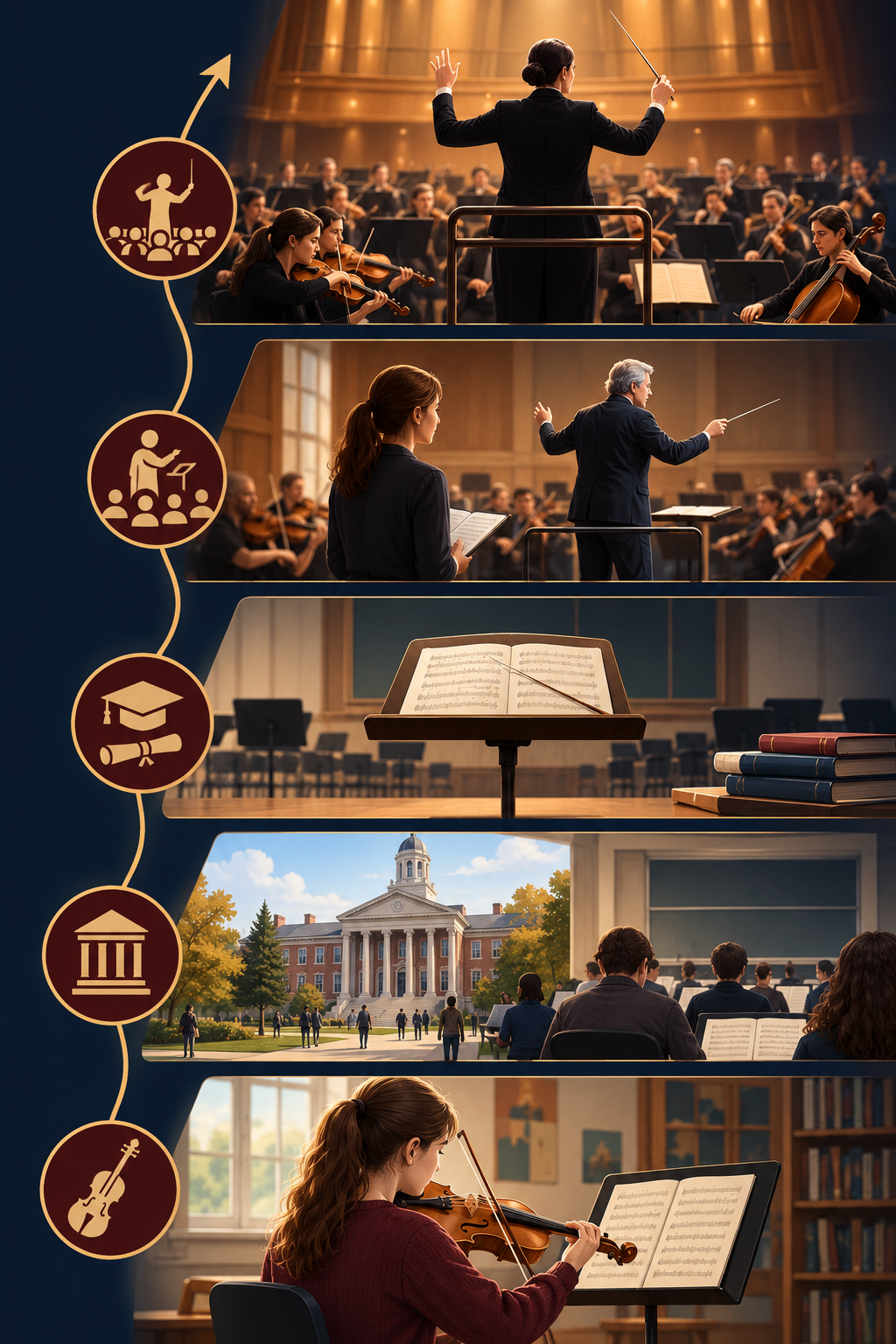
There is no licensing exam that turns someone into a conductor. There is also no single degree sequence that guarantees a podium. Still, the common pattern is clear enough to plan around.
| Stage | What usually happens | What the student should be building |
|---|---|---|
| Pre-college and early college | Instrumental or vocal training, ensemble playing, theory, ear training, piano, and score awareness | Musicianship deep enough to hear beyond one part |
| Bachelor's degree | Most students major in performance, music education, composition, or a related music field rather than undergraduate conducting | Technical fluency, rehearsal discipline, teaching language, and ensemble experience |
| First conducting study | Introductory conducting classes, small ensemble leadership, assistant opportunities, summer programs, and workshop feedback | Clear gesture, score preparation, rehearsal pacing, and the habit of taking criticism |
| Graduate study | A master's degree in conducting is often the serious professional credential | Podium time, repertoire depth, faculty mentorship, and audition materials |
| Early professional work | Assistant conductor roles, youth ensembles, church jobs, community orchestras, opera scenes, choruses, and guest conducting | References, video, programming judgment, administrative steadiness, and trust |
| Larger leadership roles | Music director, artistic director, or resident conductor posts, often after years of part-time and assistant work | Institutional leadership, fundraising comfort, hiring judgment, and artistic identity |
A useful planning window is long: roughly 8 to 15 years from a first serious conducting class to a full-time music director post, when it happens at all. That timeline should not be read as a promise. Many capable conductors spend years combining several part-time roles, and some never reach a single full-time appointment.
Start by Becoming a Musician Other Musicians Trust
Conducting starts before the baton because players do not follow a title; they respond to preparation, listening, and musical authority. A young conductor who cannot hear intonation, phrase structure, articulation, balance, or harmonic motion has very little to offer an ensemble beyond traffic control.
That is why deep instrumental or vocal training matters. A violinist, violist, pianist, singer, percussionist, or wind player learns how much physical labor sits behind one note arriving in the right place. Ensemble playing also teaches the part of conducting that cannot be faked: knowing what it feels like to wait through rests, recover after an exposed entrance, breathe with a section, or watch someone on the podium give an unclear cue.
Piano is especially useful, even for non-pianists, because score study becomes harder when every harmony has to remain abstract. The point is not to become a concert pianist. The point is to reduce the distance between the printed score and the sound you can imagine, test, and correct.
Do Not Panic If You Cannot Find an Undergraduate Conducting Major
Many students discover the profession, search for conducting bachelor's degrees, and assume they are already behind. Usually, they are not. EverythingConducting notes that few undergraduate conducting degrees exist, and that students commonly begin with a major such as performance or music education before moving toward conducting later.[2]
That sequence makes musical sense. A performance major may gain more intense technical and repertoire training. A music education major may get earlier experience explaining musical ideas, managing rehearsal time, and diagnosing problems in real time. Composition, theory, or church music can also be relevant, depending on the kind of conducting a student wants to pursue. CareerExplorer likewise describes orchestral conductors as typically needing extensive music education and training, including formal study, performance experience, and conducting-specific preparation.[3]
For a college student choosing next semester's schedule, the question is less "Which major sounds most like conductor?" and more "Which path gives me the strongest musicianship, the most ensemble contact, and the earliest responsible chances to lead?"
- If you are still in high school, prioritize private lessons, ensemble experience, theory, ear training, piano, and watching rehearsals from inside the group.
- If you are choosing a bachelor's program, ask how often undergraduates conduct, whether conducting class is required, and whether students can lead lab ensembles or new-music groups.
- If you are already a music major, start gathering small podium experiences: sectionals, chamber groups, student opera scenes, choir warmups, or assistant work.
- If your school has no formal conducting track, look for summer workshops, community ensembles, church music work, and faculty who will let you observe rehearsals seriously.
What the First Conducting Classes Actually Need to Teach
The first conducting class is often humbling because it reveals how much the body has been hiding. A student may understand the score and still give a preparatory beat that makes no one breathe. Another may have expressive hands but no plan for what to rehearse after the ensemble stops.
Basic technique matters: patterns, preparatory gestures, releases, fermatas, subdivision, left-hand independence, and cues. But technique is only useful when attached to listening. The better question after a beat pattern is not whether it looked elegant. It is whether the players entered together, played the right character, and understood what changed because of the gesture.
Score study is where serious students begin to separate themselves. Marking entrances is not enough. A conductor has to know form, harmony, instrumentation, transpositions, text when applicable, historical style, likely balance problems, and the rehearsal order that will make the best use of limited minutes. The work is quiet, repetitive, and not especially photogenic. It is also the part that players feel first.
Graduate School Is Often Where the Path Becomes Professional
For many aspiring conductors, the master's degree is the point where conducting stops being an interest and becomes a professional track. It can provide regular podium time, coached rehearsal, repertoire assignments, recital requirements, opera or choral opportunities, assistantship experience, and access to mentors who know the audition circuit.
It can also be expensive, selective, and emotionally clarifying. A student who wants to conduct because the role looks powerful may not enjoy two years of being stopped mid-gesture and told that the orchestra could not understand the upbeat. A student who loves the whole score, who wants to solve rehearsal problems, and who can accept correction without becoming theatrically wounded has a better chance of using graduate school well.
Before applying, ask blunt questions. How many minutes of podium time do conducting students receive each week? Are the ensembles real players or mostly piano reductions? Do graduate assistants conduct rehearsals, sectionals, opera scenes, or only administrative tasks? Where have recent graduates actually worked? Who pays for the degree, and how much debt follows the student out?
A prestigious name can help, but prestige without podium time is a thin bargain. Conducting is learned in front of sound.
Workshops, Mentors, and Assistantships Are Not Side Activities
Young's advice to take workshops, find a mentor, and apply for open positions belongs in the middle of the plan, not at the end of it.[1] Workshops put a conductor in front of unfamiliar players and teachers. Mentors help translate vague ambition into specific corrections. Applications force the student to assemble a biography, repertoire list, video, references, and a reason for wanting a particular ensemble.
Assistant conductor work is often where the profession becomes less romantic and more real. The assistant may mark bowings, cover a rehearsal, run a sectional, prepare program notes, conduct an education concert, step in when someone is sick, or sit silently through weeks of rehearsals learning how the music director manages time. None of that is beneath the work. It is the work before the work.
Early podium opportunities are often modest: a church choir, a community orchestra, a youth ensemble, a campus opera scene, a reading orchestra, or a new-music group that needs someone organized enough to make rehearsals function. Those posts may not impress relatives who imagine a major symphony hall. They do teach what a conductor must know: who arrives late, which passage will collapse, when to stop talking, how to keep volunteer players respected, and how to make the second rehearsal better than the first.
What Conductors Are Paid, and What the Numbers Hide
Salary data for conductors needs careful reading because the available sources measure different things. The U.S. Bureau of Labor Statistics reports on "music directors and composers," a broad category that includes conductors but does not isolate them. For May 2024, BLS listed 47,300 jobs in that combined occupation, a median annual wage of $63,670, and a top 10 percent earning more than $157,010.[4]
That median is real, but it is not a clean conductor-only number. It mixes music directors and composers across settings, so it should not be used to suggest that a newly trained orchestral conductor can expect a stable $63,670 job. BLS also projected 0 percent employment growth for music directors and composers from 2024 to 2034, while still estimating about 4,300 openings each year, largely because workers leave the occupation or retire.[4]
PayScale is narrower, listing data for "Conductor, Orchestra." Its reported median is $55,000, with a range from $22,000 to $73,000 and early-career pay around $26,000.[5] Because PayScale's figure is more conductor-specific but based on a smaller self-reported salary environment, it should be read alongside BLS rather than treated as the single answer.
| Source | What it measures | Reported pay or outlook | How to read it |
|---|---|---|---|
| BLS | Music directors and composers combined | $63,670 median annual wage; 0% projected growth from 2024 to 2034; about 4,300 annual openings | Reliable federal category, but broader than conductors alone |
| PayScale | Conductor, Orchestra | $55,000 median; $22,000-$73,000 range; about $26,000 early-career | More specific to conductors, but narrower and self-reported |
The job setting matters as much as the title. BLS reports that 55 percent of music directors and composers work in religious, grantmaking, civic, professional, and similar organizations.[4] That is a quiet but important fact. The field is not made mostly of people walking into full-time professional orchestra music director jobs. Much of the work lives in churches, schools, community institutions, nonprofits, civic ensembles, and mixed portfolios.
For a student planning rent, loan payments, and health insurance, the early question is not "Can a famous conductor earn well?" Some can. The more useful question is whether you can tolerate several years in which income may come from teaching, accompanying, church work, assistant conducting, freelance performance, administrative music work, and occasional guest conducting before anything resembling a full-time podium appears.
The Work Is Larger Than the Concert
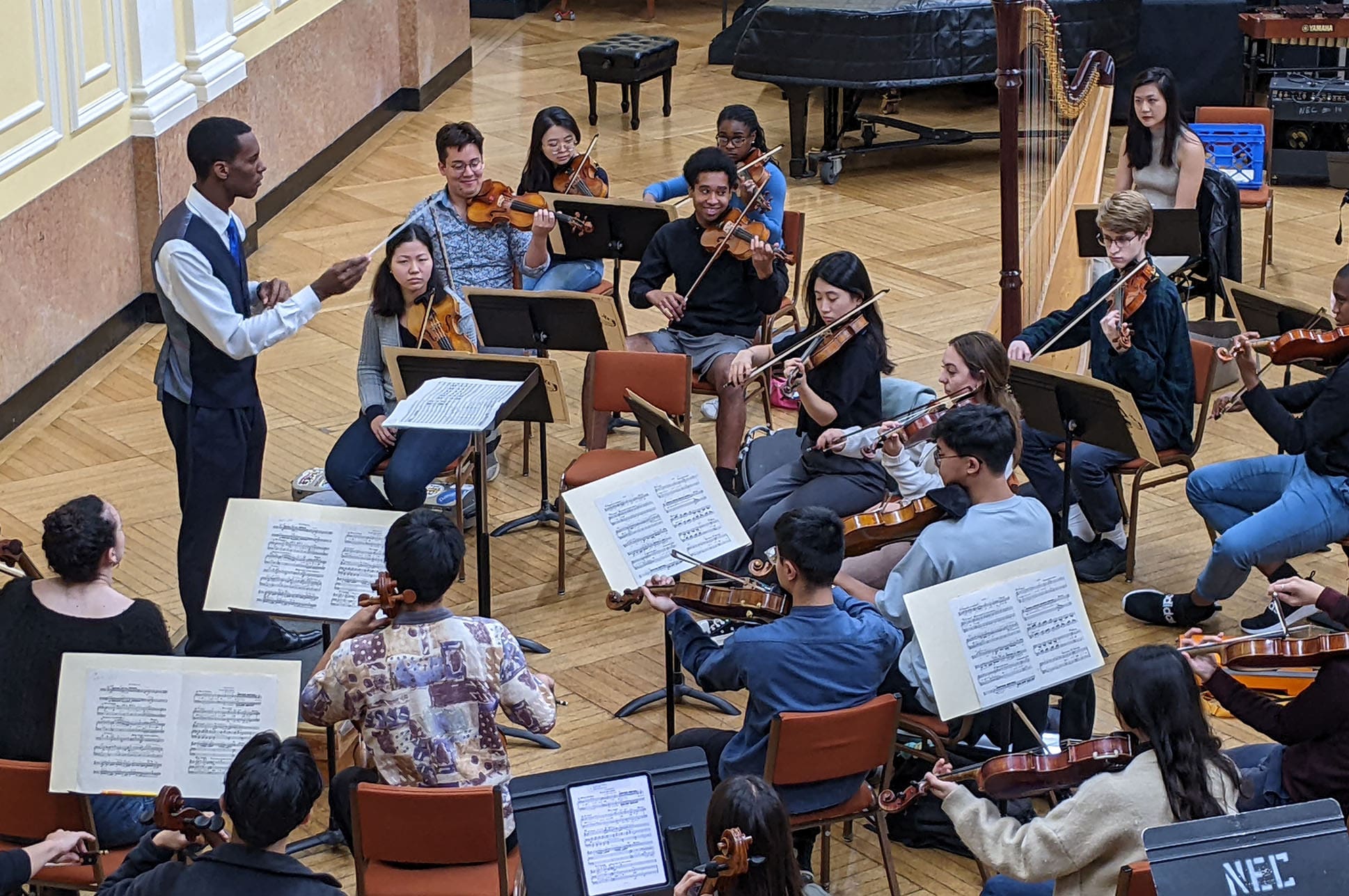
A conductor's visible task is to lead performance, but the job is wider than beating time. Berklee's career guide describes the orchestra music director role as involving artistic leadership, repertoire selection, rehearsal direction, performance, auditions, and collaboration with administrators and musicians.[6] In smaller organizations, those duties can stretch further: recruiting players, choosing editions, speaking to donors, planning seasons, hiring soloists, calming board members, and explaining why the timpani rental matters.
That is why early community and religious jobs should not be dismissed as lesser training. A conductor who can make a volunteer choir feel prepared for Sunday, or help a community orchestra survive a difficult rehearsal without wasting anyone's evening, is learning leadership under conditions that do not flatter the ego. Those settings expose weak preparation quickly. They also reward patience, clarity, and respect.
Access Is Changing, But Slowly
The podium has not been equally open to everyone. The League of American Orchestras' conductor diversity data shows movement: women conductors increased from 15.7 percent in 2015 to 28.8 percent in 2025, and conductors of color reached 32.9 percent.[7] Those numbers matter because they show that the field is not frozen in the same public image many students inherited.
They do not prove that access is fair now. A rising percentage can coexist with uneven mentorship, biased hiring assumptions, unequal access to expensive training, and different expectations in rehearsal rooms. For an aspiring conductor, the practical lesson is double: seek teachers and organizations that take access seriously, and understand that talent alone has never been the whole admissions system into the profession.
A Semester-by-Semester Way to Begin
If the career still feels too large, reduce it to the next academic term. A future conductor does not need to solve the whole profession by December. The next semester should produce more musicianship, more observation, and one concrete chance to lead something, however small.
- Stay serious on your primary instrument or voice. Conductors who stop developing as musicians too early usually have less to say from the podium.
- Add or strengthen piano, theory, ear training, and score reading. These are not résumé decorations; they shorten the distance between study and rehearsal.
- Enroll in conducting class if available. If not, ask to observe one and request permission to conduct a small student group.
- Watch rehearsals, not just concerts. Notice where the conductor stops, what gets fixed, what gets ignored, and how much talking is too much.
- Find one mentor who will be honest. A kind teacher who never corrects your gesture is less useful than a demanding one who helps you hear what the ensemble needs.
- Apply for one real opportunity: assistant work, a workshop, a church substitute post, a campus ensemble, or a community group that needs help.
The most reliable path is long, graduate-heavy, apprenticeship-driven, and financially modest at the start. It is also musically compelling for the right person: someone who wants to hear the whole ensemble, prepare more deeply than the room expects, and build opportunity while building musicianship. There is no single prescribed formula, but there is enough of a pattern to make the next semester matter.
References
- Conductor, CareersInMusic
- Considering a Career in Conducting: Part 1, EverythingConducting
- What education do orchestral conductors have?, CareerExplorer
- Music Directors and Composers, U.S. Bureau of Labor Statistics
- Conductor, Orchestra Salary, PayScale
- Music Director (Orchestra), Berklee College of Music
- Conductor Diversity, League of American Orchestras
Comments
Join the discussion with an anonymous comment.