

What Does the DHS Deputy Secretary Do? Duties, History, and Controversy
A clear overview of the DHS deputy secretary's duties, appointment process, salary, and why the role sparks debate about departmental structure. Understand how this senior official manages 260,000 employees across 22 agencies.
Updated:
The DHS deputy secretary is the Department of Homeland Security’s second-ranking official and, in practice, the department’s chief operating officer. That plain sentence hides the hard part. At DHS, “deputy” does not mean a spare official waiting for the secretary to be unavailable. It means the person directly beneath the secretary in a department built from more than 20 major components, with missions that range from airport screening and border operations to disaster response, cybersecurity, maritime security, immigration administration, and protection of national leaders.
The legal starting point is 6 U.S.C. § 113. That section, created through the Homeland Security Act framework, provides for a deputy secretary appointed by the president with the advice and consent of the Senate, and it identifies the deputy as the secretary’s “first assistant” for succession purposes.[1] For a civics answer, that gives you the essential frame: this is a Senate-confirmed presidential appointee, placed directly under the secretary, with a formal succession role and broad management duties inside a Cabinet department.
Why This Deputy Job Is So Large
DHS describes itself as the third-largest Cabinet department, after the Department of Defense and the Department of Veterans Affairs, with about 260,000 employees.[2] That figure matters because it changes the meaning of “management.” A deputy secretary at a small agency may be able to keep close track of a handful of bureaus. The DHS deputy secretary sits above a department whose operating pieces include FEMA, TSA, the Coast Guard, CBP, ICE, the Secret Service, CISA, USCIS, the Federal Law Enforcement Training Centers, and science and technology offices, among others.
The department’s mission areas are just as wide. DHS’s leadership page lists core work including preventing terrorism, securing borders, enforcing immigration laws, safeguarding cyberspace, ensuring disaster resilience, and supporting national and economic security.[2] Those phrases can sound like a brochure until you attach them to actual operating systems: airport checkpoints, ports of entry, disaster declarations, cyber incident coordination, immigration benefits processing, maritime patrols, protective details, detention operations, and emergency grants.
That is why “the deputy manages the department” is too thin an explanation. The job requires helping convert the secretary’s priorities into budgets, staffing decisions, component guidance, interagency coordination, and crisis response. If a hurricane response strains FEMA, if cyber agencies need to coordinate with infrastructure owners, if border operations require new operational guidance, or if TSA staffing affects airport security lines, the deputy secretary is part of the leadership structure that keeps those moving under the secretary’s direction.
| Exam point | What it means |
|---|---|
| Legal position | Second-ranking DHS official under the secretary |
| Appointment | Nominated by the president and confirmed by the Senate |
| Succession | Secretary’s first assistant and first in line under the cited succession order |
| Management role | Functions as the department’s chief operating officer |
| Scale | Works across about 260,000 employees and more than 20 component agencies |
| Main controversy | Whether one deputy can reasonably oversee both department-wide operations and law enforcement oversight |
What the Deputy Secretary Actually Does
The deputy secretary’s duties are not best understood as one neat checklist. They sit between law, hierarchy, and daily administration. Legally, the office is established by statute. Politically, the office is filled through presidential nomination and Senate confirmation. Administratively, the office helps run DHS when the secretary is setting direction, dealing with the White House, testifying before Congress, or responding to major events.
In ordinary department life, the deputy secretary is the official who can push across component boundaries. That is important because DHS is not one uniform agency. It is a headquarters layered over components with very different cultures: military service in the Coast Guard, law enforcement at ICE and CBP, emergency management at FEMA, transportation security at TSA, cyber coordination at CISA, immigration services at USCIS, and protective operations at the Secret Service. A secretary can set broad priorities; someone still has to make sure the department’s pieces are not quietly pulling in different directions.
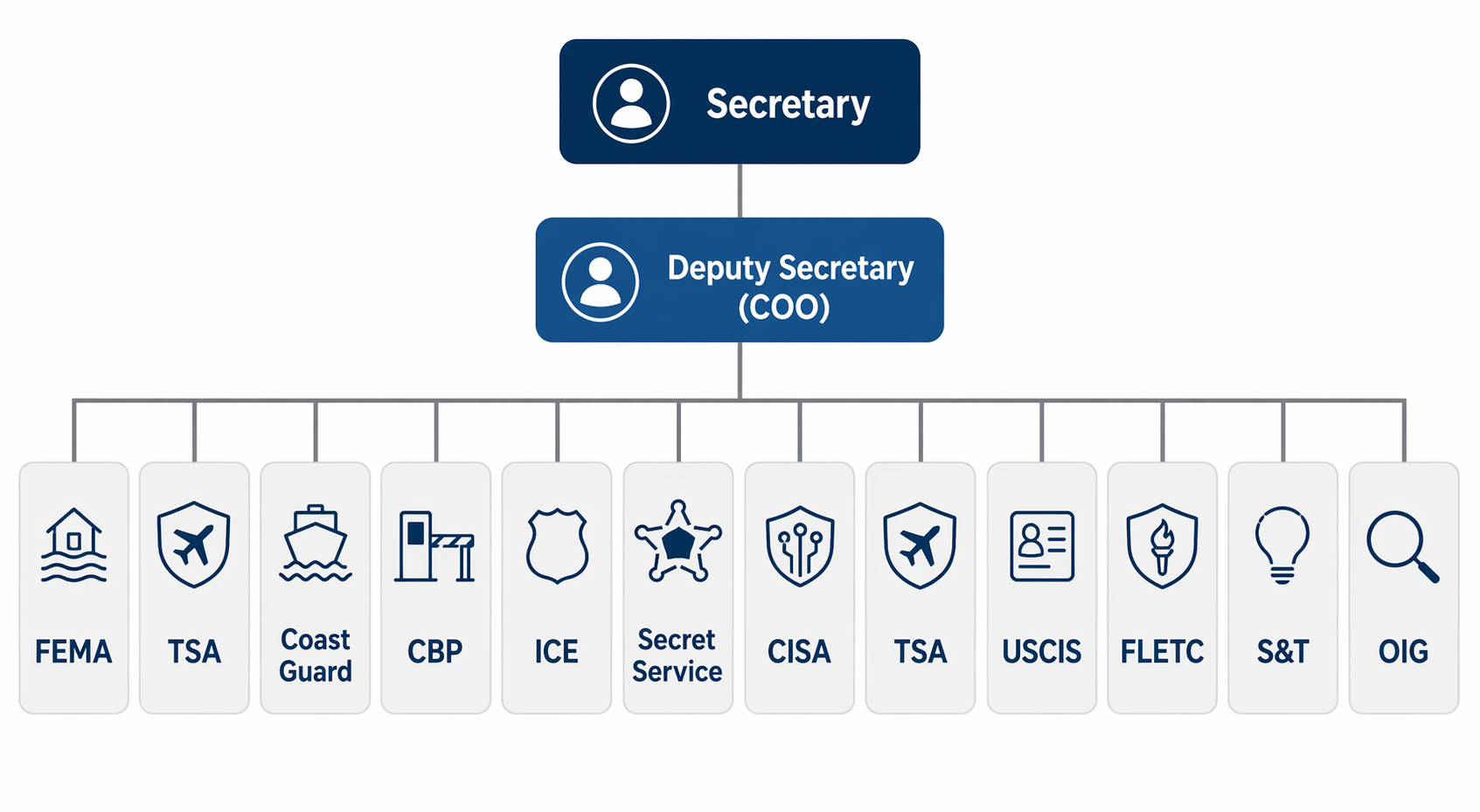
DHS’s public organizational chart shows the basic logic: the secretary is at the top, the deputy secretary sits immediately below, and the department’s offices and components branch downward from there.[3] The chart is useful for students because it shows hierarchy. It is also misleading if read too casually, because boxes make coordination look cleaner than it is. A component such as FEMA does not do the same kind of work as the Secret Service. TSA does not face the same management problems as CISA. Yet headquarters leadership has to make the department function as a single Cabinet department when Congress, the president, courts, governors, airports, local officials, or the public demand answers.
A Practical Way to Sort the Duties
- Operations: helping the secretary oversee component agencies and department-wide execution.
- Management: coordinating budgets, personnel priorities, planning, and internal performance.
- Policy execution: turning presidential and secretary-level priorities into instructions that components can carry out.
- Crisis continuity: keeping leadership decisions moving during disasters, security incidents, cyber events, or leadership vacancies.
- Succession: serving as the secretary’s first assistant and the first official in line when the secretary cannot serve.
That last point is not ceremonial. A January 2025 Federal Register succession order placed the deputy secretary first in the order of succession within DHS.[4] Succession rules matter in government because agencies cannot simply pause during a vacancy or emergency. Someone must have recognized authority to sign, direct, coordinate, and answer for the department.
Appointment, Term, and Pay
The deputy secretary is not hired like a career civil servant. The president nominates the deputy secretary, and the Senate must confirm the nominee.[1] Once confirmed, the deputy serves at the pleasure of the president rather than for a fixed term. That means the office can change hands when administrations change, when a president chooses new leadership, or when a deputy resigns.
The current deputy secretary is Troy Edgar, whom DHS identifies as the ninth person to hold the office. DHS says he was confirmed on March 7, 2025, and sworn in on March 10, 2025, and describes his previous experience as including service as DHS chief financial officer, private-sector executive roles, and mayor of Los Alamitos, California.[5] Those details are useful for placing the office in the present, but they should not distract from the institutional point: whoever occupies the job inherits the same basic span of control.
The salary is tied to Executive Schedule Level II, the federal pay category used for several high-ranking executive branch officials. For exam purposes, that pay level is a safer answer than memorizing a single dollar figure. Published dollar amounts can differ because federal pay tables are adjusted over time, and older summaries may keep circulating after they are out of date. If you see an old figure such as $168,000 beside a newer figure in the low $180,000s, the likely issue is not that the office changed categories; it is that the dollar value attached to the category changed.
Why the Numbers Do Not Always Match
Students often treat government numbers as if one source must be right and the other must be wrong. DHS is a good example of why that habit causes trouble. One public summary may say DHS has more than 208,000 employees, while DHS’s own leadership page uses about 260,000.[2] Those figures can reflect different counting methods, dates, component inclusion, or treatment of personnel categories. The right move in an exam or paper is to identify the source and avoid pretending that a broad agency workforce figure is a laboratory measurement.
The same caution applies to budget figures. DHS materials tied to the current deputy secretary describe a budget of more than $100 billion.[5] Other summaries may show much lower numbers, such as figures around the high tens of billions, depending on whether they are referring to a particular operating budget, discretionary budget authority, total budget authority, fiscal year, or another accounting category. For the deputy secretary’s role, the key lesson is not the thrill of a large number. It is that the deputy helps manage a department whose resources are large enough that definitions of “budget” matter.
How the Office Fits Into DHS History
DHS itself is a young Cabinet department by federal standards, created after the September 11 attacks to consolidate homeland security functions that had been scattered across the government. The deputy secretary’s office belongs to that design. It was built for a department that would need central leadership over many inherited agencies, not for a small, single-purpose bureau.
The office has also served as a proving ground for higher leadership. Alejandro Mayorkas, for example, served as deputy secretary before later becoming DHS secretary. That does not mean every deputy is on a path to become secretary. It does show that the deputy role is not a minor administrative post. It is close enough to the department’s core operations that experience there can matter for later Cabinet-level leadership.
The Structural Controversy: One Deputy, Too Many Missions?
The sharpest current debate is not whether DHS needs a deputy secretary. A department of this scale plainly needs a second-ranking operating official. The harder question is whether one deputy secretary can responsibly cover both department-wide management and the law enforcement-heavy parts of DHS.
In March 2026, Government Executive published a policy critique arguing that DHS lacks a true “top cop” and that Congress should create a separate deputy secretary for law enforcement.[6] The article’s concern is span of control: the same deputy secretary structure must contend with FEMA disaster response, TSA airport screening, Coast Guard missions, cybersecurity, and the department’s law enforcement components, including ICE, CBP, and the Secret Service.[6]
That argument should be read carefully. It is not an official finding that DHS’s current structure is unlawful or nonfunctional. It is a policy proposal about organizational design. But it points to a real administrative problem: DHS combines missions that, in another department, might be separated under different chains of command. Law enforcement oversight has different risks from disaster grants. Cybersecurity coordination has different rhythms from immigration detention. Protective operations have different accountability problems from airport screening.
The proposed fix is structural: keep a deputy secretary focused on broad department management while adding a separate deputy secretary for law enforcement. The appeal is obvious. A dedicated law enforcement deputy could concentrate on standards, oversight, coordination, and accountability across DHS’s enforcement agencies. The tradeoff is also obvious. Adding another Senate-confirmed leadership post can clarify responsibility, but it can also create new boundary fights unless Congress and the department define the split with care.
What to Remember for a Civics Answer
A strong student answer should not stop at “the deputy helps the secretary.” It should say that the DHS deputy secretary is a Senate-confirmed official established by statute, serving as the secretary’s first assistant and first in line of succession, while functioning as the department’s chief operating officer. The office matters because DHS is not a compact policy shop. It is a huge operating department with about 260,000 employees, more than 20 components, and missions that touch terrorism prevention, border security, immigration enforcement, cybersecurity, disaster resilience, transportation security, maritime operations, and national leadership protection.
The controversy follows from that same fact. The deputy secretary’s authority is necessary because DHS needs central coordination. It is structurally strained because the same office is expected to help oversee an unusually wide mix of management, emergency, security, cyber, immigration, and law enforcement functions. That is why some critics argue for a separate law enforcement deputy: not because the existing deputy is unimportant, but because the job may be too broad for one official to supervise with the depth each mission demands.
References
- 6 U.S. Code § 113 - Other officers, Legal Information Institute
- Leadership, U.S. Department of Homeland Security
- Organizational Chart, U.S. Department of Homeland Security
- Providing an Order of Succession Within the Department of Homeland Security, Federal Register, January 13, 2025
- Troy Edgar, U.S. Department of Homeland Security
- DHS has no top cop. Congress should fix that., Government Executive, March 2026
Comments
Join the discussion with an anonymous comment.