
Did meteorites deliver the building blocks of life?
Explore the compelling evidence that meteorites delivered a complete set of organic molecules to early Earth, and learn why scientists still haven't closed the case on life's origins.
Updated:
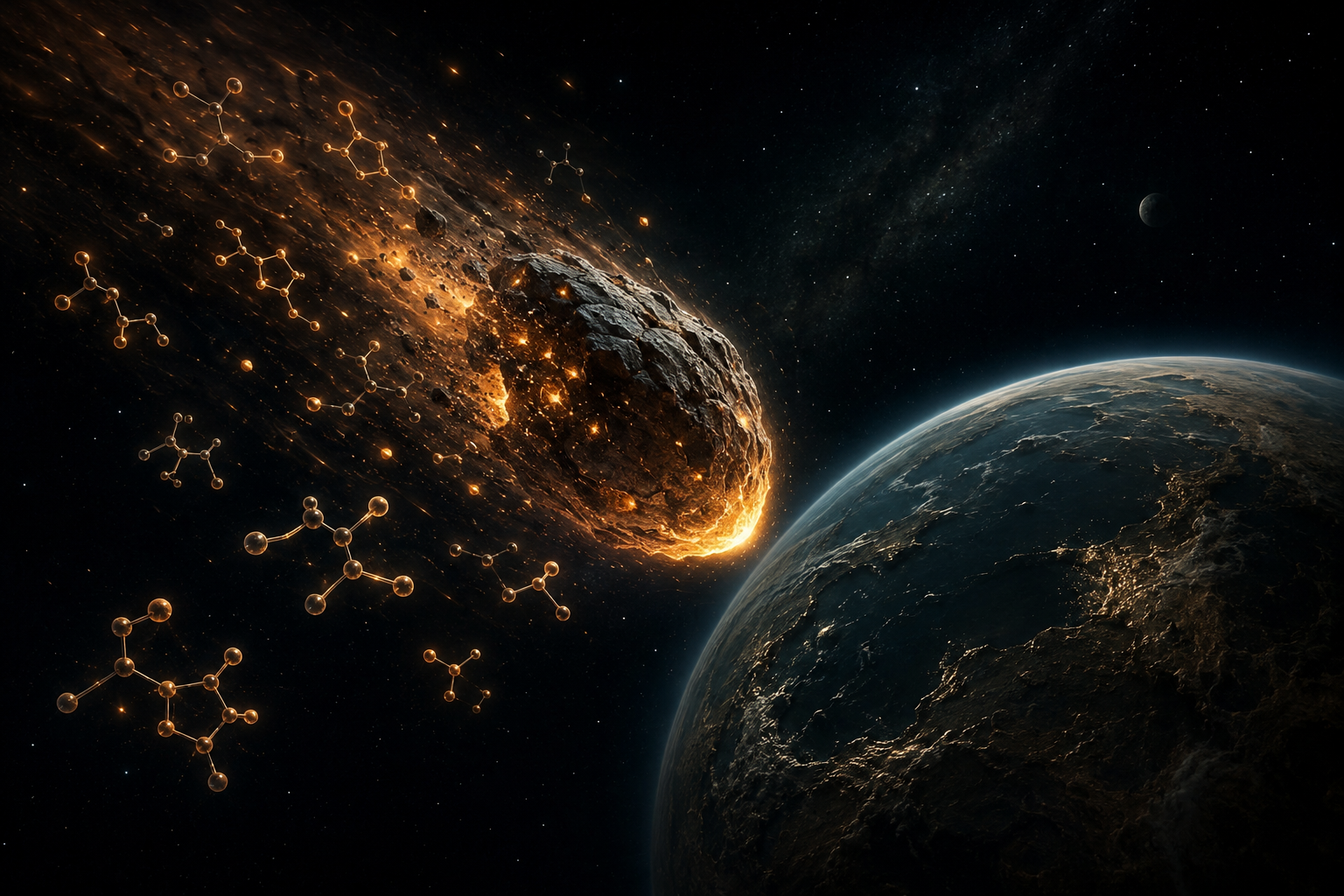
If the question is whether meteorites delivered the building blocks of life, the careful answer is yes for ingredients and no for life itself. That distinction matters because a molecule can arrive from space, sit in a brine, and still never become a polymer or a cell. The reason this is no longer a speculative guess is that a Cambridge study found unmelted planetesimals supplied about 90% of Earth's volatile zinc while contributing only about 30% of Earth's mass, which makes volatile-rich deliveries hard to dismiss as a side note.[1]
The inventory is broader than amino acids
The easiest mistake in this topic is to stop at amino acids. The stronger evidence now covers the nucleic-acid alphabet as well. A 2022 cold-water extraction study reported all five DNA and RNA nucleobases in four meteorites,[2] and later work independently confirmed the same full set in Bennu and Ryugu samples.[3][4] That still falls short of RNA, DNA, or protein, but it means the raw letters of heredity are not rare curiosities.
The logic behind that claim is easier to follow in Meteorite Scientific Analysis: A Step-by-Step Study Guide, where the cleanup, blank controls, and verification steps are spelled out more explicitly than they usually are in headlines.
The inventory also extends into chemistry relevant to sugar formation. HMT, reported by Hokkaido University researchers, matters because it is not life itself but a plausible intermediate in prebiotic reaction networks, including pathways linked to sugars.[5]
Bennu was not just a delivery box
Bennu is the sample that turns an asteroid into a chemical environment rather than a passive cargo capsule. Its evaporite sequence - calcite, dolomite, sodium-calcium carbonate, sodium sulfate, sodium carbonate, and halite - points to a long-lived brine that dried in stages, while the reported temperature window of about 20-29 °C stayed mild enough to keep reactions moving without boiling the chemistry away.[3] That is a much stronger setting for prebiotic chemistry than a dry rock with organics pasted onto it.
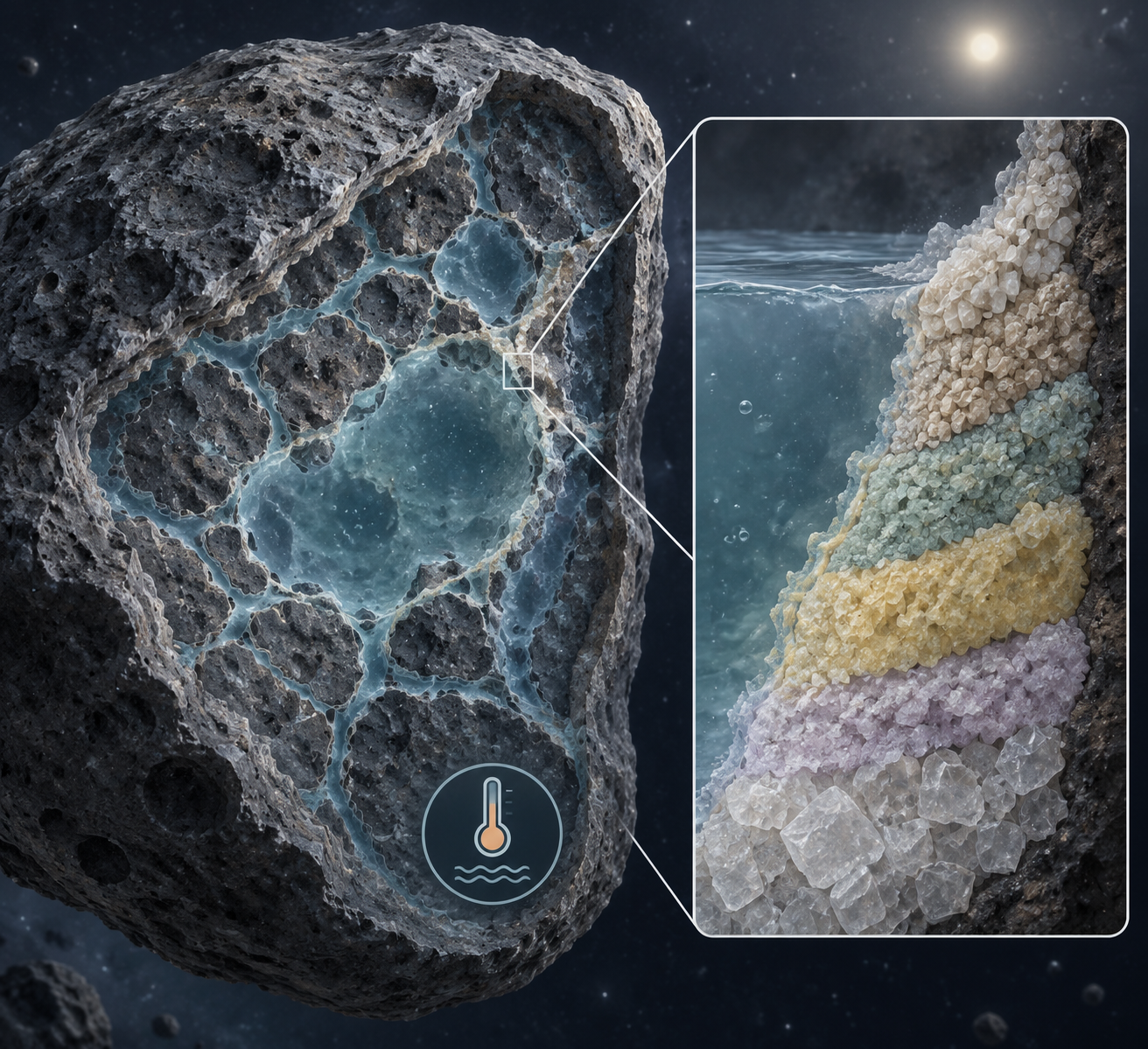
If you want the Bennu compounds collected in one place, A Student Guide to the Meteorite Building Blocks of Life is the cleaner companion to this section. The point of the Bennu result is not just that organics exist there, but that an asteroid can preserve and process them in the same place.
A useful boundary case is Orgueil. The 1864 meteorite yielded simple glycine and beta-alanine, as summarized by Scripps, and those amino acids matched comet-nucleus predictions. That does not prove life came from space, but it does show that some straightforward organics originated beyond the asteroid belt rather than only inside it.[6]
The boundary is still real
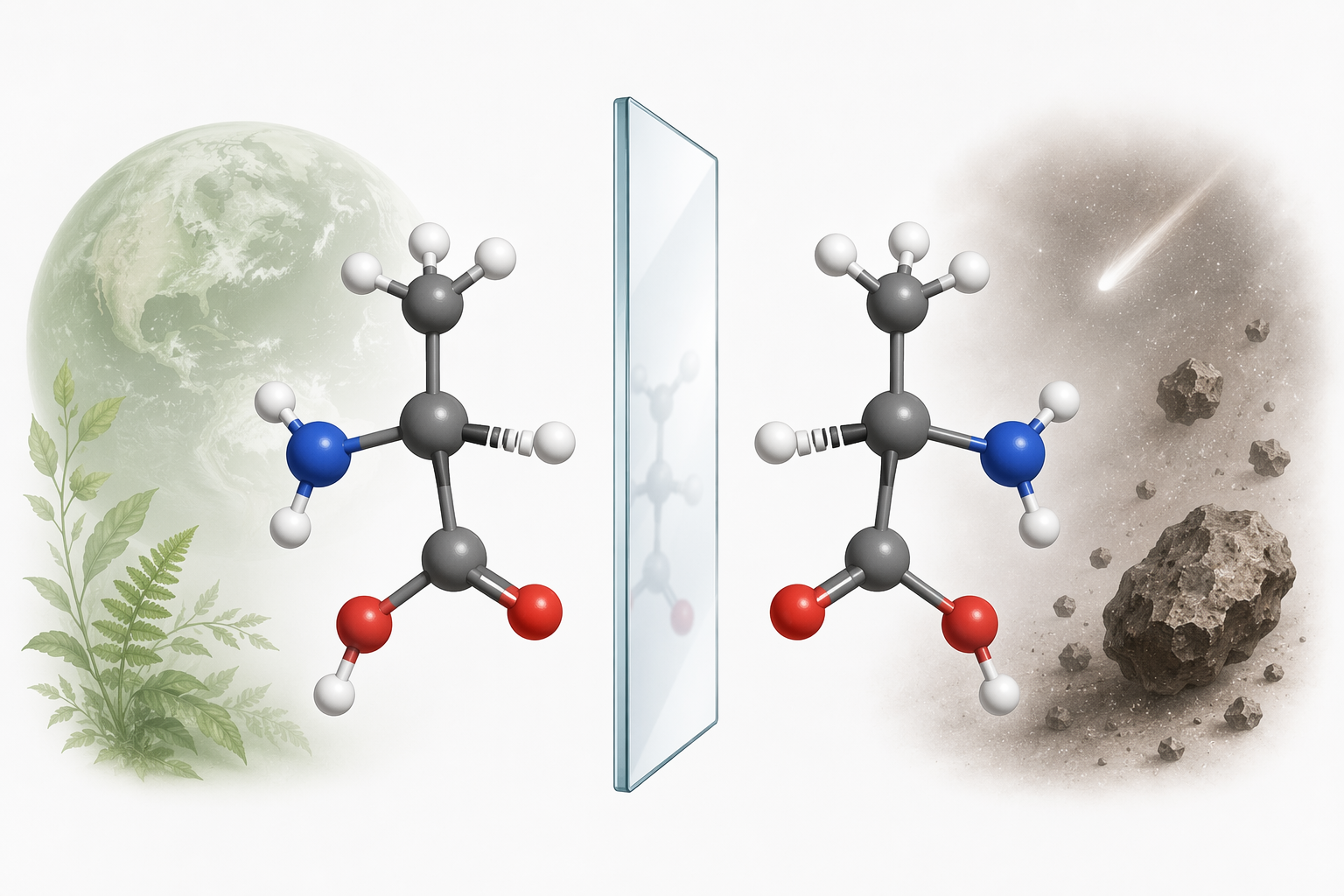
The strongest remaining problem is chirality. Bennu amino acids are racemic - equal left- and right-handed mixtures - while Earth life uses left-handed amino acids almost exclusively.[3] That gap is not a detail. It means extraterrestrial delivery alone does not explain how biology settled on one handedness and not the other.
The same caution applies to polymers. No extraterrestrial sample has yet yielded RNA, DNA, or protein polymers, even though the monomers and related intermediates are now abundant. So the disciplined answer for an essay is that meteorites and asteroids almost certainly stocked early Earth with a remarkably complete prebiotic toolkit, and some of those bodies may even have been small reactors, but the jump from delivered ingredients to self-replicating biology is still unproven.
References
- Unmelted planetesimals supplied most of Earth's volatile zinc — Cambridge University, 2024
- All five DNA and RNA nucleobases found in meteorites — Science News, 2022
- Bennu sample reveals evaporite minerals and organics — NASA, 2025
- Ryugu sample confirms nucleobases in an asteroid — Chemistry World, 2026
- HMT discovery in meteorites — Hokkaido University
- Orgueil meteorite organics and comet predictions — Scripps Institution
Comments
Join the discussion with an anonymous comment.