
Meteorite Scientific Analysis: A Step-by-Step Study Guide
Learn how scientists analyze meteorites from field recovery to final classification. This guide breaks down each stage of the analysis pipeline, covering physical testing, thin-section petrography, electron microprobe analysis, and how to read classification strings like H5 S2 W2.
Updated:
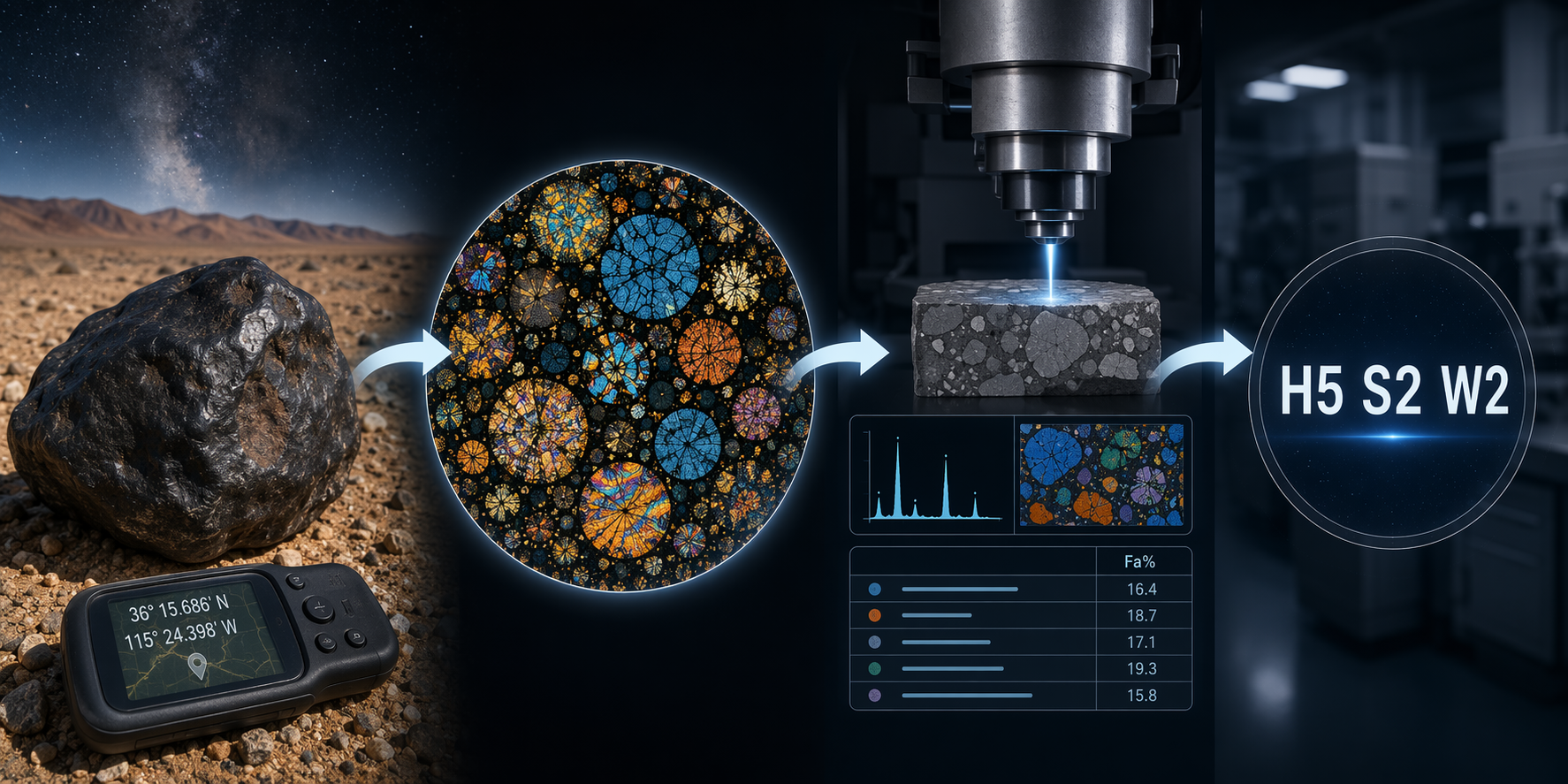
A label like H5 S2 W2 looks small enough to fit on a specimen tray, but it is not a casual nickname. It says that the meteorite is an H ordinary chondrite, that its minerals were thermally metamorphosed to petrologic type 5, that it records very weak shock at stage S2, and that it has moderate terrestrial weathering at grade W2. Getting to that string requires a sequence of observations, not one dramatic test.
That sequence matters because most introductory examples are not iron meteorites sitting cleanly apart from everything else. More than 95% of observed meteorite falls are stony meteorites, and ordinary chondrites make up about 86% of all recovered meteorites, so a student learning the analysis pipeline will meet chondrules, silicate minerals, metal grains, shock features, and weathering stains far more often than a museum-ready iron mass.[1]
A useful way to study the process is to follow the specimen as evidence becomes more specific. A fusion crust may get attention in the field. A thin section may show chondrules and recrystallized matrix. An electron microprobe may report olivine fayalite content and pyroxene ferrosilite content. Only after those pieces are in place does the code begin to mean something.
| Stage | Question it answers | What it should not claim |
|---|---|---|
| Field documentation | What was recovered, where, and in what condition? | That the object is confirmed scientifically |
| Physical screening | Is it worth laboratory attention? | That density, magnetism, or fusion crust alone proves meteorite status |
| Thin-section petrography | What textures, chondrules, inclusions, shock effects, and alteration are visible? | That visual texture alone supplies the full chemical group |
| EPMA/WDS mineral chemistry | What are the measured mineral compositions? | That the instrument is a magic identifier |
| Formal classification | How do texture, chemistry, shock, and weathering become a label? | That the label is a complete origin story |
| Advanced geochemistry | What parent-body and chronology questions remain? | That every routine classification requires every advanced method |
Start With Custody, Not Certainty
The first scientific question is not “What type is it?” It is “What exactly was recovered, and can anyone reconstruct the circumstances later?” A useful field record includes GPS coordinates, photographs before heavy handling, specimen weight, visible surface features, notes on fusion crust, and any obvious breakage or pairing with nearby stones. Every officially recognized meteorite is registered in the Meteoritical Bulletin database, which is one reason early documentation matters: the object needs to remain attached to a place, a mass, and a recoverable record rather than becoming a story passed from hand to hand.[2]
Fusion crust belongs here as an observation, not a verdict. A fresh stony meteorite may carry a thin, dark, glassy exterior formed during atmospheric entry, and that surface can be a useful clue. But the same field notebook should also record where the crust is missing, whether the interior is rusty, and whether the stone has desert varnish, soil coatings, or other terrestrial overprints. Later, when someone assigns W2 rather than W0, those early notes help separate pre-laboratory enthusiasm from documented alteration.
This is also where chain of custody protects the science from the collector shortcut. If a specimen is cut, cleaned, magnet-tested, traded, and relabeled before anyone records its original context, the eventual analysis may still identify meteorite material, but part of the evidence has already been thinned out. A classification string can compress history only if the history has not been detached from the rock.
Screening Tests Decide Whether the Rock Deserves Lab Time
Physical screening is memorable because it is tactile. Many meteorites have densities greater than 3.0 g/cm³, many stony meteorites attract a magnet because they contain free metal grains, and a fusion crust may survive as a thin glassy rind.[3] These tests are fast, cheap, and worth teaching. They are also exactly where many beginners overstate the result.
Magnetism is not proof. Hematite, magnetite-rich rocks, furnace slag, and other terrestrial materials can respond strongly enough to keep a false candidate alive. Density helps, but a dense rock is not automatically extraterrestrial. Fusion crust helps, but weathered surfaces, industrial glass, and slag textures can imitate enough of the look to confuse an untrained eye. The job of screening is to move a specimen into or out of the “worth analyzing” pile, not to award it a name.
X-ray diffraction has a similar boundary. If XRD detects quartz, calcite, micas, or clay minerals as major phases, that can strongly argue against a meteorite. But the absence of those minerals does not confirm a meteorite, because many terrestrial rocks also lack them.[3] A negative result can be useful; a positive identification still needs the rest of the pipeline.
Handheld XRF deserves a firmer warning. These instruments are built mainly for tasks such as alloy sorting, not for classifying suspected meteorites. The Washington University testing guide notes that handheld XRF units cannot detect silicon or magnesium and can misread spectral interferences as impossible exotic elements; one dealer report even claimed “15% Bohrium,” although Bohrium has an 85-millisecond half-life.[3] That is not a quirky anecdote. It is what happens when the instrument cannot answer the question being asked.
The Thin Section Is Where the Meteorite Starts Explaining Itself
For ordinary chondrites, the analysis becomes genuinely geological when a small slice is ground to about 30 microns thick and examined in transmitted and reflected polarized light.[4] At that thickness, minerals stop being a gray interior and become optical evidence: interference colors, grain boundaries, metal blebs, glassy mesostasis, recrystallized matrix, and fractures can all be read in relation to one another.
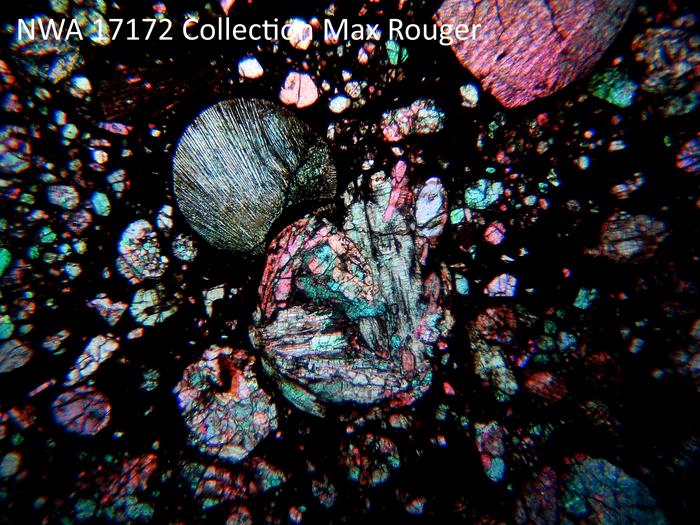
Chondrules are the obvious reward for looking. A thin section may show radial pyroxene chondrules with crystals fanning outward, porphyritic olivine chondrules with larger crystals set in a finer groundmass, barred olivine chondrules with parallel bars, or cryptocrystalline chondrules whose crystals are too fine to separate easily under the microscope.[5] Calcium-aluminum-rich inclusions, or CAIs, are another target because they record refractory material distinct from the ordinary silicate chondrule population.[4]
The thin section is not only a catalog of pretty spheres. It shows whether chondrule margins are crisp or blurred, whether the surrounding matrix is fine and unequilibrated or recrystallized, and whether mineral compositions look optically uniform enough to suggest equilibration. Those observations feed directly into petrologic type. Type 3 ordinary chondrites preserve relatively pristine, unequilibrated chondrules; type 6 material is strongly recrystallized, with chondrule boundaries largely erased; type 5 sits between those endpoints, where chondrules are still recognizable but increasingly integrated into the metamorphosed rock.[6][7]
Shock is visible here too, though it should be described carefully. A weakly shocked sample may show limited optical effects. At stronger shock levels, olivine can show planar fractures, mosaicism, localized melt, or high-pressure mineral indicators; shock stage S1 represents unshocked material with no visible deformation, while S6 represents very highly shocked material with localized melting and high-pressure minerals such as ringwoodite.[7] The practical lesson is that shock stage is not a mood. It is assigned from mineral-scale damage.
Weathering also enters through the microscope, especially for finds from hot deserts or long-exposed surfaces. Rust can spread from metal grains into surrounding silicates. Cracks can fill with terrestrial alteration products. The W scale runs from W0, a fresh fall with metal preserved, through W1 to W3 minor to moderate rust staining, and onward to W4 through W6 where silicate alteration and clay formation increasingly obscure the original texture.[7] A W2 assignment therefore says something modest but important: the meteorite has experienced moderate terrestrial rusting, not a new parent-body process.
This is why thin-section petrography is often the most cost-effective analytical step. It does not replace chemistry, and it cannot by itself deliver every number needed for classification. But it tells the analyst where to place the probe, what alteration to avoid if possible, whether the sample is equilibrated, and whether the candidate is even behaving like the type of meteorite suggested by field screening.
EPMA Turns Mineral Grains Into Classification Evidence
Electron probe microanalysis with wavelength-dispersive spectroscopy, usually shortened to EPMA/WDS, is the quantitative stage that many classification strings quietly depend on. It measures the compositions of individual mineral grains rather than giving a vague whole-rock impression. For ordinary chondrites, the important values include olivine Fa%, or fayalite content; pyroxene Fs%, or ferrosilite content; and feldspar An%, or anorthite content.[8]
Those abbreviations are compact, but they are not decorative. Olivine is a solid-solution series between magnesium-rich forsterite and iron-rich fayalite. Fa% states the iron-rich fayalite component in the analyzed olivine grain. Pyroxene receives a comparable Fs% value for the ferrosilite component. In equilibrated ordinary chondrites, repeated analyses of suitable grains should cluster in a way that supports a chemical group rather than leaving the sample to be judged by eye.
The H, L, and LL ordinary chondrite groups began with metal abundance and chemistry, but modern classification relies on mineral compositions as well. H chondrites are high in metal, with about 12–21% free metal; L chondrites have about 5–10%; LL chondrites have very little free metal.[9] EPMA values for olivine and pyroxene provide the finer chemical support needed to distinguish those groups reliably, especially after weathering has rusted metal or obscured hand-sample clues.[8][9]
The order matters. A student may want to jump from “magnetic” to H chondrite because H means high iron. That skips too much. Magnetism tells you that metal or magnetic minerals may be present. Thin section shows how metal, silicates, chondrules, matrix, shock, and weathering relate. EPMA then tests mineral chemistry grain by grain. Only the combined evidence can support the H in H5 S2 W2.
EPMA is powerful because it is specific, not because it is automatic. The analyst must choose appropriate grains, avoid obvious alteration when the goal is primary mineral chemistry, collect enough measurements to see whether the mineral population is equilibrated, and compare the results with established ordinary chondrite ranges. A bad mount, an altered grain, or a poorly chosen spot can still generate numbers. The numbers become evidence only when they answer the petrographic question already on the table.
Reading H5 S2 W2 as a Compressed History
Now the code can be read without treating it as a password. In H5 S2 W2, the H identifies the ordinary chondrite chemical group: high iron, supported by metal abundance and mineral chemistry. The 5 is the petrologic type: the rock experienced enough thermal metamorphism on its parent body that mineral compositions equilibrated and chondrule boundaries became less distinct, but the chondrules were not completely erased. S2 records very weak shock. W2 records moderate terrestrial rusting.[6][7]
| Part of the code | What it describes | Evidence that supports it |
|---|---|---|
| H | High-iron ordinary chondrite group | Metal abundance plus olivine Fa% and pyroxene Fs% from EPMA/WDS |
| 5 | Petrologic type 5 thermal metamorphism | Thin-section textures, chondrule boundary preservation, recrystallization, and equilibrated mineral compositions |
| S2 | Very weak shock | Microscopic shock effects in minerals rather than hand-sample appearance |
| W2 | Moderate terrestrial weathering | Rust staining and alteration around metal grains and cracks |
Petrologic type is often the part students blur with weathering, so keep the environments separate. Petrologic type records parent-body alteration and metamorphism. Type 1 material is hydrated and lacks chondrules, as in CI chondrites; type 3 is unequilibrated and preserves relatively pristine chondrules; type 6 is fully recrystallized, with chondrule boundaries gone.[7] Weathering grade records what happened after the meteorite arrived on Earth. A meteorite can be thermally metamorphosed on its parent body and then only lightly weathered on Earth, or it can preserve early textures but be heavily altered after terrestrial exposure.
Shock stage is separate again. An S2 designation does not mean the meteorite is “less evolved” than a type 5, and W2 does not mean the same amount of damage as S2. The three scales describe different histories: heating and equilibration, impact deformation, and terrestrial alteration. The classification string works because it keeps those histories adjacent without pretending they are the same process.
There is one more caution about classification language. The broad labels stony, stony-iron, and iron are historical categories and do not always map neatly onto genetic origin. Modern classification is more nuanced; for example, the classification literature notes cases such as CB-group chondrites with more than 50% metal that complicate old category boundaries.[7] The code is useful, but it is not a complete family tree.
When Classification Is Not the Last Question
For many teaching specimens, a well-supported classification is the appropriate endpoint. The lab has documented the sample, screened it, examined the thin section, measured key minerals, and assigned a code that other researchers can understand. More advanced methods enter when the question changes from “What is this meteorite?” to “What does it reveal about parent bodies, reservoirs, timing, and exposure?”
Oxygen isotope analysis compares ratios such as δ18O, δ17O, and Δ17O to relate meteorites to parent-body reservoirs. ICP-MS can measure trace elements and rare-earth elements for petrogenetic modeling. Noble gas analysis and radiometric dating can address cosmic-ray exposure ages and formation ages.[10] These methods are not routine replacements for petrography and EPMA; they answer larger questions once the basic identity of the material has been constrained.
Weathering can still complicate those later questions. Terrestrial alteration may disturb some chemical systems, fill cracks, replace primary material, or make a specimen less representative of its parent-body history. That is another reason the early stages matter. A careful field record, thin section, and mineral chemistry do not merely produce a label; they tell later analysts which parts of the specimen are trustworthy for more demanding work.
The main study habit is to keep each stage in its lane. Field documentation preserves context. Screening filters candidates. Thin-section petrography reveals texture, chondrules, inclusions, shock, recrystallization, and weathering. EPMA quantifies mineral chemistry. Classification combines those observations into a standardized label. Advanced geochemistry then asks origin and timing questions that the label alone cannot answer. H5 S2 W2 is short because the work behind it has already been organized.
References
- What are Meteorites? — NASA ARES.
- How do scientists study meteorites? — Astronomy Magazine.
- Meteorite testing — Washington University in St. Louis.
- The Structure and Composition of Meteorites — LPI/USRA.
- Meteorite petrography and metallography — Lin Yangchen.
- Systematics and Evaluation of Meteorite Classification — Weisberg, McCoy & Krot. 2006.
- Meteorite classification — Wikipedia.
- EPMA analysis for a meteorite — Meteoritic.org.
- Chemical composition of stony meteorites — Washington University.
- Meteorites demystified: A beginner's guide (Part 2) — Deposits Magazine. 2021.
Comments
Join the discussion with an anonymous comment.