

Why Spain's Marcha Real Has No Official Lyrics
Spain's national anthem, the Marcha Real, has no official lyrics despite over 265 years of history and multiple attempts to add them. This article explains the historical and political reasons behind the wordlessness, from its 1761 origins to the failed contests and the current status as one of only four wordless anthems.
Updated:
During Spain’s 2026 World Cup run, the camera kept finding the same small puzzle before kickoff: players lined up, shoulders squared, crowd roaring, and then no one singing. Search traffic followed the silence. Explainers from USA Today, AS USA, and Goal.com all treated the scene as something viewers wanted answered in real time: why does Spain stand through a national anthem with no words? [1][2][3]
The direct answer is simple: Spain’s national anthem, the Marcha Real, has no official lyrics. The more useful answer, especially for a paper or presentation, is that Spain did not merely forget to add them. People have tried. Governments, poets, Olympic officials, performers, and ordinary citizens have all tried in different ways. The attempts failed because lyrics do what instrumental music can avoid: they choose a language, a political memory, a version of patriotism, and often a side.
That is why the history of the Marcha Real’s wordless status is not really a missing-text story. It is a consensus story. The melody is old, official, and carefully regulated. The words are absent because no set of words has been able to belong to Spain without also seeming to belong too much to one Spain.
The anthem began as a military march, not a song
The earliest known source for the melody is not a romantic poem or a revolutionary hymnbook. It is a 1761 Spanish military manual, the Libro de la Ordenanza de los Toques Militares de la Infantería Española, associated with Manuel de Espinosa de los Monteros. In that setting, the tune appears as the Marcha Granadera, a grenadier march, which helps explain why its first life was ceremonial and military rather than lyrical. King Charles III declared it the official Honor March on September 3, 1770. [4]
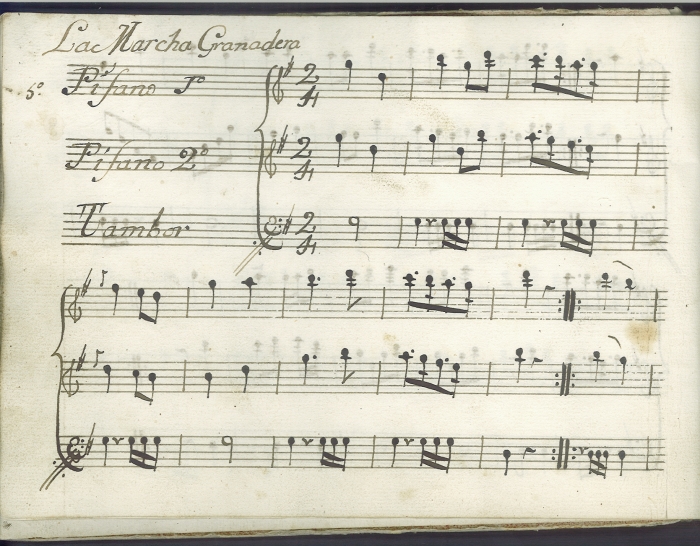
There is a small caution here. The 1761 manual is the earliest firm documentary point, but composer attribution is not as clean as patriotic storytelling often wants it to be. Espinosa is the name attached to the manual, and that is the safest way to discuss the source; older claims that Frederick the Great of Prussia composed the tune belong more to later myth than to secure evidence. For the question of lyrics, however, the important fact is plainer: the Marcha Real entered Spanish public life as a march that did not need sung words to function.
That origin matters because some national anthems begin as texts that acquire music, while Spain’s began as official sound: a signal, a ceremony, a piece of state presence. Words could be added later, but they would be additions, not the anthem’s foundation.
The first big lyric search failed before modern Spain existed
One reason the “Spain has no lyrics” fact is often misunderstood is that people assume no one took the issue seriously. The record says otherwise. In 1870, after Queen Isabella II had been overthrown and Spain was searching for political form as well as national symbols, an open competition sought lyrics for the anthem. More than 400 entries were submitted, but none was selected, and no official lyrics came out of the contest. [5]
That failed contest is a useful early clue. This was not yet the Spain of Franco, the 1978 Constitution, or the present-day debates over Catalan and Basque nationalism. Yet even then, attaching language to the anthem proved difficult. A melody can pass through a political transition more easily than a poem can. A poem announces what the nation is supposed to mean.
The Marcha Real’s official life was also not continuous in a simple straight line. During the Second Republic, Spain used the Himno de Riego instead of the Marcha Real from 1931 to 1939. Franco reinstated the Marcha Real in July 1942. [4] That interruption is not a side note; it is part of why later lyrics were so hard to separate from regime memory.
Pemán’s words were heard, but they were not official
The most famous almost-lyrics are the ones associated with José María Pemán, the poet whose text was used de facto during the Franco era. This is where accuracy matters. Pemán’s lyrics were not formally adopted as Spain’s official anthem lyrics, even though many people associate them with the regime and with public ceremonies of that period. [6][7]

That distinction may sound technical, but it changes the meaning of the story. If Pemán’s words had been official national lyrics, the democratic transition would have faced the problem of repealing or replacing a fixed text. Instead, Spain inherited something more awkward: a melody that was legally and ceremonially usable, plus lyrics many people remembered as Francoist without those lyrics having the status of official law.
For a democratic Spain trying to move beyond dictatorship, the easiest shared decision was not to rehabilitate those words. But replacing them with new ones was not easy either. Any new text would have to speak across monarchists and republicans, centralists and regional nationalists, Castilian Spanish speakers and citizens whose first political language might be Catalan, Basque, Galician, or another regional identity. The blank space was politically useful because it did not force that negotiation into every ceremony.
The 1997 decree made the silence official
Spain’s anthem is sometimes described as if it were vague or unfinished. Legally, it is the opposite. Royal Decree 1560/1997, dated October 10, 1997, set the official version of the Marcha Real: B-flat major, quarter note equals 76, 16 bars, AABB form, and an official duration of 52 seconds, in an arrangement by Francisco Grau. The state also purchased rights from the Pérez Casas estate for 130 million pesetas, roughly €782,000. [4][8]
There are practical variations in performance. Some sports broadcasts use a shorter version, and modern explainers sometimes give different durations, including about 40 seconds or just over a minute depending on the setting and source. The legal point remains that the official anthem is an instrumental work. Spain specified the music in detail and still did not specify words.
| Date or period | What happened | Why it matters for the no-lyrics question |
|---|---|---|
| 1761 | The Marcha Granadera appears in a Spanish military manual. | The anthem’s earliest firm source is instrumental and ceremonial. |
| 1770 | Charles III declares it the official Honor March. | The melody becomes tied to state ceremony before any official lyrics exist. |
| 1870 | A lyric contest receives more than 400 entries, but none is chosen. | The problem is not lack of effort; consensus fails early. |
| 1931–1939 | The Second Republic replaces it with the Himno de Riego. | The anthem becomes entangled with regime change. |
| July 1942 | Franco reinstates the Marcha Real. | Later lyric debates inherit dictatorship-era associations. |
| 1997 | Royal Decree 1560/1997 fixes the official instrumental version. | The modern legal anthem remains wordless by design. |
| 2007–2008 | An Olympic Committee lyric contest collapses after public opposition. | A democratic attempt also fails under political pressure. |
The Olympic contest showed the problem had not disappeared
The clearest modern test came in 2007–2008, when the Spanish Olympic Committee tried to solve the anthem problem before the Beijing Olympics. The contest drew thousands of submissions; sources vary widely, giving figures from about 2,000 to roughly 7,000 entries. That range should be reported as a range, not flattened into a single certain number. [4][9]
The selected lyrics were written by Paulino Cubero, and Plácido Domingo recorded the winning entry. For a moment, this looked like the kind of compromise a modern state might be able to stage: a public competition, a respected performer, Olympic timing, and words meant to be broad rather than partisan. Then the project collapsed. The lyrics were withdrawn after five days amid opposition that included Catalonian and Basque criticism. [4][9]
That five-day lifespan is the heart of the modern question. The problem was not that Spain lacked poets. It was not that citizens were indifferent. It was that a text broad enough to sound harmless to one group could still sound like ownership to another. In a country where language and region are not decorative details but political realities, even a gentle national lyric has to decide whose vocabulary of belonging it will use.
The Olympic Committee effort also reveals why official lyric projects carry more risk than casual proposals. A singer can perform words and be praised or mocked. A school can teach a song informally. But an official anthem text asks citizens to stand and voice it as the nation. The moment the state asks for everyone’s mouth, silence can become the less coercive option.
Marta Sánchez’s 2018 lyrics were an echo, not a solution
The issue returned in 2018 when pop singer Marta Sánchez performed her own lyrics for the anthem. The proposal received attention, but also widespread mockery and resistance. [6] Its importance is not that it nearly became official; the available record does not support treating it that way. Its importance is that the public reflex was still alive. Even outside a formal state process, new words for the Marcha Real could quickly become a fight over what kind of Spain was being sounded.
By then, the instrumental anthem had acquired its own kind of legitimacy. People knew how the ritual worked. Athletes could stand. Bands could play. Crowds could listen or hum. No one had to agree on a text in order for the ceremony to proceed. That makes Spain unusual, but not disorganized.
Spain is unusual, but not alone
As of 2026, Spain is one of four countries whose national anthems have no official lyrics: Spain’s Marcha Real, Bosnia and Herzegovina’s Intermeco, Kosovo’s Europa, and San Marino’s Terra di Libertà. Older lists often name only three because San Marino’s case changed in newer 2025–2026 lists, after the anthem was retitled in September 2025. [9][10]
The comparison is helpful only up to a point. Bosnia and Kosovo have their own post-conflict and multiethnic contexts. San Marino’s case follows a different path. Spain’s case is older and more layered: a Bourbon-era march, republican replacement, Francoist reinstatement, democratic codification, and repeated lyric failures. The shared category is “wordless anthem,” but the reasons are not interchangeable.
Why the missing words still work
For students, the safest thesis is this: the Marcha Real has no official lyrics because every serious attempt to add them has run into Spain’s unresolved political identities. The 1870 contest failed to produce an accepted text. Pemán’s Franco-era lyrics became historically burdened without becoming official. The 2007–2008 Olympic Committee contest showed that even a democratic, public process could collapse almost immediately under regional opposition. The 2018 Marta Sánchez proposal showed that informal enthusiasm still did not equal consensus.
None of that means Spaniards lack national feeling. It means the anthem’s instrumental form lets different citizens stand inside the same ceremony without having to pronounce the same political sentence. A flag can be seen differently by different people at the same time. A melody can carry memory without naming it. Lyrics are less forgiving.
That is the paradox that makes the Marcha Real more than a trivia answer. Spain’s anthem works as a shared national symbol partly because it leaves the most contested part unsaid.
References
- Spain national anthem lyrics World Cup, USA Today, July 14, 2026, https://www.usatoday.com/story/sports/soccer/worldcup/2026/07/14/spain-national-anthem-lyrics-world-cup/90918938007/
- Why are Spain’s players not singing? The reason why the Spanish national anthem has no lyrics, AS USA, https://en.as.com/soccer/why-are-spains-players-not-singing-the-reason-why-the-spanish-national-anthem-has-no-lyrics-f202607-n/
- 2026 World Cup: Spain - Why isn’t anyone singing along to the Spanish national anthem?, Goal.com, https://www.goal.com/en-us/lists/2026-world-cup-spain-why-isn-t-anyone-singing-along-to-the-spanish-national-anthem/6784704
- Marcha Real, Wikipedia, https://en.wikipedia.org/wiki/Marcha_Real
- Spain, nationalanthems.info, https://nationalanthems.info/es.htm
- Why doesn’t Spain’s national anthem have any words?, Classic FM, https://www.classicfm.com/discover-music/periods-genres/national-anthems/spanish-national-anthem-no-words/
- The history of the Spanish national anthem, Fascinating Spain, January 30, 2023, https://www.fascinatingspain.com/articulo/spanish-culture/history-spanish-national-anthem/20230130033059070413.html
- What is Spain’s national anthem and why doesn’t it have lyrics?, Classical Music, https://www.classical-music.com/articles/what-is-spains-national-anthem-and-why-doesnt-it-have-lyrics
- Which Countries’ National Anthem Has No Words?, World Atlas, https://www.worldatlas.com/society/which-countries-national-anthem-has-no-words.html
- The national anthems of these countries have no official lyrics, Indulge Express, June 13, 2026, https://www.indulgexpress.com/msociety/2026/Jun/13/the-national-anthems-of-these-countries-have-no-official-lyrics
Comments
Join the discussion with an anonymous comment.