
How Archaeologists Study a Bronze Age Ritual Offering Sword
Learn how archaeologists determined that a 2,700-year-old bronze sword found upright in a Polish forest was a deliberate ritual offering through depositional context, typological dating, value estimates, and a planned scientific analysis pipeline.
Updated:
What makes the Gdańsk sword useful for students is not simply that a Bronze Age weapon was found in a Polish forest, but that the detectorist stopped, left it in place, and reported it. That restraint preserved the position, depth, and surrounding soil layers that archaeologists need before they can argue for deliberate deposition rather than accident.[1]
Why the Position Carries the Argument
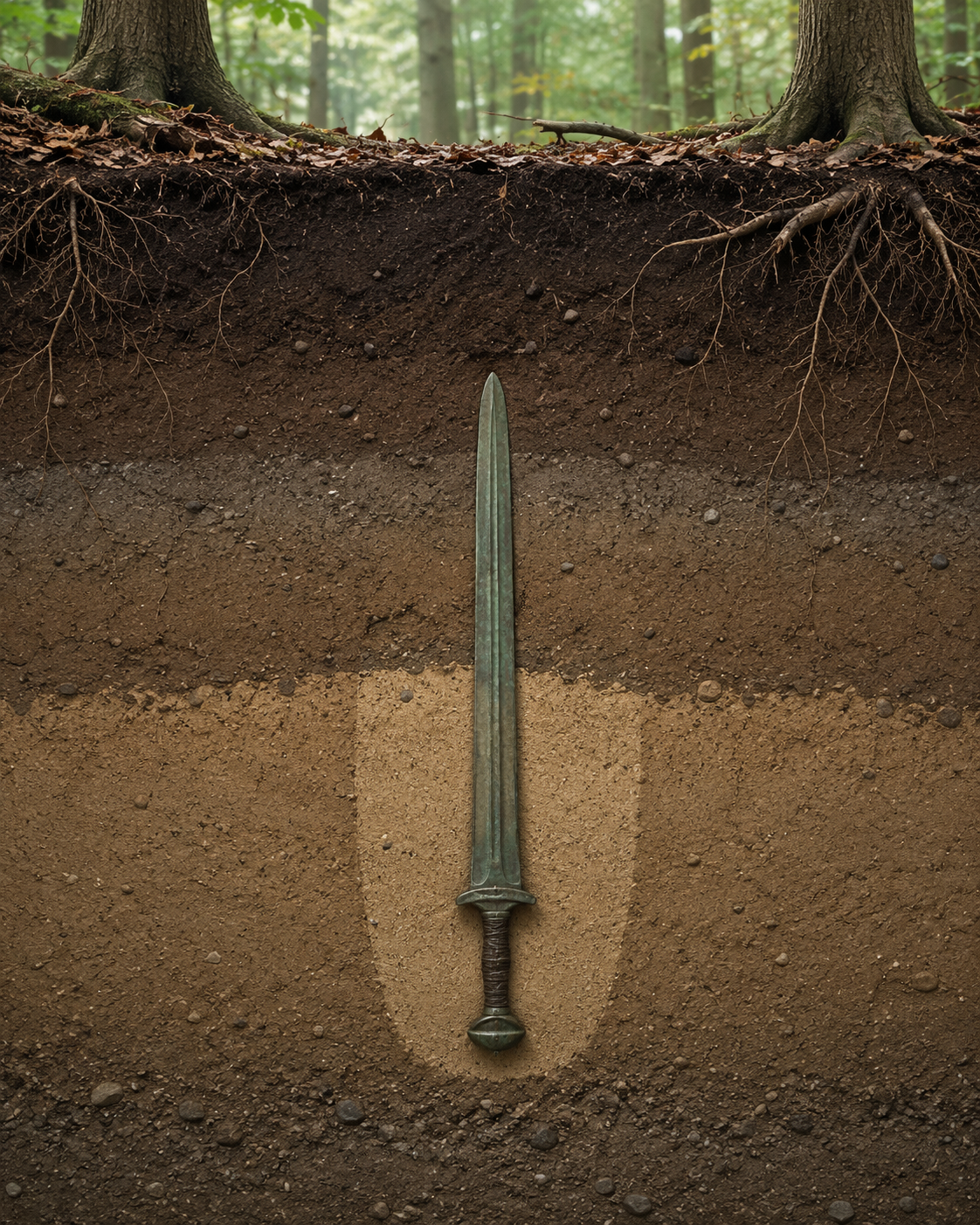
The load-bearing fact is the sword's upright, isolated placement: blade up, handle down, with no other artifacts nearby and no burial context around it.[2] That combination is very different from a weapon dropped in use, discarded with debris, or disturbed by later digging. A dropped object tends to land flat or at least at an angle that follows the force of the fall; this blade was set vertically into the ground and then left there.
Archaeologists do not begin with the object's beauty or rarity. They begin with disturbance history, association, and placement. Here, the context is unusually clean: the sword was found standing alone at roughly 60 cm deep, and the surrounding deposit did not contain a cluster of grave goods or a messy concentration of other tools that might point to settlement trash or a disturbed burial.[1][2] That makes deliberate deposition more plausible than casual loss, even before any lab work begins.
What Typology and Value Add
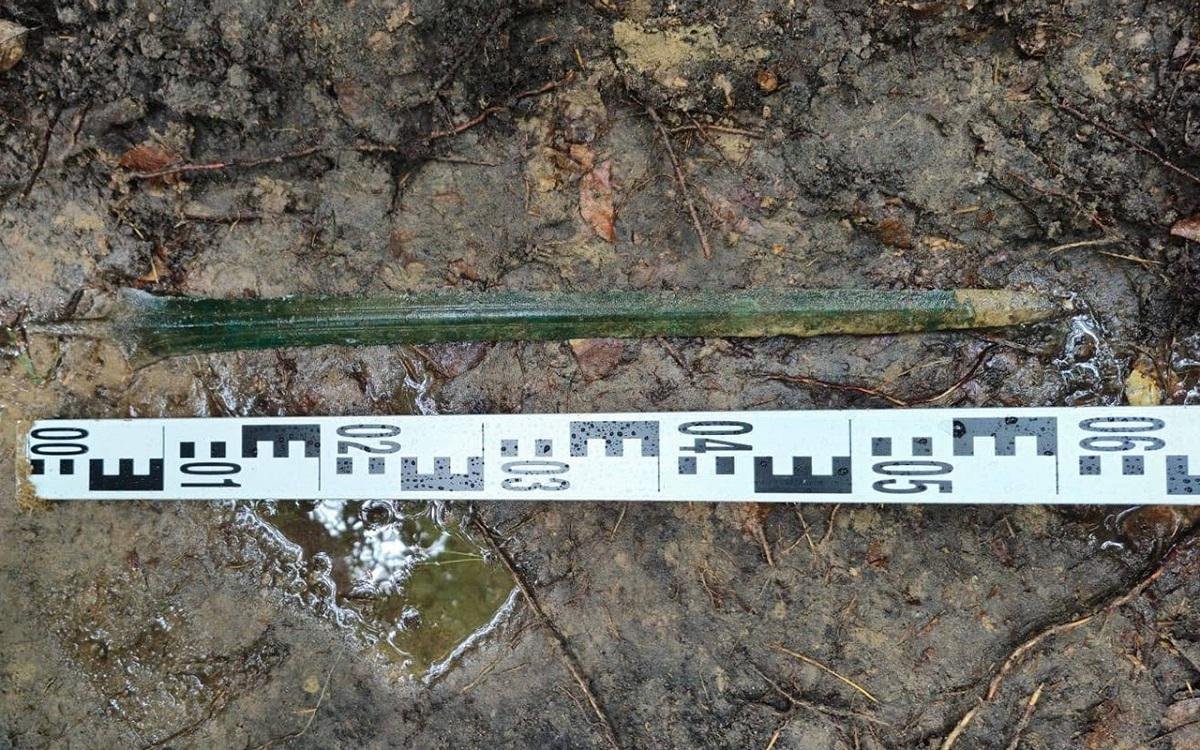
Typology narrows the interpretation without pretending to settle it. The sword is about 60 cm long, with a tang hilt, decorative grooves, engraved arcs, and short crosswise lines. On those features, HeritageDaily places it in Late Bronze Age forms of the 4th and 5th periods, roughly 900-700 BCE, while noting that conservation may sharpen that reading once the patina is removed.[1] That matters because a date by itself does not prove ritual use, but it does place the object in a world where formal deposition of metal was already part of social practice.
The value estimate works in the same way: it does not prove intent, but it makes intent harder to dismiss. Poland's State Forests, as reported in media coverage, compared the sword's worth to an entire herd of cattle.[3] Even treated cautiously as a secondary-source estimate, that is a vivid way to show students that this was not a trivial object. If someone chose to place such a weapon in the ground upright and intact, the act carries real economic weight.
What the Lab Work Can Still Test
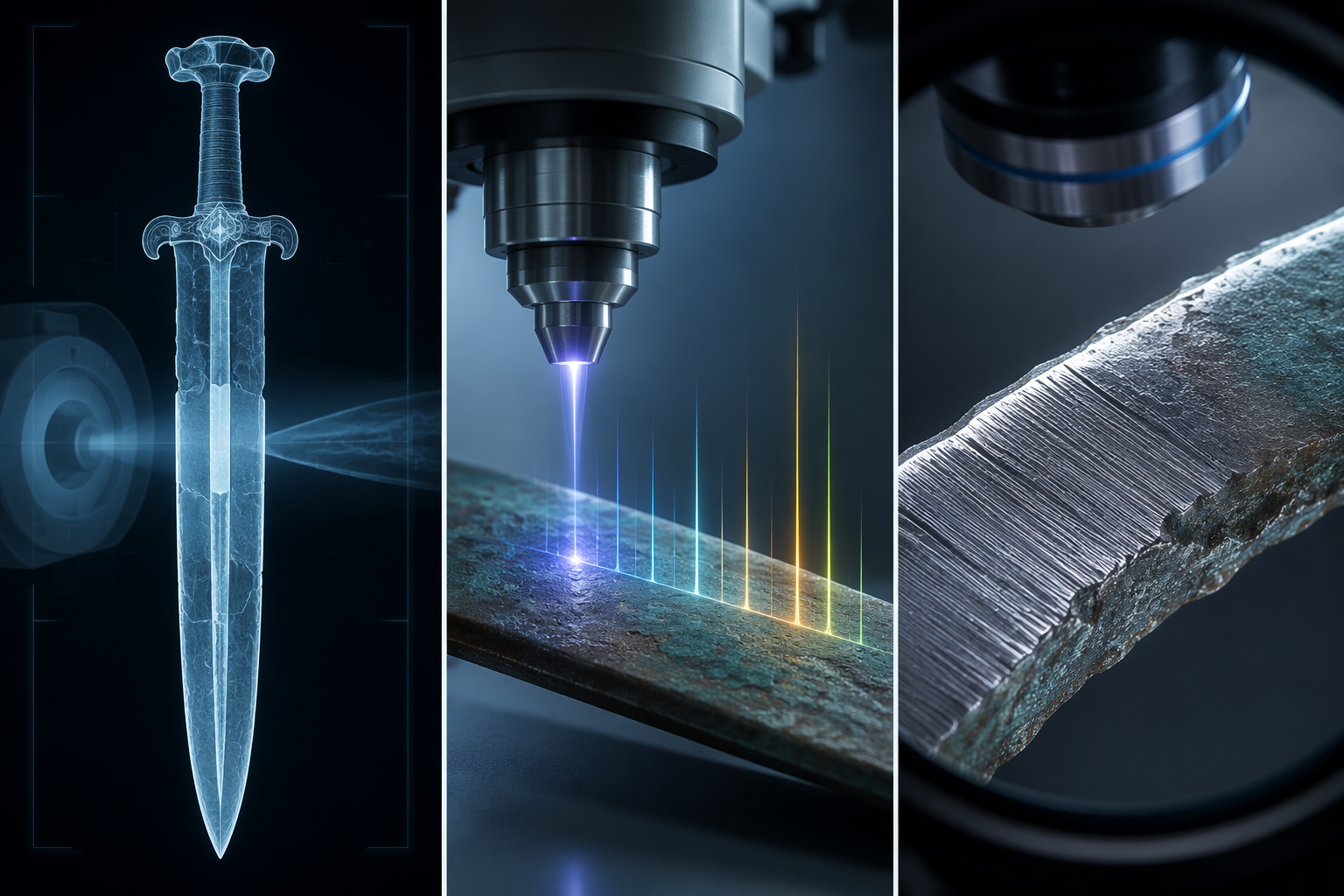
The current interpretation is strong enough to guide the next tests, but not strong enough to replace them. HeritageDaily says researchers plan X-ray imaging to look for hidden structure and repairs beneath corrosion, XRF to measure alloy composition and possible source networks, and microscopic wear analysis to check whether the blade saw combat or shows a cleaner, ceremonial history.[1] None of those results have been published yet, so they should be treated as pending tests, not as proof already in hand.
That timing matters methodologically. If wear analysis finds edge damage consistent with battle use, the sword may still have been offered later; if the blade shows little or no combat wear, the ceremonial interpretation gains support, but only in combination with the depositional context. XRF could also complicate the story by showing whether the metal fits local production, broader exchange, or a more complex supply chain. In other words, the field context starts the argument, and the laboratory work tests how far that argument can go.
Ritual, Routine, and Comparison
The Gdańsk sword is not the only Bronze Age weapon to appear in a deliberate setting. HeritageDaily points to rare upright-standing swords elsewhere in Europe, including the Isle of Shuna in Scotland, a river deposit in Germany, and votive swords from Sardinia, and those comparisons matter because they widen the frame without drowning the case in catalogues.[1][5] Water and wet ground keep recurring in these deposits, which suggests that boundaries between land and water were often treated as meaningful places to leave valuable metal.
Visser's work sharpens the word ritual instead of leaving it as a catch-all. Her 2024 database study argues that Bronze Age metal deposition in parts of Denmark, northwest Germany, and the Netherlands was not necessarily an exceptional, dramatic religious event; it could also have been ordinary community practice, a repeated way of making place and mapping relationships.[4] One of her examples shows objects from Denmark, Central Europe, and Great Britain in a single deposit, which is a useful reminder that a buried object can encode social networks as well as beliefs.
That is why the Gdańsk sword is such a good teaching case. The upright, isolated placement is already the strongest reason to read it as deliberate deposition. Typology places it in the Late Bronze Age, the cattle-herd valuation shows the cost, and the pending lab work can still test use, repair, and alloy composition.
References
- HeritageDaily, Ornate Bronze Age sword discovery was likely a ritual offering, HeritageDaily, June 2026, https://www.heritagedaily.com/2026/06/ornate-bronze-age-sword-discovery-was-likely-a-ritual-offering/158450
- Archaeology News, Bronze Age sword found upright in Polish forest, https://archaeologymag.com/2026/06/bronze-age-sword-found-upright-in-polish-forest/
- People, Archaeologists baffled by 2,700-year-old bronze sword found in Polish forest, https://people.com/archaeologists-baffled-by-2700-year-old-bronze-sword-found-in-polish-forest-12020874
- SciTechDaily, Mysterious Metal Depositions in Bronze Age Europe Were the Most Ordinary Thing in the World, https://scitechdaily.com/mysterious-metal-depositions-in-bronze-age-europe-were-the-most-ordinary-thing-in-the-world/
- Times of India, Scientists found a hidden Bronze Age sword deposit in Germany and it revealed a carefully placed river offering, https://timesofindia.indiatimes.com/science/scientists-found-a-hidden-bronze-age-sword-deposit-in-germany-and-it-revealed-a-carefully-placed-river-offering/articleshow/131827924.cms
Comments
Join the discussion with an anonymous comment.