
Why Does Spain's National Anthem Have No Lyrics?
If you've noticed Spanish players standing silent during the World Cup anthem, you're not alone. This article explains the historical and political reasons Spain's Marcha Real has never had official lyrics — and why that's unlikely to change.
Updated:
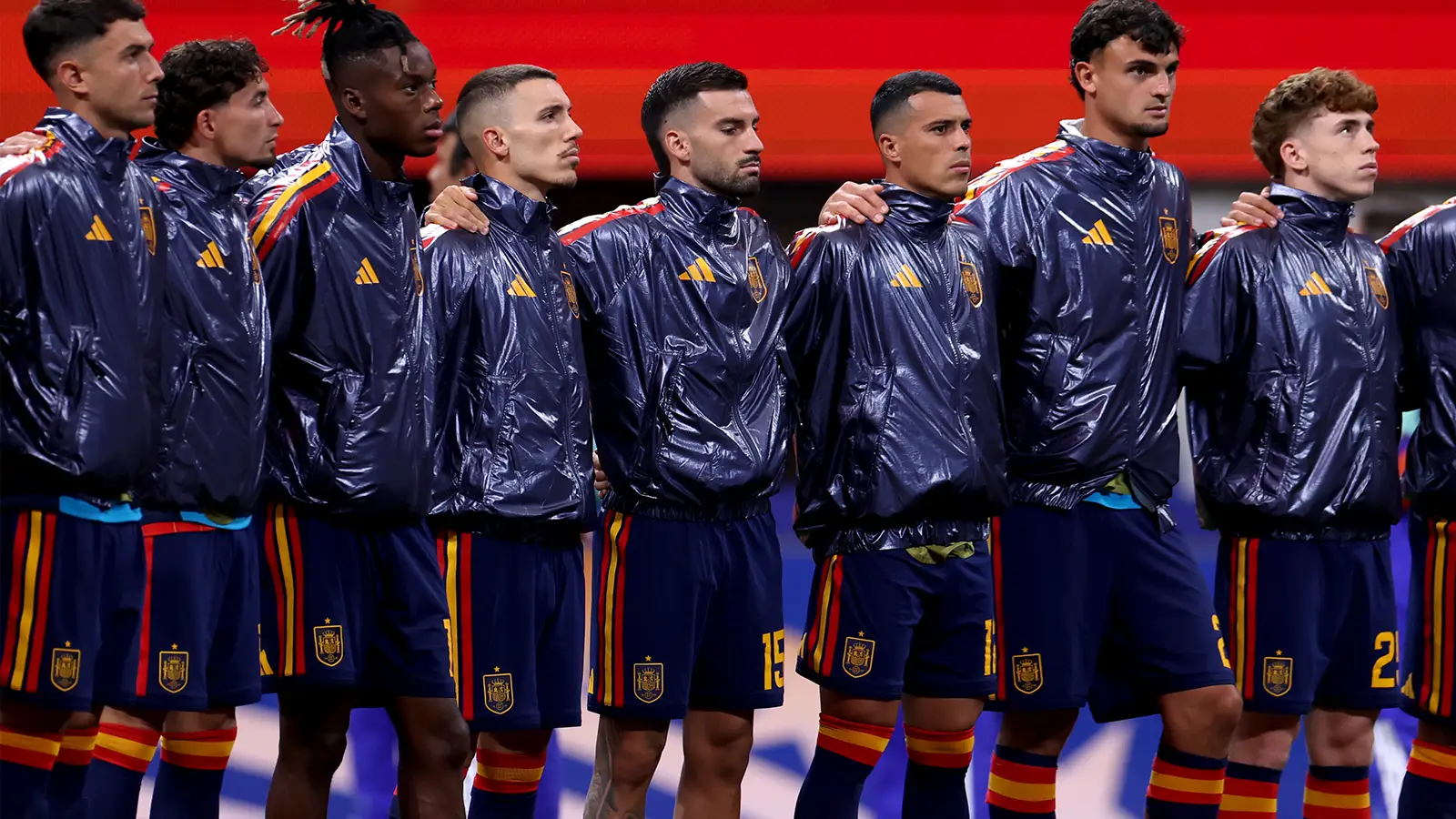
When Spain’s players stood silent during the July 2026 World Cup anthem ceremony, they were not refusing to sing. Spain’s national anthem, the Marcha Real, has no official lyrics. The music plays; the players stand; the cameras wait for mouths that are not supposed to move.[1]
That simple answer is usually where the misunderstanding begins. Spain is not missing anthem words because nobody ever tried to write them. It has no official lyrics because the attempts to give it words have repeatedly run into the same problem: a national anthem lyric does not only describe a country. It decides which version of the country gets placed in everyone’s mouth.
The current official form of the anthem makes that clear. Spain’s Royal Decree 1560/1997 specifies the anthem as music: B-flat major, 76 beats per minute, an AABB structure, and a duration of about 52 seconds.[2] What it does not specify is a text. The official anthem is the march itself.
A March Before It Was a National Song
The Marcha Real began as military music, not as a civic poem. It first appeared in a 1761 military manual and was declared a “March of Honor” by Charles III in 1770.[3] Its composer attribution is not perfectly settled; a later story crediting Frederick the Great of Prussia has circulated for generations, but it is treated as a myth rather than a reliable origin.[3]
That origin matters because many national anthems began as songs people could already shout, hymn, or teach to children. Spain’s anthem moved in the other direction. It became official and ceremonial as an instrumental march first. Words came later, and always with baggage attached.
The first major failure came long before today’s party politics. In 1870, during the government of General Juan Prim, Spain organized a national competition to find lyrics. More than 400 entries were submitted. The jury chose none of them, judging the existing march artistically superior to the proposed texts.[3]
That episode is easy to underread. It was not a social media backlash, not a Catalonia-versus-Madrid television argument, not a post-Franco crisis of symbols. It was a 19th-century institutional attempt that could not find language strong enough, acceptable enough, and usable enough to sit on top of a march that had already become the ceremony.
The Lyrics People Mistake for “Franco’s Official Words”
The most famous unofficial lyrics are associated with José María Pemán, but even here the usual shortcut distorts the history. Pemán wrote lyrics in 1928 under Miguel Primo de Rivera, before Franco’s dictatorship. Under Franco, the text was adapted: one change replaced the line about raising one’s forehead with language about raising one’s arms, and Falangist symbols were added.[3]
The crucial point is that these lyrics were never officially adopted, not even by Franco’s regime.[3] Supporters of the dictatorship often preferred singing “Cara al Sol,” the Falangist anthem, rather than turning the Marcha Real into a fully official sung anthem.[3]
After Spain’s democratic transition and the 1978 Constitution, the Pemán version was abandoned.[3] It did not disappear because people suddenly forgot the tune. It became historically unusable. For many Spaniards, especially those whose families remember repression, exile, censorship, or regional language bans, nationalist anthem language does not arrive as neutral decoration. It arrives with a past.
The Olympic Committee Tried to Solve It. The Words Lasted Five Days.
The most serious modern attempt came in 2007 and 2008, when the Spanish Olympic Committee backed a competition to create lyrics that Spanish athletes could sing at the Beijing Olympics. Depending on the source, the contest received somewhere between 2,000 and 7,000 entries.[3][4] The uncertainty in that number is less important than the scale: this was not one poet sending a patriotic verse to a newspaper. It was an organized national effort.
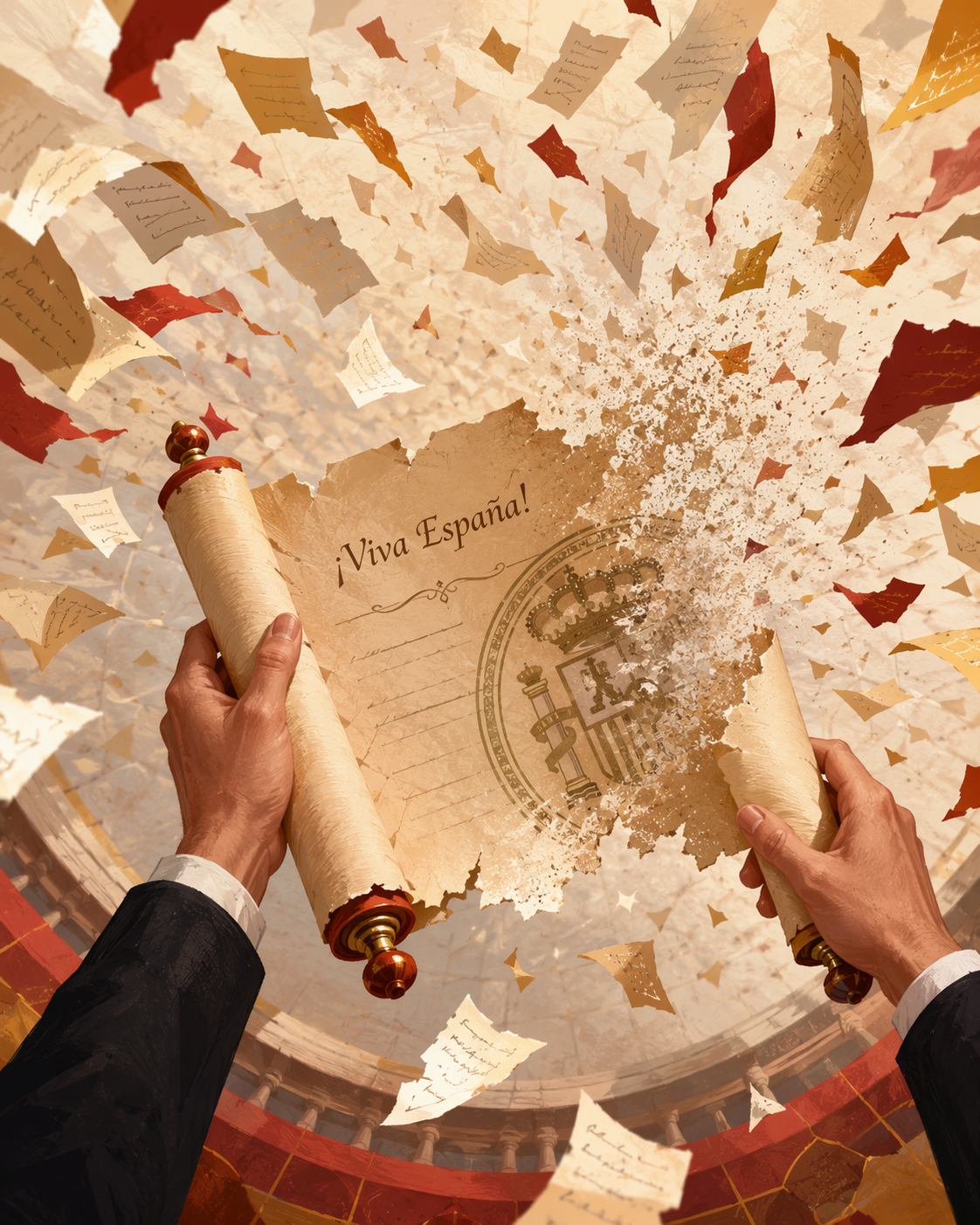
The selected text was written by Paulino Cubero and opened with “¡Viva España!” Plácido Domingo was expected to perform it.[4] On paper, the plan had every ingredient institutions usually trust: a competition, a winning entry, a world-famous singer, an Olympic deadline, and a patriotic setting that seemed safer than a parliamentary fight.
It collapsed within five days. Criticism came from Catalan and Basque nationalists and from across Spain’s political spectrum, and the Olympic Committee withdrew the lyrics before they could become the new ceremonial norm.[4][5]
The phrase “¡Viva España!” was the flash point because it could not be heard the same way by everyone. To one listener, it sounded like ordinary patriotic language. To another, it echoed Franco-era public ritual. To another, it centered a Spanish national identity that did not make room for Catalan, Basque, or Galician self-understanding. The words were short, but the audience was not simple.
That is why the 2007–2008 failure explains more than the older anecdotes do. The problem was not that the winning lyric was too clumsy, too poetic, or not poetic enough. The problem was that a lyric for Spain has to pass through several audiences at once: state institutions, athletes, conservative patriots, left-wing republicans, regional nationalists, families marked by dictatorship, and citizens who may feel Spanish and Catalan, Spanish and Basque, Spanish and Galician, or not comfortably Spanish at all.
An instrumental anthem lets those audiences stand in the same ceremony without making them pronounce the same political sentence. A lyric removes that ambiguity. Once words are printed, taught, sung, and televised, they stop being a melody and become a test.
Why “Just Write Neutral Lyrics” Has Not Worked
The obvious student answer is to make the lyrics neutral: no king, no army, no Franco-era slogans, no loaded religious language, no attack on any region. But Spanish anthem debates do not break only over extreme language. They break over what counts as neutral.
Language itself is one difficulty. A Spanish-language anthem may look practical because Castilian Spanish is the state language and the most widely understood language in the country. But Spain also includes Catalan, Basque, Galician, and other linguistic identities. For some citizens, being asked to sing national unity only in Spanish can feel less like inclusion than translation into someone else’s center.[3]
The dictatorship is another difficulty. Franco’s regime used national symbols aggressively, and that history makes certain patriotic phrases unstable even when they are not formally fascist. A word like “Spain” is not the issue by itself. The issue is the frame around it: glory, unity, arms, destiny, sacrifice, obedience. One generation may hear ceremony. Another may hear command.
Then there is the left-right divide over national symbols. In many countries, anthem rituals allow disagreement to hide under shared words. In Spain, the shared words are exactly what have failed to hold. The flag, monarchy, republican memory, regional autonomy, and the meaning of the transition to democracy all sit close to the anthem question. A lyric that tries to avoid every fight can become so thin that nobody wants it; a lyric that says something concrete immediately asks who is being asked to accept it.
That does not mean Spaniards cannot feel pride when the anthem plays. Plenty do. It means pride is not evenly packaged. A footballer standing still before a match may be carrying a family history, a regional identity, a political caution, or nothing more dramatic than the fact that there are no official words to sing.
Private Lyrics Keep Appearing
The absence of official lyrics has not stopped people from proposing their own. In 2018, pop singer Marta Sánchez performed self-written lyrics to the anthem at a boxing match, sparking another national debate about who has the authority to put words to the march.[3]
That incident followed the same pattern in smaller form. A private performance can move some listeners because it offers emotional release: finally, words. But an anthem is not only a performance. It is something schoolchildren may be expected to learn, athletes may be judged for singing or not singing, and citizens may be asked to treat as common property. The distance between “I like these lyrics” and “these are our lyrics” is where Spain’s attempts keep failing.
Spain Is Unusual, But Not Alone
Spain is one of only four countries whose national anthem has no official lyrics, alongside San Marino, Bosnia and Herzegovina, and Kosovo.[6] That makes the Marcha Real unusual, especially for a country whose athletes and footballers are so visible internationally.
There is also a useful comparison in the European Anthem, which uses Beethoven’s “Ode to Joy” melody without official sung lyrics in EU ceremonies. The reason is not identical, but it is related: in a multilingual political community, choosing one language or one text can create a hierarchy the music avoids.[5]
Spain’s silence, though, is more historically charged than a multilingual administrative compromise. It has survived royal ceremony, liberal nation-building, dictatorship, democratic transition, Olympic branding, pop-star improvisation, and global football broadcasts. Each time lyrics come close to becoming official, they stop being merely lyrical.
So Why Does Spain’s National Anthem Have No Lyrics?
Spain’s national anthem has no official lyrics because no proposed text has ever achieved enough historical, political, and cultural consensus to become usable for the whole country. The anthem began as a military march; a major 1870 competition failed to produce accepted words; the Pemán lyrics became tied to authoritarian memory without ever becoming official; and the most organized modern attempt, the 2007–2008 Olympic Committee competition, was withdrawn almost immediately under public criticism.
So when Spain’s players stand silent, the silence is not empty. It is the part of the ceremony that has survived. For now, the wordless march is the only national version broad enough to let millions hear Spain without forcing them all to sing the same definition of it.
References
- Why are Spain’s players not singing? The reason why the Spanish national anthem has no lyrics, AS USA
- What is Spain’s national anthem and why doesn’t it have lyrics?, Classical Music
- What happened to Spain’s national anthem lyrics, European Correspondent
- Spanish national anthem words spark controversy, DW
- Why doesn’t the Spanish national anthem have any words?, Classic FM
- Which Countries’ National Anthems Have No Words?, World Atlas
Comments
Join the discussion with an anonymous comment.