
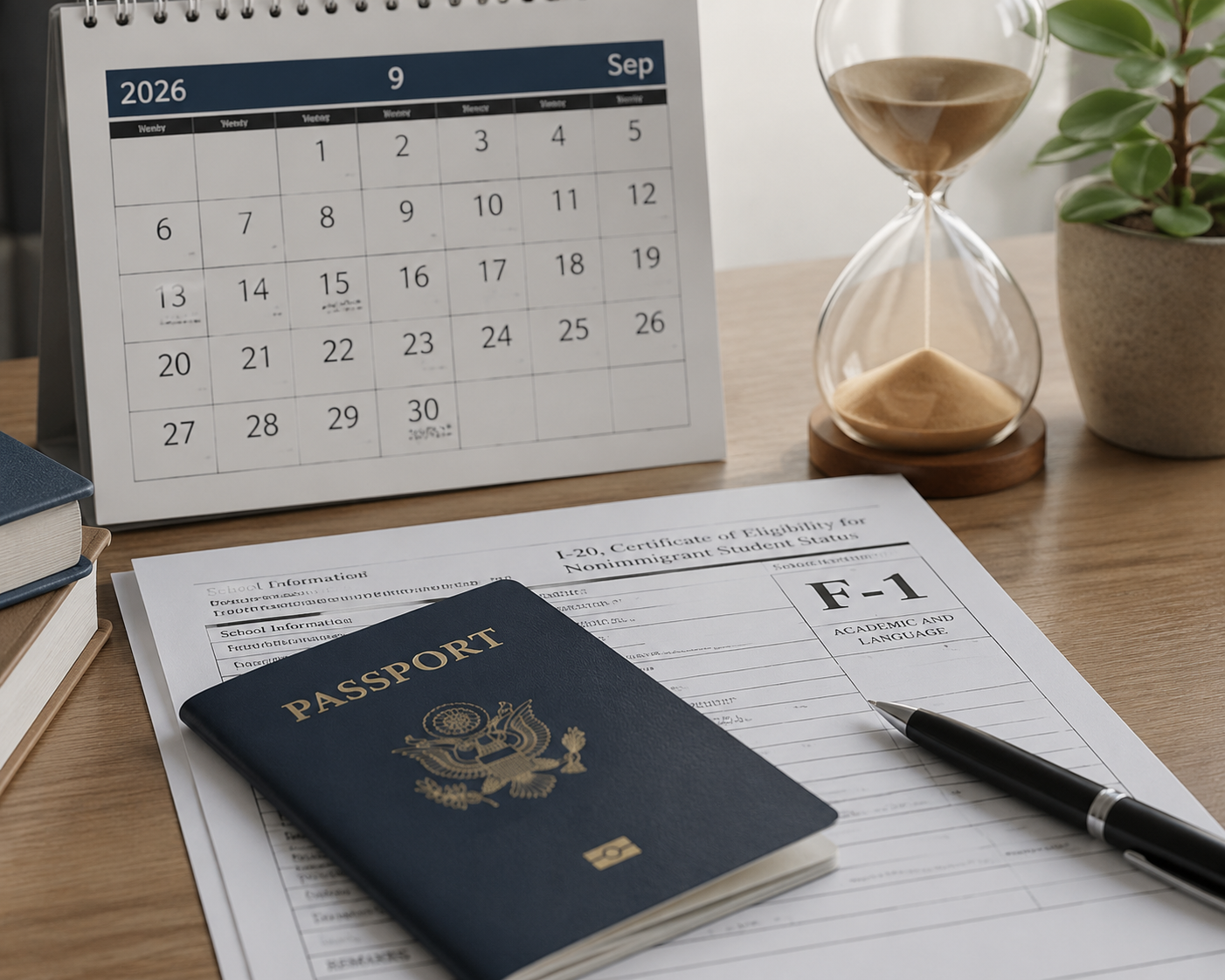
What International Students Face Under the 4-Year Visa Limit
The Trump administration's 4-year student visa cap, effective September 15, 2026, replaces Duration of Status with fixed admission periods, a shorter grace period, and stricter extension rules. This article explains who is affected, what changes, and what steps international students should take now.
Updated:
If you are an F-1 or J-1 student, the first question is not simply whether the new four-year limit affects you. It is where you will be in the system on September 15, 2026: already admitted in Duration of Status, newly entering after that date, or enrolled in a program that is likely to run beyond four years. The final rule was published on July 17, 2026, and takes effect September 15, 2026; it replaces the long-running Duration of Status model for F, J, and I categories with fixed admission periods, after a D/S system that had been in place since 1991.[1][2]
That date matters because students are not all being moved into the new system in the same way. A senior finishing a bachelor’s degree in May 2027, a new master’s student entering in January 2027, an ESL student, and a third-year PhD student with two dissertation years left may all hear “four-year limit,” but they do not have the same legal problem.
What changes on September 15
Under Duration of Status, an F-1 student was generally admitted for the time needed to complete an authorized program, so long as the student maintained status and kept the school record current. The I-20 end date mattered, SEVIS records mattered, and unauthorized breaks in status mattered, but there was not a fixed admission clock stamped at entry in the same way.
The new rule changes that operating assumption. F-1 and J-1 students will be admitted for a fixed period, generally capped at four years. Students whose authorized study needs more time must seek an extension, normally through Form I-539, before the fixed period expires. That filing is not a campus form. It goes to USCIS, carries fees and biometrics requirements, and depends on USCIS accepting the student’s reason for needing more time.
| Student position on September 15, 2026 | What the rule means first | Main risk to watch |
|---|---|---|
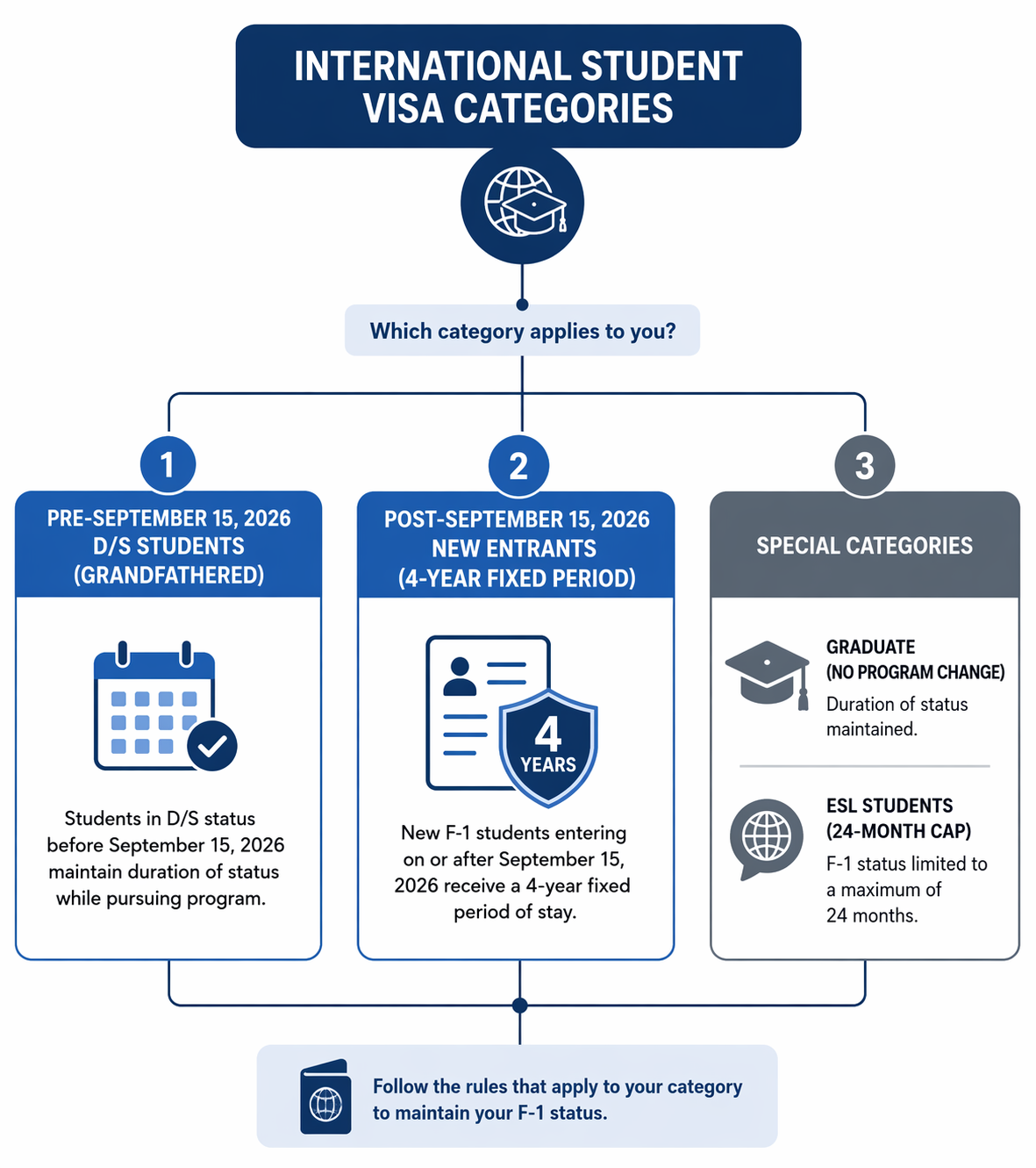
| Already admitted with D/S before September 15 | You may remain until your program end date or up to four years from the effective date, whichever is shorter | Missing the point when an I-539 extension becomes necessary |
| Entering after September 15 | You enter under the fixed admission period rather than D/S | Assuming the I-20 program length alone protects you past the admission period |
| Graduate-level F-1 student | You face the fixed period plus a separate bar on changing programs during the program of study | Treating normal academic redirection as harmless when the rule treats it as restricted |
| ESL student | F-1 English-language study is capped at 24 months total | Planning language study as an open-ended bridge to another program |
If you already have D/S before the effective date
The transition rule is the part current students should read slowly. Students admitted with D/S before September 15, 2026, can remain until their program end date or up to four years from the rule’s effective date, whichever is shorter, before they need an I-539 extension.[3]
For a student whose I-20 ends in May 2027, that may mean the program end date remains the nearer date. For a doctoral student whose current I-20 runs well beyond September 2030, the four-year transition window may become the outer limit before an extension filing is needed. The practical step is not to guess from the phrase “grandfathered.” Pull up the current I-20 or DS-2019, look at the program end date, and compare it with the transition window.
A student who was properly admitted in D/S before September 15 is in a different position from a student who first enters after that date. That difference is important enough to document. Keep copies of the I-94 showing D/S admission, current and previous I-20s or DS-2019s, and any school-issued records showing the program timeline. If you later need an extension, those records help explain what your authorized plan was before the rule changed.
The extension filing is where the new burden lands
The four-year cap does not mean every student must finish every possible academic path in four years. It does mean that time beyond the fixed admission period is no longer handled mainly through the school’s SEVIS update. The student must ask USCIS for more time.
The final rule says extensions may be supported by a compelling academic reason, documented illness, or circumstances beyond the student’s control. It also identifies reasons that do not qualify, including academic probation, suspension, or a repeated inability or unwillingness to complete the course of study.[1]
That distinction will matter in ordinary student life. A lab shutdown, adviser departure, required fieldwork delay, serious illness, or curriculum change may need to be written up clearly and supported with documents. A vague statement that the degree is taking longer than expected may not be enough. The student who waits until the last weeks of the admission period to gather proof is giving USCIS a thin file and giving the DSO very little room to help.
The harshest part is what happens if the extension is denied. The rule requires the student and any F-2 or J-2 dependents to depart immediately, and unlawful presence begins accruing the next day.[1] That is not the same as a slow campus warning process. It can affect a spouse, children, housing, funding, medical care, and the ability to return later.
Graduate students face more than a four-year clock
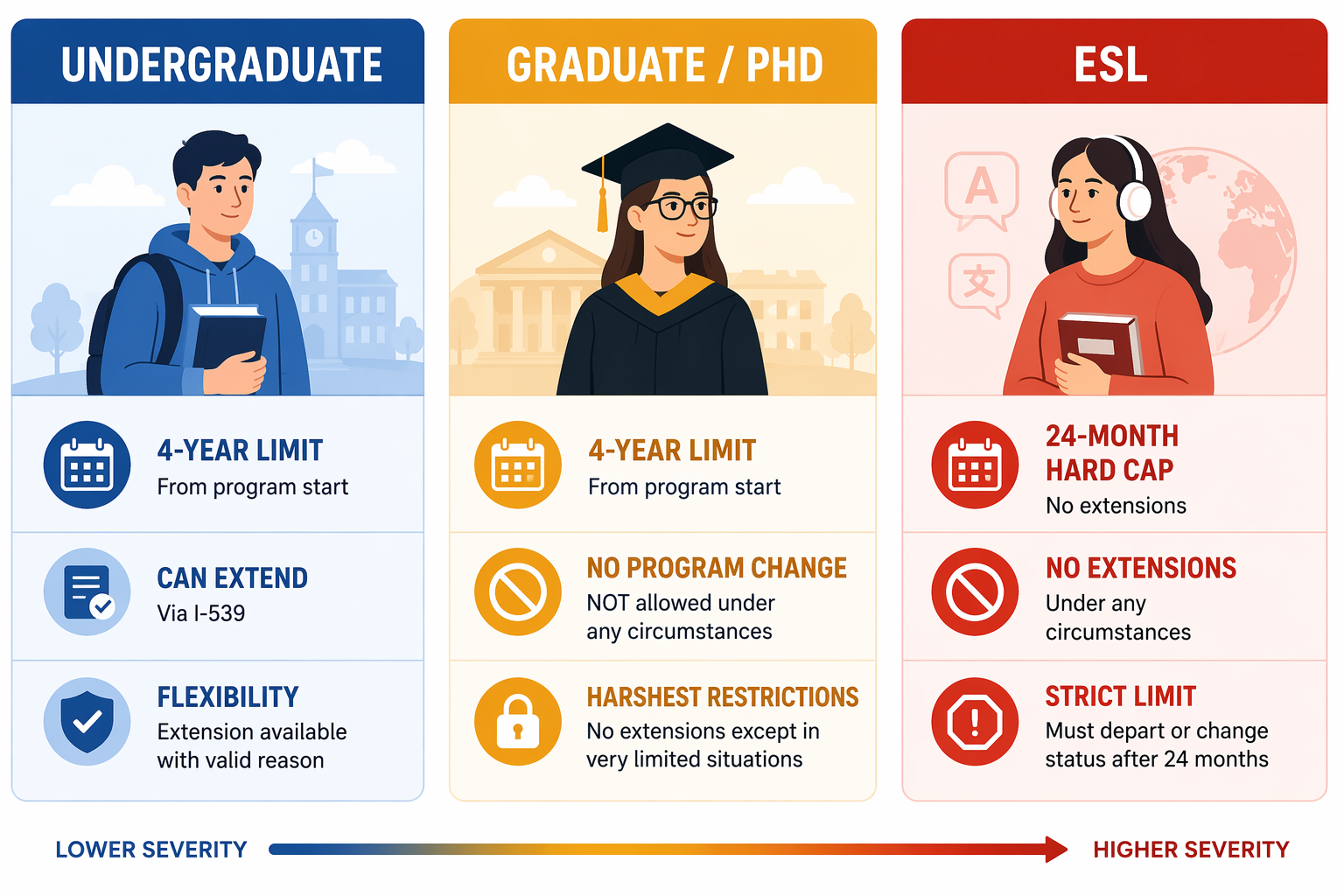
For graduate students, the fixed admission period is only part of the problem. Graduate-level F-1 students are prohibited from changing programs at any point during a program of study, even to a related field.[4] That is a sharper restriction than many students will expect from headlines about a four-year limit.
Graduate study is not always linear. A student may enter a PhD track, move from one lab to another, shift from one closely related research area to another, or discover that the funded path is not the path that will produce a dissertation. Under a campus academic lens, those changes can be normal. Under this rule, they become immigration questions.
This is why PhD students and research master’s students should not treat “my department approved it” as the end of the analysis. Before changing degree objectives, fields, departments, or schools, the student needs the DSO involved early. The academic office can approve a plan that the immigration rule does not allow.
ESL students and completing students have separate deadlines
English-language students are not simply under the general four-year discussion. The rule limits F-1 English-language study to 24 months total.[1] A student using ESL study as preparation for a degree program should ask whether the planned sequence still works within that cap and whether the school can document the next step clearly.
Students finishing a program also lose time at the end. The F-1 grace period after program completion is reduced from 60 days to 30 days.[5] That shorter window affects students preparing to leave the United States, transfer, change education level, or line up a post-completion option. Thirty days can disappear quickly when a transcript, program completion update, job offer, or travel plan is delayed.
What to do before September 15
The safest response is not panic, and it is not waiting to see whether someone sues. Treat September 15 as a planning deadline. The exact action depends on your status, but the basic file review is the same.
- Confirm your current admission record. Check whether your most recent I-94 shows D/S and save a copy.
- Check the program end date on your current I-20 or DS-2019. Do not rely on memory or an old admission letter.
- Ask your DSO how the transition rule applies to your specific record, especially if your program runs beyond September 2030.
- If your program may exceed the fixed period, begin collecting documents that explain the academic reason, illness, or circumstances beyond your control.
- If you are a graduate student, talk to the DSO before any program, department, school, or degree-objective change.
- If you are near completion, plan around a 30-day grace period rather than a 60-day one.
For students entering the United States after September 15, the planning question should be built into enrollment decisions. A standard four-year bachelor’s degree may fit the new admission period more cleanly than a doctoral program, a long research master’s program, or an academic path that depends on changing fields after arrival. That does not mean students should abandon those plans. It means the immigration timeline has to be part of the academic plan from the start.
Legal challenges may come, but deadlines still matter
There is a real possibility that the rule will be challenged. Similar Trump-era rules were blocked by courts and later withdrawn by the Biden administration, and legal challenges to this rule are considered likely, though the timing and outcome are uncertain.[6] That uncertainty should not become a personal filing strategy.
If a court pauses or changes implementation, students and schools can adjust. If no court does so before a student’s deadline, the student is still the person facing the extension filing, the denial consequence, or the shortened grace period. A pending lawsuit does not automatically extend an I-20, preserve a transfer option, or stop unlawful presence from starting after a denial.
The rule arrives in an already stressed system
The four-year cap is landing at a time when international education in the United States is already under pressure. Spring 2026 international enrollment fell 20% year over year, and graduate enrollment fell 24%.[7] Fall 2025 new international enrollment declined 17%, with NAFSA estimating a $1.1 billion revenue loss for universities and about 23,000 jobs affected.[8]
Those figures should not be read as proof that this single rule caused the decline. The broader environment includes visa processing delays, travel restrictions, social media vetting, campus enforcement actions, and other policy changes. For an individual student, though, the practical lesson is narrower: advisers may be handling more uncertainty with less time, and students should not wait until the counter is crowded.
This is the biggest F-1 and J-1 regulatory shift in decades, but the danger is not evenly distributed. Students already admitted in D/S before September 15, 2026, should map their transition window. New entrants should assume the fixed admission period applies from the start. Graduate and ESL students should treat their special restrictions as central, not as footnotes. The useful posture now is calm, documented, and early: know your dates, involve the DSO, preserve evidence, and do not build your plan around a legal challenge that has not yet changed your deadline.
References
- Final rule public inspection PDF, Federal Register, July 17, 2026.
- DHS Proposal to Replace Duration of Status, NAFSA.
- Breaking: US Department of Homeland Security publishes rule to end duration of status for international students, ICEF Monitor, July 2026.
- Trump Deals A New Immigration Blow To International Students, Forbes, August 28, 2025.
- Trump DHS, ICE 4-year cap international student visas, Higher Ed Dive.
- Current U.S. Administration, NAFSA.
- US University Higher Education International Students Asia Trump Immigration Visa, TIME, May 12, 2026.
- Fall 2025 International Student Enrollment Snapshot: Economic Impact, NAFSA.
Comments
Join the discussion with an anonymous comment.