
Learn Spanish with K-Pop Lyrics: A Step-by-Step Method
Turn your daily K-pop listening into productive Spanish study with a structured method that uses songs like (G)I-DLE's 'LATATA' and GOT7's 'Lullaby' to build vocabulary and pronunciation naturally, without extra time commitment.
Updated:
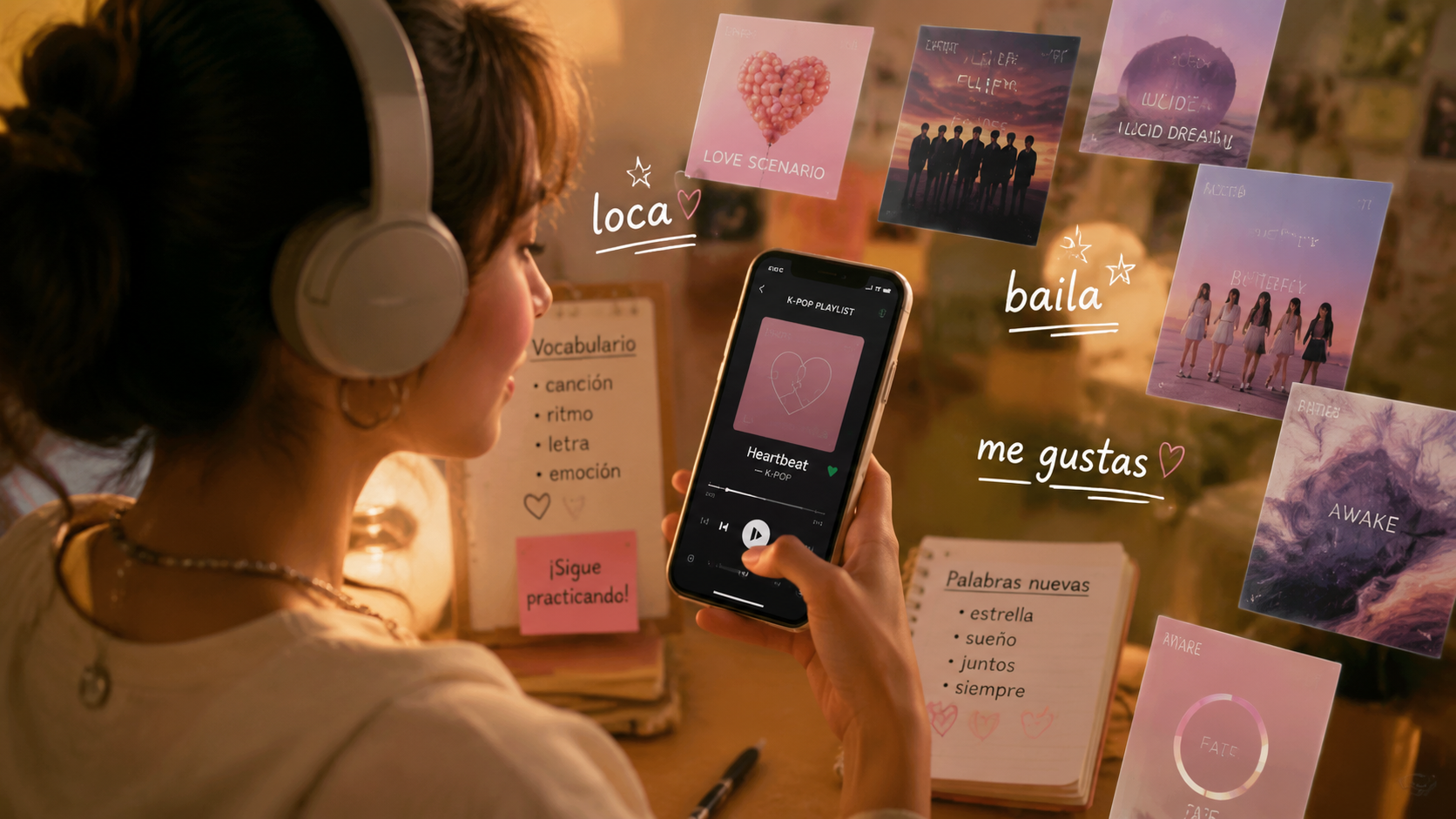
The useful moment starts small: you are replaying a K-pop chorus, and one Spanish word finally stops sounding like decoration. “Loca” lands. “Baila” lands. Maybe “me gustas” starts to feel less like a title and more like something a real person might say, with a grammar question attached.
That is enough to begin. You can learn Spanish with K-pop lyrics if you treat the song as a study surface, not as a full course. The music gives you repetition, emotion, pronunciation practice, and a reason to come back tomorrow. It does not automatically give you everyday grammar, conversation repair, or the confidence to answer a stranger in Spanish.
Start With Songs That Match Your Spanish Level
Do not start by trying to translate an entire verse just because the song is your favorite. Start where recognition is easy, then move toward songs that force you to make choices about meaning. Older K-pop-with-Spanish lists from Soompi, BuzzFeed, and Koreaboo are useful starting points, but they are not complete 2026 databases, so newer releases still need a quick lyric check before you build a playlist around them.[1][2][3]
| Level | Good Starting Songs | What You Study |
|---|---|---|
| 1. Single words | (G)I-DLE “LATATA” for “loca”; NMIXX “O.O” for “baila”; BTS “Airplane Pt.2” for place-name recognition such as “Brazil” | Sound, spelling, gender clues, and quick recognition without translating full lines |
| 2. Common phrases | GFRIEND “Me Gustas Tu”; KARD “Hola Hola”; KARD “Dimelo”; SUPER JUNIOR “Lo Siento” | Short reusable chunks, verb forms, greetings, apologies, and word order |
| 3. Longer Spanish sections or versions | GOT7 “Lullaby” Spanish Ver.; Lunafly’s Spanish-language work including “Hermosos Recuerdos”; SUPER JUNIOR “Otra Vez” with Reik | Connected lyrics, pronunciation endurance, and the difference between poetic Spanish and everyday Spanish |
Level 1 is not childish. It is where your ear learns that Spanish vowels are not optional and that a repeated word has a shape you can recognize outside the song. If you only pull “loca” from “LATATA,” you can still learn that it is the feminine form of “loco,” that it usually describes someone or something as crazy, and that the final “a” matters.
Level 2 is where the method starts feeling like language study. “Me gustas tú” is not just a pretty title; it opens the door to the backwards-feeling gustar structure that English speakers often trip over. “Hola hola” is simple enough to use immediately. “Dímelo” is more compact: di + me + lo, a command plus object pronouns packed into one word. That is the kind of lyric fragment worth saving.
Level 3 is tempting, especially if you like full Spanish versions and multilingual pop experiments. Use those songs, but do not pretend they are the same as beginner dialogue. A Spanish version of a K-pop single or a Spanish-language album gives you more exposure, not automatic control. The lines may be written to fit melody, rhyme, and mood before they are written to model textbook conversation.
The Five-Part Loop
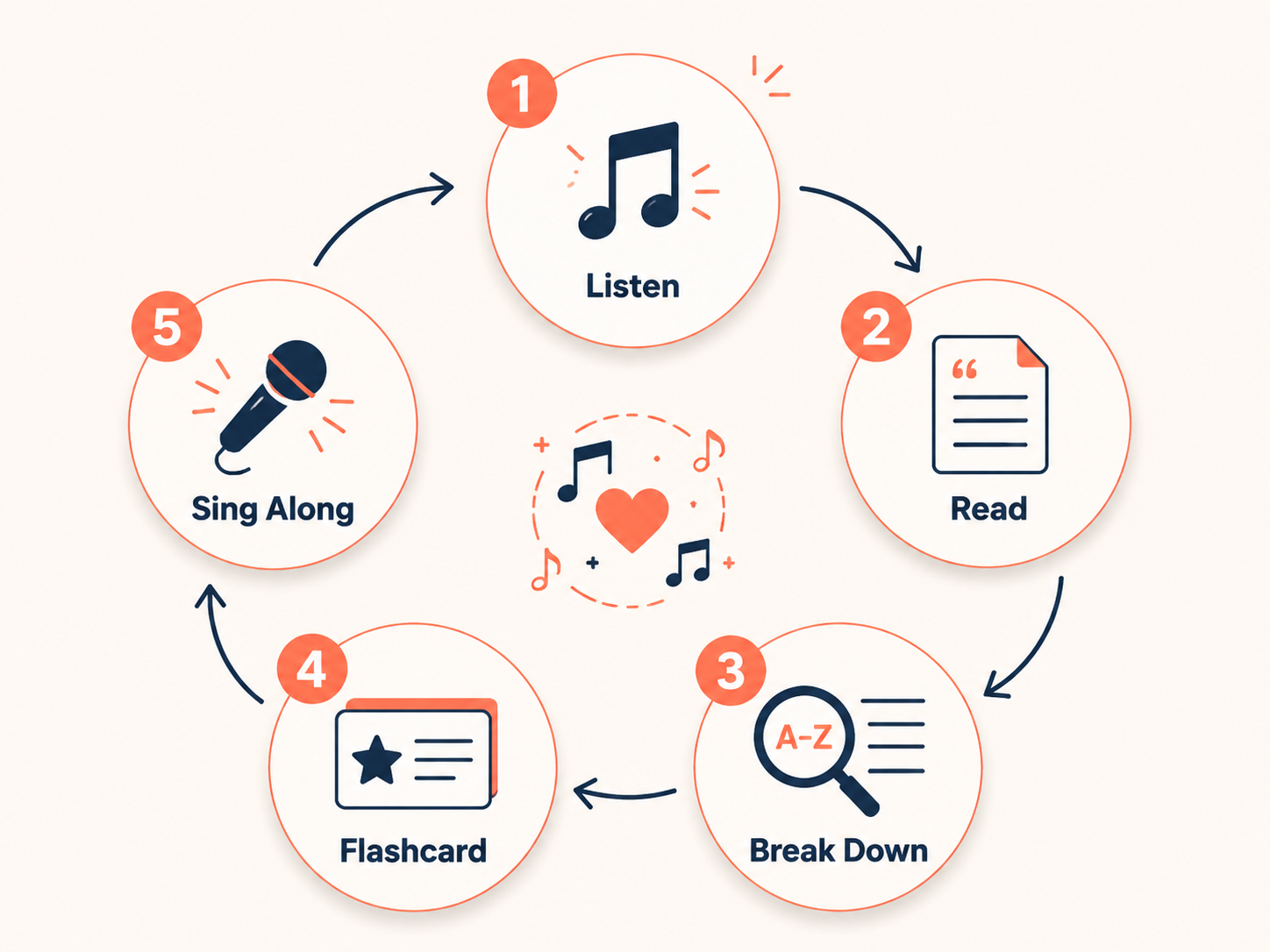
The whole method is simple enough to fit inside listening you already do: listen, read, break down, flashcard, sing along. The difference between “I heard Spanish in a song” and “I learned Spanish from that song” happens mostly in the middle two parts.
Listen Once Before You Touch the Lyrics
Play the song normally first. No pausing, no guilt, no turning your playlist into homework immediately. Your only job is to notice Spanish sounds you already recognize and mark the time stamp if one line keeps pulling your attention.
This first pass matters because it protects the reason the method works for fans: attachment. If the song becomes a worksheet before it becomes yours, you are less likely to repeat it enough for the language to stick.
Read the Lyrics With Translation Open, but Suspiciously
On the second pass, open the lyrics and a translation. This is where tools can help, as long as you remember that no major app neatly solves the exact “K-pop plus Spanish” use case for you. LyricsTraining, also known as LingoClip, works well for fill-in-the-blank lyric practice across a large multilingual song library, but you may still need to search song by song rather than browse a ready-made K-pop Spanish path.[4]
LyricFluent is closer to the music-learning idea because it combines interactive translation and spaced repetition for Spanish songs; its site reports a 4.9 rating from more than 7,000 learners, but that number should be treated as self-reported unless you verify independent store data near publication.[5] Lirica also uses music-first lesson design and has been recognized as a Google Play Hidden Gem in 2018 and an Apple App of the Day in 2020, though any monthly price quoted from third-party reviews should be checked on the official site before you rely on it.[6]
Lingopie Music can be useful when you want dual lyrics and click-to-translate support, especially if you later want to move from songs into Spanish TV content; its Spanish music page also points users toward a wider catalog of TV shows.[7] Songlingo is another Spanish-available option for lyric-based study.[8] None of these tools removes the curation step: you still choose the K-pop song, check whether the Spanish line is actually present, and decide what is worth studying.
Break Down Only the Parts You Can Reuse
This is the part passive listening skips. Do not copy a whole verse into your notes because it looks productive. Pull out the smallest useful unit: one word, one phrase, one verb form, or one pattern you are likely to meet again.
| Lyric Fragment | What to Extract | Why It Is Worth Saving |
|---|---|---|
| loca | loco / loca | Shows adjective gender and gives you a common descriptive word |
| baila | bailar; baila | Connects the song command or verb form to the base verb “to dance” |
| hola | hola | Immediate greeting; easy pronunciation anchor |
| me gustas tú | gustar pattern | Useful, but grammatically different from a direct English “I like you” |
| lo siento | fixed apology phrase | Reusable as a full chunk before you analyze every word |
| dímelo | di + me + lo | Shows how Spanish can attach pronouns to a command |
The rule is: save what will survive outside the song. A title, chant, or chorus fragment can be perfect if it gives you a word you can recognize tomorrow. A beautiful metaphor may be less useful for a beginner if you cannot tell which part is grammar and which part is lyric-writing.
For example, a beginner does not need to fully unpack every pronoun rule inside “dímelo” on day one. It is enough to label it as “tell me it” or “say it to me,” notice that the accent mark keeps the stress in place, and save the chunk for later. When your grammar catches up, the lyric will already be familiar.
Turn the Extracted Pieces Into Flashcards
A lyric you enjoyed once is a mood. A lyric you review at increasing intervals becomes vocabulary. That is where Anki or another serious flashcard system earns its place. If you want the technical reason adaptive spacing matters, the guide to true adaptive SRS apps is the better next read; if you are still choosing a setup, start with how to choose a flashcard app for language learning.
Keep the cards small. One card can ask for the meaning of “baila.” Another can ask you to complete “me ___ tú.” Another can play a short audio clip if you have the rights and a clean source for personal study. The point is not to archive the song; it is to make retrieval easy enough that your brain actually does it.
- Front: “loca” / Back: “crazy,” feminine form; masculine is “loco”
- Front: “to dance” / Back: “bailar”; lyric form to recognize: “baila”
- Front: “I’m sorry” / Back: “lo siento”
- Front: “me gustas tú” literally points to what? / Back: “You are pleasing to me”; natural meaning: “I like you”
- Front: Break down “dímelo” / Back: “di + me + lo”; “tell me it” or “say it to me”
Spaced cards are also where you avoid the fandom trap of recognizing a phrase only when the beat drops. If “lo siento” appears on a card next week and you can still produce it without the song, the lyric has moved closer to usable Spanish. For the broader evidence question, see the 2026 evidence review on language learning cards.
Sing Along After You Know What Your Mouth Is Doing
Singing is not just for confidence. Music-learning summaries from Berlitz point to research on melody, singing, and recall, including studies described as showing that melody can support memory and that sung material may be retained better than spoken material in some learning contexts.[9] That does not prove a K-pop chorus will make you conversational. It does make singing a reasonable pronunciation and memory tool once you have checked the lyric.
Sing slowly first. Spanish vowels are clean and consistent compared with English, so do not let speed blur them into your native-language habits. If you are an absolute beginner and Spanish spelling still feels unstable, spend a little time with Spanish alphabet flashcards before using fast songs as pronunciation models.
The best sign is not that you can belt the whole song. It is that you can say one phrase clearly without the track. If “me gustas tú” survives after the music stops, you have something.
A Realistic Weekly Pattern
You do not need to turn every listening session into a study block. In fact, that is how a good habit gets ruined. Keep most listening casual, then choose one or two songs per week for active work.
| When | What to Do | How Long It Needs to Feel Like Study |
|---|---|---|
| Day 1 | Pick one song and listen normally; mark Spanish words or phrases that stand out | One focused replay |
| Day 2 | Read lyrics with translation; confirm spelling and rough meaning | A short lyric check |
| Day 3 | Break down two to five useful fragments | The main thinking session |
| Day 4 | Make flashcards and review them | Small enough that you will actually repeat it |
| Day 5 or later | Sing the selected lines slowly, then at song speed | Pronunciation practice, not performance pressure |
MosaLingua’s music-learning method and StoryLearning’s song-study advice both emphasize active use of lyrics rather than background listening alone, which is the part worth borrowing here.[10][11] The K-pop angle changes the playlist, not the learning principle: the song becomes useful when you inspect it, select from it, and return to it.
What K-Pop Lyrics Can and Cannot Teach
K-pop lyrics with Spanish can teach recognition surprisingly well. Repeated hooks are good for noticing sounds, remembering short phrases, and getting comfortable saying Spanish out loud. They are especially good for learners who already replay songs for emotional reasons, because the review schedule is partly built into the fandom.
They are weaker at teaching ordinary conversation. Lyrics compress meaning. They bend grammar for rhythm. They repeat fragments that may be dramatic, flirtatious, or poetic rather than practical. “Me gustas tú” is useful, but it does not teach you how to introduce yourself, ask for clarification, repair a misunderstanding, or hold a normal beginner exchange.
That boundary should not make the method feel fake. A supplemental method is still valuable when it does its job. Use K-pop lyrics for vocabulary recognition, pronunciation practice, and motivation. Pair them with grammar explanations, beginner speaking practice, and basic pronunciation work when your goal moves from understanding fragments to answering people in real time.
If you already have K-pop playing every day, start with one Spanish word today. Check it. Break it down. Put it on a card. Sing it correctly. That is not fluency, and it does not need to pretend to be. It is a real piece of Spanish rescued from a song you were going to replay anyway.
References
- 9 Gorgeous Spanish Songs by K-Pop Artists, Soompi
- 10 Of The Best K-Pop Songs With Spanish Influence, BuzzFeed
- These 22 K-Pop Songs Have Spanish Titles, Koreaboo
- LyricsTraining
- Learn Spanish With Music, LyricFluent
- Lirica
- Learn Spanish with Music, Lingopie
- Songlingo
- Learning a Language Through Music: How Songs Help You Learn, Berlitz
- How to Learn a Language with Music in 5 Steps, MosaLingua
- Using Songs To Learn Languages, StoryLearning
Comments
Join the discussion with an anonymous comment.