
What a Red Flag Warning Means for College Students
College students in wildfire-prone areas need to know how a Red Flag Warning affects their dorm, off-campus housing, and campus activities. This guide explains the specific safety actions — from spark prevention to go-bag preparation — that general fire safety guides never cover.
Updated:
A Red Flag Warning usually arrives in the least cinematic way possible: a weather-app banner between classes, a campus alert while you are in lab, a parent text that says, “Are you okay?” It does not mean there is a wildfire at your residence hall or apartment. It also does not mean “it is hot out, drink water.” It means the weather has moved into a range where a small spark can turn into a fast-moving fire.
The National Weather Service describes Red Flag Warning conditions as low humidity and strong wind lasting long enough to make fire spread easier: relative humidity at or below 15 percent and sustained or gusty winds of 25 mph or more for at least three hours.[1] That is the part worth taking seriously. Dry air, wind, and a tiny ignition source do not care that your midterm is tomorrow.
So the useful question is not “Should I panic?” It is “What changes today?” For a student, the answer depends on where you sleep, where you cook, whether you have a car, and which campus rules switch on during the warning.
What Changes Today
During a Red Flag Warning, the main job is to avoid creating sparks, keep your information channels working, and make leaving easier if officials later tell your area to evacuate. That is different from ordinary dorm fire safety, where the focus is usually smoke alarms, candles, overloaded outlets, and cooking.
Those basics still matter. The U.S. Fire Administration tells students not to disable or tamper with smoke alarms and to know two ways out of every room.[2] Portland Fire & Rescue says 85 percent of college housing fires are cooking fires, with campus fires most common from 5 p.m. to 11 p.m. and on weekends.[3] If you live with people who cook late, forget pans on burners, or treat the smoke alarm as an annoying roommate, a warning day is not the day to shrug and hope.
Off campus deserves extra attention. A campus fire-safety fact sheet from Mountain Home Fire & Rescue, attributing its figure to NFPA and USFA data, says 94 percent of fatal campus fires occur off campus.[4] Treat that number as a warning sign rather than a universal law: off-campus housing varies wildly, and the original NFPA or USFA reporting should be checked for publication date and method before using the statistic in a policy argument. For a student deciding what to do this afternoon, the practical point is still clear enough. If you rent a room, duplex, garage conversion, older apartment, or house with five people and one distracted group chat, you have to make the fire-safety system visible.
If You Live in a Dorm
Dorms usually give you more structure than a rental: alarms, posted exits, resident assistants, campus alerts, and policies someone else wrote before you arrived. Use that structure. Do not assume it will think for you.
- Read the campus alert all the way through. Check whether it changes dining, transportation, outdoor events, athletic events, or building access.
- Charge your phone, laptop, and portable battery before you need them. Put the charger where you can grab it, not under three hoodies.
- Find your two exits before dinner, not during an alarm. Walk the route once if you have only followed everyone else so far.
- Do not use candles, incense, open flames, or improvised cooking setups. If your dorm already bans them, the warning makes the rule less negotiable, not more annoying.
- Keep shoes, ID, medication, keys, glasses or contacts, and your go-bag reachable before you sleep.
Dorm cooking is often less about full meals and more about microwaves, shared kitchens, hot plates that should not exist, and people leaving food “for one minute.” On a warning day, stay in the room while food is heating. If the microwave smells burnt, stop it. If someone has covered a smoke alarm, report it or get an RA involved. Missing or tampered smoke alarms are not a personality quirk; USFA/FEMA materials report that 58 percent of fatal campus fires involved missing or tampered smoke alarms.[2]
If the warning overlaps with a game day or a large outdoor event, look for campus-specific rules. Some schools restrict open-flame cooking, barbecues, or outdoor events during Red Flag Warnings. Check your own campus site, emergency management page, housing portal, or event notice.
If You Live Off Campus
Off-campus students often have more ways to start a problem and fewer people automatically checking the building. You may not control the landscaping, the landlord may be slow, and your roommate may think “Red Flag Warning” is a hiking term. Still, there are several things you can control before the wind picks up.
Check alarms and exits before anything else
Look at the smoke alarms. Are they present? Are they attached? Has anyone removed a battery because toast was inconvenient? If you cannot test an alarm or do not know whether it works, message the landlord and your roommates in writing. Do not let “someone should handle that” become the house plan.
Then make the exit path boring. Move the bike from the hallway. Clear the boxes by the back door. Find the keys you would need if you had to leave quickly. If your room has one obvious way out, know where the second one is, even if it is less convenient.
Do not create outdoor ignition sources
The outdoor rules are where a Red Flag Warning becomes more specific than ordinary apartment advice. Yuba Fire Safe Council and CAL FIRE guidance says to avoid mowing or trimming dry grass, avoid gas or electric power tools outdoors, avoid outdoor smoking, and avoid parking on dry vegetation during Red Flag Warning conditions.[6] This is not about whether you personally are “careful.” Wind and dry grass make the margin for error thin.
- Skip the backyard fire pit, charcoal grill, fireworks, and any open flame outside.
- Do not mow, weed-whack, cut metal, use a grinder, or run power tools near dry vegetation.
- Do not smoke outside where ash or a cigarette butt can land in dry leaves, mulch, grass, or a planter.
- Do not park a car over dry grass, even briefly.
- Bring loose outdoor items inside if wind could move them into a road, doorway, grill, or electrical equipment.
If a landlord or roommate planned yard work, postpone it. If someone insists the lease says the yard has to be done today, send the warning notice and keep the conversation practical: dry grass plus tools is the wrong combination. You are not asking for the house to become a command center. You are asking everyone to avoid adding sparks to a day built for fire spread.
Treat the kitchen like the most likely room to cause trouble
Cooking already dominates college housing fire numbers, and the late-afternoon-to-night window overlaps exactly with the time many students get home hungry, tired, and distracted.[3] On a warning day, stay at the stove. Keep towels, cardboard, sleeves, and takeout bags away from burners. If the kitchen smoke alarm goes off because something is burning, fix the cooking behavior instead of disabling the alarm.
Roommate coordination does not need to be dramatic. A useful text is enough: “Red Flag Warning today. No grill/fire pit, no yard tools, don’t park on dry grass, and please don’t take batteries out of alarms.” That message will not win a poetry prize. It may prevent the exact sloppy chain of events that student houses are good at producing.
If you have a car, make it usable
CAL FIRE’s Go Evacuation Guide recommends keeping a vehicle at least half full of fuel and charging all devices as part of wildfire readiness.[7] For a student, that means do not wait until the low-fuel light appears during an evacuation notice, a power shutoff, or a traffic jam leaving town. If you do not have a car, the equivalent task is to know who you would call, which campus shuttle or public route still operates, and where an official evacuation point would be announced.
Campus Activities Are Not Business as Usual
A warning can change what happens outside even when classes continue. Barbecues may be canceled. Tailgating rules may tighten. Outdoor events may move, shrink, or stop. Maintenance crews may delay work that could create sparks. Athletic departments may have their own instructions. The mistake is assuming that because your lecture is still happening, everything else runs normally.
UC Berkeley’s Red Flag Warning game-day guidance is a concrete example: it addresses open-flame cooking, barbecues, and outdoor events during warning conditions.[5] Your school may use different wording, different thresholds, or different offices. Check the source that can actually control your day: campus emergency management, housing, environmental health and safety, transportation, athletics, or the event organizer.
If you are working an event, tabling for a club, running AV, supervising equipment, or setting up food, do not wait for a vague “be safe” message. Ask whether the event is still approved, whether generators or cooking equipment are allowed, who can cancel, and how staff will receive updates if cell service is poor or the power goes out.
Build a Student Go-Bag You Can Actually Grab
A student go-bag should not look like a bunker catalog. It should solve the first miserable problems of leaving fast: identity, communication, medication, light, water, food, smoke protection, and the school or work items you cannot easily replace.
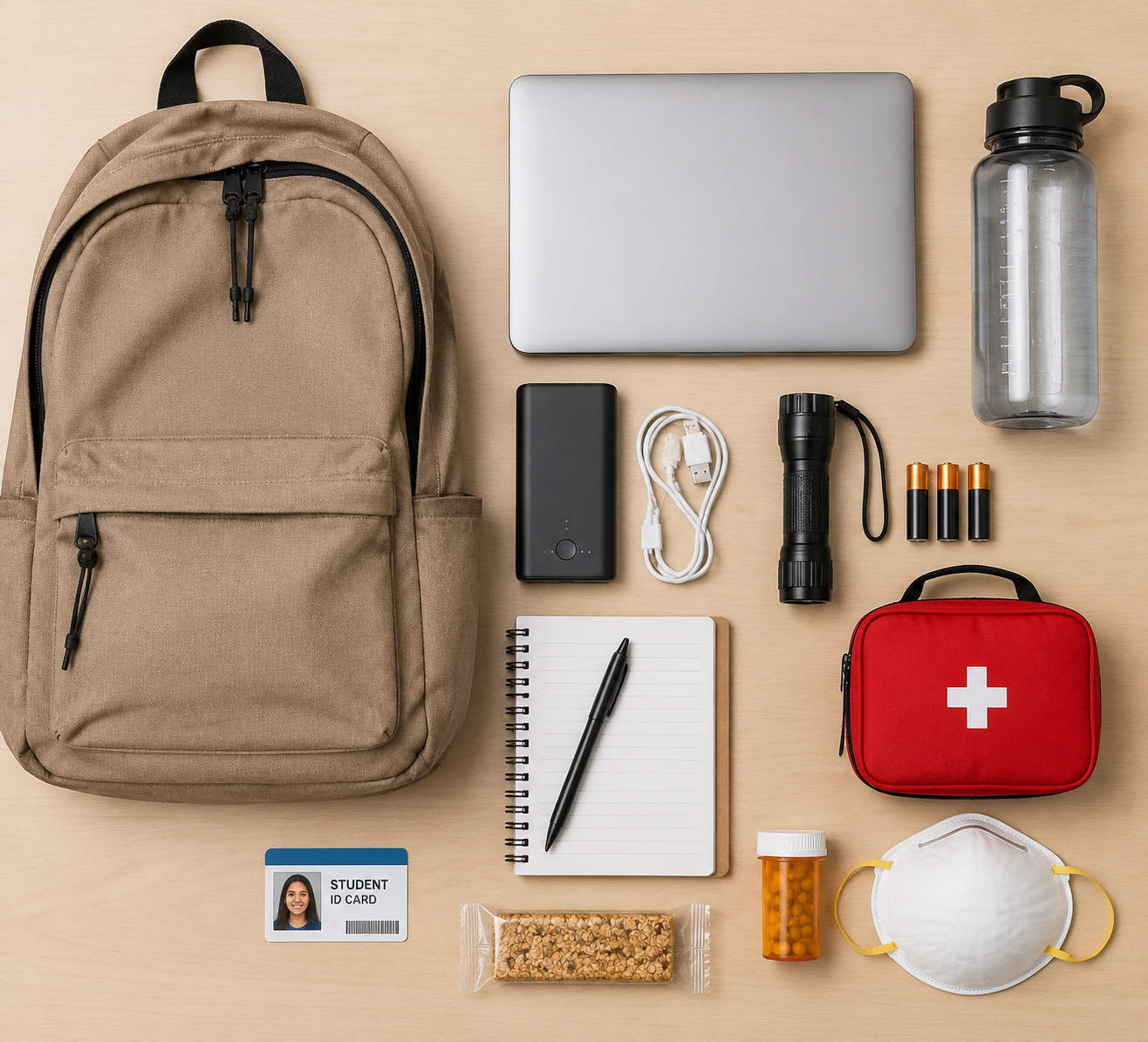
The American Red Cross recommends a three-day Go-Kit and a two-week Stay-at-Home Kit for wildfire preparedness, including items such as N95 masks, water, food, medications, a flashlight, and batteries.[8] UC Berkeley’s emergency management office lists go-bag items including a portable phone charger, flashlight and batteries, battery-operated or crank radio, non-perishable food, water, an ID copy, and a first aid kit.[9]
| Put in the bag | Why it matters for a student |
|---|---|
| Student ID and a copy or photo of government ID | You may need identification for housing, transportation, campus services, pharmacies, or family coordination. |
| Portable phone charger and cable | Your phone is your alert system, map, contact list, and school communication tool. |
| Medication, glasses, contacts, and basic first aid | A short evacuation becomes much harder if the item you need daily is sitting on a desk. |
| Flashlight and extra batteries | Hallways, parking lots, stairwells, and apartments are not guaranteed to stay lit. |
| Water and non-perishable food | Dining halls, stores, vending machines, and delivery apps may not be available when you expect them. |
| N95 masks | Smoke and ash can make even a short walk unpleasant or unsafe for some students. |
| Laptop or essential academic drive, if you can carry it safely | Do not delay evacuation for electronics, but plan ahead so your most important school work is easy to grab. |
| Keys, cash, and a written emergency contact | Dead phones, locked doors, and card-reader failures are ordinary problems during abnormal days. |
If you use medical equipment, refrigerated medication, mobility devices, or service-animal supplies, your go-bag has to reflect that. Do not let a generic list erase the item that would actually trap you.
California students should also know whether Public Safety Power Shutoffs are part of local wildfire practice. CAL FIRE describes PSPS events as potentially lasting 48 to 72 hours.[7] Students outside California may not deal with proactive utility shutoffs in the same way, but the planning question is still useful: if the power went out for two days, could you charge a phone, see in the dark, access food, and receive official instructions?
Know Which Alert Tells You to Leave
A Red Flag Warning is a prevention trigger. It is not the same thing as an evacuation order. That distinction matters because students can tune out emergency language if every alert feels like the same level of danger.
Use the warning to get ready before any evacuation message exists. Make sure campus alerts are enabled. Check local county emergency alerts, not only campus email. If you live off campus, your evacuation notice may come from the city or county before it comes from the university. If you are in class, at work, at a game, or in a lab, know whether you should follow campus instructions, county instructions, or a supervisor’s immediate safety procedure.
Parents can help without turning the student’s phone into a second emergency channel. A useful text is specific: “Do you have alerts on, charger packed, meds/ID ready, and do you know your campus rule for today?” A less useful one is five versions of “Please be careful,” which gives the student concern to manage but no action to take.
The Calm Standard
By the time a Red Flag Warning is in effect, your standard is simple: no outdoor sparks, no disabled alarms, no careless cooking, charged devices, a reachable go-bag, current alerts, and a clear read on whether dorm, rental, campus, or event rules have changed for the day.
That does not require panic. It does require treating the warning as something more useful than weather trivia. The whole point is to do the small, concrete things while they are still small.
References
- Red Flag Warning tips, National Weather Service.
- Fire Safety for College Students, USFA/FEMA.
- College Student Fire Safety, Portland.gov.
- Campus Fire Safety Facts, Mountain Home Fire & Rescue.
- Red Flag Warning Guidelines on Game Days, UC Berkeley EH&S.
- Red Flag Warning, Yuba Fire Safe Council.
- Go Evacuation Guide, CAL FIRE.
- Wildfire Safety, American Red Cross.
- Make a Go-Bag & Kit, UC Berkeley OEM.
Comments
Join the discussion with an anonymous comment.