
Which Humanoid Robot Is Right for Classroom Learning in 2026
Compare the top humanoid robots for classroom learning in 2026 — from $200 coding companions to $95,000 AI tutors — and find the one that fits your study goals, budget, and technical level.
Updated:
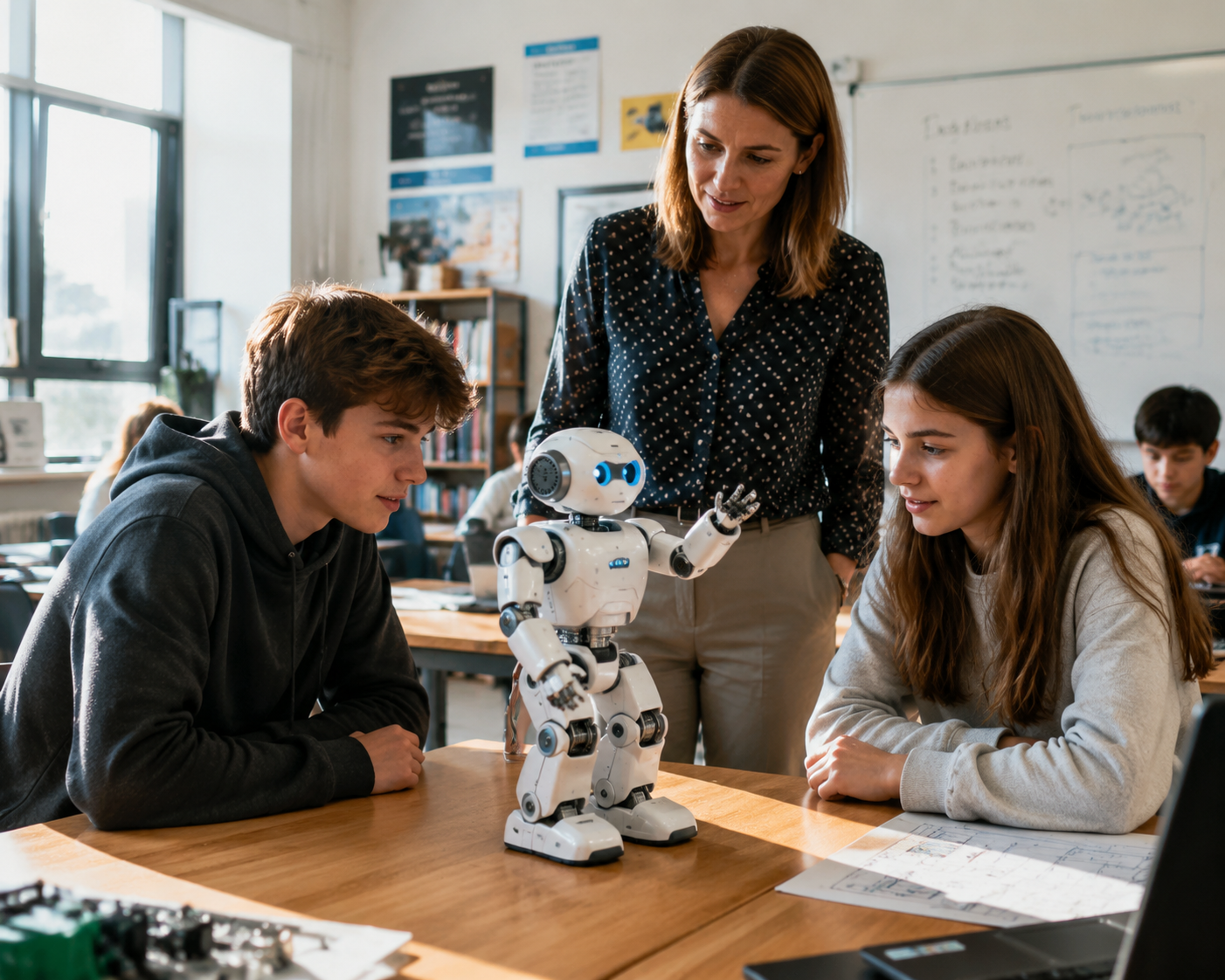
A humanoid robot in classroom for learning can mean a small coding companion that costs less than a class set of headphones, or it can mean a full-body AI tutor priced like a school bus. In July 2026 pricing, the category runs from about $200–$400 for Alpha Mini and $300–$500 for Marty to $57,590 for a discounted Realbotix school pilot and a $95,000 Realbotix M-Series list price.[1][2][3] That price spread matters because these machines do not do the same educational job.
The safest first question is not “Which robot is most advanced?” It is “What learning moment is this robot supposed to make better after the first month?” A waving robot can absolutely pull students forward in their seats. The harder procurement question is whether it still earns its charging space after the novelty has worn down, the teacher has three other classes to prep, and someone has to update the software.
The 2026 Classroom Robot Map
| Robot | Approx. 2026 price | Best classroom fit | Technical level | Evidence strength | Support risk |
|---|---|---|---|---|---|
| Alpha Mini | $200–$400 [1] | Early coding, younger learners, first robot exposure | Beginner | Useful for engagement and introductory programming; not a broad academic tutor | Lower financial risk; check app, cloud, and reseller support |
| Marty | $300–$500 [1] | Coding basics, robotics clubs, maker lessons | Beginner to intermediate | Good fit for physical programming practice; narrower humanoid interaction role | Lower cost, but depends on teacher comfort with setup and coding activities |
| Furhat | $7,000–$10,000 [1] | Conversation, social interaction, language practice experiments | Intermediate to advanced | Promising for interaction design; less of a full classroom curriculum platform | Requires planning around software, dialogue design, and data handling |
| QTrobot | $8,000–$12,000 [1] | Autism support, special education, social-emotional learning activities | Intermediate | Strongest clinical grounding among the robots in this comparison for autism/special education use [4] | Worth evaluating with special education staff, therapy goals, privacy review, and service terms |
| NAO V6 | $9,000–$16,990 [1][2] | STEM, coding, language learning, broad education programs | Intermediate to advanced | Most mature education ecosystem here; 13,000+ deployments across 70 countries [2] | Major 2026 concern: Aldebaran receivership may affect updates, parts, and long-term support [4][5] |
| Pepper | $15,000–$25,000 [1] | Reception-style interaction, demonstrations, social robotics projects | Intermediate to advanced | Less compelling than NAO for direct curriculum use in most classrooms | Same Aldebaran-related support uncertainty as NAO [4][5] |
| Realbotix M-Series | $57,590 discounted pilot; $95,000 list [3] | Experimental AI tutor pilot, advanced demonstration, research-style deployment | Advanced | Newsworthy but unproven in schools; Salamanca pilot has no published outcomes yet [3] | High cost, new school deployment model, unverified effectiveness claims |
The table makes one thing plain: “humanoid” is a shape, not a learning strategy. Marty and Alpha Mini belong in a different buying conversation from NAO, QTrobot, or Realbotix. A school that needs a first coding robot should not be shopping as if it needs an AI tutor. A district piloting advanced human-robot interaction should not pretend the purchase is just a bigger version of a classroom coding toy.
Match the Robot to the Learning Job
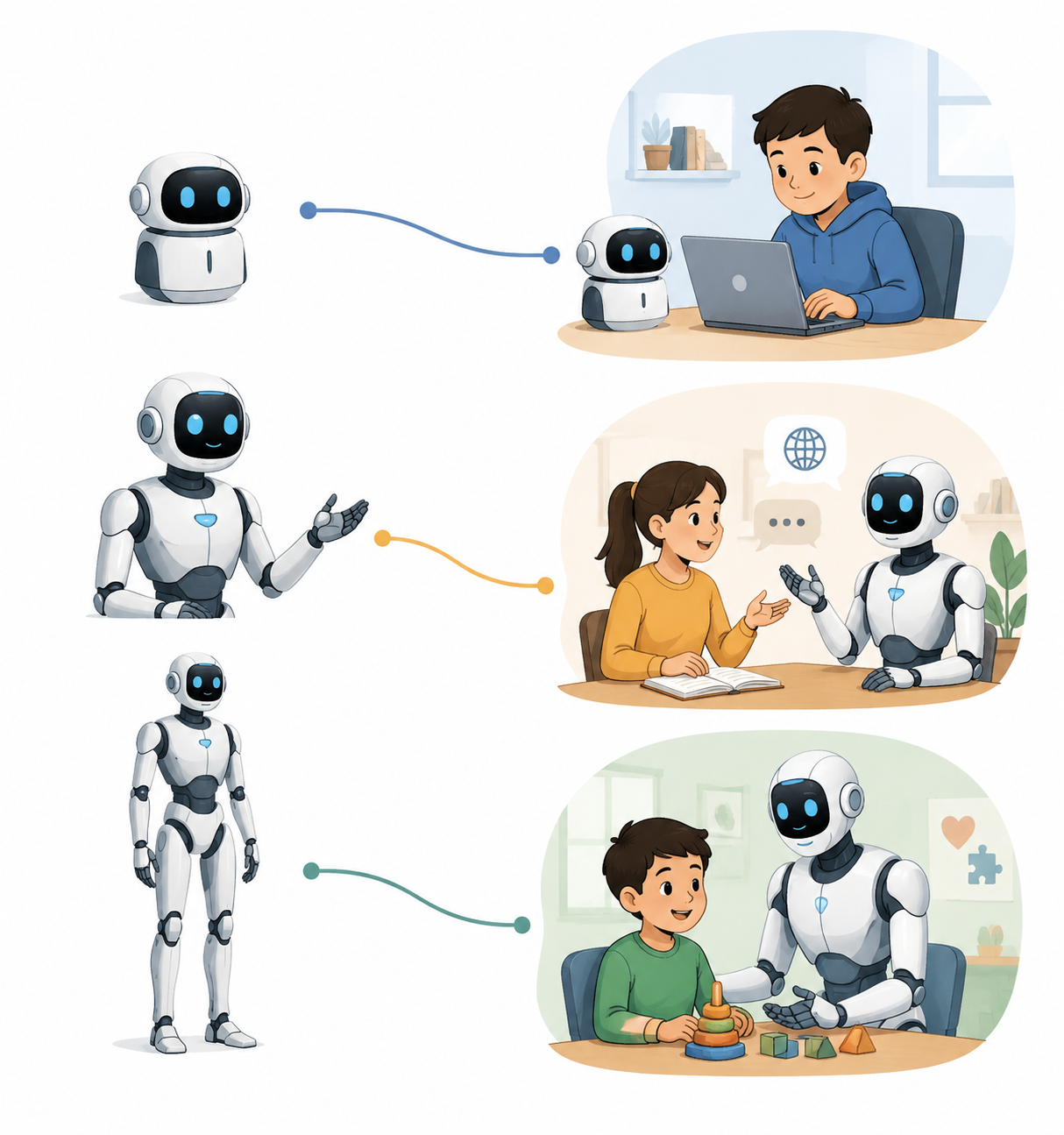
The most credible classroom uses in the current evidence base are not “robot teaches everything.” They are narrower: language practice, STEM and coding, and special education or autism support. Even there, the quality of the match matters more than the sophistication of the machine. A robot that supports one tightly designed lesson sequence is more useful than a more expensive robot waiting for a teacher to invent a curriculum around it.
For Early Coding: Marty or Alpha Mini
For elementary and middle school coding, the lower-cost robots are not consolation prizes. Marty and Alpha Mini put code into a visible body: students can make a robot move, turn, gesture, or respond, then see immediately whether their instructions worked. That physical feedback is the point. The robot does not need to look like a science-fiction lab assistant to make loops, sequencing, sensors, and debugging feel real.
This is where the $300–$500 range can be educationally cleaner than the $10,000 range.[1] If the goal is introductory programming, buying a premium humanoid may add voice features, expressive movement, and institutional prestige without improving the coding lesson. The better test is whether students can program it often, reset it quickly, and use it without one trained specialist hovering over the table.
For Language Learning: NAO Has the Stronger Classroom Case
Language learning is one of the more plausible uses for a humanoid robot because the robot gives students a social partner without the same peer pressure as speaking in front of classmates. Available studies include work on NAO vocabulary lessons showing at-least-equal outcomes with higher enjoyment, and broader reviews connect humanoid robots with reduced speaking anxiety and engagement in language activities.[4][6]
NAO’s advantage is not only that it can talk and move. It is that NAO has been used widely enough for education teams to find existing lesson ideas, examples, and community knowledge. RobotLAB describes NAO as deployed in more than 13,000 settings across 70 countries.[2] That does not prove NAO will raise test scores in a particular school, but it does mean a teacher is less likely to be starting from a blank page.
The caution belongs right next to the recommendation: Aldebaran, the manufacturer behind NAO and Pepper, entered receivership in France in June 2025.[4][5] For a classroom buyer in 2026, that is not a footnote. It can affect confidence in parts, software updates, service continuity, and the life span of purchased curriculum materials. NAO may still be the best broad education humanoid for many STEM and language programs, but the support plan needs to be written down before the purchase order is signed.
For Autism and Special Education: QTrobot Deserves Serious Attention
QTrobot is not the most famous name in general classroom robotics, but it may be the most important robot in this comparison for a specific group of learners. The available evidence identifies QTrobot as having the strongest clinical evidence for autism and special education support among the listed options.[4] That makes it different from a robot sold mainly on charisma or futuristic appearance.
The appeal is easy to understand in practice. A robot can repeat a social cue without sounding impatient. It can deliver a predictable interaction. It can give a student a face and voice to respond to while keeping the situation more controlled than a busy peer group. Those are not small advantages for some students, but they also do not replace individualized education plans, therapists, aides, or teacher judgment.
For a school team, the QTrobot question should begin with the student support goal, not the robot feature list. Is the robot being used for emotion recognition practice, turn-taking, communication routines, or social engagement? Who adapts the sessions? Who reviews whether the intervention is helping? The $8,000–$12,000 price range is substantial, but the more important issue is whether the special education team has time, consent, training, and a clear use case.[1]
For Advanced AI Tutor Pilots: Realbotix Is a Case to Watch, Not a Proven Pick
Realbotix is the robot students will ask about because it sits closest to the 2026 imagination of an AI tutor with a humanoid body. The Salamanca City Central School District pilot is described as the first U.S. school-district deployment of a humanoid plus AI avatar tutoring system, planned for fall 2026 and serving about 500 students at a discounted price of $57,590.[3]
That is worth watching. It is not yet evidence of learning effectiveness. As of the current Q3 2026 decision window, the pilot has zero published classroom outcomes in the research brief. The strongest honest description is experimental: a premium deployment testing whether a humanoid AI tutor can fit into a real district. For most classrooms, that puts Realbotix in the research, demonstration, or innovation-grant category rather than the normal instructional purchase category.
Sticker Price Is Only Half the Budget Conversation
A robot’s invoice is not the same as its classroom cost. Hardware accounts for only about 50–60% of the real cost, with schools also needing to budget for annual software licenses, teacher training, maintenance, and infrastructure upgrades.[1] RoboZaps gives typical annual software licensing at $500–$3,000 per year and teacher training at 8–20 hours per teacher.[1]
Those numbers change the comparison. A $10,000 robot can become a poor purchase if it sits unused because no one owns the curriculum. A cheaper robot can become expensive if every lesson starts with connection problems. A premium robot can be defensible in a lab or special program if the school has a trained lead teacher, technical support, and a reason to use features that cheaper robots do not have.
- Software: annual licenses, cloud access, content libraries, updates, and account management.
- Training: initial teacher onboarding, substitute coverage, refresher sessions, and curriculum planning time.
- Maintenance: batteries, joints, sensors, charging routines, shipping repairs, and downtime plans.
- Infrastructure: Wi-Fi reliability, device management, storage, charging space, and classroom setup.
- Governance: privacy review, parent communication, accessibility review, procurement rules, and data retention.
The hidden work is not glamorous, but it is where many classroom tools succeed or fail. Someone has to remember the logins. Someone has to know what to do when the robot’s arm stops responding. Someone has to decide whether a recorded interaction is stored, deleted, or never collected in the first place.
Engagement Helps, but the Novelty Clock Is Real
The first two weeks with a classroom robot can be wonderful. Students notice it. They lean in. They volunteer. That spark is not fake, and it can be especially valuable for students who have tuned out a worksheet or a screen. The problem is treating that first spark as the same thing as sustained learning.
Available reviews flag a novelty effect in which engagement gains fade after about 2–4 weeks unless the robot is supported by strong pedagogical design.[1][4] They also note that many studies are short-term, use small samples, and show only small to moderate direct test-score effects, with the strongest return appearing in engagement and special education rather than broad academic achievement.[1][4]
That does not argue against robots. It argues against buying one as if attention automatically becomes learning. The lesson still needs a sequence, a practice routine, a way to check understanding, and a teacher who knows when the robot is helping and when it is just taking up time.
Privacy Can Decide Whether a Robot Belongs in School at All
Home use and school use are not the same privacy problem. A robot with cameras, microphones, facial interaction, voice features, or cloud-connected AI may collect or process student data. In U.S. schools, that raises FERPA questions; in the European Union, GDPR may apply.[4][6] A classroom deployment needs a clearer answer than “the vendor says it is safe.”
- What data does the robot collect: video, audio, transcripts, facial data, usage logs, or student identifiers?
- Where is the data processed: on device, on a school server, or through a vendor cloud service?
- Who can access it: teachers, administrators, vendor staff, developers, or third-party AI services?
- How long is it kept, and can the school delete it?
- Can the robot run the intended lesson with cameras, microphones, or cloud features limited?
The last question is often the practical one. If a robot’s educational value depends on continuous recording or opaque cloud processing, the school may face a much harder approval path than a family experimenting at home.
Which Robot Fits Which Buyer?
| If your main need is... | Start with... | Why |
|---|---|---|
| A first classroom robot for coding | Marty or Alpha Mini | Low cost, visible physical programming, easier to justify for beginner lessons |
| Broad STEM and language curriculum | NAO V6 | Mature education footprint and existing classroom familiarity, balanced against 2026 support risk |
| Autism or special education support | QTrobot | Most specific evidence match in this comparison for special education use |
| Conversation and social robotics research | Furhat or NAO | Better fit for interaction design, language experiments, or advanced projects than basic coding |
| A public innovation pilot or AI tutor experiment | Realbotix M-Series | Newsworthy and ambitious, but still unproven for classroom outcomes |
| A general “wow” demo | Borrow, rent, or pilot before buying | Engagement alone is not enough to justify long-term cost and maintenance |
There is still room for aspiration. A high school robotics lab, university education-technology program, or AI research course may reasonably want students working with advanced humanoid hardware because the hardware itself is the subject. In that setting, a more expensive robot can be a platform for engineering, human-computer interaction, ethics, design, or AI research. The learning goal is different from “help students practice vocabulary on Tuesday.”
For ordinary classroom learning, though, the decision rule should stay plain: choose the cheapest robot that credibly fits the learning job, then budget for software, training, maintenance, and privacy review before purchase. Treat Realbotix as experimental until published outcomes exist. Treat NAO and Pepper support risk as a real procurement factor in 2026, not a minor caveat. A robot earns its place in the classroom when its body, software, curriculum, and support plan all serve the same learning purpose.
References
- Humanoid Robots in Education, RoboZaps Blog
- NAO, RobotLAB
- US schools get first humanoid robot AI tutor for classroom learning, Interesting Engineering
- Humanoid Robots in Classrooms: Benefits and Risks, WINSS Solutions
- Can a Humanoid Robot Help Teach High School?, Governing
- arXiv:2508.05646v1, arXiv
Comments
Join the discussion with an anonymous comment.