

Rabies Safety Tips for College Students
This guide explains the specific rabies risks college students face in dorms and campus housing, what to do if a bat enters your room, and how to get the right medical care quickly.
Updated:
If a bat is in your dorm room when you wake up, treat that as a medical situation first and a housing problem second. Do not spend the next half hour deciding whether it “probably” touched you. Bat bites can be very small, and public health guidance treats certain bat encounters seriously even when no bite mark is visible.
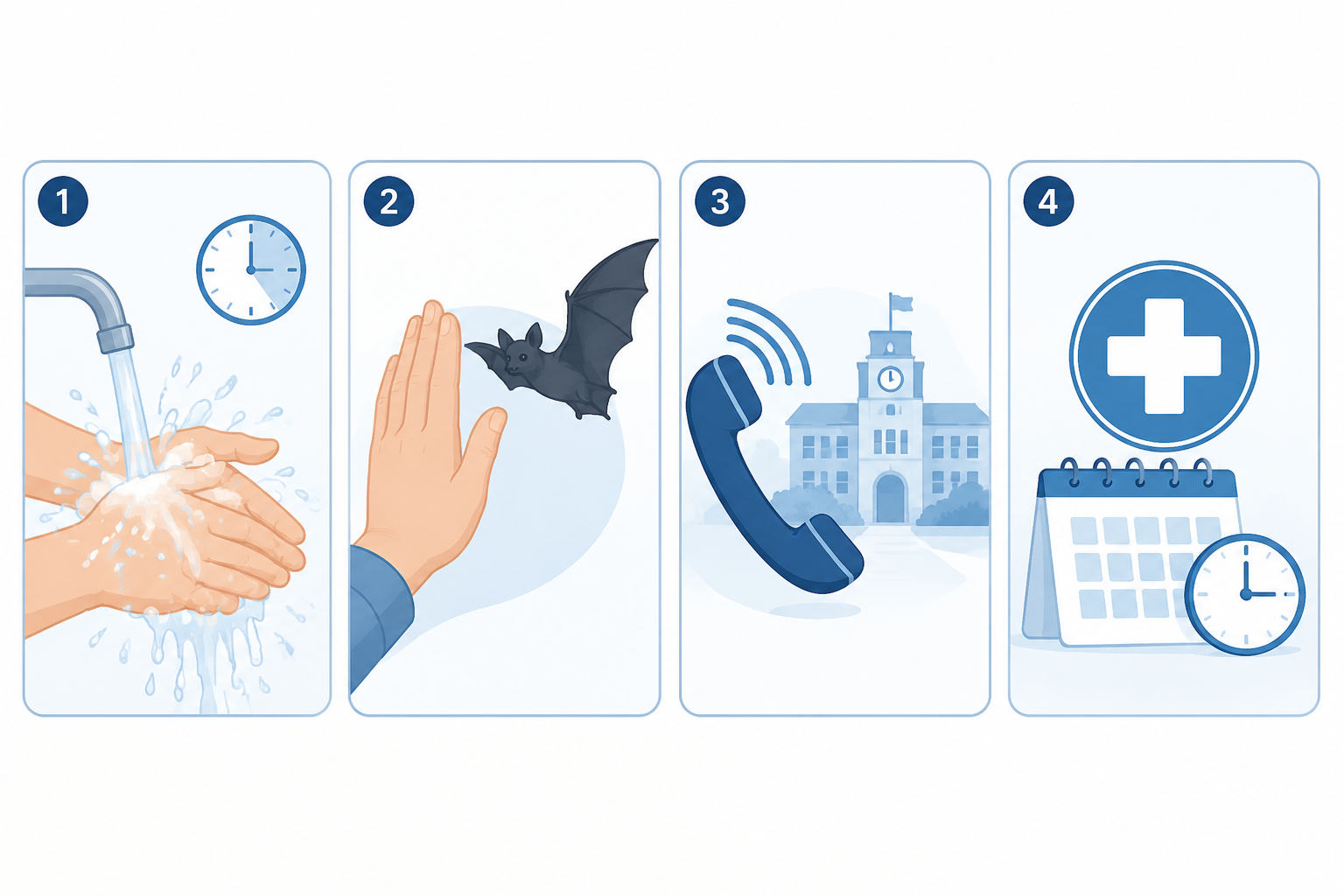
The immediate rabies safety tips for college students are simple: leave the bat alone, keep other people and pets away from it, report it to campus housing or animal control, wash any bite or suspected bite with soap and water for 15 minutes, and seek medical advice right away about rabies post-exposure prophylaxis, or PEP. PEP is not something to save for “if symptoms start.” Once rabies symptoms appear, the disease is almost always fatal; before symptoms, PEP is highly effective when given correctly.[1][2]
A Bat in a Dorm Room Is Not Just a Maintenance Issue
A loose bat in campus housing creates two separate tasks. Housing staff need to remove the animal and look for entry points. The student needs to find out whether they may have been exposed to rabies. Those tasks can happen in parallel, but they should not be confused.
The medical question is not limited to “Did I see blood?” or “Did it hurt?” CDC guidance says a person should seek medical care after a possible exposure, and bat bites can be difficult to recognize because they may leave marks that are too small to notice.[1] That matters in exactly the dorm-room scenario students are most likely to minimize: someone wakes up, sees a bat flying near the bed, and cannot say with certainty what happened while they were asleep.
This does not mean every bat seen outside a dining hall or above a campus quad is a rabies exposure. It means an indoor encounter, especially in sleeping quarters, deserves a cleaner decision process than “it’s probably fine.”
Campus Housing Has Had Real Rabies Exposure Investigations
Dorms, sorority houses, fraternity houses, and apartment-style student housing have the same features that make bat encounters hard to manage: people sleep there, rooms are shared, residents come and go, and no one expects a wildlife response plan to be part of move-in week.
A CDC report from Indiana shows why that matters. In February 2017, health officials assessed rabies exposure risk at a university sorority house where bats had reportedly colonized the attic for about 30 years. Among 94 surveyed residents, 14% were classified as having moderate-to-high exposure risk.[3]
That finding should not be read as “14% of students in every house with bats are exposed.” It was one documented investigation with its own building history and resident interviews. But it is enough to reject the casual assumption that a bat problem in student housing is only a facilities nuisance. Once bats are in sleeping areas or may have been present while residents slept, the question becomes medical.
A related CDC investigation in Kentucky involved a volunteer facility rather than a college dorm, so the comparison is not exact. Still, the setting is useful because it involved sleeping quarters and a young adult population. In that 2013 report, 257 people were evaluated, the median age was 21, and 6.3% were found to have elevated risk for rabies exposure.[4]
More recent campus-facing risk guidance has also pointed to bat incidents in student housing. United Educators described a 2024 University of Georgia off-campus housing incident in which students required PEP after a bat infestation. That account is not the same level of evidence as a CDC field investigation, but it is a practical reminder that this is still a live campus operations issue, not an old public health footnote.[5]
Why Bat Encounters Get Treated Differently
Students often expect rabies advice to center on obviously aggressive animals. With bats, the problem is more awkward: the animal may be small, quiet, and gone by the time anyone decides what to do. A person may not know whether contact happened, especially if they were asleep, intoxicated, groggy, or otherwise unable to give a reliable account.
CDC identifies bats as a major rabies concern in the United States and advises people to avoid contact with bats and seek care after possible exposure.[1] The practical campus rule follows from that: if a bat was in the room with someone who was sleeping or unable to confidently rule out contact, do not let reassurance substitute for a medical assessment.
The wrong move is to make the student prove exposure before anyone takes action. Public health staff can help decide whether PEP is needed, but they need a prompt report, a clear description of the encounter, and, when possible, access to the bat for testing. That is another reason students should not chase, crush, release, or handle the animal themselves.
What to Do in the First 15 Minutes
The first minutes after a possible exposure are not for group chat debate. Use them to reduce risk and start the chain of people who can handle the situation.
- Get away from the bat without touching it. Close the room door if you can do so safely, and keep roommates, visitors, and pets out.
- Wash any bite, scratch, or suspected contact area with soap and water for 15 minutes. CDC describes thorough wound washing as especially important after a possible rabies exposure.[1]
- Call campus housing, the RA on duty, campus police, or the emergency facilities number your school provides. Ask them to contact animal control or the appropriate wildlife professional.
- Contact a medical provider, urgent care, emergency department, or local health department right away and say plainly: “There was a bat in my sleeping area, and I need advice about rabies exposure.”
- Do not release the bat if it can be safely contained by trained staff. Testing the bat may help health officials decide whether PEP is necessary.
If you are an RA or housing staff member, your job is not to diagnose exposure in the hallway. Your job is to keep the bat from being handled, document who may have been in the room, escalate to the campus protocol, and steer possibly exposed students to medical care. Calm is useful only if it speeds up the right steps.
When PEP Comes Up
Rabies post-exposure prophylaxis is the treatment used after a possible rabies exposure and before symptoms begin. For someone who has not previously been vaccinated against rabies, CDC guidance describes PEP as wound care, human rabies immune globulin, and a four-dose rabies vaccine series given over 14 days.[2]
The details are for clinicians and public health staff to manage, but students should understand the urgency. PEP is highly effective when given before symptoms appear, and rabies is almost always fatal once clinical symptoms begin.[2] That is why the correct threshold is “possible exposure,” not “visible bite confirmed by everyone in the room.”
If the bat is captured and tests negative, health officials may decide PEP is not needed or can be stopped. If the bat is gone, cannot be tested, or the encounter details are uncertain, the decision may be more cautious. Either way, that decision belongs with medical and public health professionals, not with whoever is least worried on the floor.
What Counts as a Possible Exposure in Student Housing
A possible exposure is not always dramatic. In campus housing, the situations that deserve prompt reporting include a bat found in a bedroom, a bat in a room where someone was sleeping, direct contact with a bat, a bite or scratch from a bat, or a bat near someone who cannot reliably describe what happened.
| Situation | What to do |
|---|---|
| You wake up and a bat is in your room | Leave the bat alone, report it immediately, and seek medical guidance about possible exposure. |
| A bat brushes your skin or hair | Wash the area with soap and water for 15 minutes and seek medical care right away. |
| A roommate handled a bat | Have them wash any contact area, stop anyone else from touching it, and call medical/public health staff. |
| A bat is flying in a hallway | Keep people away, report it to housing or campus safety, and do not try to catch it yourself. |
| You only saw a bat outdoors | Avoid contact and report unusual behavior if needed; outdoor sighting alone is not the same as a sleeping-area exposure. |
The distinction matters because overreaction can create confusion, but underreaction can cost time. A bat outside at dusk is different from a bat in a closed room with a sleeping student. The second situation needs documentation and medical triage.
How to Make Your Campus Plan Before You Need It
The best time to look up your campus bat protocol is not 1 a.m. with a towel under your door. Save the phone numbers for your RA duty line, housing office, campus police or safety dispatch, student health service, and local health department. If your school uses an after-hours nurse line, add that too.
Ask housing how animal incidents are handled in your building. Some campuses route calls through facilities, some through police or public safety, and some through residential life. The exact route varies, but the standard you want is the same: no student handles the bat, possible exposures are referred for medical assessment, and the animal is captured for testing when trained personnel can do so safely.
Students who already think about wildlife risks on trails may recognize the pattern: preparation matters because decisions get worse when everyone is tired, surprised, and improvising. The difference is that rabies risk can begin inside the room where you sleep. If a bat gets into that room, wash any possible wound, do not handle the animal, call the campus response line, and get medical or local health department guidance immediately.
References
- Rabies Prevention and Control, CDC
- Rabies Post-exposure Prophylaxis Guidance, CDC
- Notes from the Field: Assessment of Rabies Exposure Risk Among Residents of a University Sorority House — Indiana, February 2017, MMWR
- Assessment of Risk for Exposure to Bats in Sleeping Quarters Before and During Remediation — Kentucky, 2012, MMWR
- Bats on Campus: Safety Considerations, United Educators
Comments
Join the discussion with an anonymous comment.