
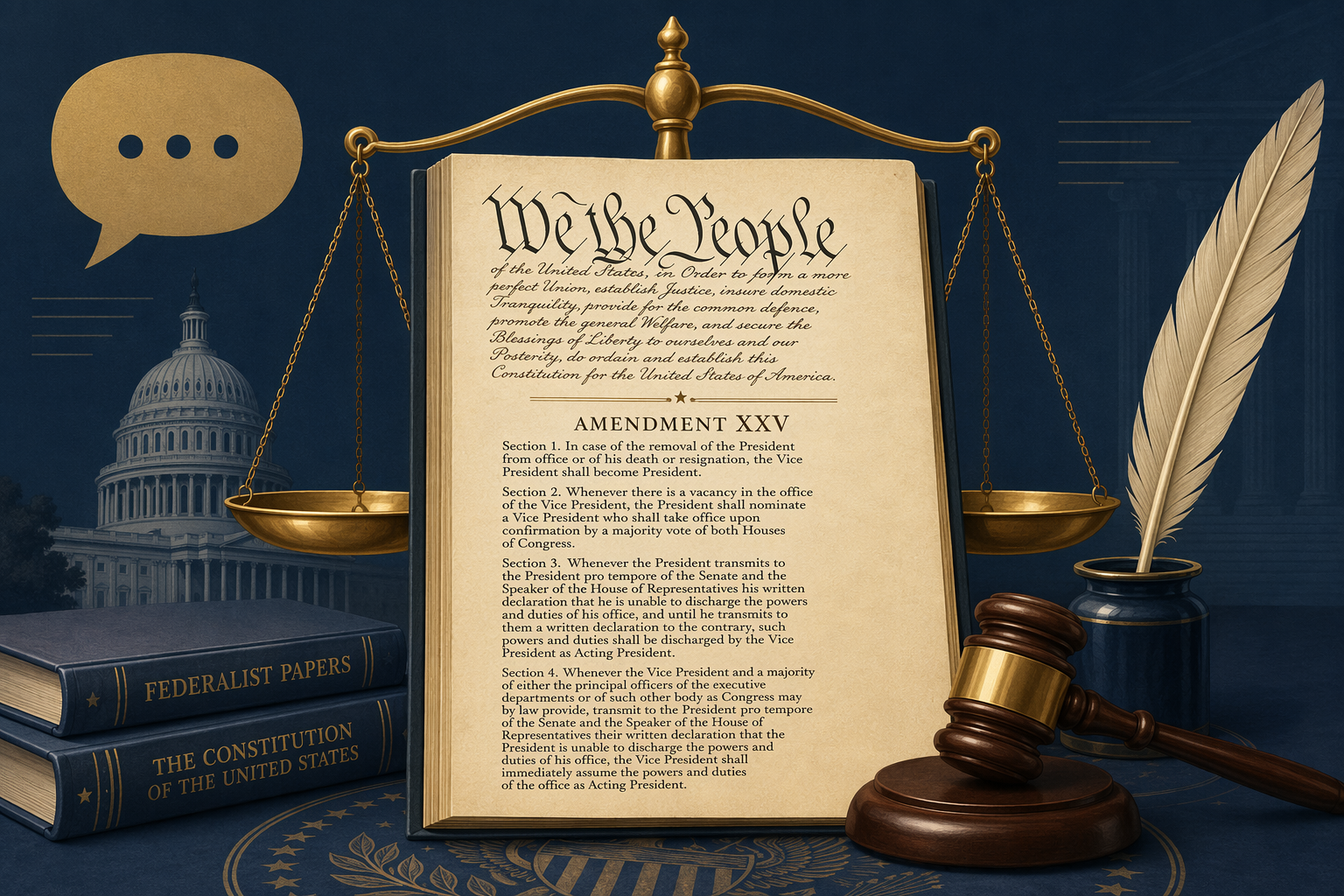
What Gavin Newsom's 25th Amendment Remarks Mean for AP Gov
This article uses Gavin Newsom's July 2026 remarks about the 25th Amendment as a current-events hook to explain the amendment's four sections, its historical origins, and how it is tested on the AP US Government exam. It clarifies why Newsom's statement is a political move rather than a formal constitutional trigger and covers key Section 4 procedures and common exam traps.
Updated:
On July 16, 2026, California Gov. Gavin Newsom called President Trump’s latest election-fraud remarks a “25th Amendment moment” and described them as the “ramblings of a mad king,” according to reporting published the next day by The Daily Beast.[1] That is a sharp political line. It is also exactly the kind of line that can make an AP Gov student learn the wrong constitutional rule if it gets treated as more than rhetoric.
Here is the exam-safe correction: Newsom cannot activate Section 4 of the 25th Amendment. A governor cannot. A member of Congress cannot. A cable-news guest cannot. Under Section 4, the formal process begins only when the Vice President and a majority of the principal officers of the executive departments — usually described as the Cabinet — send a written declaration that the President is unable to discharge the powers and duties of the office.[2]
That distinction is the whole value of this current event for AP Government. Newsom’s statement may matter politically because it adds another high-profile demand to a long-running debate over presidential fitness. It does not start the constitutional machinery. The 25th Amendment is not a public-pressure button; it is a four-section rulebook for vacancy, replacement, and inability.
Why the 25th Amendment Exists
The Constitution originally said that if a President was removed, died, resigned, or became unable to serve, presidential powers and duties would “devolve” on the Vice President. That wording left an important question: did the Vice President become President, or only acting President? When William Henry Harrison died in 1841, Vice President John Tyler treated himself as the full President. That practice became known as the Tyler Precedent.[3]
The problem was not only death in office. Woodrow Wilson’s 1919 stroke showed how unclear the system could become when a President was alive but seriously impaired. Dwight Eisenhower’s health episodes in the 1950s, including heart problems, reinforced the need for clearer procedures. John F. Kennedy’s assassination in 1963 then supplied the direct political urgency for a formal amendment.[3][4]
Congress proposed the 25th Amendment on July 6, 1965, and the states ratified it on February 10, 1967.[4] For AP Gov, the date matters less than the constitutional lesson: the amendment was designed to make presidential succession and inability less dependent on custom, private bargaining, or improvisation during a crisis.
The Four Sections, Without the Cable-News Fog
The 25th Amendment has four sections. They are often discussed together, but they answer different questions. Mixing them up is one of the easiest ways to miss an AP-style multiple-choice question.
| Section | Question it answers | Exam-safe rule |
|---|---|---|
| Section 1 | What happens if the presidency becomes vacant? | The Vice President becomes President. |
| Section 2 | What happens if the vice presidency becomes vacant? | The President nominates a Vice President, who must be confirmed by majority vote in both houses of Congress. |
| Section 3 | What if the President voluntarily transfers power temporarily? | The President declares inability in writing; the Vice President serves as Acting President until the President declares ability to resume. |
| Section 4 | What if others believe the President is unable but the President does not voluntarily step aside? | The Vice President and Cabinet majority begin the process; Congress may have to decide if the President disputes it. |
Section 1: the Vice President becomes President
Section 1 is the cleanest part: when the President is removed from office, dies, or resigns, the Vice President becomes President.[2] It constitutionalized the Tyler Precedent rather than leaving the matter to custom. On an exam, this is not a temporary transfer. It is succession to the office itself.
Section 2: filling a vice-presidential vacancy
Section 2 handles the vacancy that used to be politically awkward: an empty vice presidency. When the vice presidency is vacant, the President nominates a replacement, but that nominee does not take office automatically. A majority of both the House and Senate must confirm the nominee.[2]
This section has been used twice. Gerald Ford was confirmed as Vice President in December 1973 after Spiro Agnew resigned. Nelson Rockefeller was confirmed in December 1974 after Ford became President following Richard Nixon’s resignation.[5] Those examples are useful because they show Section 2 working through ordinary constitutional procedure: nomination, confirmation, office.
Section 3: voluntary temporary transfer
Section 3 is the part to remember when the President knows in advance that temporary inability is likely, such as during a medical procedure requiring anesthesia. The President sends a written declaration to the President pro tempore of the Senate and the Speaker of the House stating that he or she is unable to discharge the powers and duties of the office. The Vice President then becomes Acting President. When the President sends another written declaration saying the inability has ended, the President resumes power.[2]
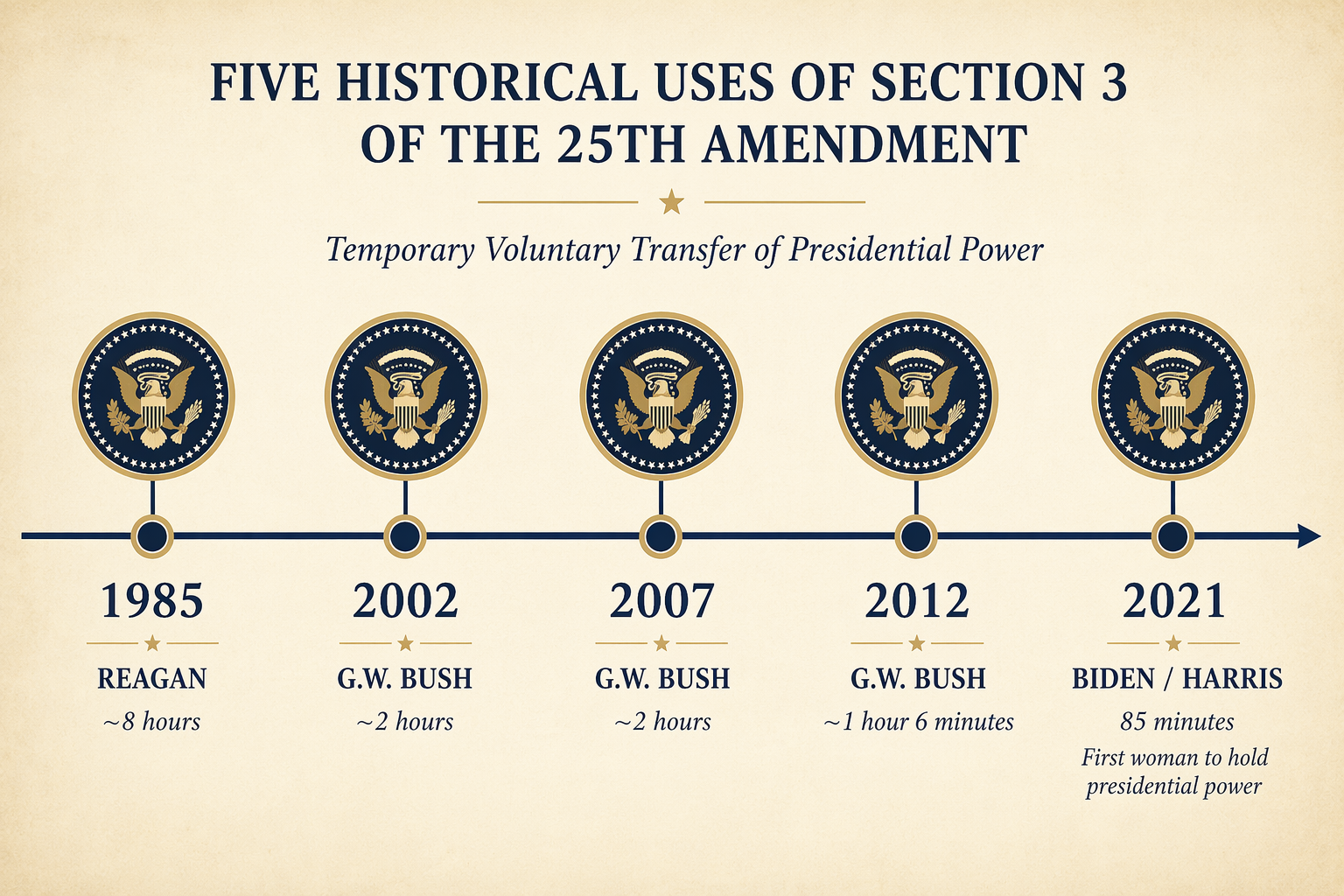
Section 3 has been used without the constitutional drama that surrounds Section 4. Ronald Reagan invoked it in 1985 for about eight hours during surgery. George W. Bush invoked it in 2002 and 2007 during colonoscopies. Joe Biden invoked it in 2021, making Kamala Harris the first woman to hold presidential powers, though only temporarily as Acting President.[5]
That history matters for students because it separates actual use from political imagination. The 25th Amendment is not unused as a whole. Section 3 has been used. Section 2 has been used. Section 4 — the part being invoked rhetorically in Newsom’s comment — has not.
Section 4 Is the Part Newsom Was Pointing At
Section 4 is built for the hardest scenario: the President is alleged to be unable to serve, but the President does not voluntarily transfer power. It is the provision people usually mean when they say “invoke the 25th Amendment” against a sitting President. It is also the provision where public discussion gets sloppy fastest.
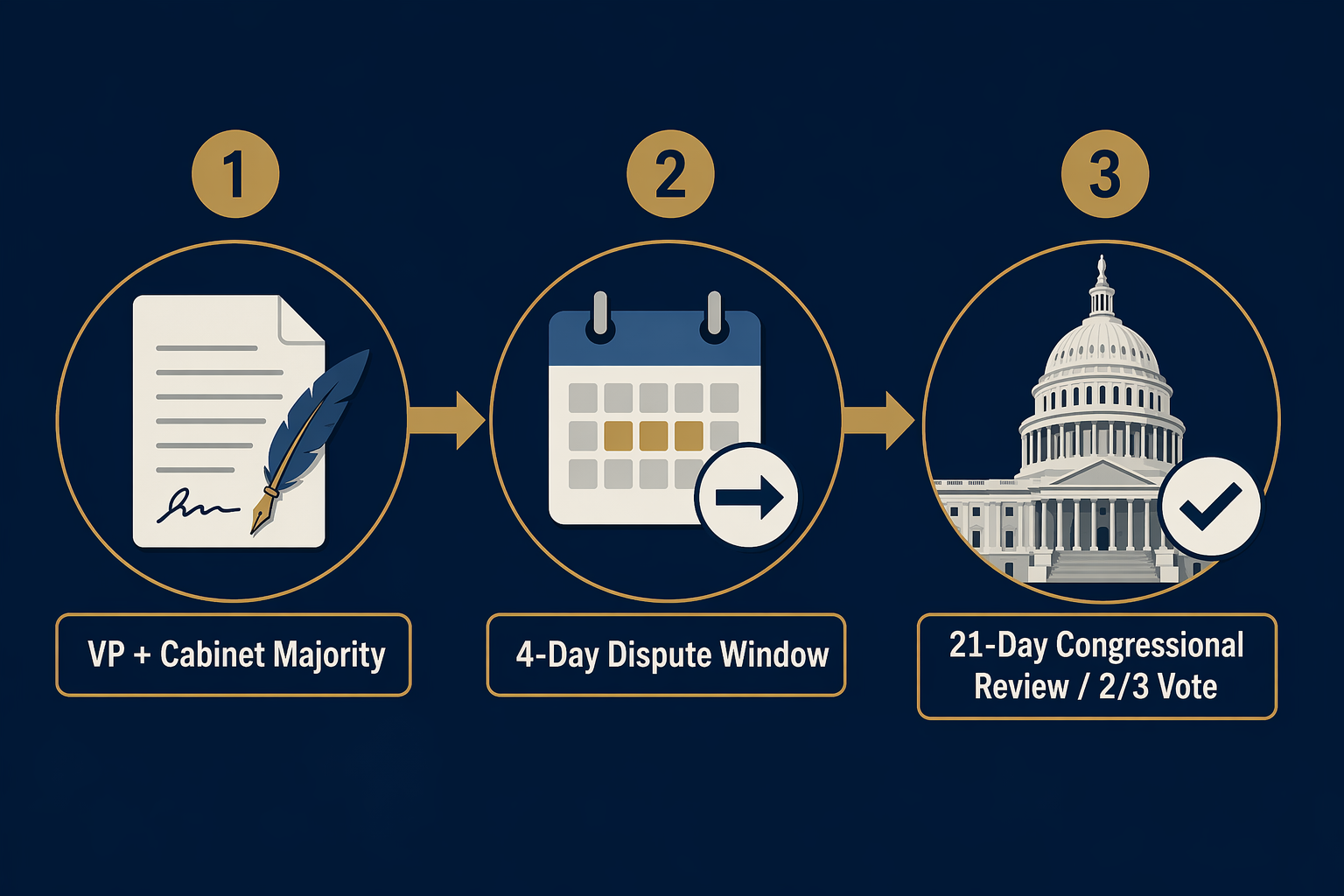
The first move belongs to the Vice President and a majority of the principal officers of the executive departments. They send a written declaration to the President pro tempore of the Senate and the Speaker of the House stating that the President is unable to discharge the powers and duties of the office. At that point, the Vice President immediately assumes the powers and duties as Acting President.[2][6]
The President can contest that declaration by sending a written statement that no inability exists. If the Vice President and Cabinet majority do nothing further, the President resumes power. If they disagree, they have four days to send another declaration that the President remains unable. That second declaration sends the dispute to Congress.[6]
Congress then has 21 days to decide the question if it is in session, or 21 days after it is required to assemble if it is not. To keep the Vice President as Acting President over the President’s objection, two-thirds of both the House and Senate must vote that the President is unable. If that supermajority is not reached, the President resumes the powers and duties of the office.[2][6]
For AP Gov, the burden is the point. Section 4 does not allow a simple congressional majority to remove presidential power. It does not allow one chamber to act alone. It does not let public opinion substitute for the Vice President and Cabinet. The design makes a disputed transfer difficult because it is supposed to handle incapacity without becoming an ordinary partisan weapon.
What Has Actually Happened Before
Section 4 has never been invoked in U.S. history.[6] That sentence is short, but it does a lot of exam work. Political actors have discussed it. Commentators have demanded it. Members of Congress have floated it. None of that equals a Section 4 declaration from the Vice President and Cabinet majority.
The provision was debated after January 6, 2021. It was also raised during the April 2026 Iran war, when more than 50 House Democrats called for it. Newsom’s July 2026 remarks came after Trump’s election-fraud speech and became another high-profile example of Section 4 being used as political vocabulary rather than formal constitutional action.[1][6]
Because the Newsom story was reported on July 17, 2026, it should be treated as a live current event, not as a settled constitutional episode.[1] New reporting could change the political context. It would not change the first procedural rule students need: unless the Vice President and Cabinet majority act, Section 4 has not begun.
How AP Gov Is Likely to Test This
This topic can appear in more than one AP Gov lane. It connects to the presidency in Unit 2 because it concerns presidential power, succession, and the Vice President’s role. It also connects to the amendment process in Topic 3.8 because the 25th Amendment is a constitutional amendment created to solve a structural problem.[7]
A good AP question will usually test authority, sequence, or comparison. It is less likely to care whether a student remembers every quote from the current controversy. The distractors practically write themselves:
- A governor calls for the 25th Amendment, so Section 4 begins. Wrong: governors have no initiating role.
- Congress invokes Section 4 by majority vote. Wrong: the Vice President and Cabinet majority start the process; Congress decides only if the President disputes and the dispute continues.
- The Cabinet can remove the President without the Vice President. Wrong: Section 4 requires the Vice President plus a Cabinet majority.
- Section 3 and Section 4 are the same because both create an Acting President. Wrong: Section 3 is voluntary; Section 4 is contested or potentially involuntary.
- The 25th Amendment is the same as impeachment. Wrong: impeachment addresses removal for misconduct; Section 4 addresses inability to discharge presidential powers and duties.
That last comparison deserves special care. Impeachment begins in the House, where a majority can impeach. Removal after impeachment requires conviction by two-thirds of the Senate. Section 4, by contrast, begins inside the executive branch with the Vice President and Cabinet majority, and Congress enters only if the President contests the declaration and the Vice President and Cabinet majority persist.[2][8]
| Scenario | Constitutional category | Who acts first |
|---|---|---|
| President dies, resigns, or is removed | 25th Amendment, Section 1 | Succession occurs; Vice President becomes President |
| Vice presidency is vacant | 25th Amendment, Section 2 | President nominates; House and Senate confirm |
| President voluntarily transfers power temporarily | 25th Amendment, Section 3 | President sends written declaration |
| President is alleged to be unable but does not step aside | 25th Amendment, Section 4 | Vice President and Cabinet majority send written declaration |
| President is accused of misconduct warranting removal | Impeachment | House begins impeachment process |
The Clean Answer to the Newsom Question
So what do Gavin Newsom’s 25th Amendment remarks mean for AP Gov? They are a current example of political actors invoking Section 4 language to challenge presidential fitness. They are not a constitutional trigger. They do not transfer power, force a Cabinet vote, require Congress to act, or create an Acting President.
The usable rule is narrower and stronger: Section 4 starts only with the Vice President and a Cabinet majority; the President can dispute; the Vice President and Cabinet majority then have four days to persist; Congress has a 21-day review window; and keeping the Vice President as Acting President over the President’s objection requires a two-thirds vote in both houses.[2][6] If a student can keep that sequence separate from Section 3 and impeachment, the headline has done its job.
References
- Newsom Calls for Trump to Face 25th Amendment After ‘Ramblings of a Mad King’ — The Daily Beast, July 17, 2026, link
- Twenty-Fifth Amendment — National Constitution Center, link
- The 25th Amendment — Bill of Rights Institute, link
- Twenty-fifth Amendment to the United States Constitution — Wikipedia, link
- What Is the 25th Amendment? — Bipartisan Policy Center, link
- How does the 25th Amendment work? — Good Authority, link
- Amendment Process — Fiveable, link
- What Is the 25th Amendment? — Rock the Vote, link
Comments
Join the discussion with an anonymous comment.