
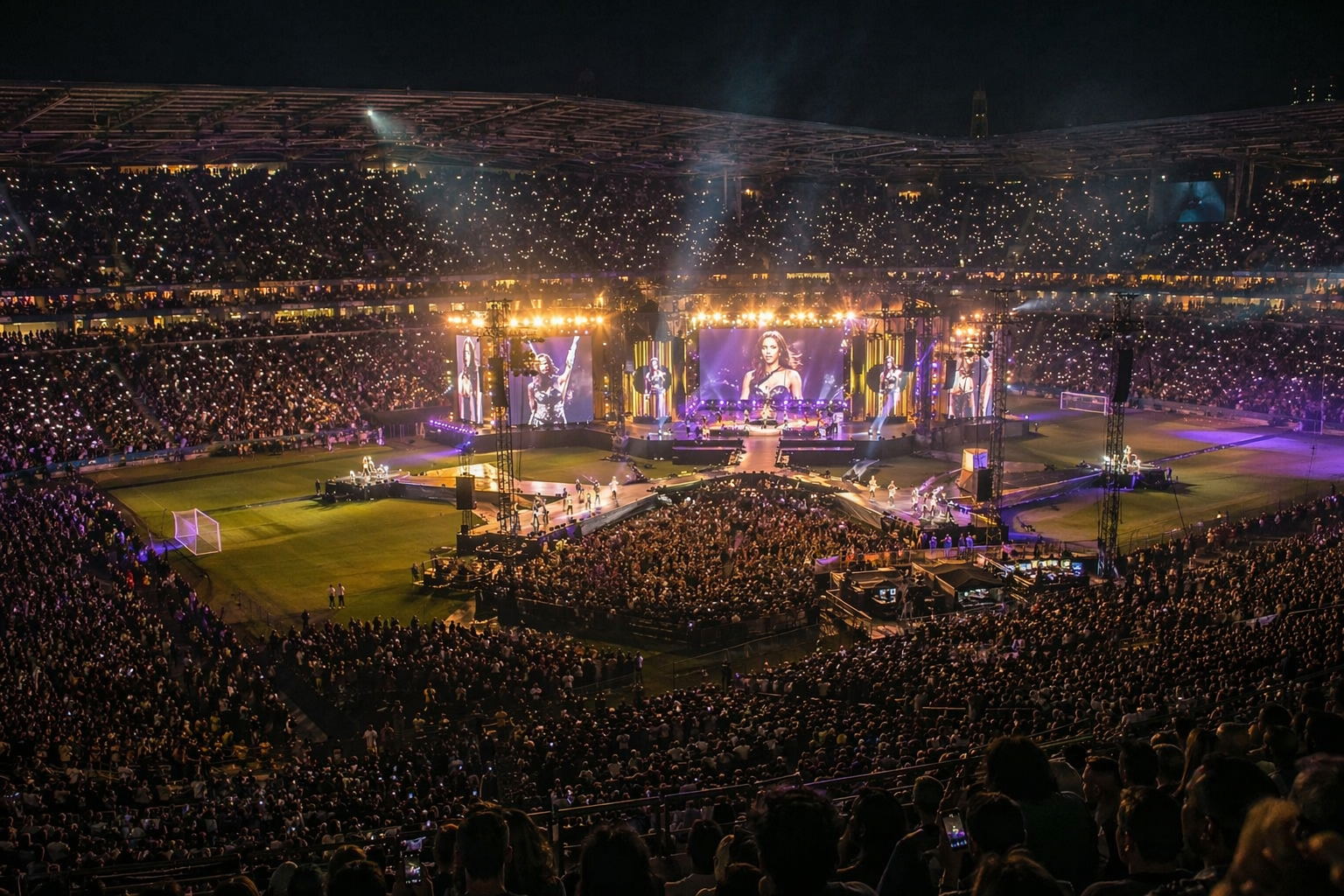
FIFA's 2026 Half-Time Rule Change Explained
FIFA extended the World Cup final halftime beyond the standard 15 minutes for a Super Bowl-style show in 2026. Here's what actually changed, why it happened, and how it conflicts with football's rules.
Updated:
The short answer is yes, FIFA changed half-time for the 2026 World Cup final — but not by rewriting football’s universal law for every match. The normal rule is still the one in IFAB Law 7: “Players are entitled to an interval at half-time, not exceeding 15 minutes.”[1] That sentence is the starting point because it is not vague. It does not say “usually 15 minutes,” or “around 15 minutes,” or “unless a final needs a bigger show.”
For the July 19, 2026 World Cup final between Spain and Argentina, FIFA allowed a longer interval to stage a first-of-its-kind World Cup final halftime show. The performance itself was planned for 11 minutes, with Madonna, Shakira, BTS, and Justin Bieber involved, curated by Coldplay’s Chris Martin; The Athletic also reported roughly seven minutes for stage setup and roughly seven minutes for teardown.[2] That is where the rules problem begins: the show was not just a song slipped into the ordinary interval. It required match time to bend around event production.
What Actually Changed
The change was final-specific. FIFA did not announce a new global rule saying all football matches can now have half-hour intervals. It created an exception inside its own World Cup final operation: the interval was extended beyond the standard 15 minutes so a concert-style production could be built, performed, and removed before the second half.
That distinction matters because a lot of the public argument collapses two different things. One question is whether the Laws of the Game still say half-time may not exceed 15 minutes. They do.[1] The other question is whether FIFA, as the competition organizer of its own tournament, wrote or applied tournament rules in a way that permitted a longer World Cup final interval. The reported regulatory loophole is that FIFA’s tournament regulations did not carry over the same “not exceeding” wording from IFAB Law 7. That does not make the tension disappear; it explains how FIFA could preserve a formal competition-document route while departing from the ordinary match structure.
Why Reports Said 17 Minutes, 20 Minutes, or 30 Minutes
The disputed duration is not a trivial detail, because different numbers imply different levels of departure from the normal law. In the days before the final, Marca and Sporting News reported a total half-time length of 17 minutes. Reuters and the BBC reported that the break could run between 20 and 30 minutes. The difference likely comes from what each report counted: the performance alone, the official interval, the production changeover, or the full period between the referee ending the first half and restarting the second.
| Reported figure | What it appears to describe | Why it matters |
|---|---|---|
| 11 minutes | The planned musical performance | This is the show itself, not the whole break. |
| 17 minutes | A shorter reported total interval from Marca and Sporting News | Still beyond IFAB’s 15-minute ceiling if treated as the full half-time interval. |
| 20–30 minutes | The wider Reuters and BBC reporting on the expected break | This better reflects the concern created by setup, teardown, and restart logistics. |
| About 7 minutes setup and about 7 minutes teardown | Production logistics reported by The Athletic | These extra minutes are why the performance cannot be analyzed as an isolated 11-minute segment.[2] |
The temptation is to average those numbers into one neat answer. That would be less accurate than leaving the disagreement visible. A 17-minute interval is already outside the IFAB wording. A 20-to-30-minute interval turns the same legal issue into a much larger welfare and match-rhythm issue. The sources do not support pretending those are the same claim.
The Athletic’s logistics are especially important because they show why the break could not be judged by performance length alone. If a stage has to enter the pitch, be made safe for performers, then be removed quickly enough for elite players to restart a World Cup final, the relevant clock is not just the music. It is the full interruption of the match environment.[2]
The Law Is Plain, but the Competition Route Is Messier
IFAB Law 7 is written for the match itself. It gives players an interval, caps it at 15 minutes, and leaves no entertainment exception in the quoted sentence.[1] In ordinary football administration, that kind of wording is supposed to keep the basic rhythm of a match predictable: 45 minutes, interval, 45 minutes, with added time handled separately.
FIFA’s position is more awkward than a simple “they broke the rules” line. Tournament regulations can set competition procedures, and the World Cup is not run only by a pocket copy of the Laws of the Game. The reported omission of the “not exceeding” phrase in FIFA’s tournament framework created room for FIFA to authorize a longer final interval while arguing from its own competition documents.
That is exactly why the 2026 final matters. The problem is not just that famous singers appeared near a football pitch. The problem is that FIFA could use a competition-specific document to soften a limit that the game’s law states plainly. If that sounds procedural, it is; most football controversies become less noisy and more serious once the wording is actually read.
Why Player Welfare Is Not a Side Issue
A longer half-time is not only an aesthetic complaint about a Super Bowl-style spectacle. IFAB previously rejected CONMEBOL’s request for a 25-minute Copa America half-time, with the objection tied to the “negative impact on player welfare and safety” created by longer inactivity, as reported by the BBC and The Athletic.[2] That prior response matters because it treats the interval as a performance and safety condition, not merely a programming slot.
Players do not restart from a television break. They restart after cooling down, receiving tactical instructions, managing injuries, completing warm-up routines, and returning to a competitive intensity that may decide the World Cup. Match officials also have to manage the restart, the pitch condition, the teams’ timing, and whatever production footprint remains after the show has been removed.
The welfare argument does not require claiming that one longer break automatically injures players. The narrower and better-supported point is that IFAB has already treated extended inactivity as a player safety concern in another competition context. FIFA’s final then created the kind of extended interval that the law normally prevents and that IFAB had previously resisted.
The Club World Cup Test Run
The 2026 final did not arrive from nowhere. The 2025 Club World Cup final in New Jersey had a 24-minute half-time with a Coldplay-curated show, and Reuters described it as a test run for the World Cup final concept. That precedent is useful because it shows FIFA had already tested whether a major final could absorb a concert-format interval before doing it on the sport’s biggest stage.
A test run does not prove a permanent policy. It does, however, make the 2026 World Cup final look less like an improvised one-off and more like the next step in FIFA’s event model. The more important pattern is logistical, not cultural: build a show, hold the players, clear the pitch, restart the match.
The Global Citizen Framing Does Not Settle the Rules Question
FIFA and its partners presented the halftime show partly through a charitable frame. The show was tied to Global Citizen and an aim to raise $100 million for children’s education and sports programs, according to Reuters and the BBC. That is relevant context, and it is better than pretending the event was only a commercial vanity project.
But a charitable purpose does not answer the match-structure question. If the interval is longer than the law’s stated cap, the reason for the show may affect how people feel about the decision, but it does not change what players and officials have to manage. Good intentions can sit beside a bad precedent.
The broadcaster reaction showed the same tension in another form. Multiple broadcasters, including the BBC and ITV, initially planned not to air the show before reversing course, according to Dazed and The Athletic.[2] That reversal belongs in the story, but it is not the center of it. Broadcast choices are downstream of the first decision: FIFA made the half-time show part of the final’s event architecture.
Other 2026 Rule Changes Are a Different Category
The 2026 World Cup also came with other rule and procedure changes reported across sports outlets: 10-second substitutions, five-second restarts, mandatory hydration breaks, expanded VAR powers, red cards for covering mouths, and semi-automated offside technology. Those changes affect how the game is controlled, timed, reviewed, or disciplined. They are not the same kind of issue as extending a World Cup final interval for a stage show.
That distinction is worth keeping because otherwise the half-time controversy gets lost in a generic “new rules” pile. A substitution timing rule can be judged by whether it reduces delay. Semi-automated offside can be judged by decision speed and accuracy. A concert-length final interval has to be judged against the written half-time limit, player inactivity, and the authority FIFA gives itself when staging its own showcase.
What the 2026 Half-Time Change Really Means
The fair explanation is narrow but serious. FIFA did not abolish the 15-minute half-time rule across football. It did extend the 2026 World Cup final interval beyond the standard IFAB limit to stage a major entertainment production. The reported total length remains source-dependent — 17 minutes in some accounts, 20 to 30 minutes in others — and that uncertainty should not be ironed out for convenience.
The sharper issue is the mechanism. IFAB’s law says the half-time interval must not exceed 15 minutes.[1] FIFA’s final-specific operation made room for an 11-minute performance plus production time.[2] IFAB had previously treated longer inactivity as a welfare and safety concern when another confederation wanted a 25-minute Copa America interval.[2] Put together, those facts make the 2026 final more than a celebrity cameo at half-time.
FIFA did not merely add a concert. It created a World Cup final exception that exposed the tension between football’s written match structure, commercial event-making, and the people who have to restart the match after the lights go down. The 2026 final does not prove that every future World Cup half-time will become a Super Bowl-style show. It does make the conflict visible enough that it can no longer be treated as hypothetical.
References
- The Duration of the Match, IFAB.
- World Cup halftime show: Shakira, BTS, Madonna among performers for final, The Athletic, July 17, 2026.
Comments
Join the discussion with an anonymous comment.