
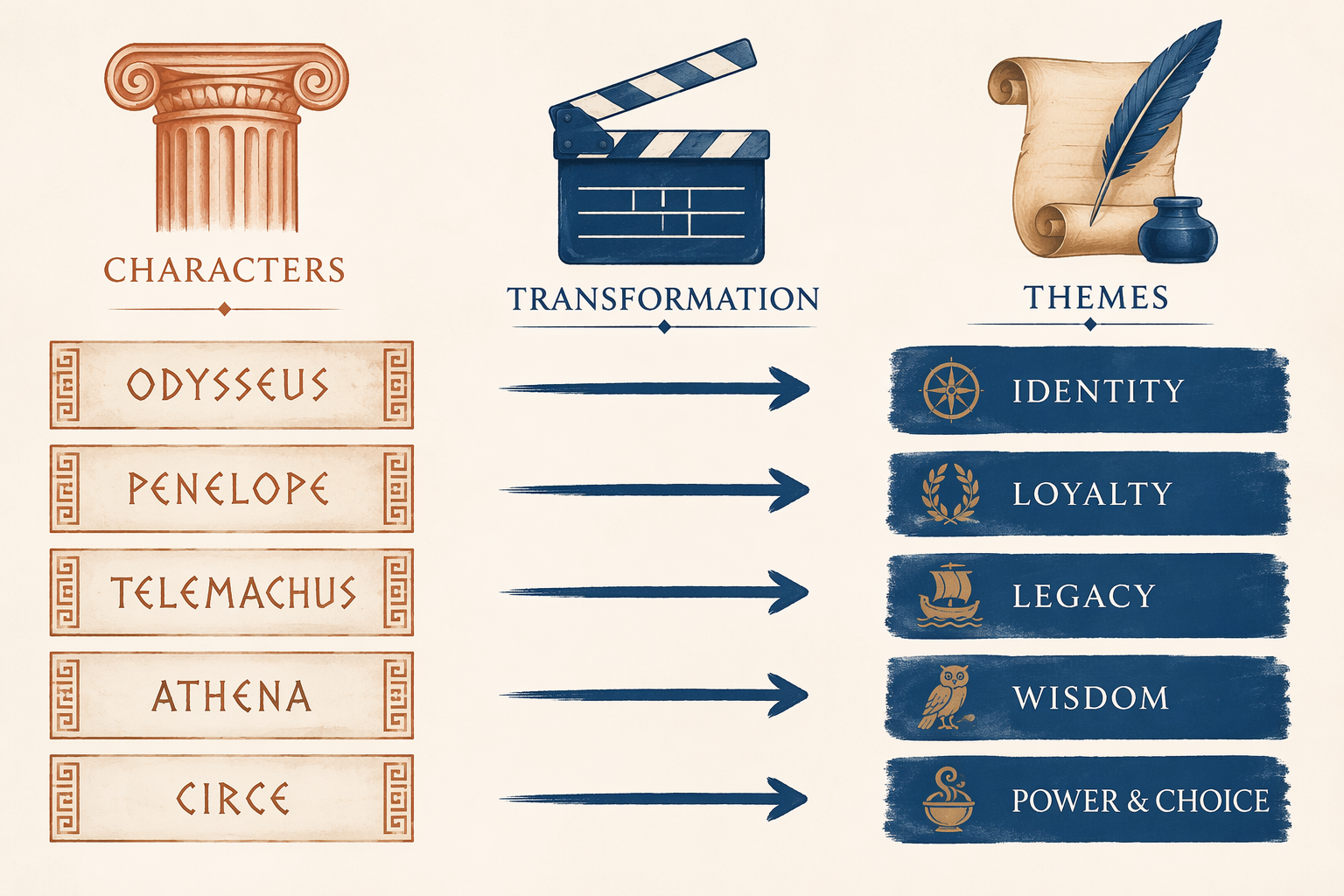
How Nolan Changed Homer’s Characters in The Odyssey 2026
A complete character guide for literature students studying Homer’s epic alongside Christopher Nolan’s 2026 film. Learn which actors play each role, how Nolan reimagined the characters, and why those changes matter for your essays and class discussions.
Updated:
If you are using Nolan’s film for a literature discussion, start with the safest caution: this is not a filmed transcription of Homer. The better question is not simply whether a character is “accurate,” but what a change makes visible in the poem. The film was released on July 17, 2026, so early classroom arguments still need to separate confirmed casting and plot choices from first-week interpretation.[1]
For a quick orientation, use the table first, then slow down over the characters whose changes actually alter an essay claim. The factual spine here comes from the AP character guide, Variety’s cast list, and standard classroom descriptions of Homer’s characters such as SparkNotes.[2][3][4]
| Character | Actor | Homeric baseline | Nolan change | Best essay use |
|---|---|---|---|---|
| Odysseus | Matt Damon | The many-turned strategist, famous for endurance, cunning, and survival | A guilt-marked commander whose war experience presses on his return | Heroism, trauma, moral responsibility |
| Penelope | Anne Hathaway | The queen of Ithaca, known for fidelity, delay, and the weaving trick | Angrier, more intellectually confrontational, and less reducible to patience | Gender justice, domestic power, emotional labor |
| Telemachus | Tom Holland | The son who must grow into public speech and household authority | Given more emotional weight and more father-son interaction | Inheritance, masculinity, the burden of a famous father |
| Athena | Zendaya | A goddess who directly guides and protects Odysseus and Telemachus | Appears through weather, birds, and intuition rather than ordinary divine intervention | Divine agency, ambiguity, modern realism |
| Antinous | Robert Pattinson | The most aggressive suitor and a chief threat inside Odysseus’ house | More possessive and psychologically predatory toward Penelope | Sexual threat, household invasion, power without legitimacy |
| Calypso | Charlize Theron | An immortal who detains Odysseus on her island | A more sympathetic therapeutic figure, with lotus used as medicine | Captivity, healing, the desire not to return |
| Circe | Samantha Morton | A dangerous enchantress who transforms men into pigs and later helps Odysseus | An earthy sorceress who exposes men’s nature; no sexual relationship with Odysseus | Male appetite, transformation, consent |
| Polyphemus | Bill Irwin | The Cyclops defeated by Odysseus’ “Nobody” trick | A horror-inflected figure; the famous trick is absent | Cunning, violence, what gets lost when wit is deemphasized |
| Helen and Clytemnestra | Lupita Nyong’o | Women tied to the causes and aftermath of the Trojan War | Dual casting makes war’s cost on women more explicit | Memory, blame, gendered aftermath of war |
| Sinon | Elliot Page | Not an Odyssey character; he belongs to Virgil’s Aeneid | Imported into the underworld material as a deliberate anachronism | Imperial guilt, dead soldiers, adaptation as argument |
| Eumaeus | John Leguizamo | The loyal swineherd who shelters Odysseus before the palace reckoning | Presented as a loyal blind swineherd | Recognition, loyalty, classed forms of knowledge |
| Tiresias | James Remar | The dead prophet who instructs Odysseus in the underworld | Retained as the blind prophetic figure | Prophecy, consequence, the limits of heroic control |
| The Bard | Travis Scott | The poem repeatedly values song, memory, and oral performance | A modern performer links bardic tradition to contemporary rap | Oral tradition, fame, who gets to narrate violence |
Odysseus: From Cunning Survivor to Damaged Commander
In Homer, Odysseus is not just “smart.” He is polytropos: many-turned, versatile, hard to pin down. That word matters because it lets a student argue about intelligence as adaptability, deception, endurance, and moral slipperiness rather than as one neat heroic trait. SparkNotes’ classroom baseline rightly keeps him at the center as the king of Ithaca, husband of Penelope, father of Telemachus, and the wandering veteran trying to get home after Troy.[4]
Nolan’s Odysseus, played by Matt Damon, pushes the veteran part forward. Vanity Fair describes the film’s Odysseus as marked by PTSD, and The Conversation frames the adaptation through the older moral question of Odysseus as “destroyer” rather than uncomplicated hero.[5][6] That does not erase Homer’s cunning, but it changes what students should watch for. A scene or choice that once looked like strategic brilliance may now also read as a symptom of someone trained by war to survive through suspicion, concealment, and controlled cruelty.
The Sirens change is especially useful for essays. In many classroom readings of Homer, the Sirens episode becomes a clean example of disciplined curiosity: Odysseus wants knowledge, arranges restraints, and survives the danger. Vanity Fair’s account of Nolan’s version makes the moment more ambivalent, less a victory lap for cleverness than a pressure point around whether return itself is still desired.[5] That gives students a sharper claim than “the movie made him sadder.” The film asks whether nostos, the homecoming that organizes the epic, still feels like rescue to a man who has become almost unfit for peace.
A strong comparison should therefore keep two truths in view. Homer’s Odysseus is already morally complicated; Nolan did not invent that complication. What the film appears to do is relocate the complication from epic cleverness alone into the afterlife of command. The question becomes not only “How does he get home?” but “What kind of person has war made available to return?”
Penelope: The Waiting Wife Who Refuses to Be Only Waiting
Penelope is one of the easiest characters to flatten in a student essay. She waits; she weaves; she is faithful. All true, and all insufficient. In Homer, her delay tactics are acts of intelligence under pressure. The suitors are not an abstract inconvenience. They occupy her household, consume its wealth, threaten her son’s future, and try to convert her husband’s absence into their own authority.[4]
Nolan’s Penelope, played by Anne Hathaway, makes that pressure less decorous. Vanity Fair quotes the film’s version of Penelope as “a volcano of a human,” and the AP guide describes a portrayal that gives her more force and intellectual parity with Odysseus.[5][2] This is where “fidelity” becomes too small a word. The film’s Penelope is not valuable because she preserves herself unchanged for the hero’s return; she is valuable because she has been conducting a political and emotional defense of Ithaca while everyone else treats her as a prize.
That alteration can support an essay about gender justice, but it needs care. Do not claim Homer gives Penelope no agency. The weaving trick alone disproves that. A better claim is that Nolan externalizes and intensifies agency that the poem often stages through indirection, silence, coded speech, and delay. The result is not simply a “stronger” Penelope. It is a Penelope whose anger becomes readable as evidence rather than subtext.
Her pairing with Damon’s Odysseus also matters. If he returns as a damaged commander, then the reunion cannot be treated as the automatic restoration of order. Penelope has also been living inside a siege, though not the kind sung as military glory. A useful essay might compare the battlefield trauma that follows Odysseus home with the domestic trauma Penelope has had to manage in his absence.
Telemachus, Athena, and the Problem of Inherited Glory
Telemachus is not only “Odysseus’ son.” In the poem, he is a young man trying to speak in a house where older men have made his immaturity convenient. SparkNotes emphasizes his coming-of-age arc, and the AP and Variety guides identify Tom Holland as Nolan’s Telemachus, with the film giving the father-son relationship greater screen time and emotional force.[4][2][3]
That change matters because Telemachus inherits a legend before he inherits a father. If Nolan gives him more direct contact with Odysseus, the poem’s long-distance education shifts into a more immediate confrontation: what does a son do when the heroic story arrives in human form, wounded and compromised? The character becomes a way to discuss masculinity as inheritance rather than destiny.
Athena’s change pushes that same issue into the film’s treatment of divine agency. Zendaya’s Athena is not handled as a goddess who simply appears, instructs, and exits. The AP guide describes Nolan’s version as working through weather, birds, and intuition rather than literal divine intervention.[2] For students, that makes divine help harder to separate from perception. Is Telemachus being guided by a god, by instinct, by a tradition of reading signs, or by the film’s own visual grammar?
This is a good place to avoid a lazy “modern films remove the gods” claim. Nolan’s version does not appear to remove Athena so much as translate her. The gods become less like characters entering a room and more like forces a human being has to interpret. That gives classroom discussion a stronger problem: when divine will is indirect, responsibility becomes harder to outsource.
Antinous Makes the Household Threat Personal
Antinous is already dangerous in Homer because he treats another man’s household as an opportunity. He is the lead suitor, one of the clearest faces of the disorder in Ithaca, and a direct threat to Telemachus’ future.[4] Robert Pattinson’s version sharpens that threat through tone. Vanity Fair reports that Nolan wanted an “inner Alan Rickman” quality, and the AP guide emphasizes the character’s creepy, possessive dynamic around Penelope.[5][2]
That gives students a concrete before-and-after distinction. Homer’s suitors are a collective social and economic violation; Nolan’s Antinous seems designed to make the violation feel intimate as well. The danger is not only that Penelope may be forced to remarry. It is that her household has become a place where predatory entitlement can rehearse itself every day.
Calypso and Circe: Desire, Healing, and Male Nature
Calypso and Circe are often rushed together as “women who delay Odysseus,” but the film’s changes make that shortcut less useful. In Homer, Calypso detains Odysseus on Ogygia, offering a version of immortality that competes with the mortal life he is trying to recover. Circe is an enchantress who transforms men into pigs, becomes Odysseus’ lover, and later helps him continue his journey.[4]
Charlize Theron’s Calypso is shifted toward a sympathetic therapist figure, with lotus used as therapeutic medicine rather than a trap, according to the AP guide and Vanity Fair.[2][5] That is a major interpretive adjustment. The island is no longer only temptation or captivity; it also becomes a possible site of treatment. The danger, then, is more complicated than seduction. Healing can become another form of delay if it allows Odysseus to avoid the consequences waiting at home.
Samantha Morton’s Circe changes in a different direction. The AP guide describes her as an earthy sorceress who exposes men’s “true nature,” and notes that Nolan’s version removes the sexual relationship with Odysseus.[2] That matters for any essay about gender. Instead of making Circe another erotic episode in the hero’s travels, the film appears to use her magic as diagnosis: what are these men when the civilizing story falls away?
A careful student should not pretend these versions are “more feminist” just because they reduce seduction. The stronger claim is narrower: Nolan changes the function of both women. Calypso becomes tied to trauma and recovery; Circe becomes tied to revelation and male appetite. Those functions can be compared to Homer without turning either text into a simple morality chart.
Polyphemus Without “Nobody”
The Cyclops episode is one of the poem’s cleanest demonstrations of Odysseus’ verbal cunning. The “Nobody” trick lets him weaponize language itself: he survives because Polyphemus cannot make others understand who has harmed him. SparkNotes treats Polyphemus as the Cyclops whose encounter with Odysseus brings Poseidon’s wrath down on the journey home.[4]
Nolan’s Polyphemus, played by Bill Irwin, moves toward horror. Vanity Fair says the design is inspired by Goya’s Saturn Devouring His Son, and both Vanity Fair and the AP guide note that the famous “Nobody” trick is absent.[5][2] That absence is not a small cut. It changes the intellectual center of the scene. Without the pun, the episode no longer proves Odysseus’ mastery of naming in the same way.
This is a useful place to write about adaptation loss without sounding outraged. Some losses are productive because they expose what a scene used to do. If the film gives viewers terror rather than wordplay, students can ask what happens when Odysseus’ cleverness is less delightful and the violence of survival is harder to aestheticize.

Helen and Clytemnestra Carry the War’s Aftermath
Lupita Nyong’o’s dual casting as Helen and Clytemnestra is one of the film’s clearest interpretive signals. The AP guide presents the pairing as a way of emphasizing the cost of war on women, while the BBC discusses the casting debate as part of the film’s wider controversies.[2][7] For literature students, the dual role is not merely a production curiosity. It asks viewers to place women associated with the beginning and aftermath of the Trojan War into the same field of judgment.
Helen is often made to carry the question of blame: cause, pretext, victim, collaborator, prize, storyteller. Clytemnestra carries a different aftermath: rage inside the house, the return of a husband from war, and the violence that homecoming can unleash. Nolan’s pairing appears to compress those questions. War does not end when the ships leave Troy; it reenters households through memory, marriage, suspicion, and grief.
The representation critique should be acknowledged plainly. The BBC reports debate around the absence of Greek actors in the principal cast, as well as arguments over accent, Helen’s casting, and whether the film became a proxy fight over modern translations and interpretation.[7] That controversy does not replace character analysis, but it does affect how students talk about adaptation authority. A film can make intelligent interpretive choices and still raise questions about who gets to embody a culture’s canonical figures.
Sinon Is Not a Mistake from Homer
Elliot Page’s Sinon needs careful handling because he is the character most likely to trip up a student who writes from memory. Sinon is not a Homeric Odyssey character. He belongs to Virgil’s Aeneid, where he is connected to the deception of the Trojan Horse. Vanity Fair, the AP guide, and the BBC all identify his presence in Nolan’s film as a deliberate importation rather than an accidental mix-up.[5][2][7]
That anachronism matters because Virgil is later than Homer and writes from a different literary and political world. If the film brings Sinon into underworld material, it is not just filling an empty slot. Vanity Fair describes the substitution as replacing Achilles in the underworld encounter, so that Odysseus is confronted with dead men and the moral cost of the war story he helped make possible.[5]
In an essay, the safe claim is not “Homer includes Sinon.” He does not. The safe claim is that Nolan imports a Virgilian figure into the Odyssey’s moral architecture. That move lets the film fold later epic memory back onto Odysseus, especially the guilt attached to victory, deception, and the bodies left behind.
Secondary Figures Still Change the Argument
Not every character needs a full essay paragraph, but several smaller roles can rescue a discussion from sounding as if the film has only three people in it. Eumaeus, played by John Leguizamo, remains tied to loyalty and recognition, though the AP guide identifies Nolan’s version as a loyal blind swineherd.[2] That blindness is worth noticing because it shifts recognition away from ordinary sight. Loyalty becomes a form of knowledge that does not depend on the obvious visual proof other characters demand.
Tiresias, played by James Remar, keeps the prophetic function familiar from Homer: the dead blind prophet who tells Odysseus what he must know.[2][4] In a film already interested in trauma and consequence, prophecy is less about spoiling the plot than about narrowing Odysseus’ illusions of control. He can scheme, disguise, and endure, but he cannot make the moral structure of the journey disappear.
The Bard, played by Travis Scott, is useful for another reason. Variety and the AP guide identify the role, while Nolan’s own comments to TIME help frame his interest in adaptation as a living act rather than museum display.[3][2][8] A bardic figure links Homer’s oral tradition to modern performance culture. Students do not need to argue that rap and epic are identical forms. It is enough to notice that both raise the same classroom question: who turns violence into memorable song, and what does fame leave out?
A Note on Emily Wilson and Modern Scholarship
Many early discussions connect Nolan’s choices to modern scholarship and especially to the public influence of Emily Wilson’s 2017 Odyssey translation. That comparison can be useful, particularly around gender, slavery, violence, and the refusal to prettify heroic behavior. But the BBC frames the Wilson connection as part of a wider proxy debate, not as an officially confirmed statement of Nolan’s direct dependence.[7]
So write the relationship carefully. It is fair to say the film participates in interpretive conversations that Wilson’s translation helped bring to a broader readership. It is not safe, based on the available material here, to say Nolan directly adapted Wilson unless you have a confirmed production statement in front of you.
How to Use This in an Essay
The strongest essays will track three things at once: the Homeric role, the film alteration, and the theme intensified by that alteration. If you only list differences, you have a cast guide. If you only praise or condemn the differences, you have a reaction. Literary analysis begins when the change helps you reread both versions.
| If your topic is... | Start with... | Avoid claiming... |
|---|---|---|
| Heroism | Odysseus as polytropos versus Odysseus as traumatized commander | That Homer’s Odysseus is morally simple |
| Gender | Penelope’s strategic patience versus Nolan’s more openly angry agency | That Homer gives Penelope no intelligence or power |
| Family | Telemachus inheriting a reputation before a father | That more screen time automatically means a better adaptation |
| The gods | Athena translated into signs, weather, birds, and intuition | That divine agency simply disappears |
| Violence | Polyphemus without the “Nobody” trick and Sinon imported from Virgil | That every change is either a mistake or an improvement |
| Representation | Helen and Clytemnestra as dual-cast figures of war’s aftermath | That casting controversy is irrelevant to adaptation authority |
For broader plot support, pair this character map with The Odyssey Summary and Analysis for Students. If your assignment is specifically about adaptation choices, compare it with 10 Differences Between Homer’s Odyssey and Nolan’s Film, 10 Ways Nolan’s The Odyssey Diverges from Homer’s Epic, or Study Homer’s Odyssey Through Christopher Nolan’s Film. Keep this page for the character-level distinctions: which changes are confirmed, which are interpretive, which are controversial, and which deserve the most time in discussion.
References
- The Odyssey (2026 film). Wikipedia.
- The characters in Christopher Nolan’s ‘The Odyssey,’ explained. AP News.
- Odyssey Cast & Characters Christopher Nolan. Variety.
- The Odyssey: Character List. SparkNotes.
- The Odyssey: Christopher Nolan Changes From Homer. Vanity Fair.
- Odysseus the destroyer: Christopher Nolan’s new Odyssey adaptation revives an ancient moral question. The Conversation.
- Why The Odyssey has caused so much controversy. BBC.
- Christopher Nolan Odyssey Interview. TIME. May 12, 2026.
Comments
Join the discussion with an anonymous comment.