

What College Decommitment Does to a Student-Athlete's Mental Health
This article explores the emotional and psychological impact of college decommitment on student-athletes, offering guidance on how to navigate the fear, guilt, and anxiety that often accompany the decision. Readers will learn how common decommitment is and how to protect their mental health through the process.
Updated:
Last updated: July 20, 2026.
The hardest part of college decommitment often arrives before anyone else knows. A student-athlete sits with the phone, the coach’s number, the parents in the next room, the team group chat still full of congratulations from months ago, and the private thought that feels almost unsayable: I may have chosen the wrong place.
That moment can make a teenager feel ungrateful, disloyal, or suddenly unsafe in the recruiting world. It can feel as if one changed mind will disappoint a coach, embarrass a family, anger future teammates, and erase years of work. The college decommitment impact on students is not only about rules. It is about what happens when a non-binding decision starts to feel like a moral contract.
Why decommitment feels so personal
Recruited athletes are often asked to make college decisions under pressure that ordinary applicants do not face in the same way. Research on the college decision process for student-athletes describes a compressed recruiting timeline, where athletic opportunities, coach contact, roster needs, and scholarship conversations can push decisions earlier than a student’s full understanding of the school, academic fit, playing role, cost, or coaching environment.[1]
That matters because regret is easy to mislabel. A student who committed early may later learn more about the major, the campus culture, the coach’s expectations, the financial aid package, the team’s depth chart, or their own mental health needs. None of that automatically means the first decision was careless. It may mean the decision was made with the information and emotional maturity available at the time.
A verbal commitment also has an odd shape. It is powerful socially, but it is not the same as a signed, enforceable agreement. Honest Game explains that verbal commitments are non-binding and that the NCAA does not track them.[2] That clarification can be a relief, but it does not erase the practical reality: coaches plan rosters, families make announcements, athletes change recruiting behavior, and other programs may move on.
So the honest sentence is the uncomfortable one: a verbal commitment is not formally binding, but it can still carry consequences. That distinction is where many students get stuck. If it is non-binding, they wonder why it feels so serious. If it feels so serious, they wonder whether reconsidering makes them a bad person.
The post-NLI landscape did not remove the emotional risk
The formal recruiting landscape has changed quickly. The National Letter of Intent was eliminated in October 2024, and NCSA notes that this removed the NLI’s automatic one-year penalty structure.[3] That does not mean every commitment is now simple to exit. Financial aid agreements, institutional policies, roster spots, admissions timelines, conference rules, and coach relationships can still shape what happens next.
For a student trying to protect their mental health, this is a reason to slow down rather than spiral. The question is not only, “Can I decommit?” It is also, “What exactly have I agreed to, what documents have I signed, what aid is attached, and who needs to help me understand the consequences before I send a message I cannot unsend?”
Policies around recruiting, NIL, and grant-in-aid practices are still evolving in 2026. Any student close to decommitting should check current NCAA, conference, school, and state rules rather than relying on an older article, a teammate’s story, or a recruiting rumor.
The mental health load is real, even when the rules sound simple
The mental strain around decommitment lands on top of an athlete experience that is already carrying pressure. The NCAA has reported that mental health concerns among student-athletes are 1.5 to 2 times higher than before the pandemic. Among athletes considering transferring, 61% of female athletes and 40% of male athletes cited mental health as a reason.[4]
Those transfer numbers are not the same as decommitment data, and they should not be stretched into a claim they do not support. They do show something important: athletic fit and psychological well-being are connected. When a student is afraid of entering an environment that feels wrong, or staying attached to a commitment that now feels unstable, the concern is not just preference. It can become sleep loss, irritability, panic, dread before practice, or a sense of being trapped.
Firsthand accounts on College Confidential’s “Decommitment struggles” thread give texture to that private pressure. Students and parents describe fear, guilt, isolation, and the sense that changing course has created a mess too big to fix.[5] A forum thread is not broad research evidence, and it cannot tell us how often these feelings occur across sports. But it captures a recognizable emotional pattern: the athlete is not only evaluating a school. They are anticipating judgment.
The fear has several parts. There is fear that the original coach will be angry. Fear that other coaches will hear about it and decide the athlete is unreliable. Fear that teammates will think the athlete used the program. Fear that parents will feel embarrassed after telling relatives, club coaches, and neighbors. Fear that the new option will disappear, leaving the student with no secure place at all.
Guilt can be just as heavy as fear. Many coaches are kind. Many recruited athletes do like the staff they committed to. A student can feel genuine gratitude and still know the fit is no longer right. That combination is emotionally difficult because gratitude starts acting like a lock: if the coach believed in me, if they offered me a spot, if they called my parents by name, then leaving must mean I am betraying them.
That is where shame becomes dangerous. Shame makes students hide information, delay hard conversations, and search for certainty that may never arrive. It can also make them confuse discomfort with wrongdoing. A hard decision can hurt other people’s plans without being dishonest. A student still owes honesty and care, but they do not owe a school four years of their life because a public announcement made reconsidering feel humiliating.
You are not the only athlete who has changed direction
One reason decommitment feels so frightening is that commitments are public, while doubt is usually private. The Instagram post is visible. The second thoughts are not. That imbalance makes each student feel uniquely unstable, even when recruiting has always involved movement, uncertainty, and changing information.
In one football-specific analysis, 247Sports reported that 18.8% of Power Four football commits in the 2024 class decommitted.[6] That figure should not be treated as a universal rate for all sports, divisions, or recruiting levels. A non-revenue sport athlete, a Division III recruit, and a Power Four football prospect may be living in very different recruiting ecosystems.
Still, within that Power Four football context, the number does something useful: it punctures the fantasy that every verbal commitment stays fixed. Decommitment is serious, but it is not unimaginable. It is not proof that a student is uniquely weak, selfish, or confused.
A process that protects your mind before it protects your image
A careful process cannot make decommitment painless. It can keep fear from making every decision at once. Before contacting a coach, posting anything, or asking another program for reassurance, the student needs enough structure to separate urgency from panic.
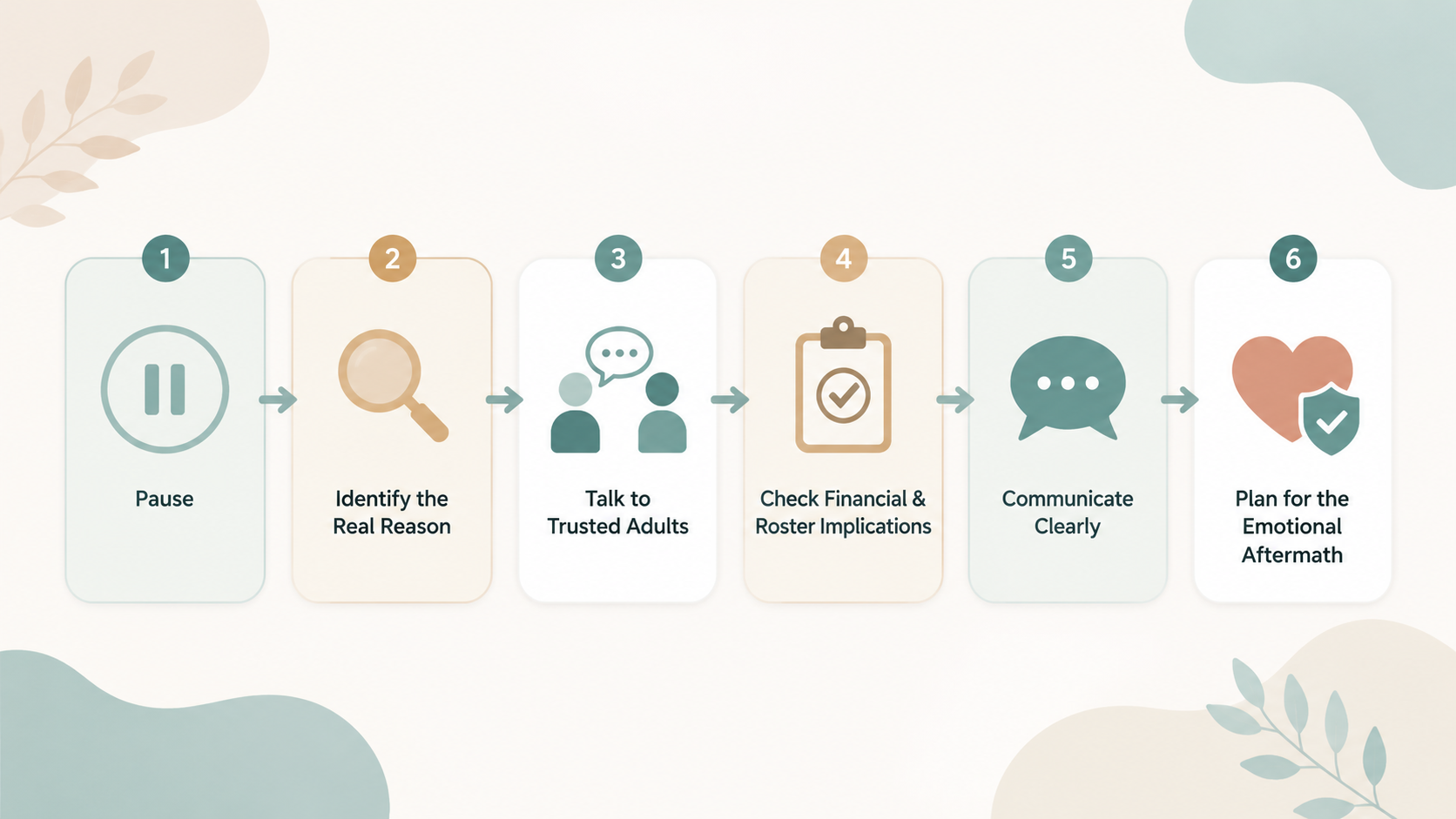
| Stage | What it is for |
|---|---|
| Pause | Stop the decision from being driven only by panic, pressure, or one bad day. |
| Identify the real reason | Name whether the concern is academic, athletic, financial, social, health-related, or about trust. |
| Talk to trusted adults | Bring in people who can protect the student, not just the family’s public image. |
| Check financial and roster implications | Understand aid, admissions, signed documents, roster timing, and alternative options. |
| Communicate clearly | Tell the current program directly, briefly, and respectfully once the decision is real. |
| Plan for the aftermath | Prepare for grief, relief, awkwardness, and continued responsibility. |
Pause long enough to know what kind of doubt this is
Not every doubt deserves the same response. A bad tournament, a tense coach call, a friend committing somewhere else, or one frightening late-night thought may need rest and perspective before action. A repeated dread that returns for weeks, a financial package that no longer works, a major that is not available, a coach relationship that feels unsafe, or a mental health concern that keeps intensifying needs more serious attention.
This pause should not become avoidance. Give it a short, concrete job: write down the reasons for doubt, what changed since the commitment, what information is still missing, and what would have to be true for staying committed to feel responsible. The goal is not to talk yourself into staying. It is to stop the fear from becoming the only voice in the room.
Separate the real reason from the loudest reason
The loudest reason is often “everyone will be mad.” That may be true for a while, but it is not the same as the underlying reason for decommitting. The underlying reason might be that the school is too expensive, the academic program is wrong, the coach who recruited the athlete left, the promised role no longer matches the roster, the athlete’s body needs a different training environment, or the student has started to recognize a mental health risk.
Parents can help here, but they can also accidentally make the room hotter. Treating decommitment as a catastrophe can push a student into secrecy. Treating it as a simple administrative switch can ignore the relationships involved. The steadier role is to ask specific questions: What are you afraid will happen? What facts do we have? What do we need to verify? Are you trying to leave because the fit is wrong, or because the conversation is scary?
Choose adults who can tolerate the truth
A student needs at least one adult who can hear the whole situation without immediately protecting the coach, the family’s reputation, or the fantasy version of the original commitment. That person might be a parent, school counselor, club coach, therapist, academic advisor, or another adult who understands recruiting without being invested in a specific outcome.
This is especially important when the student’s body is already showing signs of strain. Trouble sleeping, constant nausea, dread before opening messages, crying after practices, or feeling unable to focus in class are not proof that decommitment is the correct decision. They are proof that the student should not carry the decision alone.
Check what could actually change
Before communicating a final decision, the family should understand the practical pieces. Has anything been signed? Is admission connected to athletics? Is financial aid institutional, athletic, need-based, merit-based, or still only verbal? Are there deadlines for housing, deposits, applications, or scholarship paperwork? If another program is involved, has that school clearly explained what is available now, not just what might be available later?
This is where practical honesty matters. Coaches do have rosters to manage. A late decommitment can affect another athlete’s opportunity, a team’s depth, and a staff’s planning. That does not make the student morally trapped, but it does mean timing and communication matter. The student should not disappear, stall indefinitely, or keep a program as a backup while privately acting as if the relationship is already over.
Communicate without over-explaining
Once the decision is real, the message should be direct and respectful. The athlete does not need to prosecute the entire history of doubt or seek permission to feel differently. A coach deserves timely clarity, not a performance of guilt.
A reasonable message might say that after further reflection and family discussion, the student has decided to decommit and pursue another path; that they appreciate the coach’s time and belief in them; and that they wanted to communicate directly rather than allow uncertainty to continue. If there are signed documents, financial aid questions, or admissions issues, the family may need to involve the appropriate school office rather than relying only on a coach conversation.
The message should not blame another program, exaggerate personal hardship, or invent a reason because the real one feels awkward. It also does not need to invite a long debate if the decision has been made. Respectful does not mean endlessly available for persuasion.
Plan for the emotional aftermath, not just the announcement
Many students expect the hard part to end after the message is sent. Sometimes the opposite happens. Relief may come first, then grief. Or the student may feel calm for an hour and then panic when the coach replies, a teammate texts, or a parent asks whether they are “sure.”
This aftermath needs a plan. Decide who will handle follow-up questions. Decide whether the athlete will respond to teammates or let the news settle. Decide what, if anything, will be posted publicly. Decide when recruiting conversations with other programs will happen. A student should not have to improvise all of that while flooded with adrenaline.
Parents should watch for the quiet period after the visible crisis. A student may look functional because they still go to school, practice, lift, compete, and answer texts. That does not mean they are fine. The same athlete who can perform under pressure may still be carrying fear that they damaged their future or disappointed everyone who believed in them.
A helpful parent response sounds less like a verdict and more like containment: We will handle the next step. We will check the facts. You are allowed to feel sad and still make a responsible decision. You are not alone with the coach’s reaction.
What decommitment should not become
Decommitment should not become a secret second recruitment where the original program is kept in the dark until every better option is secured. It should not become a public drama managed through vague posts, deleted commitment graphics, or friends delivering the news. It should not become a test of whether a teenager can absorb adult disappointment without support.
It also should not become a purity test where the only honorable choice is to stay committed no matter what has changed. That advice may sound disciplined from a distance. Up close, it can ask a student to ignore new information about cost, academics, coaching, health, or safety because they once made a decision inside a recruiting timeline designed by adults.
A safer standard is care: for the student’s mental health, for the coach’s need to know, for the financial and academic consequences, and for the fact that a seventeen- or eighteen-year-old can make a serious commitment and still need to revise it when the facts change.
Decommitment may still hurt. It may cost a relationship. It may lead to an uncomfortable call, a disappointed coach, or a smaller set of options. But the mental health toll becomes more manageable when the student understands the pressures at work, stops treating shame as evidence of wrongdoing, and moves through the decision with structure instead of secrecy, panic, or avoidance.
References
- Recruiting the Student-Athlete: An Examination of the College Decision Process, PMC, 2015
- The Truth About Verbal Commitments, Honest Game
- NCAA Eliminates National Letter of Intent (NLI). What Now?, NCSA
- College sports not immune to mental health challenges, NCAA.org
- Decommitment struggles, College Confidential
- College football's decommitment reality, 247Sports
Comments
Join the discussion with an anonymous comment.