
College Athlete Study Tips to Meet NCAA Eligibility Benchmarks
Learn the specific NCAA Division I and II GPA and credit benchmarks you need to meet each year, and discover which digital study tools — like MyStudyLife, Anki, and Google Calendar — can help you track and achieve them around a packed athletic schedule.
Updated:
Last updated: July 19, 2026. NCAA rules and school policies can change, so treat every benchmark here as something to verify with your athletic academic advisor, your compliance office, and the current NCAA Eligibility Center rules at eligibilitycenter.org before you make course or eligibility decisions.
Academic eligibility for college athletes is not a mood, a reputation, or a coach saying you are “doing fine.” It is a set of numbers that shows up every term: enrolled credits, completed credits, applicable degree credits, cumulative GPA, and progress toward the degree. The study tips that matter are the ones that keep those numbers visible before a bad week becomes a bad semester.
Start With the Eligibility Dashboard
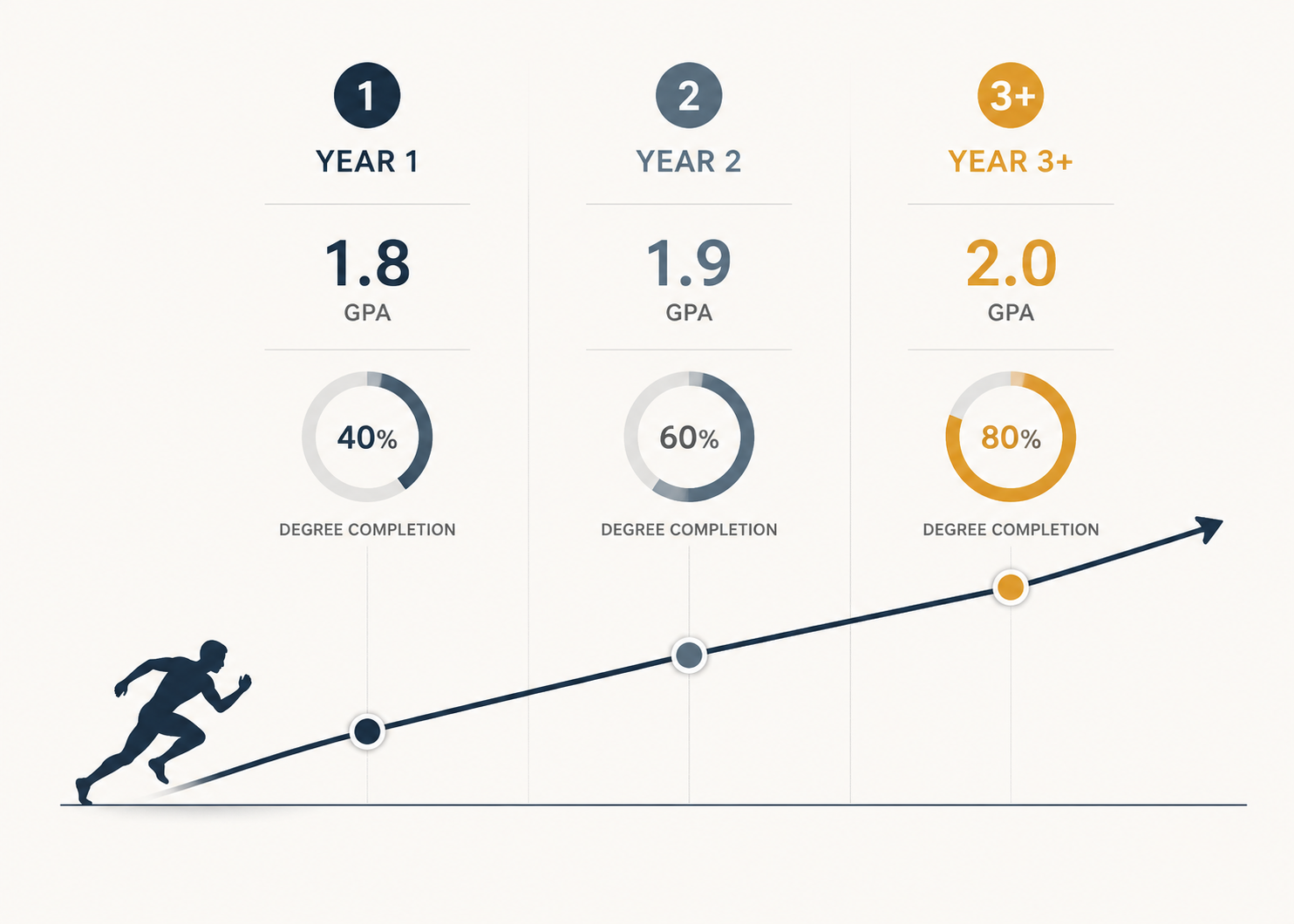
For Division I athletes, the continuing-eligibility checkpoints are specific. Entering the second year, an athlete must have at least a 1.8 cumulative GPA and have completed 40% of the degree. Entering the third year, the marks rise to a 1.9 cumulative GPA and 60% degree completion. Entering the fourth year, the athlete must have at least a 2.0 cumulative GPA and 80% degree completion. Division I athletes also must earn at least 6 applicable credits each term, football has a 9-credit fall requirement, and athletes generally must stay enrolled full time with at least 12 credits unless an exception applies.[1][2]
| Checkpoint | Division I continuing-eligibility benchmark | What to track every term |
|---|---|---|
| Entering second year | 1.8 cumulative GPA and 40% degree completion | Cumulative GPA, applicable credits, declared-degree progress |
| Entering third year | 1.9 cumulative GPA and 60% degree completion | Whether completed credits actually count toward the degree |
| Entering fourth year | 2.0 cumulative GPA and 80% degree completion | Remaining degree requirements, GPA cushion, term credit minimums |
| Each term | At least 6 applicable credits; football has a 9-credit fall requirement | Credits passed, credits applicable to degree, full-time enrollment |
Those thresholds are why “just pass your classes” is too loose. A class can appear on a transcript and still fail to solve the eligibility problem if it does not apply to the degree requirement being measured. A 12-credit schedule can keep a student full time in the moment, but a withdrawal, failed course, or non-applicable elective can make the term-credit math uglier later.
Division II athletes should not simply copy the Division I dashboard. Division II has its own continuing-eligibility structure, and athletes should verify current GPA, credit, and progress-toward-degree rules with the school and the NCAA Eligibility Center. Division III is different again: Division III schools set their own academic standards and are not certified through the NCAA Eligibility Center.[3]
Initial eligibility rules should also stay in their lane. The Division I 10/7 rule is an initial-eligibility rule, not a continuing-eligibility study plan: before the seventh semester of high school, a Division I prospect must complete 10 core courses, including 7 in English, math, or natural/physical science. Division II does not use that same core-course progression lock.[3]
The GPA Trap Is Usually Hidden Until Someone Recalculates
The most dangerous GPA misunderstanding starts before college, but the habit follows athletes into college: assuming every GPA means the same thing. For NCAA initial eligibility, the NCAA calculates GPA from 16 approved core courses on an unweighted 4.0 scale. NCSA gives the example of a school-reported 3.7 GPA recalculating to a 2.9 once electives and weighted grades are removed.[4]
That example is not a reason to panic over every transcript number. It is a reason to stop treating GPA as a single universal object. In college, the same discipline applies: know which GPA your school, conference, team, scholarship, major, and NCAA status are using. Some schools may require athletes to meet internal standards above the NCAA minimum, including higher GPA expectations, so the NCAA floor is not automatically the school floor.
The athlete who is actually protected is not the one who can recite a motivational quote about academics. It is the one who knows, before add/drop closes, whether a course counts toward the declared degree, whether the credit load survives a withdrawal, and whether the GPA has enough room to absorb a hard class during travel season.
Match the Tool to the Eligibility Risk
A pretty planner does not keep anyone eligible by itself. A useful system assigns each tool a job. One tool should show the courses and deadlines. One should protect the fixed calendar blocks. One should make travel review possible. One should make the week visible enough that an advisor, tutor, teammate, or parent can spot trouble early.
| Eligibility risk | Tool that fits | How to use it |
|---|---|---|
| Missing an assignment that affects a course grade | MyStudyLife | Enter every syllabus deadline, exam, lab, quiz, and recurring class task |
| Losing track of full-time enrollment and degree-applicable credits | MyStudyLife plus advisor degree audit | Tag courses by requirement area and compare them with the official audit |
| Letting practice, treatment, travel, and class collide | Google Calendar | Block immovable commitments first, then place study blocks in the remaining space |
| Wasting bus or airport time because materials are not ready | Anki or Quizlet | Build small review decks that work on a phone and can be used in short sessions |
| Letting the week become invisible until Sunday night | Notion or Trello | Use a weekly board for assignments, exams, tutor meetings, and eligibility checks |
MyStudyLife fits the coursework-tracking role because it is a free cross-platform planner built around classes, tasks, exams, and schedules. Student-athlete time-management guides also commonly point athletes toward digital planners, color-coded calendars, Notion or Trello boards, and Pomodoro-style timers because the schedule changes often enough that memory is a bad system.[5][6][7][8]
Google Calendar should hold the commitments that are not really negotiable: class, lift, practice, film, treatment, travel departure, tutoring, study hall, and sleep. Color-coding is not decoration here. It lets the athlete and advisor see whether the week has any real academic work time left after the athletic schedule is entered.
Anki and Quizlet belong in the travel slot. Flashcard systems are useful because they turn scattered time into review time: a bus ride, an airport delay, a hotel lobby, the half hour after breakfast before a scouting meeting. Student-athlete study guides specifically recommend mobile flashcard tools such as Anki and Quizlet for studying around travel and packed athletic schedules.[9][10]
Notion or Trello is for weekly accountability, not for building a second life as a productivity influencer. A simple board with “This week,” “Waiting on,” “Travel work,” “Advisor questions,” and “Done” is enough. If an assignment depends on a professor response, a missed lab makeup, or an eligibility-office answer, it should be visible somewhere other than a text thread.

Build the Week Around Heavy Days and Light Days
The athletic week is not evenly shaped, so the study plan should not pretend it is. A heavy day after lift, class, practice, treatment, and film is the wrong place to schedule three hours of dense reading and a major paper draft. A lighter day or weekend window is where deep work belongs. Carpe Diem Academics describes a two-tier approach for busy students: heavy practice days get short, low-cognitive-load sessions focused on urgent deadlines, while lighter days and weekends get deeper focus work.[11]

On a heavy day, the goal is not academic heroics. It is damage prevention. Open the planner, identify the next deadline, complete the smallest necessary task, and review material that is already organized. Flashcards, problem-set corrections, lecture-note cleanup, short discussion posts, or reading annotations fit better than starting an unfamiliar research assignment at 10:30 p.m.
On a lighter day, the job changes. That is when the athlete should write, solve harder problem sets, visit office hours, meet a tutor, work through missed class material, and check whether the week’s credits and assignments are still on track. If the only study time protected is the exhausted time, the plan is already leaning on the weakest part of the week.
| Day type | Best academic work | Tool setup |
|---|---|---|
| Heavy practice or travel day | Flashcards, urgent submissions, short review, deadline checks | Anki or Quizlet deck; MyStudyLife task list; calendar alert |
| Moderate day | Reading, quiz prep, assignment drafting, tutor meeting | Google Calendar study block; Notion or Trello weekly board |
| Light day or weekend | Deep writing, major exam prep, office hours, degree-progress review | MyStudyLife plus degree audit; longer calendar block |
Turn Benchmarks Into Recurring Checks
The weekly system should include a short eligibility check, not just homework review. This is where many athletes lose time: they know an assignment is due Friday, but they do not know whether the class is degree-applicable, whether a withdrawal would drop them below full time, or whether a borderline grade threatens the next GPA checkpoint.
- Every Monday: check the week’s assignments, exams, travel, tutoring, and practice conflicts.
- Every add/drop period: confirm that each course applies to the degree plan and that the schedule keeps full-time status.
- Every month: compare completed and in-progress credits against the term-credit rule and the degree-completion benchmark.
- Before any withdrawal: ask the compliance office and academic advisor how it affects full-time enrollment, applicable credits, GPA, and team or scholarship rules.
- Before finals: identify the courses where one exam could change eligibility math, not just the courses that feel hardest.
This check does not need to be dramatic. Put a 20-minute recurring block in Google Calendar. Open MyStudyLife, the official degree audit, and the team academic portal if the school uses one. Update the Notion or Trello board with any advisor questions. If something is unclear, the task is not “worry about eligibility.” The task is “email advisor about whether BIO 1XX applies to major requirement” or “ask compliance whether dropping below 12 credits creates an issue.”
Use Travel Time for Review, Not Rescue Work
Travel study fails when the athlete packs a laptop, three textbooks, and a fantasy version of the bus ride. The work that survives travel is usually smaller and already prepared: flashcards, recorded lecture review, outline cleanup, practice questions, reading notes, or a professor-approved makeup plan.
That is why Anki and Quizlet need setup time before the trip. A deck made on the bus is usually a deck made too late. On the lighter day before departure, build the cards from lecture notes, key terms, formulas, or exam objectives. During travel, review them in short bursts. After returning, mark weak topics for the next tutor session or office-hours visit.
The same rule applies to papers and projects. Travel is a good place to revise a paragraph, annotate a source, or outline a section. It is a bad place to discover that the library database login is not working, the assignment instructions are missing, or the group project partner assumed the athlete would finish the slides after the game.
Do Not Let Professional-Sports Odds Distort the Academic Plan
The NCAA says fewer than 2% of college student-athletes go on to play professional sports.[12] That number does not need to be used as a lecture. It is enough to make the degree-progress conversation honest. Eligibility is not only about playing next week. It is also about leaving college with credits that counted, a transcript that can survive review, and a degree path that did not get sacrificed to short-term confusion.
That is especially important when an athlete is already tired. Exhaustion makes vague advice worse. “Manage your time” turns into guilt. A better system turns the next action into something visible: check the course against the degree audit, move the exam block away from travel day, ask the professor about the missed lab, review 30 flashcards before film, or meet the advisor before dropping a class.
A Practical Setup Before the Season Gets Messy
The best time to build the system is before the first congested travel week. Start with the official sources, not a teammate’s memory of last year’s rule. Confirm the NCAA requirement, the school requirement, the team requirement, the scholarship requirement, and the major requirement. If those disagree, the strictest practical standard is the one that can cost you.
- Get the official degree audit and mark which current courses count toward the degree.
- Enter all classes, exams, assignments, and recurring deadlines into MyStudyLife.
- Put class, practice, lift, treatment, film, travel, tutoring, and study hall into Google Calendar.
- Create Anki or Quizlet decks for courses that require repeated recall during travel.
- Build one Notion or Trello weekly board for assignments, advisor questions, travel work, and eligibility checks.
- Schedule a recurring credit-and-GPA review before add/drop, before midterms, before withdrawals, and before finals.
None of this requires becoming a perfect student or studying for hours every night after practice. It requires checking the right numbers early, protecting small repeatable blocks, and using tools for the risks they actually cover. Verify the current NCAA and school rules, build the tracking system before the calendar gets crowded, and revisit credits and GPA before the eligibility conversation becomes urgent.
References
- NCAA Eligibility Requirements, NCSA College Recruiting, https://www.ncsasports.org/ncaa-eligibility-center/eligibility-requirements
- NCAA Requirements, UNLV Student-Athlete Academic Services, https://www.unlv.edu/studentsuccess/services/student-athlete/ncaa-requirements
- Preparing Yourself Academically, Scorability, https://scorability.com/recruiting/preparing-yourself-academically/
- NCAA GPA Requirements, NCSA College Recruiting, https://www.ncsasports.org/ncaa-eligibility-center/gpa-requirements
- Best Tips for Time Management for Student-Athletes, Keystone Sports, https://keystonesports.com/best-tips-for-time-management-for-student-athletes/
- Time Management Tips for Student-Athletes, Positive Coaching Alliance, https://positivecoach.org/resource-zone/time-management-tips-for-student-athletes/
- How to Manage Time as a Student-Athlete, North Central College, September 15, 2021, https://www.northcentralcollege.edu/news/2021/09/15/how-manage-time-student-athlete
- Tips for Scholar Athletes, Stony Brook University Libraries, https://guides.library.stonybrook.edu/scholar-athletes/tips
- 7 Tested Time Management Tips for Student-Athletes, The College of St. Scholastica, https://www.css.edu/about/blog/7-tested-time-management-tips-for-student-athletes/
- Student-Athlete Tips, The Skill Collective, https://theskillcollective.com/blog/student-athlete-tips
- Weekly Study Schedule for Busy Students, Carpe Diem Academics, https://carpediemacademics.com/post/weekly-study-schedule-for-busy-students
- Student-Athlete Experience, NCAA, https://www.ncaa.org/student-athletes/student-athlete-experience/
Comments
Join the discussion with an anonymous comment.