
How Recruiting Commitments Affect College Athletes in 2026
The elimination of the National Letter of Intent and the rise of the transfer portal have fundamentally changed what a college athletic commitment means. This guide explains the new legal and financial realities athletes and families need to understand before making a decision.
Updated:
"I committed" used to sound like the end of recruiting. In 2026, it is closer to the beginning of a paperwork sequence. The same phrase can mean a coach made a verbal offer, an athlete accepted publicly, a one-year athletic financial aid agreement is ready to sign, NIL or revenue-sharing terms are being negotiated, or everyone is simply behaving as if the relationship is settled.
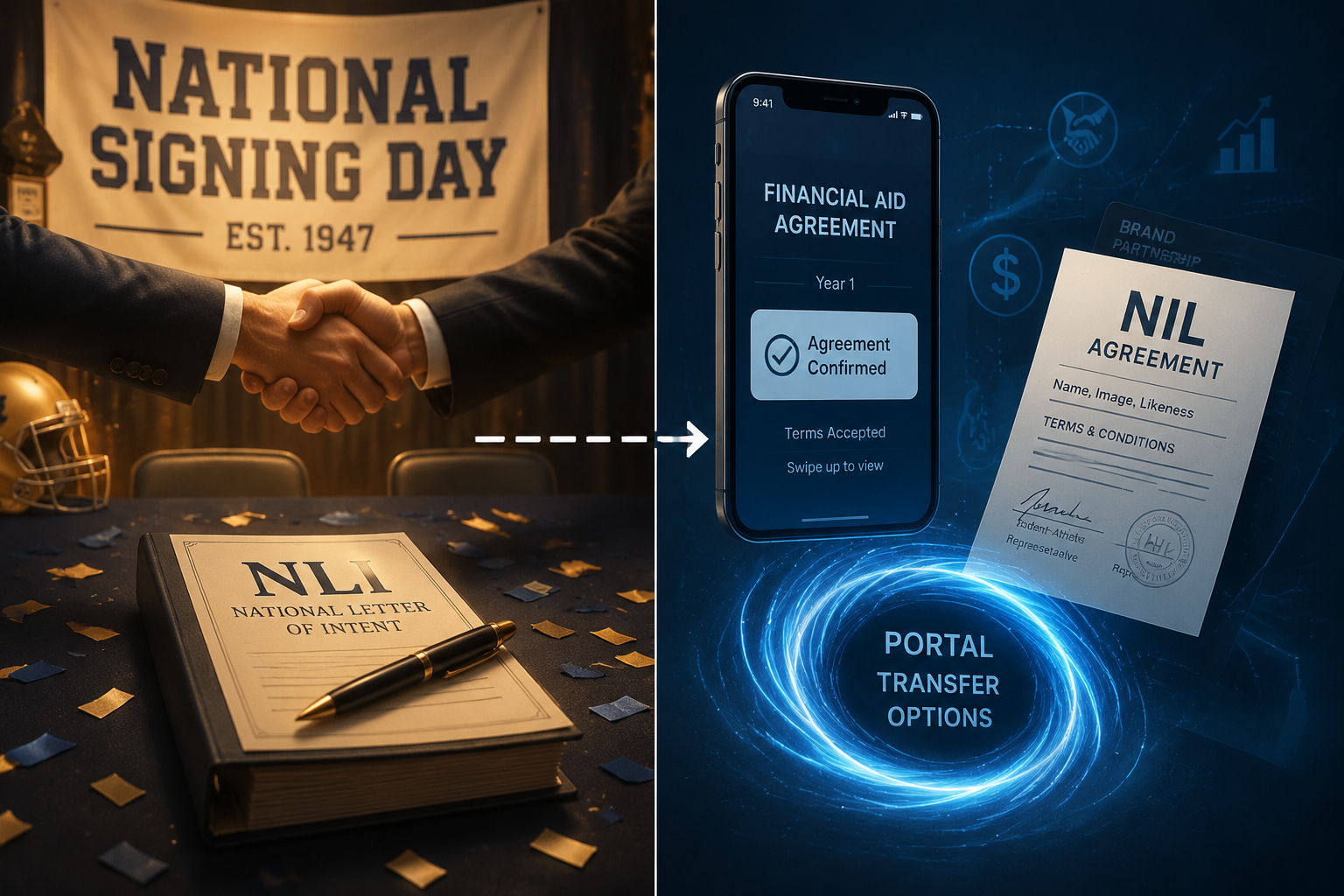
That distinction matters because the National Letter of Intent program was eliminated on October 9, 2024, after 60 years. What replaced it is not a four-year promise dressed in new language; it is an athletic grant-in-aid or financial aid agreement, generally binding for one academic year.[1]
So the practical question behind how recruiting commitments affect college athletes is not whether commitment still matters. It does. A commitment can shape admissions timing, scholarship expectations, roster planning, public reputation, family finances, and transfer options. But families now have to ask a more precise question: which part of the commitment is actually enforceable, for how long, and against whom?
The Word "Commitment" Now Covers Several Different Promises
The most common recruiting misunderstanding starts with vocabulary. A family hears "offer," "commitment," "signing," and "scholarship" as if they are stages of one guaranteed path. They are not. Each word sits in a different part of the process.
| Part of the process | What it usually means in 2026 | What families should not assume |
|---|---|---|
| Verbal offer | A coach indicates interest and may invite the athlete to commit | That the NCAA recognizes it or that either side is locked in |
| Verbal commitment | The athlete says yes, often publicly | That scholarship money, admissions, roster status, or NIL terms are finalized |
| Financial aid agreement | A written athletic grant-in-aid agreement, generally for one academic year | That it automatically guarantees four years |
| NIL or revenue-sharing addendum | Separate financial terms that may come with their own conditions | That the language is standardized across schools or athletes |
| Enrollment and roster spot | The athlete joins the school and team environment | That the same coach, role, or roster need will remain unchanged |
The table looks plain because the issue is plain. A social media graphic does not create the same obligation as a signed financial aid agreement. A scholarship conversation does not answer what happens if a coach leaves. A dollar figure in an NIL conversation does not explain termination language. The athlete may be making one life decision, but the school may be using several separate documents and several separate decision points.
A Verbal Commitment Is Still Real Socially, But Not the Way Families Often Mean It
A verbal commitment can be emotionally huge. It may be the first time an athlete feels a college coach has fully seen the years of training, travel, injuries, missed weekends, and academic juggling. It can also slow down recruiting conversations with other schools, change how teammates and high school coaches talk about the athlete, and create pressure to act loyal before anything enforceable exists.
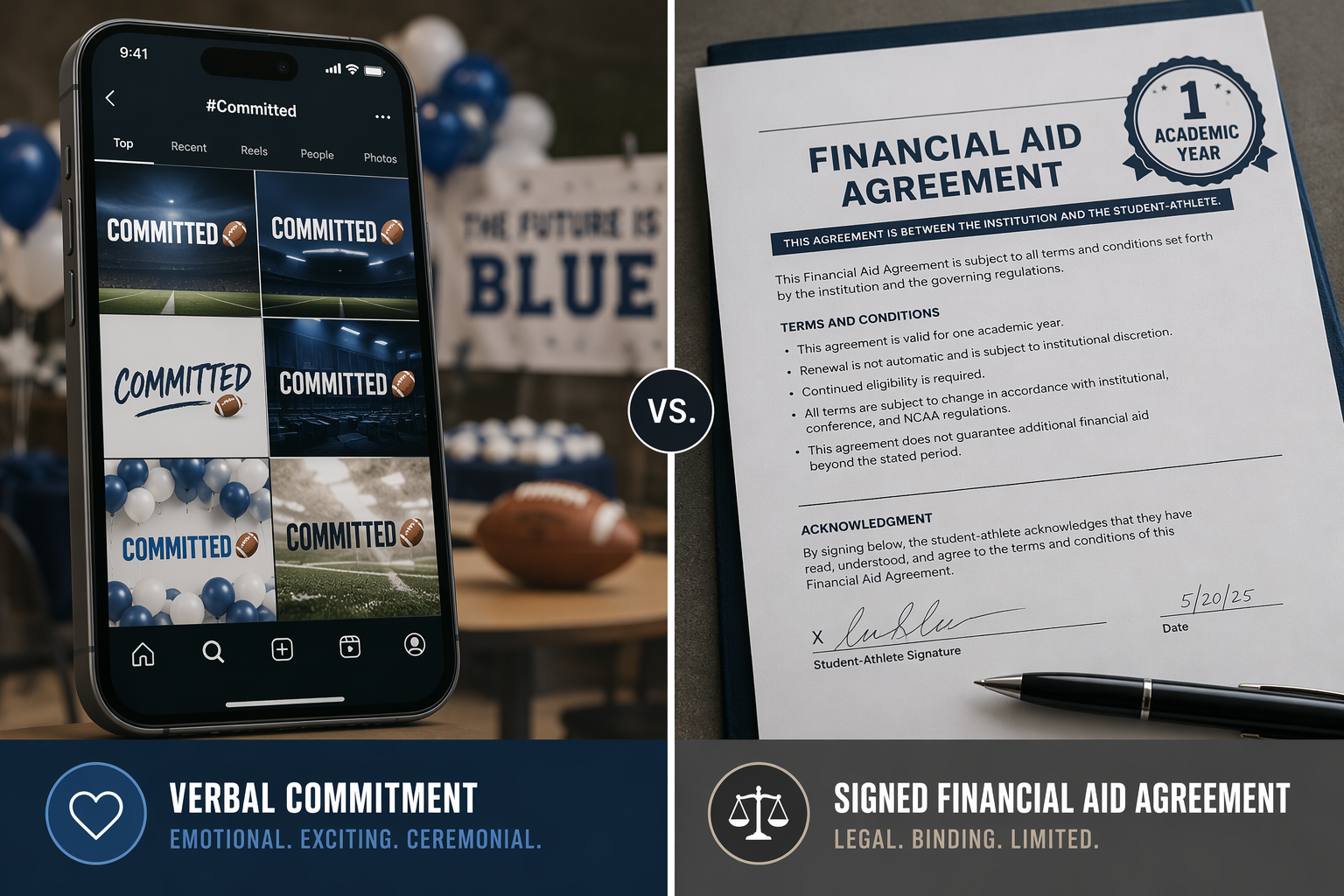
The NCAA does not track or recognize verbal commitments, and either party can walk away without penalty.[2] That sentence is uncomfortable precisely because the recruiting culture around verbal commitments can feel so formal. There may be a phone call, a family huddle, a post, a school logo, and congratulatory messages from adults who know better. Still, if the commitment is only verbal, the athlete has not yet secured the same thing as a signed financial aid agreement.
This does not make the coach dishonest or the athlete naive. It means the family has to separate relationship signals from contractual terms. A coach may sincerely want the athlete. The athlete may sincerely want the school. Both can be true, and the commitment can still be unenforceable.
The pressure point is time. Coaches commonly want an answer on a verbal offer within about seven days, but athletes can ask for more time. Former Division I athlete Machia Mullens, quoted by NCSA Sports, puts the standard more humanely: "this should be an exciting moment, not a rushed one."[1] The point is not to stall for sport. It is to avoid treating a deadline from a recruiting conversation as if it were the same as a deadline on a binding document.
The Signed Financial Aid Agreement Is Narrower Than the Celebration
The written athletic financial aid agreement is the first place many families should slow down. It is also the place where the old family group-chat version of recruiting can do the most damage. If relatives are saying, "She got a full ride," the next adult sentence should be, "For which academic year, under which conditions, and what costs are not covered?"
Post-NLI financial aid agreements are binding for one year. Breaking such an agreement can cost the athlete a year of eligibility, while coaching changes, roster cuts, or school-side decommitments do not carry the same institutional penalty.[3] That asymmetry is the part families tend to miss. The athlete may face an eligibility consequence for backing out after signing. The institution may have more room to change the practical situation around the athlete.
That does not mean the agreement is meaningless. It can secure a defined year of athletic aid and give the athlete something much more concrete than a verbal promise. But it should be read as a one-year document unless the actual language says otherwise. The family should not infer multi-year security from a coach’s enthusiasm, a signing table, or a school’s reputation.
The questions belong before the signature, not after a coaching change or depth-chart surprise:
- What exact academic year does the athletic aid cover?
- Is the aid athletic, academic, need-based, or some combination?
- Which costs are excluded: housing, meals, books, fees, travel, insurance, summer coursework, or training expenses?
- What happens if the athlete is injured, changes majors, does not compete, or enters the transfer portal?
- What is the renewal process for the next academic year, and who makes that decision?
A family does not need to turn every recruiting call into a cross-examination. But once a document exists, vague reassurance is not the same as an answer. If a promise matters enough to affect enrollment, housing, tuition, or eligibility, it matters enough to locate in writing.
Money Has Added a Second Layer of Paperwork
The House v. NCAA settlement changed the financial conversation around commitment because some schools can now discuss direct athlete compensation in a way families did not have to process in the old signing-day script. Under the settlement finalized in 2025, Division I schools that opt in can directly compensate athletes up to about $20.5 million per school in year one, and athletes can negotiate NIL deals before enrolling.[4]
That number does not mean every athlete receives revenue-sharing money. It does not mean every sport is treated the same. It does not mean an athlete’s NIL value is settled by committing. It means that for some recruits, the commitment conversation may now include a financial layer that sits beside, not inside, the athletic aid agreement.
This is where families have to resist the easiest misunderstanding: more money can mean more opportunity, but it can also mean more contract language. Revenue-sharing contracts may include payback clauses and termination provisions, and Harris Law Firm warns that "there is no standardized language yet, agreements can vary widely between schools, sports, and even athletes on the same team."[4]
The absence of standardized language is not a technical footnote. It affects what a commitment costs if the athlete leaves, loses a roster spot, violates a term, changes eligibility status, or does not enroll. Two athletes can say the same sentence — "I committed to that school" — while one has only a verbal understanding, another has a one-year aid agreement, and a third has separate compensation language that survives or terminates under conditions the family has not yet read.
What to Read Separately
The athletic aid agreement, NIL agreement, and revenue-sharing addendum should not be mentally blended into one scholarship package. They may come from different offices, use different terms, and create different consequences. A parent who asks only, "How much are they giving us?" may miss the more important question: "What can make this money stop, and what do we owe if it does?"
- For athletic aid, look for duration, renewal, reduction, cancellation, injury treatment, and covered costs.
- For NIL, look for deliverables, exclusivity, use of name or image, payment timing, morality clauses, and termination.
- For revenue sharing, look for eligibility conditions, payback language, transfer consequences, school opt-in status, and who controls disputes.
Those are not anti-athlete questions. They are how an athlete protects the value of the opportunity.
The Transfer Portal Has Changed the Meaning of Permanence
Recruiting commitments also affect college athletes differently because leaving has become a more visible and common part of the college sports landscape. In football, transfer-portal entrants grew from 786 in 2020 to roughly 4,060 in 2025, a reported 418% increase.[5] That is a striking change, but it should be read carefully: the cited figures are football-focused and reported through The Sport Journal, which cites On3.com and NBC Sports, so they should not be stretched into a precise claim about every sport.
Even with that caution, the signal is hard to ignore. Initial commitments feel less permanent in an environment where athletes and programs both know that movement is available. A coach recruiting a high school senior may also be watching the portal. A roster spot that once seemed attached to a developmental plan may be compared against older transfers who have college film. An athlete who committed early may arrive on campus and find that the team’s needs have changed.
This cuts both ways. Athletes have more mobility than families in an older recruiting culture often imagined. If the fit is wrong, if the coach changes, if playing time collapses, or if the academic situation becomes unworkable, the portal may give the athlete a path to search again. That mobility can be valuable. It can also be disruptive, public, and uncertain.
The mistake is to treat transfer freedom as a safety net strong enough to ignore the first agreement. Transferring can reopen recruiting, but it can also mean credit-transfer issues, scholarship uncertainty, new admissions requirements, housing disruption, delayed graduation, and another round of roster competition. The portal may make exit more possible. It does not make the original commitment consequence-free.
Early Commitment Can Help, But It Can Also Freeze the Wrong Assumption
Committing early can still help an athlete. It can reduce recruiting noise, give the athlete more time to plan academically, clarify college applications, and allow a family to compare real financial documents instead of chasing attention. For some athletes, especially those exhausted by constant outreach and evaluation, the relief is not imaginary.
The risk is that early commitment can freeze an assumption before the athlete has enough information. A sophomore or junior who verbally commits may be making a public identity decision before seeing the final aid package, the school’s revenue-sharing approach, the academic support structure, or the actual roster they will join. The earlier the public promise, the longer the athlete has to live with changes that happen after it.
The better dividing line is not early versus late. It is informed versus ceremonial. An athlete can commit early with eyes open, or late with almost no contract awareness. The calendar does not protect the family. The documents do.
What the Athlete Actually Gives Up
A commitment affects more than legal rights. Once an athlete commits, other recruiting conversations may slow or stop. Some coaches will move on. The athlete may feel pressure not to take other visits, even where rules would allow it. The high school coach may start talking as if the decision is done. Parents may stop asking hard questions because they do not want to ruin the moment.
That social cost is real even when the commitment is verbal. If the athlete later decommits, the consequences may be reputational rather than NCAA-imposed: awkward calls, disappointed coaches, criticism from adults, or the feeling of having failed at loyalty. Families should not pretend those pressures do not matter. They should also not confuse them with binding legal obligations.
After signing a financial aid agreement, the stakes narrow and sharpen. Now the athlete needs to understand eligibility consequences, aid terms, and release rules. If there is NIL or revenue-sharing language, the athlete also needs to understand what happens to compensation if they do not enroll, transfer, are removed from the roster, or fail to perform required promotional obligations.
What the School Is and Is Not Promising
A school may be promising less than the family hears. It may be offering a roster opportunity, not a playing-time guarantee. It may be offering one academic year of aid, not four. It may be expecting the athlete to meet admissions, amateurism, academic progress, conduct, medical, or team requirements. It may be discussing money through more than one document.
Families should be especially careful with sentences that sound complete but are not: "You’ll be taken care of." "We see you as part of the future." "The money will work out." "We don’t expect any issues." Those may be sincere recruiting statements. They are not the same as written commitments about aid duration, renewal criteria, revenue-sharing terms, or release consequences.
The school also has interests that are not identical to the athlete’s. Coaches manage rosters. Athletic departments manage budgets. Compliance offices manage rules. Collectives, sponsors, or revenue-sharing administrators may manage separate financial terms. A family that treats all of those actors as one friendly voice can miss where responsibility actually sits.
A 2026 Commitment Checklist That Starts With Paper, Not the Post
Before an athlete announces or signs, the family should be able to answer these questions without relying on memory from a phone call:
- Which promises are only verbal, and who made them?
- Which promises are written, and in which document?
- Does the athletic aid last one academic year or longer?
- What can cause the aid, NIL money, or revenue-sharing compensation to be reduced, ended, repaid, or delayed?
- What happens if the athlete changes their mind before enrollment?
- What happens if the coach leaves, the roster changes, or the school no longer wants the athlete?
- What are the transfer, release, and eligibility consequences after signing?
- Who has reviewed the documents besides the person who wants the athlete to sign them?
The last question is not about distrust. It is about role clarity. A coach can be supportive and still not be the right person to explain every financial, legal, or academic consequence. A family may need help from a school counselor, compliance office, financial aid officer, attorney, or advisor who is not emotionally invested in the commitment photo.
The Practical Meaning of Commitment Now
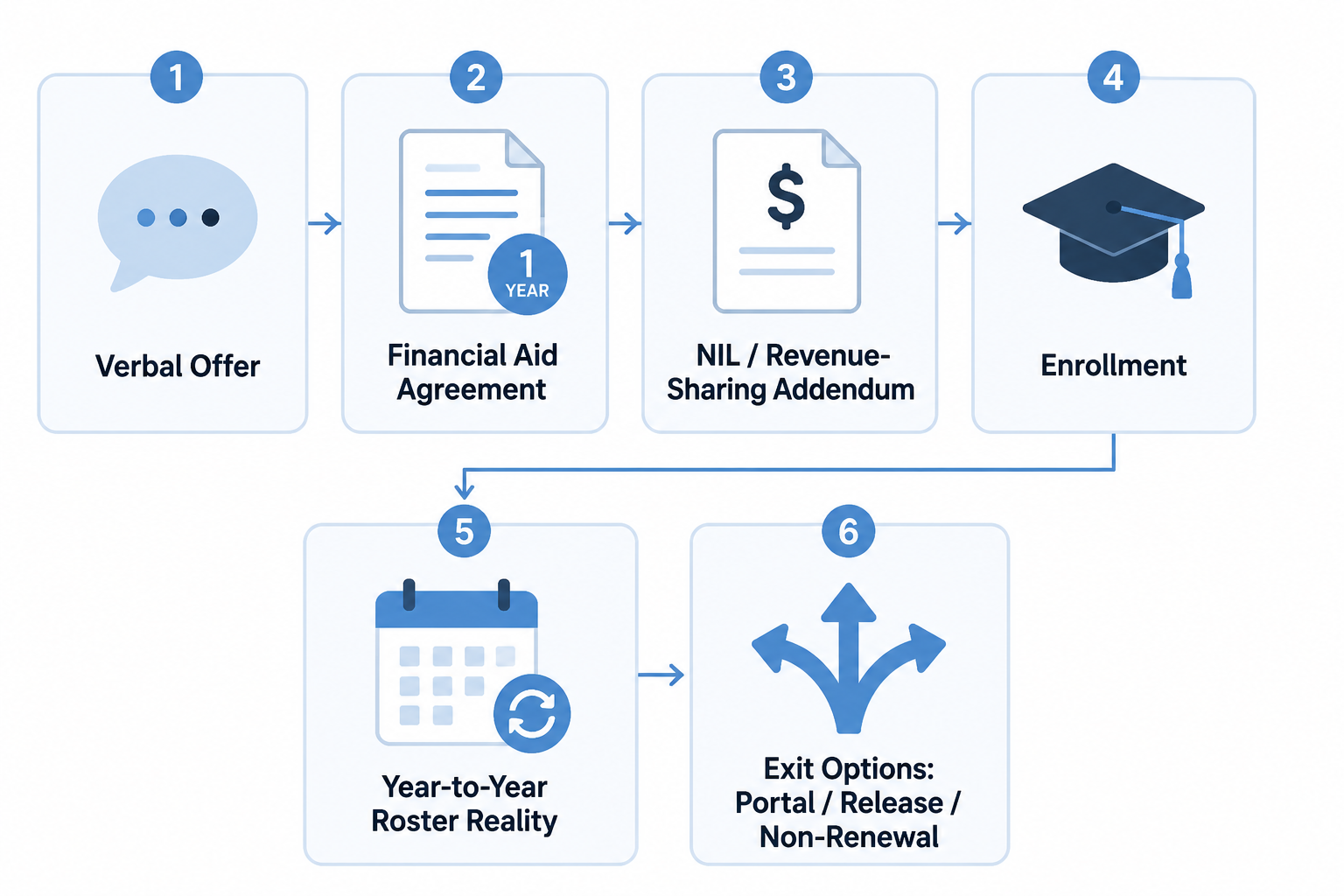
Recruiting commitments still affect college athletes deeply. They can open a door to admission, aid, competition, coaching, exposure, and a campus life the athlete has worked for. They can also narrow options before the athlete understands the terms. In 2026, the commitment is not one promise. It is a stack: verbal relationship, written aid, possible NIL or revenue-sharing language, enrollment, roster status, and transfer consequences.
The safest family in this environment is not the least excited one. It is the one that knows exactly which promise is verbal, which is written, which lasts one year, what happens if either side exits, and what financial terms remain after the celebration ends.
References
- NCAA Eliminates National Letter of Intent (NLI). What Now?, NCSA Sports
- Guiding Student-Athletes: Understanding Verbal Commitments in College Athletics, IECA
- The New Path to Commitment – College Sports without the National Letter of Intent (NLI), Honest Game
- The Signing Day Playbook, Harris Law Firm, January 2026
- The Impact of Head Coach and Student Athlete Decision Making in the Transfer Portal Era of College Sports, The Sport Journal
Comments
Join the discussion with an anonymous comment.