
How Good Grades Give Student-Athletes a Recruiting Advantage
Strong academic performance gives student-athletes a direct recruiting advantage by making them lower-risk, scholarship-efficient recruits. This guide explains how grades and test scores double roster odds and cut costs for coaches, and provides a strategic roadmap to leverage academics in the college recruiting process.
Updated:
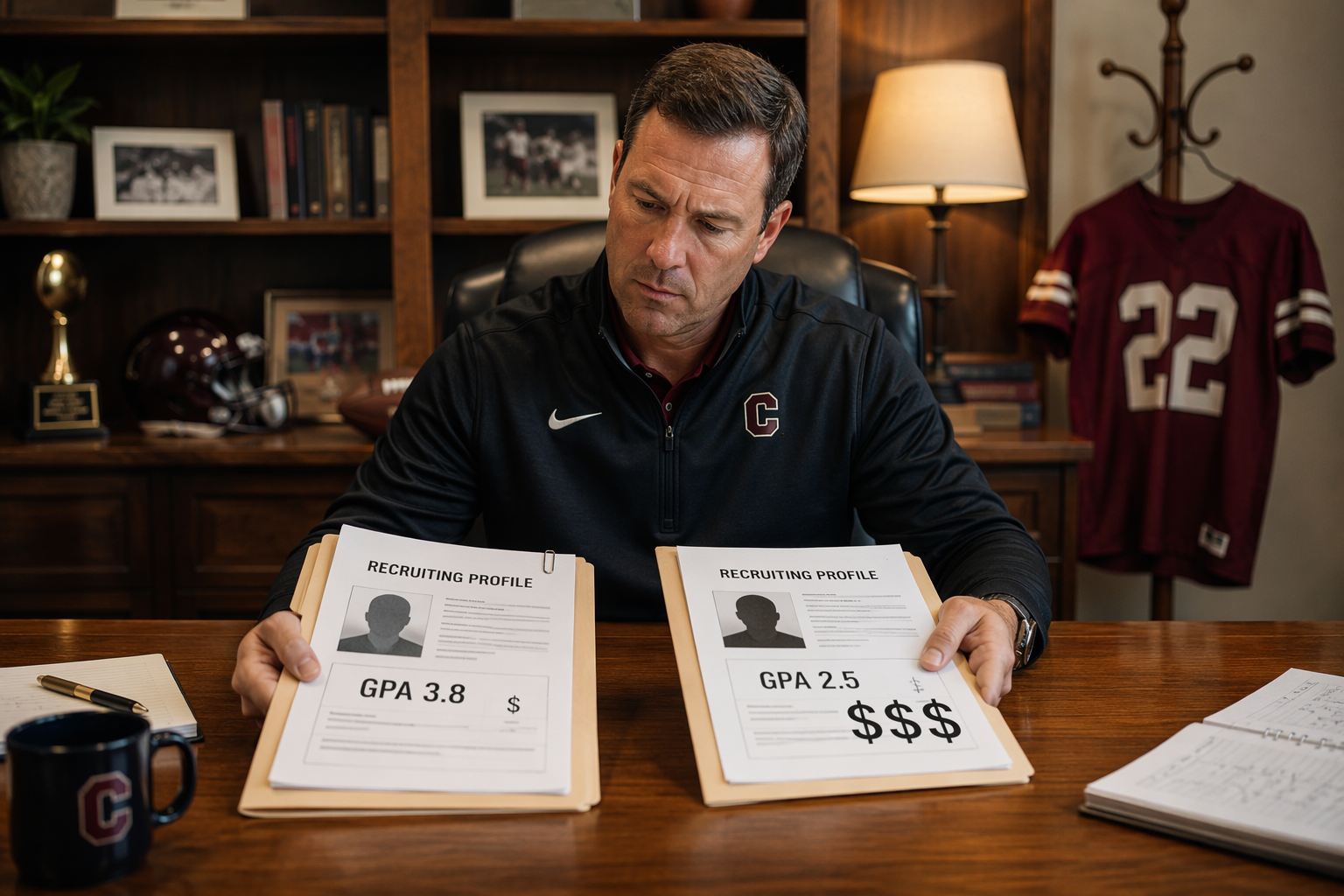
In the college recruiting process for student athletes, a coach is rarely choosing between “good player” and “bad player.” More often, the decision is between two athletes who can both help the roster, but one comes with cleaner admissions odds, lower eligibility risk, and a smaller draw on the athletic scholarship budget.
That is where grades stop being a vague character signal and start becoming a recruiting asset. A student-athlete with a strong transcript may give a coach more ways to build the roster: academic merit aid can reduce the amount of athletic money needed, admissions is less fragile, and the athlete is less likely to create eligibility problems after arriving on campus.
This does not mean grades replace speed, size, film, stats, or fit. Coaches still need athletes who can compete at their level. But among recruitable athletes, academics can change the financial and administrative answer to a very practical question: how hard is this athlete to roster?
The scholarship math coaches notice
The clearest example is scholarship stacking. TNS Recruit describes a recruiting scenario in which an athlete with a 3.8 GPA and 1350 SAT can combine a partial athletic scholarship with academic merit aid, costing the coach about $25,000 per year in athletic scholarship money, while a 2.5 GPA athlete may require about $50,000 per year in athletic aid to make the same college affordable.[1]
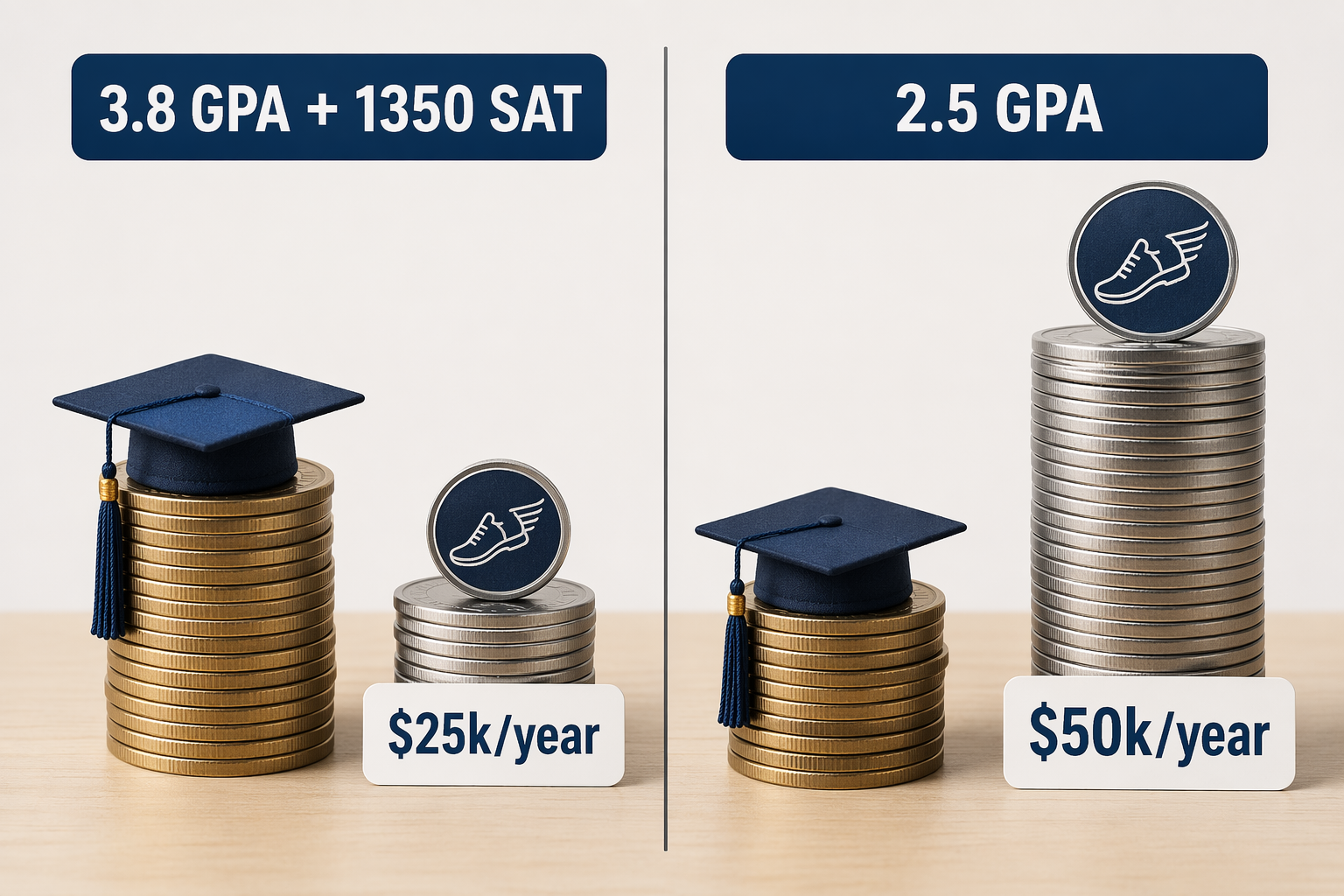
That difference is not a motivational poster. It is a budget line. If a coach can roster one athlete for roughly half the athletic scholarship cost because admissions or institutional aid can carry part of the package, the coach may have more room to support another recruit, protect depth at a thin position, or respond to a late roster need.
Families sometimes hear “partial scholarship” and assume the rest is just a private financial problem. Coaches do not see it that way. If the family cannot make the net cost work, the commitment may not hold. If the coach must use scarce athletic money to close every gap, that recruit becomes more expensive than another athlete with a similar on-field profile and stronger academic aid eligibility.
The phrase “stackable recruit” matters because it describes a student who can be funded from more than one bucket. Athletic aid is one bucket. Academic merit aid may be another. Need-based aid may be separate, depending on the institution. The exact package varies by school, division, sport, and family finances, but the recruiting advantage is straightforward: a recruit who can qualify for academic money gives the coach more options.
That matters even more in the post-2025 environment, as Division I programs adjust to House v. NCAA settlement implementation and new roster-cap structures. TNS Recruit identifies roster management and scholarship efficiency as current coach concerns, and cites new roster limits such as 34 for baseball and 105 for football.[1] The details of implementation may continue to settle, but the direction is not friendly to vague recruiting files. A coach who has fewer casual roster spots to play with has less patience for avoidable academic uncertainty.
Good grades widen the four-year college pool
The NCAA’s 2024–25 participation data puts the overall odds in perspective: about 7% of high school athletes go on to play at NCAA schools, with sport-by-sport rates ranging from 3.0% for boys’ wrestling to 14.7% for boys’ lacrosse.[2] Those numbers are not meant to scare a recruit out of trying. They explain why small advantages matter when the funnel is already narrow.
Baseball gives the cleanest documented look at how academics can change the denominator. ScholarshipStats reported for 2022–23 that 8.5% of all high school baseball players played at a four-year college, but 17% of high school baseball players who enrolled in a four-year college made a roster.[3]
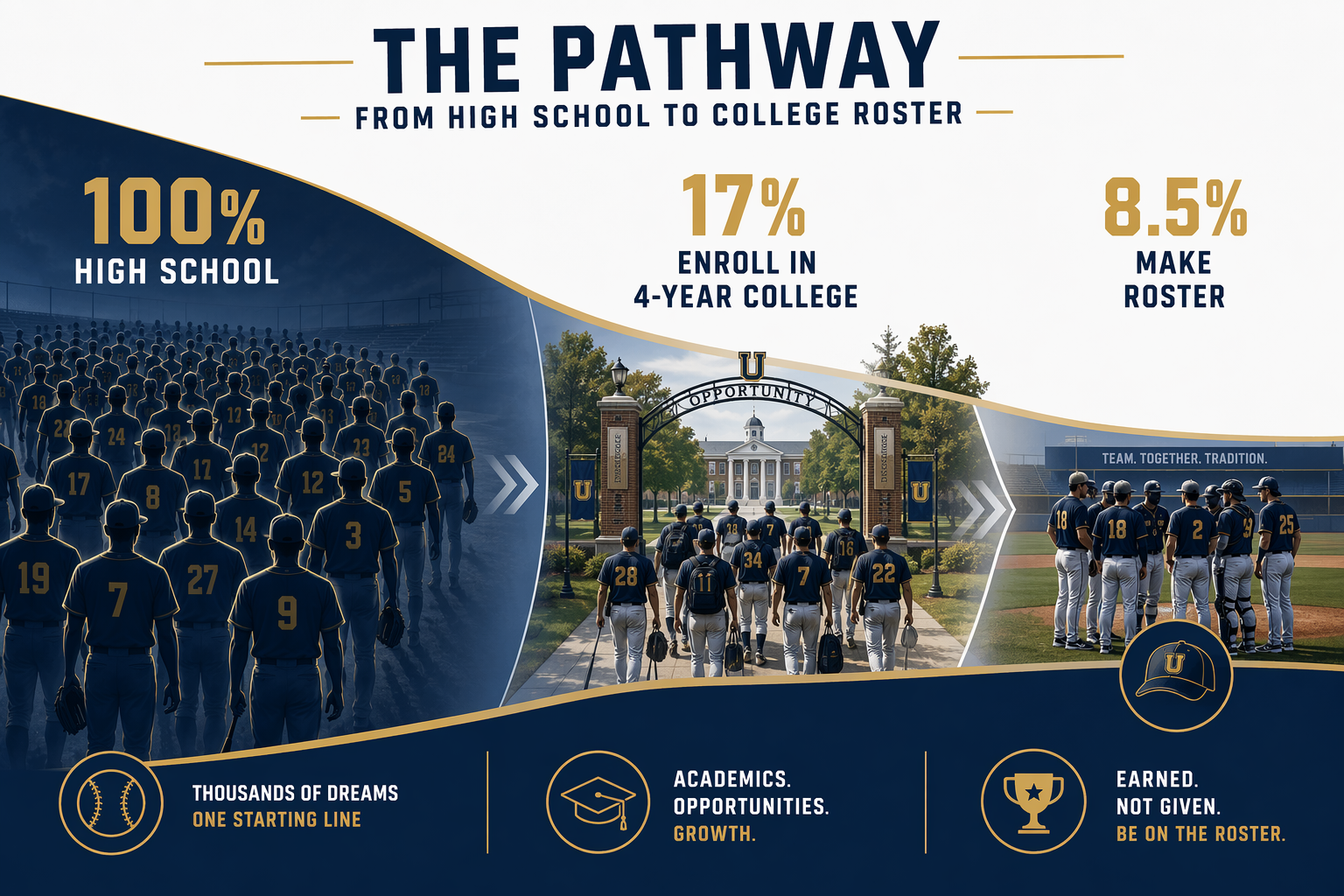
That does not prove that a higher GPA alone doubles an individual athlete’s chances in every sport. The data years and methods differ from the NCAA’s overall participation report, and baseball is only one sport. The narrower, more useful conclusion is this: being academically able to enroll at a four-year college moves an athlete into the pool where four-year roster spots are actually available. In the ScholarshipStats baseball example, that enrollment filter is associated with a jump from 8.5% to 17%.[3]
That is the part families often miss. Grades are not just a compliance hurdle at the end of recruiting. They shape which schools can seriously consider the athlete in the first place. A player who can only be admitted at a small slice of institutions has a narrower recruiting market. A player with a transcript that travels well has more realistic conversations available.
For an athlete who is not a national-name prospect, this can be the difference between chasing attention and expanding fit. Coaches at academically selective schools, high-cost private colleges, and programs with limited athletic aid may not need the best athlete at the showcase. They may need the athlete who can help them win, pass admissions review, qualify for merit money, and stay eligible without weekly rescue work.
Eligibility is the floor, not the advantage
NCAA eligibility still matters. Division I academic eligibility requires 16 NCAA-approved core-course credits and uses a core-course GPA/test-score sliding scale, according to NCAA Eligibility Center guidance summarized by recruiting resources.[4] A recruit who misses the basic eligibility mark can turn a coach’s interest into paperwork trouble quickly.
But meeting the minimum is not the same as becoming an easy yes. A transcript that barely clears the line may keep the door from closing. A stronger transcript can change the tone of the conversation, especially at schools where admissions review, merit aid, and team academic standing all sit in the background.
For the full mechanics of core courses, GPA calculation, sliding-scale issues, and common eligibility mistakes, use this deeper guide to NCAA eligibility rules for student-athletes in 2026. The recruiting strategy here is simpler: do not let eligibility be the best academic thing a coach can say about you.
Division targets are different from minimums
Academic targets vary by program, school, and sport, but recruiting guidance commonly describes a gap between eligibility minimums and competitive academic profiles. TNS Recruit reports broad coach-facing targets of roughly 3.5+ GPA for many Division I programs, 3.3+ for Division II, 3.0+ for Division III and NAIA, and about 3.8+ with 1400+ SAT for Ivy League-level recruiting conversations.[1]
| Recruiting context | Academic profile to watch |
|---|---|
| NCAA minimum eligibility | Core-course completion and GPA/test-score rules determine whether the athlete clears the floor. |
| Scholarship efficiency | Higher GPA and useful test scores may open academic merit aid that reduces athletic scholarship pressure. |
| Selective admissions | Stronger transcripts and scores can make a coach’s admissions conversation less risky. |
| Ongoing roster trust | A stable academic record signals lower in-season eligibility risk. |
Those targets should not be read as universal cutoffs. A 3.4 GPA does not automatically end Division I interest, and a 3.8 GPA does not create athletic ability that is not there. The useful move is to ask where your academic profile changes the school list. A recruit with a 3.7 GPA may be more realistic for certain high-academic Division III programs than a stronger athlete with a transcript that cannot survive admissions review. A recruit with a 3.3 may need to protect the current GPA instead of assuming one difficult junior-year semester will be forgiven later.
Test-optional does not always mean test-irrelevant
Standardized testing deserves a calmer conversation than families usually get. Many colleges have test-optional admissions policies, so SAT or ACT scores may not be required for admission review. That does not mean scores have lost all recruiting value.
TNS Recruit reports that a 1200+ SAT can unlock merit aid at many schools, while a 1350+ SAT can qualify athletes for significant merit packages in the $10,000 to $20,000 per year range.[1] This is why a coach may still care about a score even when the admissions website says test-optional. The score can affect the funding conversation.
The right test strategy depends on the athlete’s current score, GPA, school list, recruiting timeline, and stress load. A senior with a strong score already in range may be better served by sending clean academic updates to coaches. A sophomore or junior near a merit threshold may have a real financial reason to spend another month preparing. If you are deciding whether free SAT prep is enough for the target score, start with this guide to Khan Academy SAT prep.
Make the academic advantage visible to coaches
A good academic profile does not help much if it stays buried in a transcript no coach has seen. Recruiting communication should make the academic line easy to find without turning the email into a school report.
NCSA’s recruiting process guidance emphasizes that athletes should actively communicate with college coaches, share key recruiting information, and maintain an organized recruiting profile rather than waiting to be discovered.[5] Academics belong in that profile alongside position, graduation year, measurable stats, club or high school team, video, and contact information.
- Include cumulative GPA and, if stronger, core GPA or weighted GPA with clear labels.
- Add SAT or ACT scores when they strengthen the file or may support merit-aid review.
- Mention honors, AP, IB, dual-enrollment, or rigorous courses only when they clarify academic fit.
- Update coaches after a stronger semester, new test score, or confirmed eligibility milestone.
- Keep an unofficial transcript ready so the coach does not have to chase it.
The tone should be factual. “I currently have a 3.76 GPA and a 1320 SAT, and I am interested in your biology program” gives a coach usable information. “I work hard in the classroom” does not.
Protect the GPA during the athletic calendar
The hardest academic damage often happens during predictable pressure points: tournament weekends, travel weeks, playoff seasons, late-night returns, and the first semester after a heavier course load begins. Waiting until grades drop and then asking a coach, teacher, or counselor to help clean it up is a poor recruiting strategy.
Student-athletes do not need an elaborate productivity system. They need a calendar that shows practices, games, travel, major assignments, test dates, and recovery time in the same place. They also need a weekly habit of looking ahead before the sport takes over the week. For a practical structure, use this weekly study schedule template and adapt it around practices and competition days.
If NCAA benchmarks are already part of the concern, pair the schedule with targeted college athlete study tips for NCAA eligibility. The point is not to study like a non-athlete with unlimited evenings. It is to prevent the athletic calendar from quietly making the recruit more expensive, less admissible, or harder to trust.
Use the recruiting timeline before it uses you
Academic leverage is strongest when it appears early enough to shape the school list. College Solutions’ year-by-year recruiting timeline places academic preparation, school research, athletic exposure, and coach communication across the high school years rather than treating recruiting as a senior-year scramble.[6]
Freshman and sophomore years are when course selection and study habits quietly build or limit the future recruiting file. Junior year is when GPA, test planning, video, and coach outreach often start interacting more directly. Senior year is when weak paperwork becomes expensive because there is less time to repair the transcript, retest, or adjust the school list.
Coach-contact rules also vary by division, sport, and date. NCSA’s recruiting rules guide tracks contact timelines and explains that different NCAA divisions have different limits on when and how coaches may communicate with recruits.[7] Families should check the current rules for their sport rather than assuming a coach’s silence means lack of interest or that any message can receive a full reply immediately.
The academic work does not wait for the first permissible phone call. A coach may not be able to have every conversation yet, but the recruit can still build the transcript, prepare scores where useful, organize video, research academic fit, and make sure every outreach email eventually gives the coach a clean file to review.
What to do with this information
The practical move is not to chase every academic credential possible. It is to identify which academic factors change recruiting access for this athlete, in this sport, at this level of school.
- If the GPA is strong, make it visible in every recruiting profile and introductory email.
- If the GPA is near a meaningful threshold, protect it before adding unnecessary academic risk.
- If test scores may unlock merit aid, decide whether another prep cycle is worth the time.
- If core-course status is unclear, verify it before the coach has to ask.
- If the school list includes selective or high-cost colleges, ask how academic merit aid and admissions support usually work for recruited athletes.
A recruit with clean academic documentation is easier to evaluate. The coach can see the athletic fit, estimate admissions risk, think through scholarship stacking, and decide whether the athlete belongs on the next call list. That does not guarantee an offer. It does remove reasons for hesitation.
Academics do three jobs in recruiting: they keep the athlete eligible, make the athlete cheaper to roster, and lower the coach’s risk. Grades are part of the recruiting package, just like film, measurable stats, tournament schedule, references, and coach communication.
References
- The 2026 Student-Athlete Reality Check: 3 Things College Coaches Want Now, TNS Recruit
- Probability of Competing Beyond High School, NCAA.org
- Odds of a High School Athlete Making a College Team, ScholarshipStats.com
- NCAA Eligibility Center, NCAA.org / Eligibility Center
- College Recruiting Process, NCSA Sports
- The Year-by-Year Recruiting Timeline, College Solutions
- NCAA Recruiting Rules, NCSA Sports
Comments
Join the discussion with an anonymous comment.