
How Do You Buy Bitcoin as a Beginner?
This guide walks absolute beginners through buying Bitcoin for the first time — choosing a safe exchange, placing a buy order, and understanding fees, wallets, and tax obligations so you don't overpay or get caught off guard.
Updated:
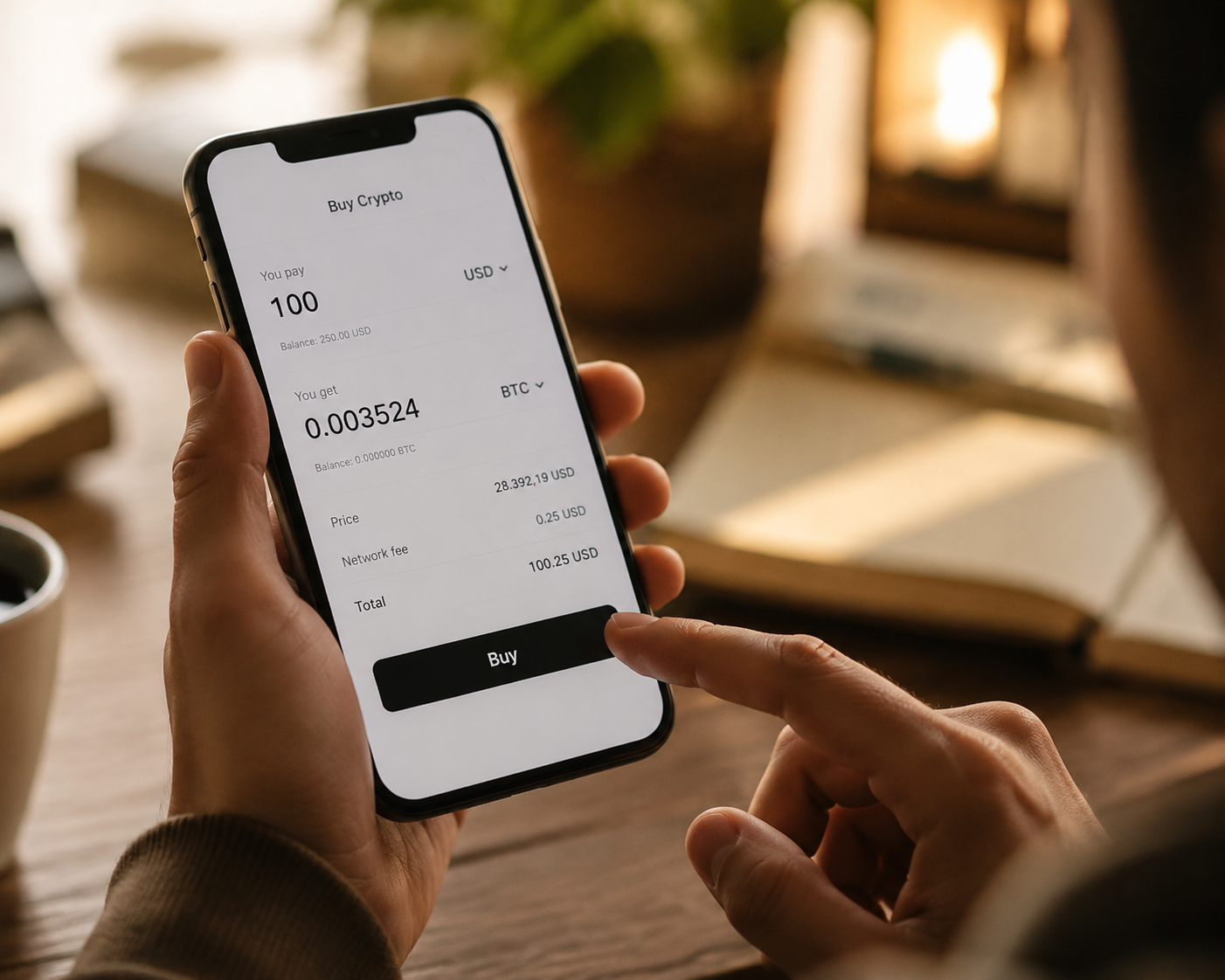
Yes, you can buy Bitcoin as a beginner in one sitting. The actual purchase is usually the easy part: open an account with a regulated crypto exchange, add a payment method, enter a small dollar amount, review the quote, and confirm.
The part worth slowing down for comes before and after the buy button. Beginners usually get punished by three things that look harmless in the moment: using the easiest purchase screen without checking fees, misunderstanding where the Bitcoin is stored, and forgetting that selling or trading crypto can create a tax event.
That matters even more if your first purchase is $10, $25, or $50. Coinbase allows purchases as low as $2, and many exchanges support minimums around $10, so you do not need to make your first Bitcoin purchase feel like a major financial commitment.[1]
Start With A Tiny Test Purchase
For a first purchase, the useful question is not “How much Bitcoin should I buy?” It is “What amount lets me learn the process without caring too much if I decide this is not for me?”
A tiny test purchase does three things. It lets you practice account setup, fee comparison, and recordkeeping before the dollar amount gets emotionally loud. If you are still building basic money habits, it is worth comparing this with more familiar investing routines, such as starting stock investing with a small monthly amount, before treating Bitcoin as your default first investment.
| Step | What You Are Trying To Avoid |
|---|---|
| Choose a regulated exchange | Sending money to a sketchy app, fake platform, or high-fee shortcut |
| Secure the account | Losing access because your login or two-factor method is weak |
| Fund the account | Paying extra card or instant-buy costs without noticing |
| Compare the simple buy quote with the trading interface | Overpaying for the exact same Bitcoin |
| Place a small order | Learning with money you cannot afford to lose |
| Decide where to store it | Moving coins into a wallet before you understand recovery |
| Record the transaction | Trying to reconstruct tax details months later |
Choose The Exchange Before You Think About Bitcoin Price
Bitcoin’s current price can distract beginners into thinking the purchase is mainly about timing. For a first buy, the more practical decision is where you are buying and what that platform charges you to do it.
Use a regulated, mainstream exchange that clearly shows fees, lets you download transaction history, and gives you basic account-security tools. NerdWallet notes Kraken’s long security record, saying it has operated since 2011 without a breach of customer funds, which is the kind of boring detail that should matter more to a beginner than a flashy promotion.[1]
Coinbase, Kraken, Gemini, and similar large exchanges are not magic shields against every possible problem. They are simply more appropriate places for a first small purchase than a random social-media link, a stranger’s “investment platform,” or a Bitcoin ATM in a convenience store.
Bitcoin ATMs deserve a special warning because they can feel beginner-friendly: cash in, Bitcoin out. NerdWallet cites an analysis of 7,520 U.S. Bitcoin ATMs showing typical fees around 13% to 15%, which can eat a painful share of a small purchase before you even start.[1]
The Fee Trap: The Easy Button May Cost More
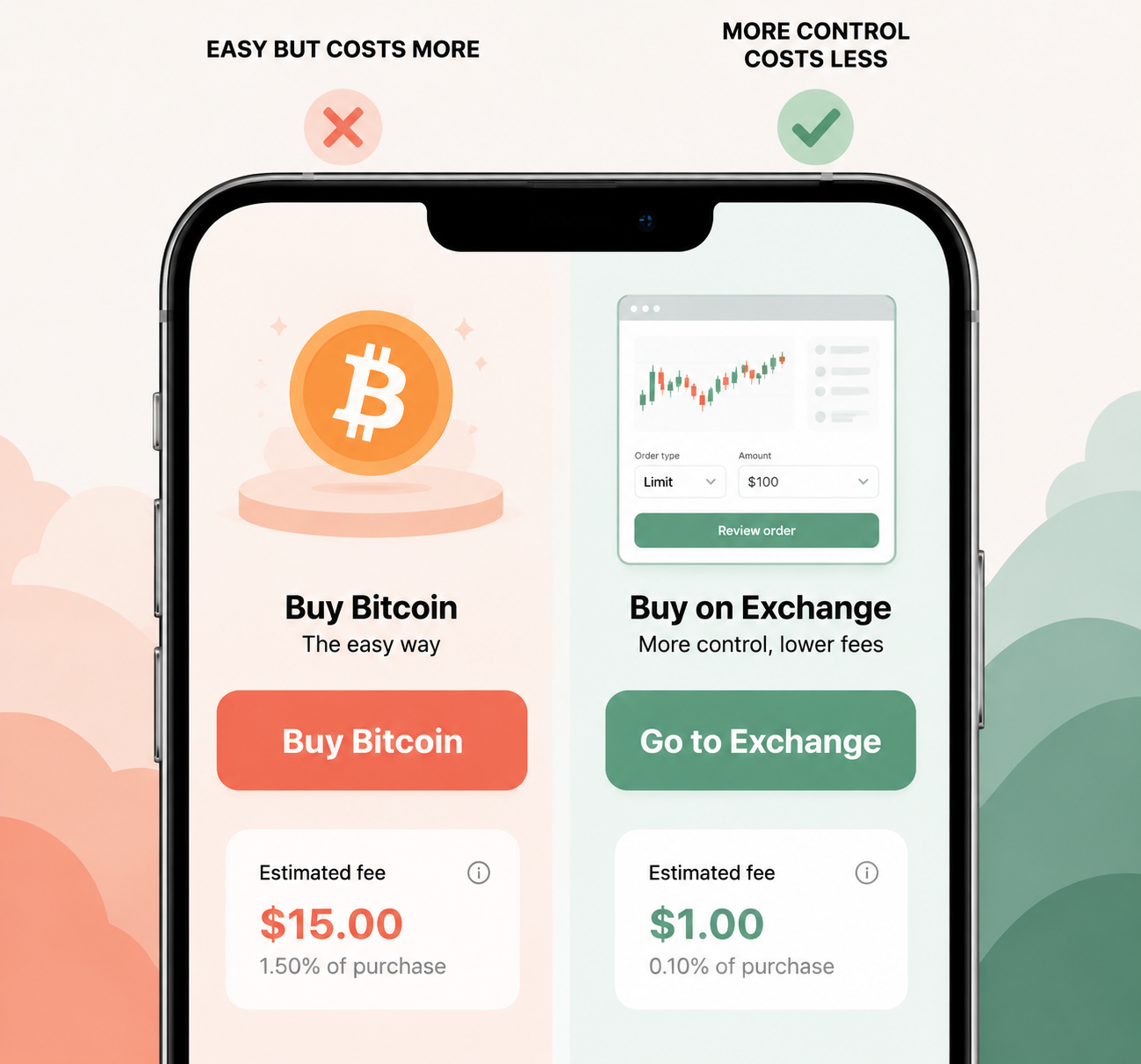
This is the place to slow down. On some exchanges, the same company gives you two ways to buy Bitcoin: a simple buy screen and a more detailed trading interface. The simple screen is designed to feel easy. The trading interface may look more intimidating, but it can charge much less.
NerdWallet describes Coinbase’s basic buying experience as having effective costs that can reach roughly 2% to 4% once the visible fee and spread are considered, while Coinbase Advanced has maker-taker fees around 0.4% to 0.6% for lower-volume users.[1] Bitbo also lists materially different costs across U.S. buying options, including Coinbase fee estimates that vary by buying method.[2]
Those percentages are not permanent promises. Exchange pricing changes, spreads move, and payment methods can affect the final quote. Treat them as a warning label, not a coupon. Before you press buy, compare the all-in quote on the simple screen with the quote on the platform’s lower-fee trading screen if it offers one.
For a small test buy, the dollar difference may not ruin your day. But the habit matters. If you learn on the expensive button, you may keep using it when the amount gets larger.
What To Check On The Quote Screen
- The dollar amount you are spending, not just the Bitcoin amount you receive
- The listed transaction fee
- Any spread between the market price and the price you are quoted
- Whether your payment method adds extra cost
- Whether the exchange has a lower-fee “Advanced,” “Pro,” or trading view
Set Up The Account Like Losing Access Would Be Annoying
Account setup usually means giving your legal name, date of birth, address, and identity documents. That can feel excessive if you expected Bitcoin to be as simple as downloading an app, but regulated U.S. exchanges generally require identity verification before you can buy.
Use an email account you control, create a unique password, and turn on two-factor authentication. Avoid SMS two-factor if the exchange offers a stronger app-based option. Store backup codes somewhere you can actually find later, not in a random screenshot you may delete.
This caution is not paranoia. Security.org’s 2026 report says 30% of U.S. adults own cryptocurrency, while 59% lack confidence in crypto security.[3] The same report says 16% of crypto owners have experienced access problems such as lost passwords, lost keys, exchange outages, or frozen accounts.[3]
If you are a student, the scam angle is especially worth taking seriously. Fake exchange links, “support” DMs, and phishing emails can look routine when you are rushing. The same instincts that help you spot phishing scams targeting college students apply here: type the exchange URL yourself, do not click login links from messages, and never share recovery codes.
Fund The Account Without Turning Convenience Into A Fee
Once the account is approved, connect a payment method. A bank transfer is often cheaper than a debit card or instant purchase option, though it may take longer. The exchange should show you the available methods before you commit.
If this is your first attempt, patience is cheaper than speed. Waiting for a bank transfer may feel less exciting than buying immediately, but the goal of a test purchase is to learn the process cleanly, not to prove you can react fast.
Place The Buy Order
For a first purchase, a market order is usually the simplest: you choose the dollar amount, and the exchange buys Bitcoin at the available quoted price. A limit order lets you choose a price you are willing to pay, but it may not fill if the market does not reach that price.
A clean first order looks like this: choose a tiny amount, review the total cost, confirm the fee, check the Bitcoin amount you will receive, and then buy. After the order fills, the exchange balance should show your Bitcoin and the transaction should appear in your history.
Do not judge success by whether the price moves up five minutes later. The win for a first purchase is that you used the right platform, understood the fee, secured the login, and created a record you can find again.
Decide Where The Bitcoin Lives
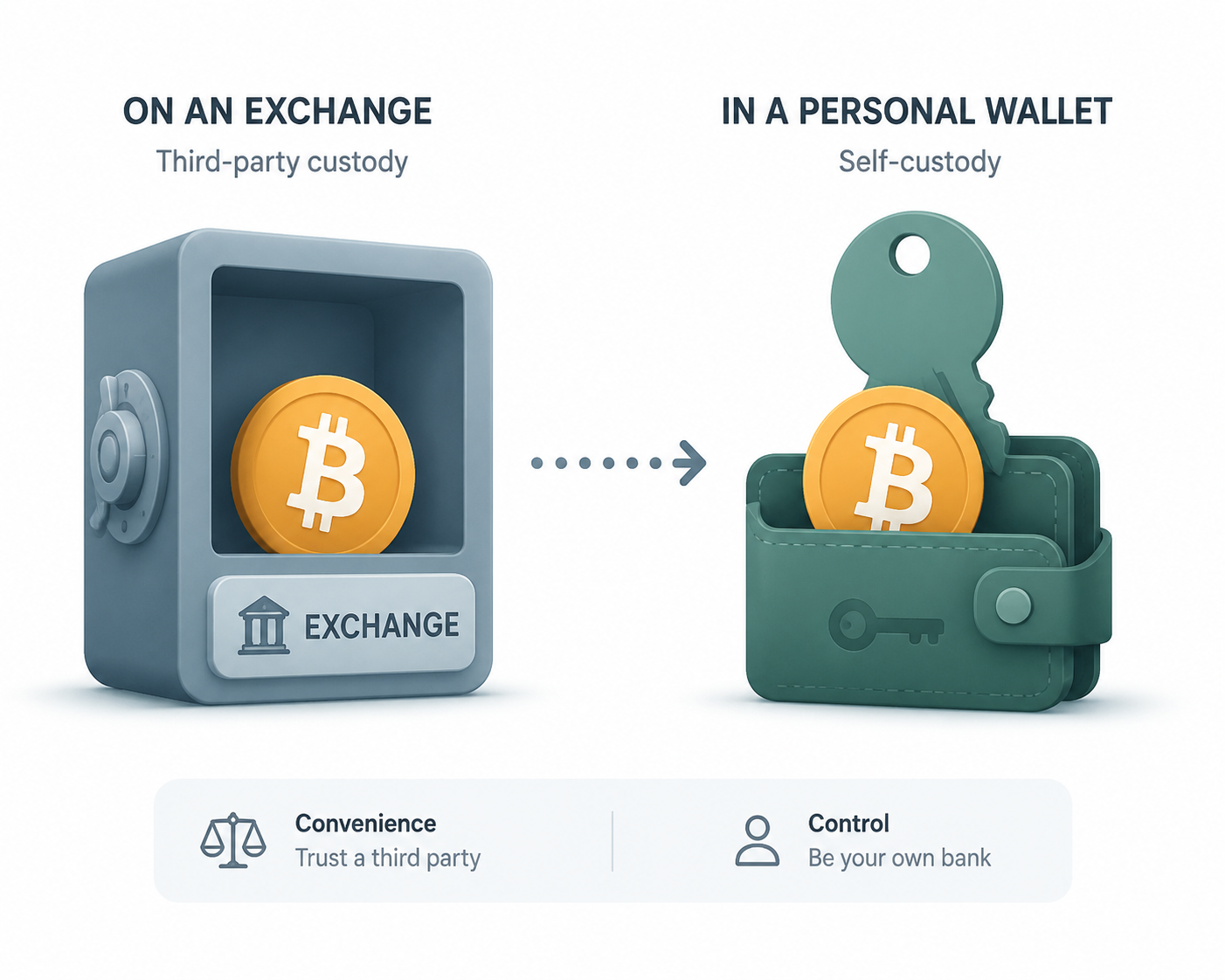
After the purchase, your Bitcoin is either held for you by the exchange or moved to a wallet where you control the private keys. This is where beginner advice often gets too dramatic too fast.
Leaving a small first purchase on a regulated exchange can be reasonable while you learn. NerdWallet and FinWise Hub both frame exchange custody as a practical starting point for small amounts, with FinWise Hub using a rough under-$200-to-$500 range before a hardware wallet becomes worth considering for many beginners.[1][4]
That does not mean exchange custody is risk-free. You are trusting the exchange’s security, account controls, and withdrawal access. The tradeoff is that if you forget your password, there may be an account-recovery process.
A personal wallet gives you more control, but it also gives you more ways to make an irreversible mistake. If you lose the recovery phrase for a self-custody wallet, there may be no help desk that can restore the Bitcoin. Hardware-wallet companies often emphasize this control, and Ledger’s wallet guide discusses hardware wallets as a security option, but that advice comes from a company that sells wallet products.[5]
A Simple Custody Rule For Your First Buy
- If the purchase is tiny and you are still learning, leaving it on a reputable exchange is a practical starting point.
- If the amount grows enough that losing exchange access would seriously bother you, start learning self-custody before transferring.
- If you use a personal wallet, practice with a small transfer first and confirm you understand the recovery phrase.
- Never store a recovery phrase in cloud notes, email, or a photo library.
Keep Records From Day One
Buying Bitcoin is not usually the taxable part by itself. The tax problem begins when people sell, trade, or spend crypto and then realize they have no clean record of what they paid, when they bought, and what happened later.
In the U.S., every sale or trade of cryptocurrency can be a taxable event, and the result may be a capital gain or loss depending on your cost basis and sale value.[6] Starting in 2026, brokers are required to report cost basis information on Form 1099-DA, which makes the “I’ll figure it out later” approach much weaker.[6]
For your first purchase, save the date, exchange name, dollar amount, Bitcoin amount, fee, and transaction confirmation. If the exchange lets you export transaction history, check where that feature lives while the purchase is still fresh.
If you are still learning the basics of budgeting, taxes, debt, and investing vocabulary, Bitcoin should sit inside a broader money plan, not outside it. A general student financial-literacy foundation will make the crypto decisions less mysterious.
The Beginner Order Of Operations
- Pick a small test amount you can afford to see fluctuate.
- Choose a regulated exchange with clear fees, account-security tools, and downloadable records.
- Create the account, verify your identity, use a unique password, and turn on strong two-factor authentication.
- Connect a payment method, checking whether speed adds cost.
- Compare the simple buy screen with the exchange’s lower-fee trading interface if one is available.
- Place the order only after reviewing the fee, spread, total dollars spent, and Bitcoin received.
- Leave a very small first purchase on the exchange while you learn custody, or move it only after you understand wallet recovery.
- Save the transaction details for taxes before you forget where they are.
That is enough for a first Bitcoin purchase. Make it small, use a serious exchange, avoid high-fee shortcuts, do not rush into self-custody before you understand recovery, and keep records from the start.
References
- How to Buy Bitcoin (BTC): Quick-Start Guide — NerdWallet
- 9 Best Sites to Buy Bitcoin in USA — Bitbo
- 2026 Cryptocurrency Adoption and Sentiment Report — Security.org
- How to Buy Bitcoin in 2026: The Complete Beginner's Guide — FinWise Hub
- 10 Best Bitcoin Wallets in 2026 — Ledger
- Crypto Tax Guide: 2026 Rates and Rules — NerdWallet
Comments
Join the discussion with an anonymous comment.