
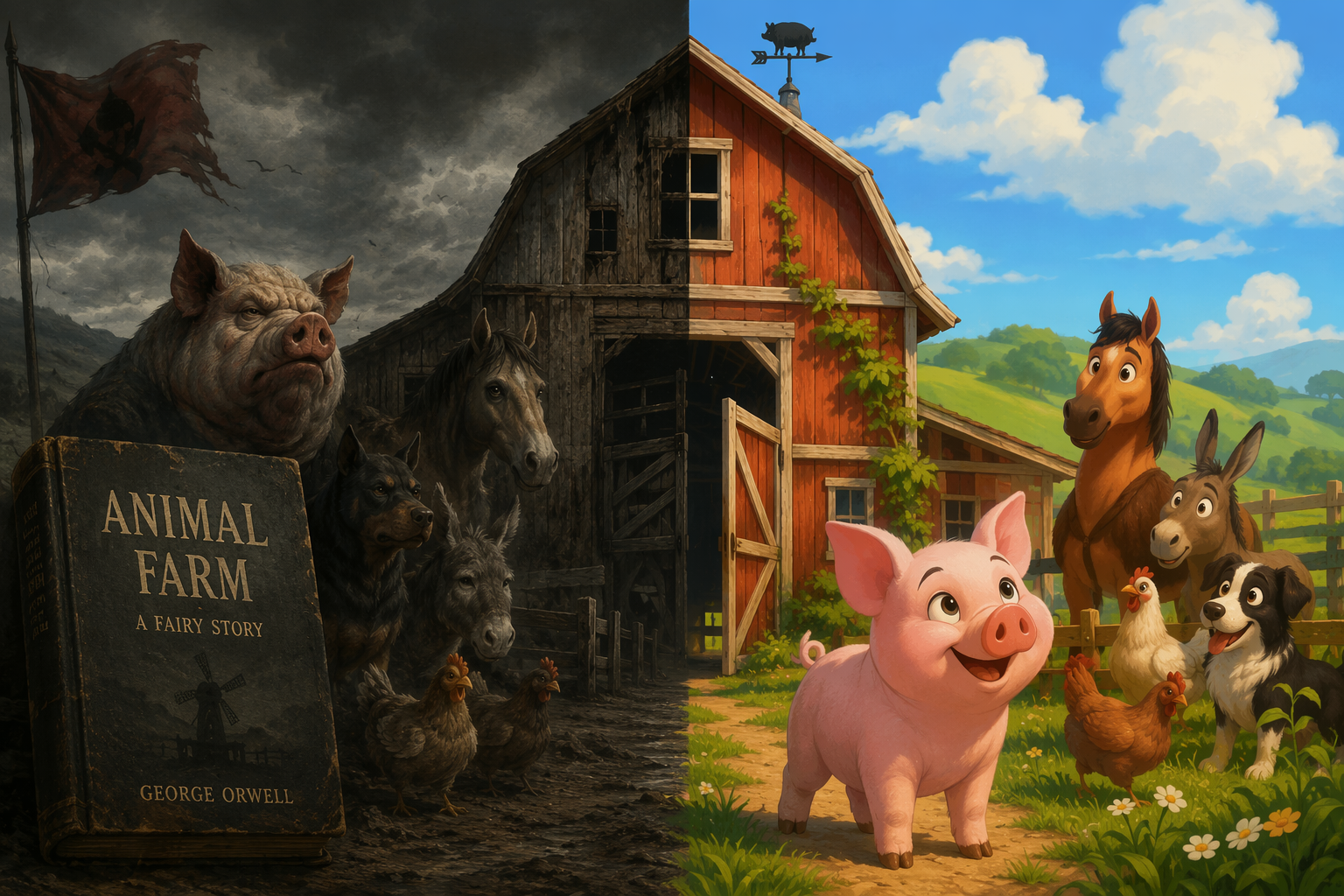
What the 2025 Animal Farm Film Changes from the Book
This study guide compares Andy Serkis' 2025 animated Animal Farm with Orwell's original novella, documenting every major plot, character, and thematic change to help students and teachers decide how — or if — the film can supplement class reading.
Updated:
If you searched for an Animal Farm Netflix adaptation study guide, the first correction is practical: the film most people mean is Andy Serkis’ CG-animated Animal Farm, which was developed at Netflix beginning in 2018 but was later dropped; Angel Studios distributed it theatrically in the United States. Its release path is also easy to muddle: it premiered at Annecy in June 2025, opened in U.S. theaters in May 2026, and reached U.K. theaters in July 2026. It is not simply “the Netflix Animal Farm,” and it should not be treated as a streaming substitute for Orwell’s novella. [1]
The short study answer is this: watch it only after reading the book, and watch it with a pencil in hand. The film can help students notice what Orwell’s original is doing because it changes so much. It cannot safely replace the novella for a class essay, quiz, or exam. Variety’s warning is blunt enough to tape above a desk: “Woe to the student who tries watching this toon instead of doing the reading.” [2]
The Changes Students Most Need to Label
The safest way to use the film is to mark each major deviation before discussion begins. A student who remembers the piglet Lucky, the comic Napoleon, or the celebratory ending as if Orwell wrote them will not merely have a few details wrong. The student will have imported a different argument into the book.
| Element | Orwell’s novella | Serkis’ film | Study consequence |
|---|---|---|---|
| Opening frame | The farm animals gather around Old Major, whose speech and dream help launch the rebellion. | Old Major is removed from the film’s plot summary, and the story is refocused around Lucky, a young piglet. [1] | Do not cite Lucky as a book character or use the film’s opening as evidence for how revolutionary language begins in the novella. |
| Main character focus | The novella works as a compact political fable with no single childlike hero guiding the reader through events. | Lucky becomes a new protagonist and audience entry point. IGN identifies Lucky as one of the film’s major additions. [3] | The film gives younger viewers someone to follow, but that doorway changes the book’s colder, more collective structure. |
| Old Major | Old Major’s speech supplies the animals’ first revolutionary vocabulary and helps establish the allegorical connection to Marxist-Leninist revolutionary tradition. | Old Major is absent, so the origin of the revolution no longer carries the same weight in the plot summary. [1] | Essays about the book should still treat Old Major as essential, not optional background. |
| Snowball | Snowball is Napoleon’s rival and becomes central to the rewriting of history after his expulsion. | Snowball is voiced by Laverne Cox, and the film changes the character’s presentation within its revised political world. [1] | Students should separate the book’s Snowball-Trotsky framework from the film’s altered characterization. |
| Napoleon | Napoleon consolidates power through force, propaganda, scapegoating, and gradual imitation of human tyranny. | Seth Rogen voices a more comic, dude-bro Napoleon, a choice several reviews connect to the film’s softer satirical register. [1][2] | A funny Napoleon can be memorable, but the book’s Napoleon becomes frightening because his absurdity does not cancel his power. |
| Allegorical target | The standard classroom reading treats Animal Farm as an allegory of the Russian Revolution, Stalinism, and the corruption of revolutionary ideals. | The film shifts toward corporate and Trump-era populist satire, with critics noting the updated political targets. [4] | Do not use film-only corporate or contemporary-populist details as proof of Orwell’s original historical allegory. |
| Tone | The novella grows increasingly bleak as the animals lose language, memory, food, and political agency. | The film is brighter, more broadly comic, and more child-accessible, though reviewers disagree on whether that accessibility helps or weakens the satire. [2][5] | The tonal shift is not decorative; it affects what viewers think the story is warning them about. |
| Ending | The pigs and humans become indistinguishable, leaving the animals unable to tell oppressor from oppressor. | The film gives a happy resolution in which Napoleon drowns and the animals’ future looks more hopeful. [1][3] | This is the most dangerous substitution. The film resolves what the book deliberately refuses to resolve. |
Why the Ending Is Not a Minor Change
In the novella, the ending is the final lesson. The animals look from pig to man and from man to pig and can no longer tell the difference. Orwell does not send in a late rescue, a purified next generation, or a last-minute moral correction. He ends with recognition: the revolution has not merely failed to keep its promises; it has produced rulers who resemble the old masters.
The film’s ending moves in the opposite emotional direction. In the plot summary and in IGN’s account of the altered finale, Napoleon dies by drowning and the animals receive a more triumphant resolution. [1][3] That makes the film easier to leave, especially for younger viewers. It also changes what oppression looks like. In Orwell, the danger is not only one bad ruler. It is a system of language, fear, privilege, and forgetfulness that teaches the animals to accept the next version of the same domination.
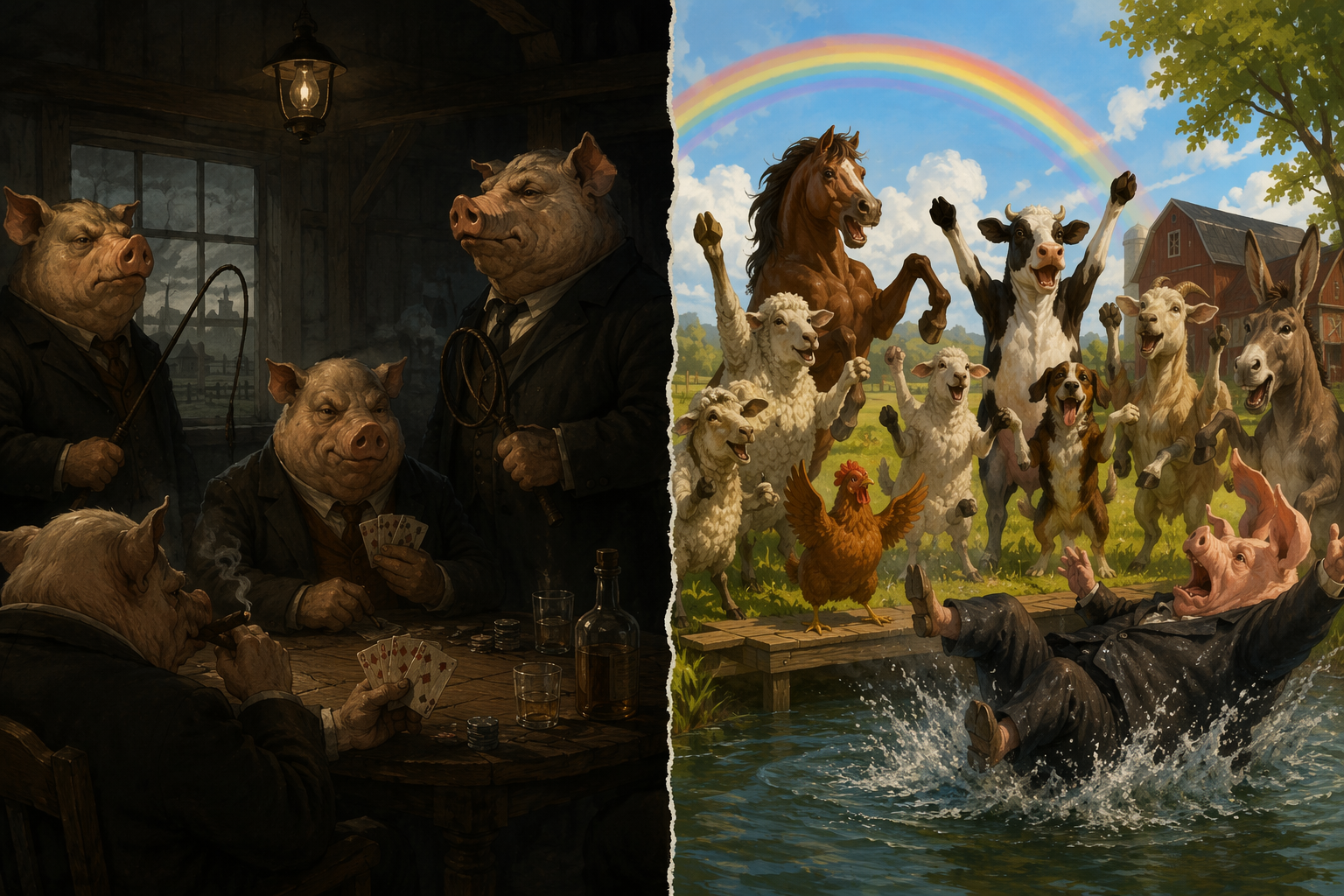
This is where a film detail can do the most classroom damage. A student who writes that Animal Farm ends with Napoleon defeated has not remembered a harmless variant; the student has reversed the book’s political structure. In the novella, the animals’ tragedy is that they can see the corruption and still have no rescue from it.
Lucky the Piglet Changes the Reader’s Job
Lucky is the film’s most useful classroom warning label. A new young protagonist gives viewers a point of attachment. That can be a generous adaptation choice: students who find Orwell’s fable distant may enter more easily through a vulnerable character who has something immediate to lose. Common Sense Media’s review, which rates the film for ages 8+, treats the movie as a possible starting point for discussion and says it can “lay a foundation for critical thinking,” while also noting that it cannot carry the book’s full weight. [6]
But a doorway is not the house. Orwell does not build the novella around an innocent child-hero whose fate organizes the reader’s hopes. He makes the farm itself the field of political education. The reader has to watch slogans harden into commandments, commandments revise themselves, and memory lose against repetition. Lucky’s presence can help a viewer care, but it can also encourage a simpler question — will the good little character survive? — where the novella asks a harder one: how does a whole community become unable to defend its own freedom?
Old Major’s Absence Removes the First Lesson in Political Language
Old Major matters because he gives the animals a language before Napoleon corrupts it. His speech supplies grievance, memory, song, and theory. A class can argue about the speech’s idealism, its simplifications, or its historical echoes, but it cannot skip the fact that Orwell begins with revolutionary imagination before he shows revolutionary betrayal.
The film’s removal of Old Major changes the shape of causation. Without that opening figure, the rebellion’s origin becomes less anchored in a specific inherited doctrine and more available to the film’s updated satire. That may be efficient for a family animated feature, but it weakens one of the book’s central study questions: how do noble-sounding principles become tools for domination after the original speaker is gone?
Snowball and Napoleon Are Not Just Rival Personalities
Students often reduce Snowball and Napoleon to “the smart one” and “the bad one.” The film’s revised character presentation can make that shortcut even more tempting. In the book, though, their rivalry is not merely a personality clash. Snowball’s expulsion allows Napoleon to control memory: plans are reassigned, blame is redirected, and an absent enemy becomes useful precisely because he cannot answer back.
Napoleon’s comic treatment also needs careful handling. Seth Rogen’s casting is not automatically a mistake; comedy can expose vanity and vulgarity. The trouble begins when comedy makes the tyrant feel less structurally dangerous. The Hollywood Reporter called the film a “dumbed-down” adaptation, and The Guardian described it as a “sugaring” of Orwell’s satire. [7][5] Those judgments point to the same classroom concern: if Napoleon becomes primarily ridiculous, students may miss how Orwell makes ridiculous language and brutal power operate together.
The Allegory Has Moved
Most students encounter Animal Farm as a political allegory tied to the Russian Revolution and Stalinism. That framework is not a decorative footnote; it shapes the function of Old Major, Snowball, Napoleon, the dogs, the commandments, the windmill, the purges, and the final human-pig dinner. A standard book-only study guide such as SparkNotes keeps attention on that allegorical structure because it is central to how the novella is commonly taught. [8]
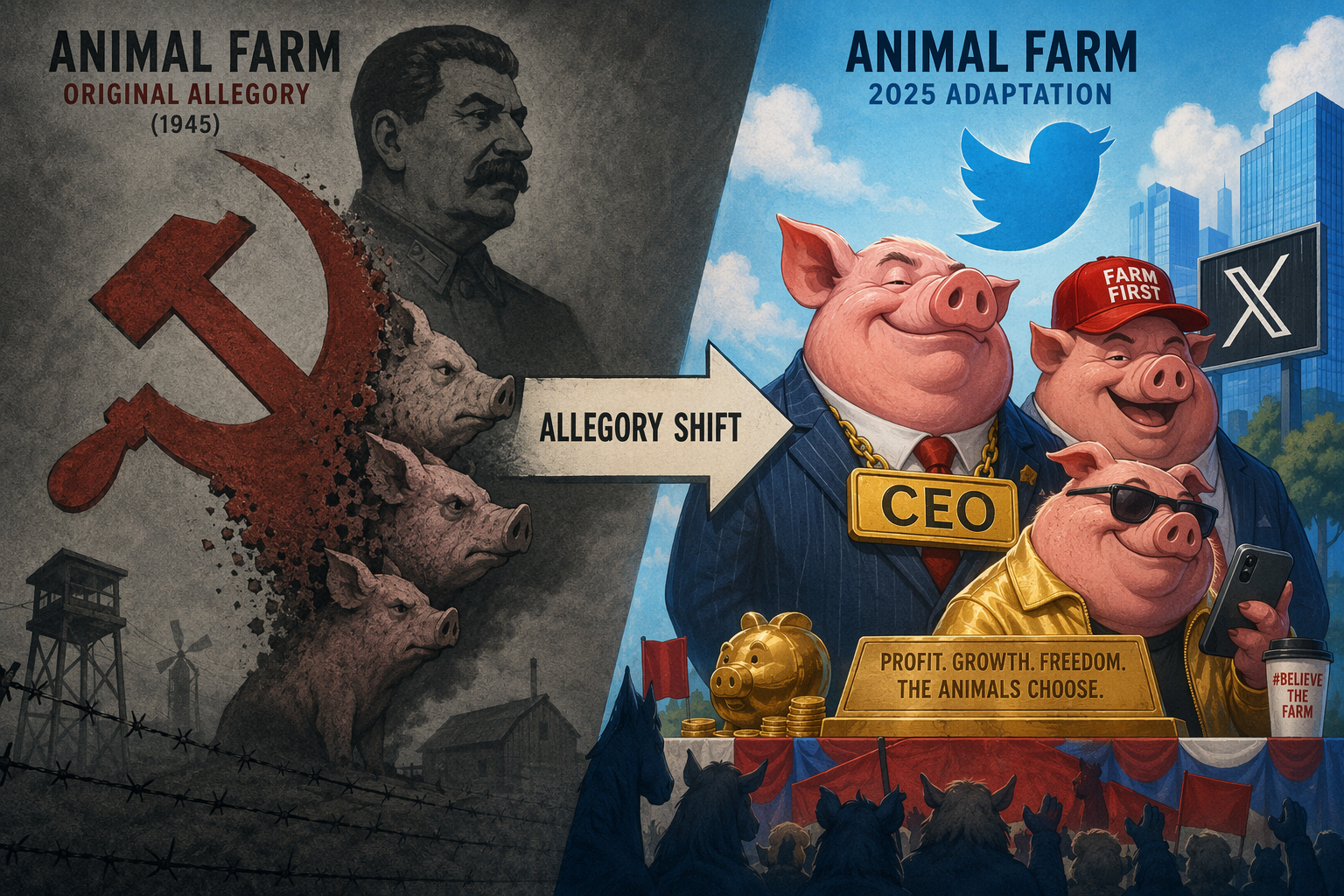
The film redirects much of that energy toward corporate power and contemporary populist performance. Slate’s analysis identifies the adaptation’s move away from Stalinist allegory and toward corporate and Trump-era populist satire. [4] Variety, The Guardian, IGN, and The Hollywood Reporter all respond, in different registers, to the consequences of that softening and updating: the movie becomes more legible as a modern animated satire, but less reliable as a guide to Orwell’s original political machinery. [2][5][3][7]
That distinction is not a complaint that adaptations must preserve every historical one-to-one correspondence. A classroom adaptation can change period, medium, and emphasis. The question is whether the change is labeled. If a student writes, “Orwell criticizes corporate branding through Lucky’s story,” the sentence sounds polished and is still wrong as a claim about the novella. If the student writes, “Serkis’ film updates Orwell’s Stalinist allegory into a corporate-populist satire, which changes the function of Napoleon and the ending,” the film has become useful.
Reception Matters Less Than the Study Problem, but It Explains the Caution
The film’s reception was not merely mixed. Variety reported a $35 million budget, $6.2 million in box office, and a C- CinemaScore, while Rotten Tomatoes listed a 30% critic score and 54% audience score. [2][9] Those numbers should not become the main reason to reject the film for study. Weak reviews do not automatically make a film useless in class. Sometimes a flawed adaptation is better for teaching comparison because its choices are visible.
Still, the critical pattern is relevant because reviewers repeatedly notice the same classroom-sensitive changes: simplification, softened tone, comic characterization, and a less devastating ending. A student-journalism critique in The Burlingame B argues that the adaptation “completely misses” Orwell’s original message, which is worth noticing not because one student outlet settles the matter, but because it shows how clearly the problem appears to readers close to the school setting. [10]
How Students Should Use the Film Without Damaging the Essay
The film is safest after the novella, not before it. If you watch first, its images may become the version your memory reaches for under deadline pressure. That is how Lucky wanders into a book paragraph, or how a happy ending quietly replaces Orwell’s final table scene.
- Read the novella first, especially Old Major’s speech, the commandments, Snowball’s expulsion, Boxer’s removal, and the final farmhouse scene.
- While watching, keep a two-column note page labeled “book” and “film,” not a single plot summary.
- Mark Lucky, Old Major’s absence, Snowball’s changed presentation, comic Napoleon, and the new ending as film-only or film-altered details.
- For a book essay, cite only events and language from Orwell’s novella unless the assignment explicitly asks for adaptation comparison.
- For an adaptation essay, make the change itself the evidence: explain what the film alters and what that alteration does to theme, tone, or allegory.
A useful comparison sentence begins with a clear boundary: “In Orwell’s novella...” or “In Serkis’ film...” That small phrase prevents a large category error. It also forces the writer to decide whether the evidence belongs to the source text, the adaptation, or the space between them.
How Teachers Can Use Selected Scenes
For teachers, the film is more promising as an adaptation exercise than as a substitute assignment. Gale’s educator material anticipated the film as an occasion to teach the meaning and message of Animal Farm, and existing classroom resources such as Teach with Movies already treat screen versions as discussion tools rather than replacements for literary study. [11][12]
| Teaching use | Best scene or issue | Question to ask |
|---|---|---|
| Introducing adaptation choices | Lucky as new protagonist | What does the film gain by giving viewers a young hero, and what does the book gain by refusing one? |
| Teaching allegory | Old Major’s absence and the updated political frame | What happens to the Russian Revolution and Stalinism framework when the film shifts toward corporate and populist satire? |
| Teaching propaganda | Snowball’s altered role and Napoleon’s public image | How does an adaptation change the audience’s understanding of scapegoating and rewritten history? |
| Teaching endings | Napoleon’s defeat versus the book’s pig-human indistinguishability | Which ending leaves the audience with responsibility, and which ending gives the audience relief? |
The important preparation is not a long lecture before pressing play. It is a short warning that the film is about to change the evidence. Once students know that, even a softened adaptation can sharpen their reading of the original. Without that warning, the next class period may become a repair session.
Final Study Judgment
Andy Serkis’ Animal Farm is weakest as a replacement for Orwell and strongest as a contrast tool. Students may watch it after reading; teachers may use selected scenes to teach adaptation, tone, allegory, and endings. Neither group should treat the movie’s plot, characters, ending, or updated political frame as evidence of what the novella says. The safest study guide is the simplest one: label every major deviation before discussion or essay writing begins.
References
- Animal Farm (2025 film), Wikipedia
- Animal Farm Review: Andy Serkis’ Toon Take on George Orwell’s Classic Is a Muddled Mess, Variety
- Animal Farm Review, IGN
- Animal Farm George Orwell Movie Book Seth Rogen, Slate
- Animal Farm review – Orwell animation, The Guardian, July 15, 2026
- Animal Farm Movie Review, Common Sense Media
- Animal Farm Review, The Hollywood Reporter
- Animal Farm, SparkNotes
- Animal Farm (2025), Rotten Tomatoes
- Animal Farm 2026 Completely Misses Orwell’s Original Message, The Burlingame B
- Teach the Meaning and Message of Animal Farm Before Its Netflix Release, Gale Blog
- Animal Farm, Teach with Movies
Comments
Join the discussion with an anonymous comment.