
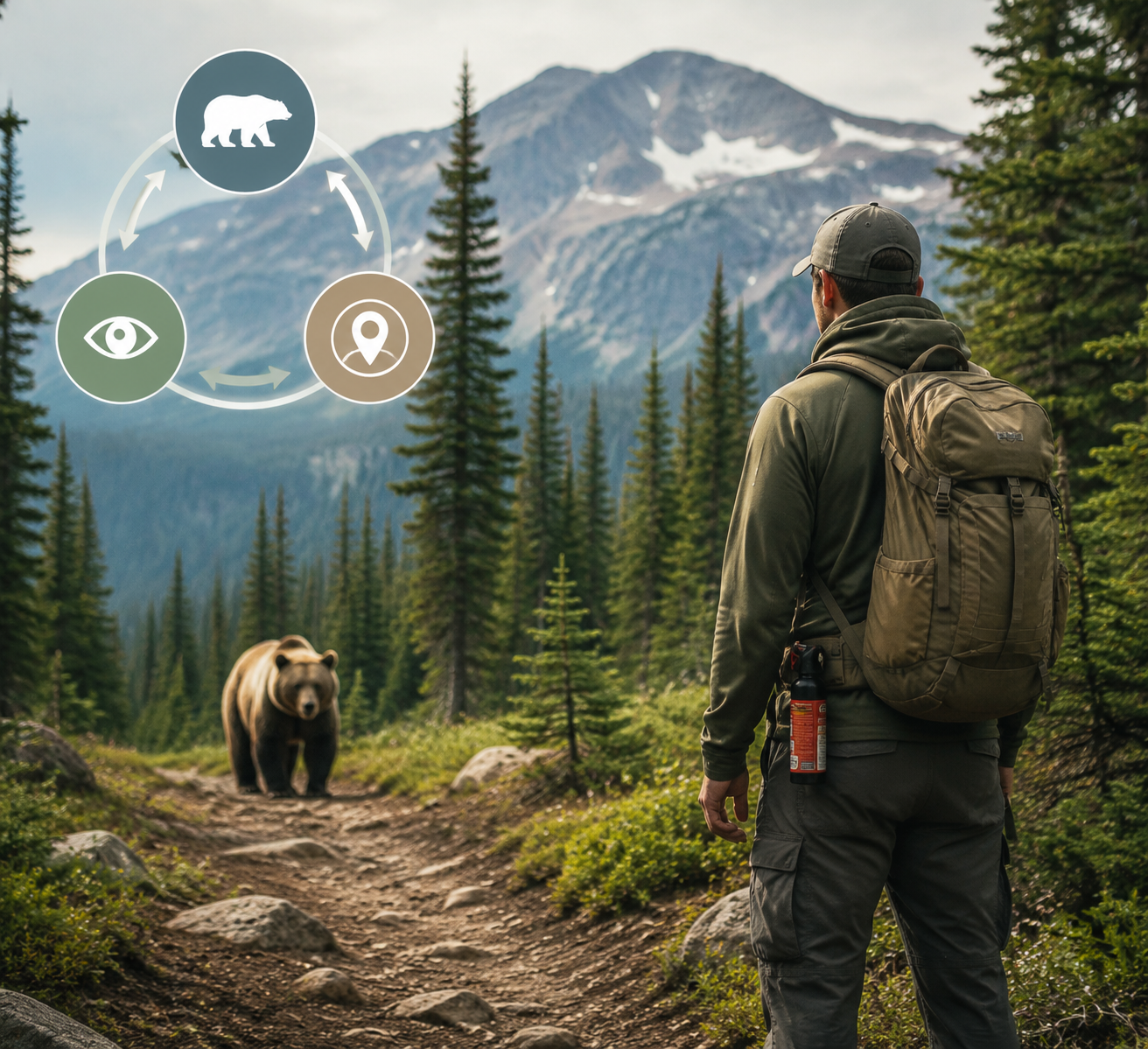
The Bear Safety Decision Tree Every Hiker Should Know
This article breaks bear encounter safety into a simple decision tree based on species, bear behavior, and distance, helping you react correctly under pressure. Learn the 'Black fight back, brown lie down' mnemonic and when to apply it.
Updated:
The bad moment is not “a bear exists somewhere in the park.” The bad moment is a bear appearing close enough that your brain starts throwing slogans at you: black fight back, brown lie down, make noise, don’t run, use spray, look big, play dead. Some of those bear encounter safety tips are correct in some situations. Several are dangerous in the wrong one.
The useful question is narrower: what am I looking at, what is it doing, and how far away is it? That sequence matters because the familiar mnemonic only works after you identify the bear and decide whether the animal is defensive, curious, or predatory. A grizzly swatting the ground at close range is a different problem from a black bear silently following you. Treat them the same and the rule has failed you, not because the rule is silly, but because you skipped the conditions.
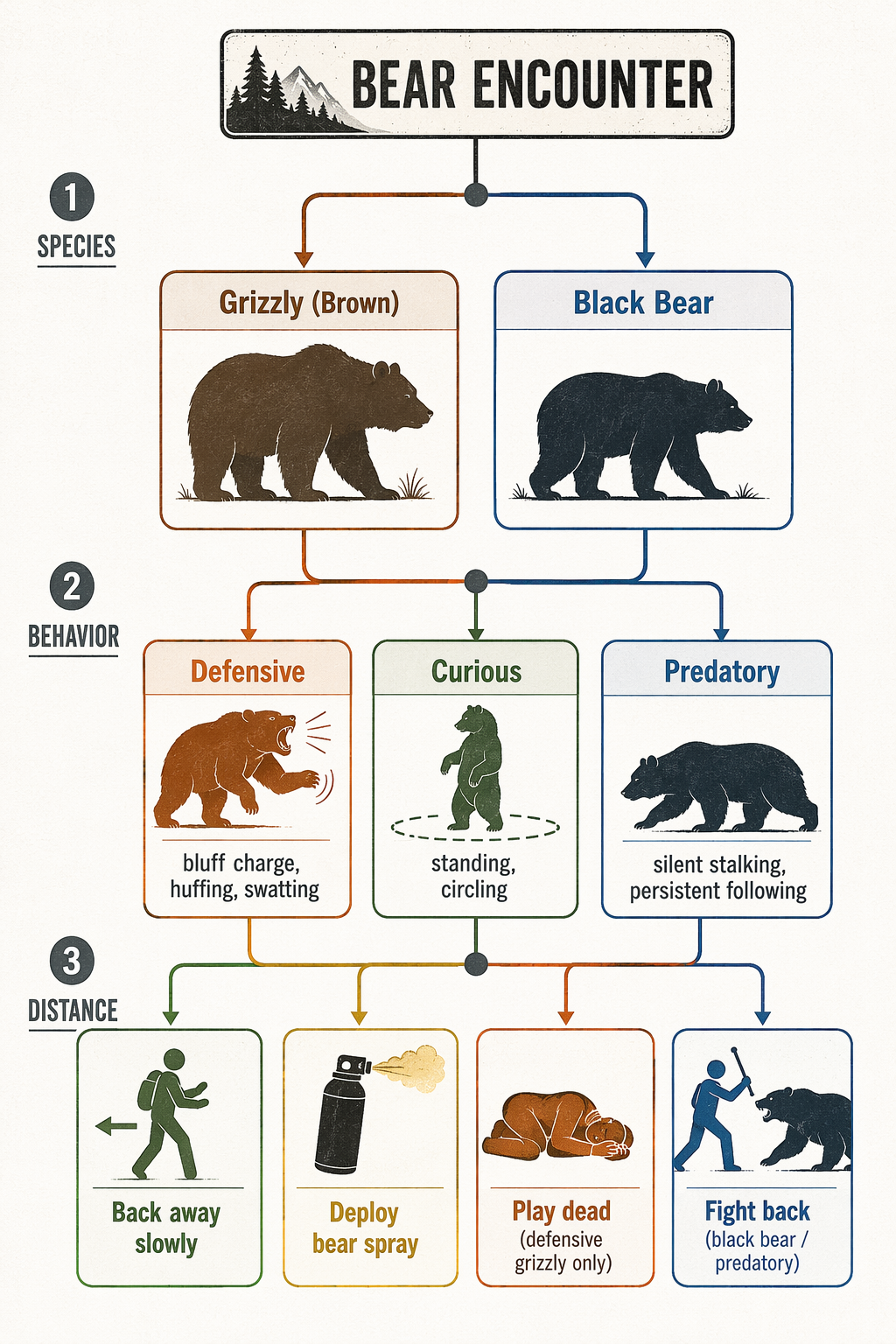
The Whole Decision Tree First
Here is the rehearsal version. Do not wait until a bear is moving toward you to assemble this from memory.
| Decision Point | What To Check | Default Action |
|---|---|---|
| Species | Grizzly/brown bear, black bear, or polar bear | Use shoulder hump, ears, and face profile before applying the mnemonic |
| Behavior | Defensive, curious, or predatory | Respond to the behavior, not to the bear’s reputation |
| Distance | Far enough to leave, close enough to prepare spray, or immediate contact | Back away, deploy spray, play dead, or fight back as the situation demands |
| Mnemonic | Black fight back, brown lie down, white good night | Use only after species and behavior are clear |
That compact version is not meant to replace judgment. It is meant to protect judgment when adrenaline makes your working memory worse. A 2026 statistics aggregation citing National Park Service data reports that 68% of grizzly attacks in Yellowstone involve surprise encounters, which is exactly the kind of situation where long advice lists become poor tools.[1]
First: Identify The Bear You Are Actually Seeing
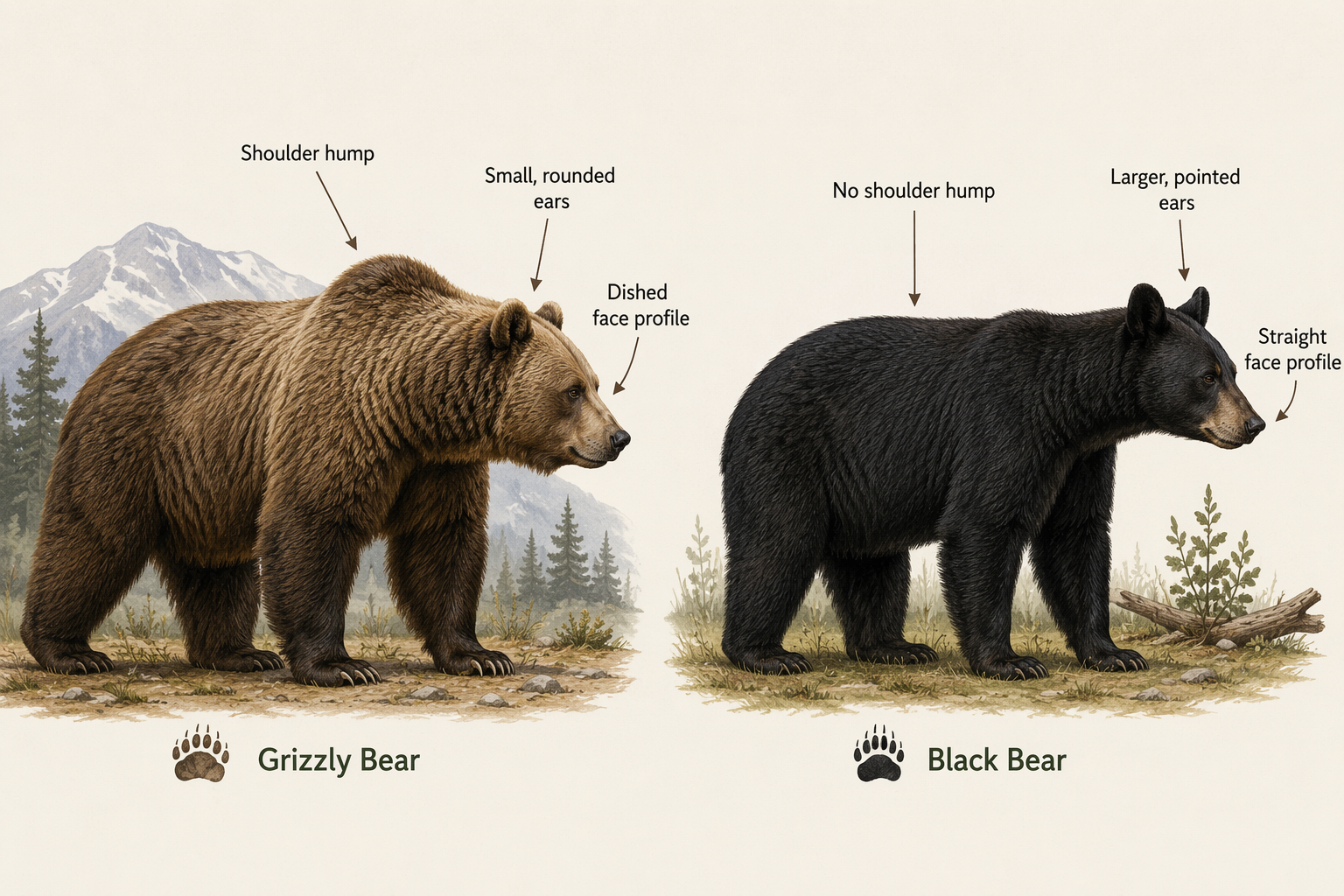
Start with body shape, not color. Black bears can be brown, cinnamon, or blond, and grizzlies are not always the dramatic silver-tipped animal people picture. The quick field checks are the shoulder hump, ear shape, and face profile. National Park Service guidance points hikers to these visible differences rather than coat color alone.[2]
| Feature | Grizzly / Brown Bear | Black Bear |
|---|---|---|
| Shoulders | Prominent shoulder hump | No obvious shoulder hump; back looks flatter |
| Ears | Smaller, rounded ears | Taller, more pointed ears |
| Face | Dished or concave profile | Straighter profile |
| Claws and tracks | Often longer front claws, but hard to judge during an encounter | Often shorter curved claws, but not a first-choice cue under stress |
The mnemonic now has a place to land: “black fight back, brown lie down, white good night.” Its clean rhythm is useful, but it is a last-contact rule, not a whole encounter plan. “Brown lie down” applies to a defensive grizzly or brown bear attack, not to a bear that is treating you as prey. “Black fight back” means that if a black bear attacks, you should resist aggressively; it does not mean you should provoke, crowd, or challenge a black bear that is trying to avoid you. National Park Service and Interagency Grizzly Bear Committee guidance both separate these cases rather than treating the rhyme as complete instruction.[2][3]
Polar bears deserve a brief boundary. The “white good night” line is memorable because polar bear encounters are severe and often require specialized planning, deterrents, and local guidance. For most hikers in the Lower 48, Alaska interior trips, and Canadian mountain parks, the practical decision tree is mainly a black bear and grizzly bear framework. If your route is in polar bear country, this article is not enough.
Second: Read Behavior Before Choosing The Rule
Behavior is where many hikers lose the thread. A bear standing on its hind legs is not automatically about to charge. It may be trying to see or smell better. A bear that huffs, pops its jaws, swats the ground, or bluff charges is communicating something different. A bear that follows quietly and persistently is different again. The Interagency Grizzly Bear Committee’s encounter guidance makes this split explicit: defensive and predatory encounters call for different responses.[3]
| Behavior Pattern | What It May Look Like | What It Means For Your Next Move |
|---|---|---|
| Defensive | Huffing, jaw popping, swatting ground, bluff charging, guarding cubs or food | Give space, speak calmly, prepare spray, and do not appear like a new threat |
| Curious or assessing | Standing, looking, moving to get your scent, circling at a distance | Stay calm, group up, talk in a low voice, and back away without running |
| Predatory | Silent approach, persistent following, focused stalking, no obvious defensive trigger | Do not play dead; stand your ground, use spray if possible, and fight if attacked |
The defensive bear is usually trying to remove a threat. That does not make it safe; it makes your job specific. You want to become less threatening while staying ready. Stop. Keep your group together. Speak in a calm, firm voice so the bear can identify you as human. Back away slowly if the bear is not closing. Get bear spray into your hand before the distance is desperate.
The curious bear is not a cartoon villain and not a pet. If it stands, sniffs, circles, or looks uncertain, you still do not walk toward it for a better photo, and you do not run. You give it information and distance: voices, grouped bodies, slow retreat, no food reward.
The predatory pattern is the one that makes the simple rhyme dangerous if applied lazily. If a bear, including a grizzly, is stalking, silently following, or continues to approach without defensive signals, playing dead is the wrong lesson. In that case, make yourself look large, stand your ground, deploy spray if you can, and fight back if contact happens. The guidance changes because the bear’s objective has changed.[2][3]
Third: Let Distance Turn Judgment Into Action
Distance is the part that decides whether you are managing an encounter or surviving an attack. It also changes fast. The same 2026 aggregation reports that 59% of bear attacks occur within 100 meters of trails, a useful reminder that “on the trail” is not the same thing as “safely separated.”[1]
If The Bear Has Not Noticed You
Leave quietly. Do not announce yourself just to test a principle. Do not cut between a sow and cubs. Do not move toward the bear for a clearer look. Backtrack, detour, or wait from a safe distance if the route allows it. This is the easiest branch of the tree, which is why it is also the branch people ruin with cameras.
If The Bear Has Noticed You But Is Not Approaching
Group up. Pick up small children. Speak calmly. Keep your pack on. Slowly increase distance without turning your back. If the bear is near your intended route, that route is closed for now. You are not negotiating trail rights with a large animal that has better acceleration than you do.
If The Bear Approaches Or Charges
Do not run. Running can trigger pursuit, and it does not solve the speed problem. Stand your ground enough to use your tools. If you have bear spray, remove the safety clip and be ready before the bear is inside your personal panic radius. If it is a defensive grizzly charge and spray fails or contact happens, fall on your stomach, clasp your hands behind your neck, spread your legs to make rolling harder, and play dead until the bear leaves. If it is a black bear attack, or any predatory attack, fight back with everything available.[2][3]
Bear Spray Belongs Inside The Decision Tree
Bear spray is not a lucky charm in your pack lid. It is a short-range tool that must be carried where your scared hands can reach it. The Interagency Grizzly Bear Committee tells users to remove the safety clip, aim slightly downward toward the charging bear, spray in short bursts, and create a cloud between themselves and the bear.[4]
- Carry it on your body: hip belt, chest holster, or another reachable position, not buried in a backpack.
- Remove the safety clip when deployment becomes likely, not after the bear is already at your boots.
- Aim slightly downward so the spray cloud rises into the bear’s path instead of passing over it.
- Use short bursts when the bear is roughly 30 to 40 feet away, adjusting for movement and wind.
- Think cloud barrier, not precision shot. You are building an irritant wall the bear has to enter.
The numbers support carrying it, with a careful definition. Smith et al.’s 2008 study, summarized from 72 incidents involving 175 people, reported bear spray success rates of 92% for brown bears, 90% for black bears, and 100% for polar bears; “success” meant stopping undesirable bear behavior, such as causing the bear to stop, retreat, or change direction.[5] That is not the same as guaranteeing that every full-contact charge ends harmlessly. It is still a strong reason to carry the tool where it can be used.
It is also a reason not to overrate firearms as the default answer. National Park Service material contrasts bear spray’s strong field record with lower reported firearm effectiveness, including a 70% figure for firearms in the cited comparison.[6] The practical lesson is simple enough: most hikers are more likely to benefit from a defensive cloud they have practiced deploying than from imagining perfect marksmanship under a sudden charge.
Wind matters. Spraying into wind can blow capsaicin back into your own face and turn your tool into a self-inflicted problem. A 2025 Outside.com first-person account is useful here only as a cautionary story: several mistakes compounded, including poor wind awareness during an encounter.[7] One story does not prove what usually happens. It does show why “I own spray” is not the same as “I can deploy spray under field conditions.”
Where Prevention Fits Without Taking Over
Avoiding the encounter is still the better outcome. Hike in groups when possible, make human noise where visibility is poor, store food correctly, keep a clean camp, and do not surprise bears at bends, brushy creeks, or carcass sites. BearWise reports that 83% of bear attacks involved solo hikers or pairs, which does not mean groups are invincible; it means group size is one risk factor worth taking seriously.[8]
Complete beginners who need the basics before the encounter-response framework should start with What Every Student Hiker Should Know About Bear Safety. This article is the next layer: what to do after prevention has not kept distance between you and the animal.
Risk calibration helps, as long as it does not become complacency. World Animal Foundation’s 2026 summary, citing National Park Service figures, lists 8 fatal bear attacks in Yellowstone since 1872 compared with 125 drowning deaths.[9] That comparison does not make bear encounters trivial. It means the goal is competence, not panic theater.
Rehearse The Sequence Before The Trailhead
The decision tree is short enough to practice out loud: species, behavior, distance, action. Grizzly with defensive signals at close range: spray, and if contact happens, play dead. Black bear attack: fight back. Any bear stalking or persistently following: do not play dead. Bear far enough away and not approaching: group up, speak calmly, and back away. Bear spray: reachable, safety off when needed, aim low, short bursts, cloud barrier.
No single rule is safe enough by itself. A small set of trained distinctions works better: identify the bear, read what it is doing, respect the distance, and keep spray where your hand can find it in ten seconds. Run that sequence before the trailhead, when your brain is still available.
References
- Bear Attack Statistics 2026, Gitnux, 2026.
- Staying Safe Around Bears, National Park Service.
- Encounter Behavior & Myths, Interagency Grizzly Bear Committee.
- Bear Spray Guidelines, Interagency Grizzly Bear Committee.
- Bear spray, Wikipedia.
- Bear Attacks, National Park Service.
- I Encountered a Bear. I Made Every Mistake Possible., Outside.com, 2025.
- Bear Encounters, BearWise.
- Bear Attacks Statistics 2026, World Animal Foundation, 2026.
Comments
Join the discussion with an anonymous comment.