
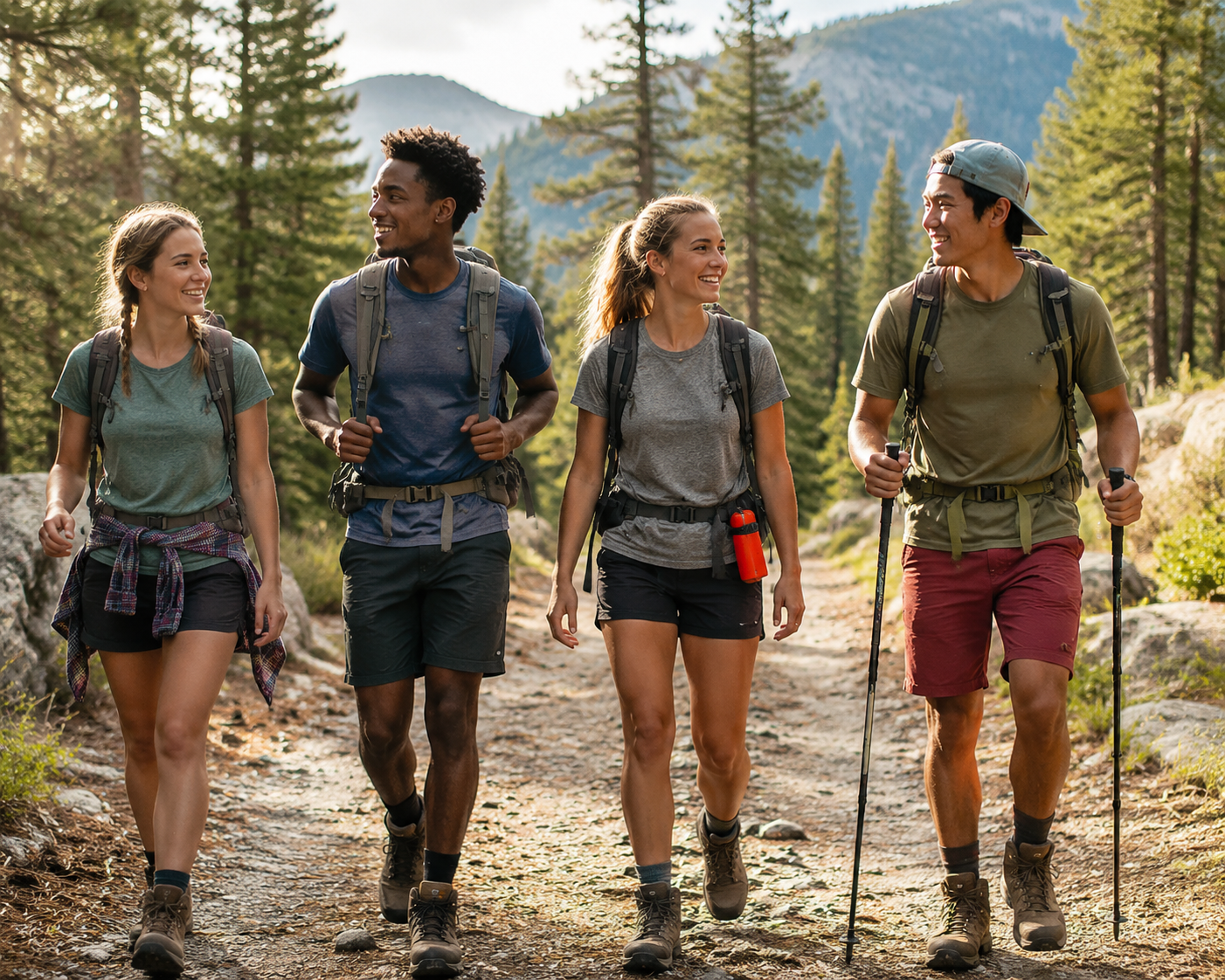
What Every Student Hiker Should Know About Bear Safety
Bear attacks are extremely rare, and most risks can be eliminated with four simple, low-cost habits. This guide explains how student hikers can stay safe in bear country without expensive gear.
Updated:
If you are a student planning a weekend hike in bear country, the first answer is the calming one: you should take bears seriously, but you do not need to treat the trip like a survival movie. The National Park Service puts the chance of being injured by a bear at about 1 in 2.1 million, and BearVault’s compiled attack history lists roughly 180 fatal bear attacks across North America from 1784 to the present.[1][2]
That does not mean “ignore bears.” It means the useful question is not how to feel about bears. It is what a student group can actually do before leaving campus, without buying half an outdoor store. The four habits that matter most are simple: hike in a group of four or more, carry bear spray where someone can reach it, keep food away from tents, and make enough noise that you do not surprise an animal at close range.
Rare risk is not the same as random risk
The most common student mistake is picking one of two bad interpretations. One student reads a dramatic attack story and decides every trail is dangerous. Another hears that attacks are rare and treats every bear-safety rule as optional. Neither reaction helps the trip leader who has to load people into a van on Friday afternoon.
The practical middle ground is this: bear injury is extraordinarily uncommon, and the situations that create problems are often predictable. BearWise summarizes the two big patterns as surprise encounters at close range and bears being attracted by unsecured food.[7] Those are not personality traits in the bear. They are planning failures on the human side often enough that a club can build habits around them.
| Before the trip | What the group actually does | Cost |
|---|---|---|
| Choose the group | Plan for four or more people who stay together on trail | Free |
| Decide on spray | Bring bear spray and make sure at least one person can deploy it quickly | Usually $40–60 |
| Pack food | Seal scented items and keep them away from tents according to local rules | Low to moderate, depending on the park |
| Walk the trail | Talk, call out, and avoid surprising bears around blind corners or noisy water | Free |
Start with the group size, because it changes the whole trip
A lot of student hikes quietly become two- or three-person trips because that is who was free, who had a car, or who answered the group chat. In bear country, that is worth rethinking before anyone argues about tents or snacks.
Bear biologist Tom Smith told Backpacker that he knew of no documented case of a bear making physical contact with a group of four or more people who stayed together.[3] That is an expert assessment from an interview, not a peer-reviewed rule of nature. Still, it is useful because it points to a decision students can control for free: do not split a small group into smaller pieces.
The “stayed together” part matters. Four people on the sign-up sheet are not the same as four people walking within earshot. If one fast hiker pushes ahead, two people stop for photos, and one person lags behind with a sore ankle, the group has functionally turned into several smaller parties. That is exactly the kind of sloppy trip math that looks harmless in a parking lot and becomes a problem on trail.
For a campus club, the cleanest rule is boring and effective: assign a front person and a sweep, regroup at every junction, and make it normal to slow down before the group stretches out. Nobody needs to perform wilderness confidence. They need to keep the group intact.
Bear spray is worth budgeting for, but do not oversell what the numbers mean
Bear spray is where student hesitation is most understandable. A canister can cost $40–60, and that feels expensive if someone is already borrowing boots, splitting gas, and trying not to spend textbook money on a weekend trip. The Interagency Grizzly Bear Committee says bear spray generally has an EPA shelf life of 3–4 years, which makes it more reasonable as shared club gear than as a one-time personal purchase.[9]
The evidence is strong enough to justify carrying it, but it needs to be stated carefully. In a peer-reviewed study of 133 bear-spray incidents in Alaska, Smith and colleagues found that bear spray stopped undesirable bear behavior in 92% of incidents, with only three minor human injuries reported.[4] REI’s bear-country guidance cites a 98% figure for people who used bear spray and escaped uninjured.[5] That is an injury outcome, not a magic shield.
The distinction matters because “98% effective” gets repeated online as if it means a charging bear always stops. Outside’s review of bear-spray evidence describes a narrower reading: in 14 close encounters with aggressive brown bears, spray succeeded 85% of the time; in 9 brown bear charges specifically, spray stopped the charge 33% of the time, although no protracted mauling occurred in those cases.[6] That is still a good reason to carry spray. It is not a reason to hike carelessly because a can is clipped to someone’s belt.
The student-club version of the rule is simple: buy or borrow real bear spray where it is legal, check the expiration date, keep it reachable, and make sure the person carrying it has read the directions before the trailhead. Spray buried in a backpack is more like a receipt than a safety tool.
- Carry it on a hip belt, chest strap, or other spot reachable with one hand.
- Do not test-spray it casually around other students, tents, cars, or food.
- Confirm local rules before travel, especially if crossing borders or using public transportation.
- Treat one shared canister as the minimum for a small group, not as permission for people to scatter.
Food storage is not glamorous, which is why it gets skipped
Food mistakes on student trips are rarely dramatic. They are usually a granola bar in a hoodie pocket, a half-open trail mix bag in a tent vestibule, a scented lip balm left in someone’s daypack, or a group that assumes “we are only camping one night” changes what a bear can smell. It does not.
Because BearWise identifies unsecured food as one of the major reasons bears and people come into conflict, food storage deserves the same seriousness as route planning.[7] The exact method depends on the land manager. Some places require bear canisters. Some provide metal food lockers. Some allow specific hanging methods, and some do not because the local bears have learned the usual tricks.
A low-budget group should not improvise this at the campsite. Check the park or forest rule before leaving campus, then assign one person to be annoying about food. That person’s job is not to be outdoorsy. It is to make sure everything scented goes where the rule says it goes before people get tired and start making exceptions.
- Pack all food, trash, cooking oil, toothpaste, deodorant, and scented toiletries as bear-attractants.
- Keep food storage separate from sleeping areas, following the local distance or container rule.
- Do the food check before dark, not after everyone is cold and half asleep.
- Never reward a bear with student leftovers, even accidentally.
Make noise like a normal group, not like a myth
Making noise does not need folklore attached to it. The point is to reduce surprise encounters, especially where visibility is poor: brushy trail, blind corners, windy ridgelines, or loud creek crossings. A group of students talking at a normal volume often does part of the work already.
Where the trail gets tight or loud, call out before moving through. Do not rely on headphones, a speaker, or one person occasionally remembering to clap. The habit is more useful when everyone understands the reason: a bear that knows people are coming has a better chance to move away before anyone is close.
Dogs change the plan
Students like bringing dogs because it makes a hike feel easier to organize and more fun to post about. In bear country, a dog is not just another group member. University of Calgary research found that half of 92 studied bear attacks in North America involved a dog.[8] That does not mean every dog creates a bear encounter, but it is enough to change the decision.
If dogs are allowed at all, keep them leashed and under control. If the park discourages dogs in a particular area, listen. A dog that runs ahead, startles wildlife, and then bolts back toward its people has just made the group’s problem bigger. For a student club, the simplest policy may be no dogs on bear-country trips unless the local rules and the trip leader both clearly allow it.
Check the local rules before copying advice from somewhere else
Bear safety is not perfectly universal. The National Park Service notes that recommendations can vary by park because bear behavior and local conditions vary.[1] Advice written for black bear country in one region may not fit grizzly habitat somewhere else. Food-storage rules, bear-spray rules, trail closures, dog policies, and campsite requirements can all change by land manager.
This is where the campus safety lead earns their mildly unpopular authority. Before the trip, someone needs to read the current park page, not a five-year-old forum thread. If a rule says canisters are required, rent or borrow canisters. If bear spray is recommended, make the group budget for it. If dogs are restricted, do not negotiate with the rule in the parking lot.
Student hikers do not need to be fearless, rich, or heavily outfitted to make bear risk very small. They need enough discipline to stay together, carry the one piece of safety gear that actually matters, store food correctly, make themselves known on trail, and follow the local rules even when those rules are boring.
References
- Staying Safe Around Bears, National Park Service
- Bear Attack Statistics by Species, BearVault
- 9 Bear Safety Tips From a Bear Biologist, Backpacker Magazine
- Efficacy of Bear Deterrent Spray in Alaska
- Backpacking in Bear Country, REI Expert Advice
- Does Bear Spray Work?, Outside Online
- Bear Safety Tips: Hiking, Camping, Fishing & Outdoors, BearWise
- Half of bear attacks involve dogs, study finds, University of Calgary
- Bear Spray, Interagency Grizzly Bear Committee
Comments
Join the discussion with an anonymous comment.