

What the Antikythera Mechanism Was Built For
This explainer breaks down what the Antikythera mechanism was built to do — predict eclipses, track the Moon and planets, and schedule Olympic Games — and why its precision gear-work rewrites what we thought ancient Greeks could build.
Updated:
Sponge divers found the Antikythera mechanism in 1901 in a Roman-era shipwreck near the Greek island of Antikythera, mixed in with bronze statues and other luxury cargo. At first, one of the most important scientific objects ever recovered from the ancient world looked like a ruined lump of bronze. Only later, especially after X-ray work in the 1950s, did researchers see the nested gears inside it.[1]
That contrast matters. The object does not look impressive until you know what it was meant to do. The plain answer is this: the Antikythera mechanism was a hand-powered analog computer for showing and predicting astronomical and calendar cycles. For students, the easiest place to start is the hand crank. Turning it moved a set of bronze gears that displayed where the Sun, Moon, and known planets were in their cycles, when eclipses might happen, how the lunar calendar lined up, and when major Greek athletic festivals were due.[2]
It was probably built by Greek engineers sometime around 200–100 BCE. The surviving device fit into a wooden case about 34 cm by 18 cm by 9 cm, roughly shoebox-sized, with bronze dials on the front and back and a crank on the side. At least 30 bronze gears survive. A 2021 reconstruction from University College London proposed a complete system of 69 gears, but that larger number belongs to a reconstruction, not to the surviving fragments themselves.[1][3]
What Turning the Crank Told You
Imagine a box on a table. You turn a handle. Pointers move across engraved scales. The machine is not doing arithmetic the way a laptop does; it is letting gear ratios stand in for repeating cycles in the sky. A small gear turning a larger gear, or one gear driving another at a particular rate, can model a cycle just as a clock models hours and minutes.
The useful question is not “Was it mysterious?” The useful question is “What could a person read from it?”
| Part of the display | What the user could learn |
|---|---|
| Front dial | The positions of the Sun and Moon against calendar and zodiac scales |
| Moon display | The Moon’s phase and its uneven motion through the sky |
| Planetary display | The cycles of Mercury, Venus, Mars, Jupiter, and Saturn as understood in Greek astronomy |
| Back spiral dials | Longer calendar and eclipse cycles |
| Saros and Exeligmos dials | Possible solar and lunar eclipses, with timing corrections |
| Festival dial | The four-year cycle of Panhellenic games, including Olympia and other festivals |
That is the heart of the machine. It was a scheduler for the sky and for society: not a telescope, not a planetarium in the modern sense, and not a digital computer, but a physical model that turned cycles into readable motion.
The Front Face: Sun, Moon, Calendar, and Planets
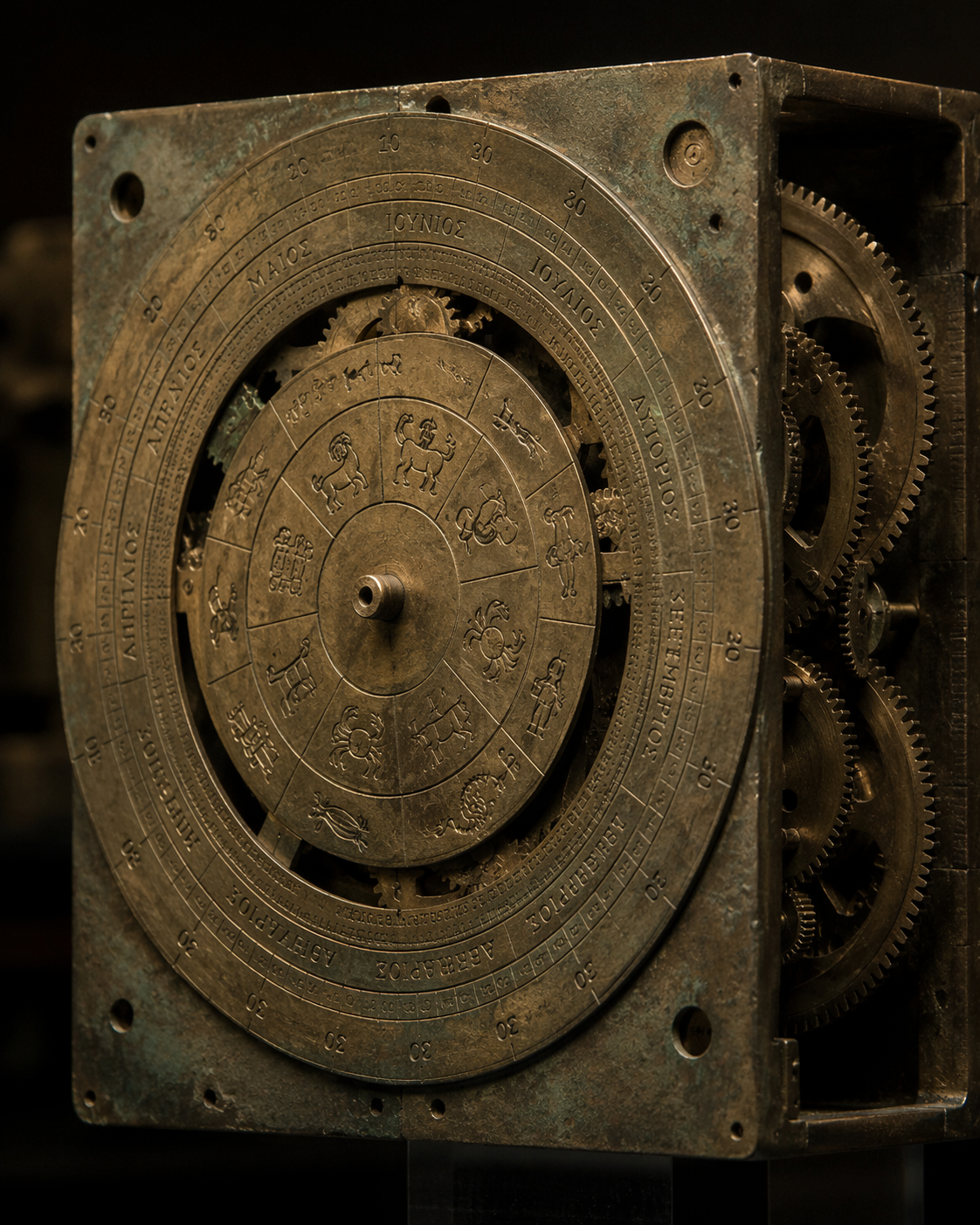
The front face was the most direct part to read. It showed the Sun and Moon moving around circular scales, including a zodiac scale and a calendar scale. To a student, this is easiest to picture as an ancient version of a classroom demonstration model: set the date by turning the crank, then watch the pointers show where the heavenly bodies should be in their cycles.
The Moon display was especially clever because the Moon does not move at a perfectly steady apparent speed. Its orbit is elliptical, so it appears to speed up and slow down. The Antikythera mechanism used a pin-and-slot epicyclic gear arrangement to imitate that uneven motion. Research summarized by World History Encyclopedia reports that this lunar model tracked the Moon’s sidereal month to within 0.0006 days of the modern value of 27.321661 days.[2]
That number is tiny, so it needs translating. A sidereal month is the Moon’s cycle measured against the background stars. An error of 0.0006 days is less than a minute. The point is not that an ancient user carried a stopwatch. The point is that the gear ratios were chosen with enough care to model a messy natural motion, not just a simple circle.
The front display also appears to have included the five planets known to ancient Greek astronomy: Mercury, Venus, Mars, Jupiter, and Saturn. The 2021 UCL reconstruction proposed a ring-based “Cosmos” display with marker beads for the planets, and it used inscriptions and surviving gear evidence to model how the planetary cycles may have been shown. Some details of that reconstruction remain hypothetical, but the inscriptions make clear that planetary cycles belonged to the machine’s design problem.[3]
This is where the device stops being “just an eclipse predictor.” It brought together several different sky cycles in one box. A person did not need to recalculate the system from scratch each time. The mechanism stored the relationships mechanically.
The Back Dials: Eclipses You Could Look Up in Advance
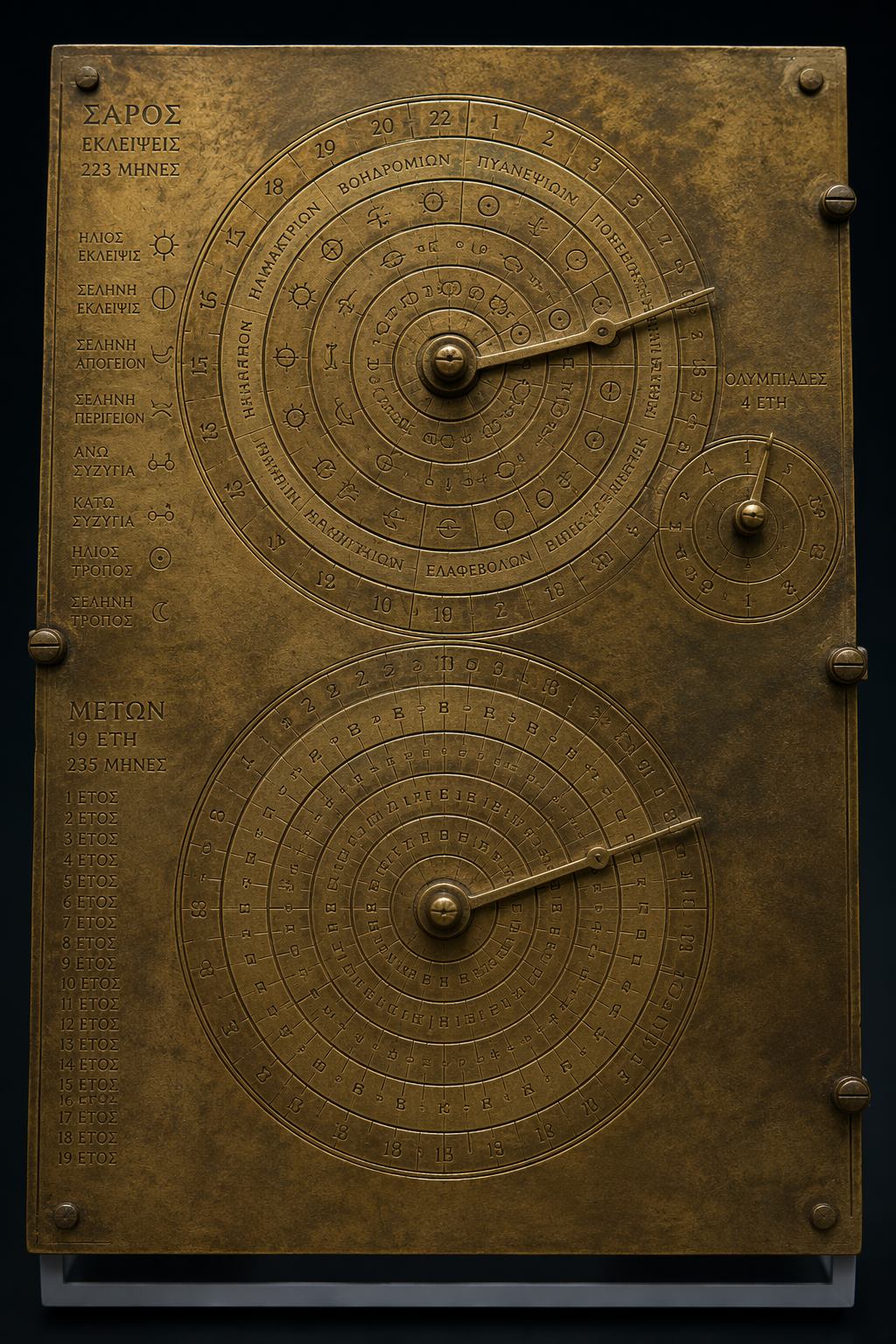
The back of the mechanism carried the part students usually find easiest to respect once it is explained: eclipse prediction. Eclipses look sudden if you are only watching the sky night by night. But they follow cycles, and the Antikythera mechanism turned those cycles into a readable dial.
One of the key back dials was the Saros dial. The Saros cycle is an eclipse cycle; after one Saros, the Sun, Moon, and Earth return to nearly the same eclipse-producing arrangement. The mechanism’s Saros dial included glyphs predicting 38 lunar eclipses and 27 solar eclipses, with information such as month, day, hour, and eclipse type. A smaller Exeligmos dial supplied an 8-hour or 16-hour correction because a Saros cycle does not bring the eclipse back at exactly the same time of day.[1][4]
This is a good place to slow down. The device was not causing eclipses, and it was not magically “seeing” the future. It was using a cycle discovered from observation. If a known pattern repeats, a geared machine can represent that repetition. Turn the crank to a future date, and the pointer lands near a glyph telling you that an eclipse is expected.
For a classroom comparison, think of a paper calendar that marks full moons. The calendar does not know anything; its printed pattern encodes knowledge. The Antikythera mechanism did something similar, but instead of a printed grid, it used gear motion and engraved dials. That is why calling it an analog computer is fair. The changing physical positions of its parts represented changing astronomical values.
The Calendar Was Lunar, Not Just a Civil Date Tracker
For more than a century, researchers often treated one ring on the mechanism as if it had represented a 365-day solar calendar. A 2024 analysis by Joseph Bayley and Graham Woan at the University of Glasgow changed that interpretation. Using Bayesian methods associated with gravitational-wave astronomy, they concluded that the calendar ring had 354 or 355 holes, matching a Greek lunar year rather than a 365-day solar year.[5]
The same study estimated the hole spacing precision at about 0.028 mm.[5] Again, that number is not decoration. If holes around a ring are uneven, a pointer attached to that ring will drift. A spacing error smaller than the thickness of a sheet of paper shows that whoever made the ring was not casually decorating bronze. They were laying out a measurement system.
That lunar-calendar finding sharpens the purpose of the whole object. The mechanism was not only matching sky positions to a generic date. It was coordinating cycles that mattered in Greek life: lunar months, astronomical events, and public festivals.
The Games Dial Put Human Events on the Same Machine
One small dial tracked a four-year cycle of Panhellenic festivals. These included Olympia, but not only Olympia: the cycle also marked Isthmia, Nemea, Pythia, Naa, and Halieia. The pointer for this festival dial is described as the only anticlockwise-moving pointer on the device.[1][2]
That detail is easy to treat as trivia, but it changes the feel of the object. The Antikythera mechanism was not an astronomer’s toy sealed off from ordinary timekeeping. It connected the sky to schedules people cared about. If a family, official, teacher, or traveler needed to understand where they were in a major cycle of events, the mechanism could put that civic rhythm beside lunar and solar rhythms.
How Gears Became a Model of the Sky
The Antikythera mechanism worked because gears can preserve ratios. If one gear has twice as many teeth as another, the two gears turn at related speeds. Stack enough carefully chosen ratios together, and a single crank can drive several cycles at once: one for the Sun, one for the Moon, one for an eclipse cycle, another for a calendar cycle.
This is the difference between a clever diagram and a machine. A diagram can show that two cycles are related. A geared mechanism makes the relationship move. The operator supplies only one input — turning the crank — and the internal gear train distributes that motion through the system.
The surviving teeth are small and triangular, with spacing on the order of about 1.6 mm. Combined with the 2024 estimate of 0.028 mm precision in the calendar-ring holes, the workmanship gives students something concrete to picture: bronze parts cut and arranged finely enough that a box could carry several astronomical cycles at once.[5][6]
The most sophisticated surviving example is still the Moon model. The pin-and-slot arrangement did not merely slow one wheel down. It created a varying motion, a mechanical imitation of the Moon’s uneven apparent speed. That makes the device more than a set of rotating calendar hands. It is a model of a theory about how the heavens move.
What We Know, What We Reconstruct, and What We Do Not Know
The surviving fragments do not give us a complete, working device. That is why careful language matters. Researchers have physical fragments, inscriptions, gear teeth, dial remains, and X-ray CT data. They also have reconstructions that try to make those pieces fit into a working whole.
The 2021 UCL model is important because it offered a complete front-display solution, including the planetary rings and a proposed 69-gear system. But parts of that model, including some details of the planetary display, remain reconstructed rather than directly preserved. A good reconstruction is not a guess tossed into the air; it is an argument constrained by evidence. Still, it should not be described as if every missing gear had been found.[3]
The builder is uncertain too. Archimedes, Hipparchus, and Posidonius are often mentioned because their work or locations connect plausibly to Greek mathematical astronomy and mechanical traditions. But no inscription on the surviving mechanism says that any one of them built this particular object.[2]
There is also a newer debate about how well the machine would have worked in practice. A 2025 digital simulation by Szigety and Arenas suggested that the hand-cut triangular gears might have jammed after about four months of simulated cranking, raising the possibility that the mechanism was more of a display or teaching model than a heavily used daily instrument. Other scholars, including Voulgaris and Edmunds, have disputed the conclusion, arguing that corrosion and deformation make exact gear-performance measurements unreliable.[6]
That debate is worth knowing, but it does not erase the mechanism’s purpose. A jam-prone reconstruction would change how we imagine its day-to-day use. It would not change the fact that the gearing, dials, and inscriptions were designed to calculate and display astronomical and calendar cycles.
Why Historians Had to Take It Seriously
The Antikythera mechanism forced historians to widen their picture of ancient Greek engineering. It showed that Greek makers could build compact, precise gear trains for mathematical astronomy more than two thousand years ago. Britannica describes it as the oldest known analog computer, and no comparable mechanism of such complexity is known from the ancient world.[4]
The surprise is partly the gap. Mechanical complexity at this level is not known again in Europe until medieval astronomical clocks, often placed in the 14th century. That does not mean every workshop in ancient Greece had machines like this. It means at least one tradition of high-level geared astronomical engineering existed, and the surviving evidence is only one damaged object from a shipwreck.[7]
For students, that is the cleanest reason to care. The Antikythera mechanism proves that computation did not begin with electronics. Long before silicon chips, a crank, bronze gears, engraved rings, and careful astronomical observations could turn time into something a person could read from a dial.
References
- Antikythera mechanism - Wikipedia, Wikipedia
- Antikythera Mechanism, World History Encyclopedia
- Nature Scientific Reports (Freeth et al. 2021), Nature Scientific Reports, 2021
- Antikythera mechanism, Britannica
- 2024 calendar ring hole count breakthrough (lunar year), Jerusalem Post, 2024
- How Well Did the Mysterious Antikythera Mechanism Actually Work?, Smithsonian Magazine, 2025
- The Antikythera mechanism: an ancient Greek machine rewriting the history of technology, The Past
Comments
Join the discussion with an anonymous comment.