

Why Brazil Has the Most World Cup Victories
Brazil holds the record for most World Cup titles with five. This article examines the statistical evidence behind that dominance — wins, goals, consistency — and places it in historical context, including the current drought since 2002.
Updated:
Brazil has the most World Cup victories because its record is not resting on the title count alone. The headline number is five championships, one more than Germany and Italy, who have four each. That is the scoreboard answer. The stronger analytical answer is that Brazil also leads, or sits at the extreme end, in the statistics that usually make championships less accidental: wins, goals, goal difference, winning rate, perfect campaigns, and tournament presence across eras.[1]
Through the 2026 World Cup, Brazil has appeared in all 23 tournaments from 1930 through 2026, the only national team with that uninterrupted record. Across those tournaments, Brazil has played 119 matches, won 79 of them, and produced a 66.7% win rate.[1][2] Add 247 goals and a +135 goal difference, and the argument starts to look less like mythology and more like repeated performance over nearly a century.[3]
The Five Titles Are the Result, Not the Whole Explanation
A country can win a tournament with a short peak. It can catch a favorable bracket, survive penalties, ride a hot goalkeeper, or have one generation solve everything for four weeks. That does not describe Brazil's World Cup record very well. Brazil's five titles matter because they sit on top of a broader base: it has won more World Cup matches than any other nation, scored more World Cup goals than any other nation, and owns the best goal difference in the competition's historical record.[1][3]
| Measure | Brazil's World Cup Record | Why It Matters |
|---|---|---|
| Titles | 5 | Most championships in men's World Cup history |
| Closest title rivals | Germany and Italy, 4 each | Shows Brazil's lead at the top of the trophy table |
| Matches won | 79 wins in 119 matches | Shows repeat success beyond finals alone |
| Win rate | 66.7% | Shows efficiency across a large sample of tournament matches |
| Goals | 247 | Shows sustained attacking output |
| Goal difference | +135 | Shows Brazil has not merely won often, but often won by outscoring opponents substantially |
| Tournament appearances | 23 of 23 from 1930 through 2026 | Shows unmatched continuity across every World Cup era |
The title comparison is still the cleanest entry point. Five beats four. But if the question is why Brazil has the most World Cup victories, stopping there is like explaining a student's final grade by pointing only to the transcript. The title count is the visible outcome. The surrounding numbers show the habits that made the outcome more likely.
Brazil Kept Creating the Conditions That Produce Titles
The most persuasive part of Brazil's case is not any single statistic. It is the way the statistics point in the same direction. A team with the most wins might be defensively efficient but not especially explosive. A team with the most goals might be entertaining but inconsistent. A team with a great goal difference might have one or two unusually dominant tournaments. Brazil's record combines all of those indicators across the full history of the World Cup.
The 79 wins are the first layer. World Cups are short tournaments, so a national team does not get many chances to repair a bad week. Winning 79 of 119 matches means Brazil was not just a famous finalist; it repeatedly handled the earlier and middle stages that remove most teams from the tournament.[1] That matters because titles are not won only in finals. They are built through group-stage control, knockout survival, and the ability to avoid the kind of ordinary loss that ends a campaign before it becomes legendary.
The goals column adds another layer. Brazil's 247 goals are not a decorative statistic; they measure how often Brazil converted tournament presence into scoreboard pressure.[3] A high goal total over so many tournaments suggests that Brazil's dominance was not based only on narrow avoidance of defeat. It repeatedly generated enough attacking output to make long runs plausible.
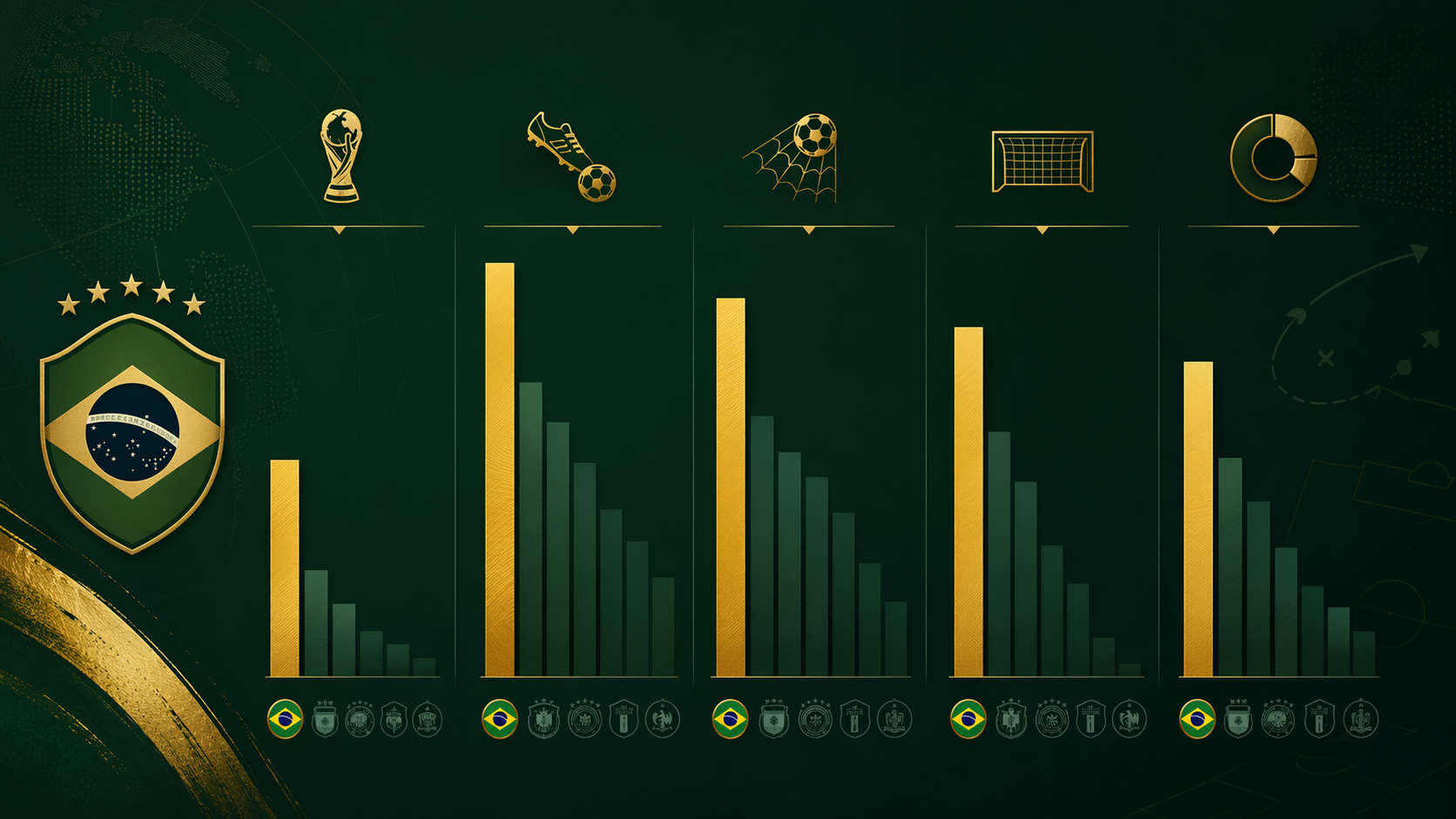
Goal difference is where the argument becomes harder to dismiss as just accumulated appearances. Brazil's +135 World Cup goal difference means its scoring advantage has been large across the full record.[3] That does not mean every Brazilian tournament was dominant, and it does not erase famous defeats. It means that, over time, the surplus of goals for over goals against has been bigger than anyone else's. In a tournament decided by small margins, that long-run surplus is a serious clue.
Then there is the win rate. A 66.7% winning rate across 119 matches is high enough to matter because the sample is not tiny.[1][2] World Cup matches are not friendlies against handpicked opponents. They are played against teams that survived qualification, often under knockout pressure, often with tactical caution increasing as the tournament advances. Winning two-thirds of those matches across decades is not a perfect measure of quality, but it is a strong one.
The Rare Perfect Campaigns Show Peak Quality Without Explaining Everything
Brazil also owns a cleaner peak-performance fact: its 1970 and 2002 title runs are the only perfect winning campaigns in World Cup history, meaning Brazil won every match it played in those tournaments.[2] That is the kind of detail that deserves attention because it is both concrete and rare. It is not a mood, a reputation, or a highlight reel. It is a tournament-by-tournament result.
The temptation is to let those two teams carry the whole explanation. The 1970 side is easy to romanticize because of Pelé and the enduring image of Brazilian attacking football. The 2002 side has its own obvious focal points, especially Ronaldo's return to the top of the sport. But perfect campaigns explain Brazil's highest peaks, not the full record. A country does not reach five titles and the top of the all-time wins, goals, and goal-difference tables through two tournaments alone.
The 2002 win also connects to another measurable stretch: Brazil put together an 11-match World Cup winning streak from 2002 to 2006.[2] That is useful evidence because it crosses the boundary between one title tournament and the next cycle. It suggests that Brazil's advantage was not only a four-week spike in form, even if that streak eventually ended like all streaks do.
Showing Up Every Time Changes the Math
Brazil's appearance record is easy to treat as trivia, but it is central to the question. The team has played in every World Cup from 1930 through 2026, all 23 editions.[1] That does two things at once. It gives Brazil more opportunities to win, and it proves that the program kept clearing the first competitive hurdle: reaching the tournament at all.
More appearances alone would be a weak explanation if Brazil had merely accumulated matches without elite results. That is not what the record shows. The appearance streak matters because it is paired with the leading totals in wins, goals, and goal difference. Presence created opportunity; performance converted enough of that opportunity into trophies.
This is where broad cultural explanations need to be handled carefully. Brazil's football identity, player production, and famous attacking style are not imaginary. They are part of why the team became symbolically larger than most national teams. But as an answer to why Brazil has the most World Cup victories, culture is too loose unless it shows up in results. The measurable part is that Brazil kept qualifying, kept winning matches, kept scoring, and kept building large goal advantages across eras.
The 2002–2026 Drought Keeps the Claim Historical
The strongest version of the Brazil argument also has to admit its biggest complication: Brazil has not won the World Cup since 2002. After the 2026 tournament, that remains the longest title drought in the country's World Cup history.[1] A data-driven explanation should not hide that, because it changes what the record can and cannot prove.
Brazil's five-title lead proves historical supremacy in the competition's full record. It does not prove current supremacy in 2026. Those are different claims. The first is supported by the all-time table: five titles, 79 wins, 247 goals, +135 goal difference, a 66.7% win rate, and participation in every tournament.[1][2][3] The second would require recent-tournament dominance, and the post-2002 record does not allow that conclusion.
That distinction matters because World Cup analysis often slides between eras too easily. A team can have the best cumulative record and still not be the team most likely to win the next tournament. Brazil's historical margin remains real because no other country has yet passed its title total or matched the full statistical profile behind it. But the gap no longer feels inevitable in the present, especially after six completed tournaments without a Brazilian title from 2006 through 2026.
So Why Does Brazil Have the Most World Cup Victories?
The best answer is that Brazil combined peak excellence with long-run consistency. The five titles are supported by the all-time performance columns around them: most wins, most goals, best goal difference, a high winning percentage, two perfect winning title campaigns, an 11-match winning streak, and the only perfect attendance record across every World Cup through 2026.[1][2][3]
None of those numbers alone explains Brazil. Together, they make the title record look less like a cluster of famous moments and more like the output of repeated competitive advantage. Brazil did not simply win five finals. It kept reaching the tournament, kept winning the matches before the final, kept scoring at a historic rate, and kept ending tournaments with a larger cumulative goal surplus than anyone else.
The drought since 2002 keeps the conclusion honest. Brazil's World Cup record is the strongest historical case, not a guarantee of present dominance. That is still enough to answer the question: Brazil has the most World Cup victories because, across the full history of the tournament, its championship total is backed by the deepest statistical record in the competition.
References
- Brazil at the FIFA World Cup, Wikipedia
- Five Stars: Brazil's FIFA World Cup Wins, Opta Analyst, November 17, 2022
- FIFA World Cup Records, Britannica
Comments
Join the discussion with an anonymous comment.