
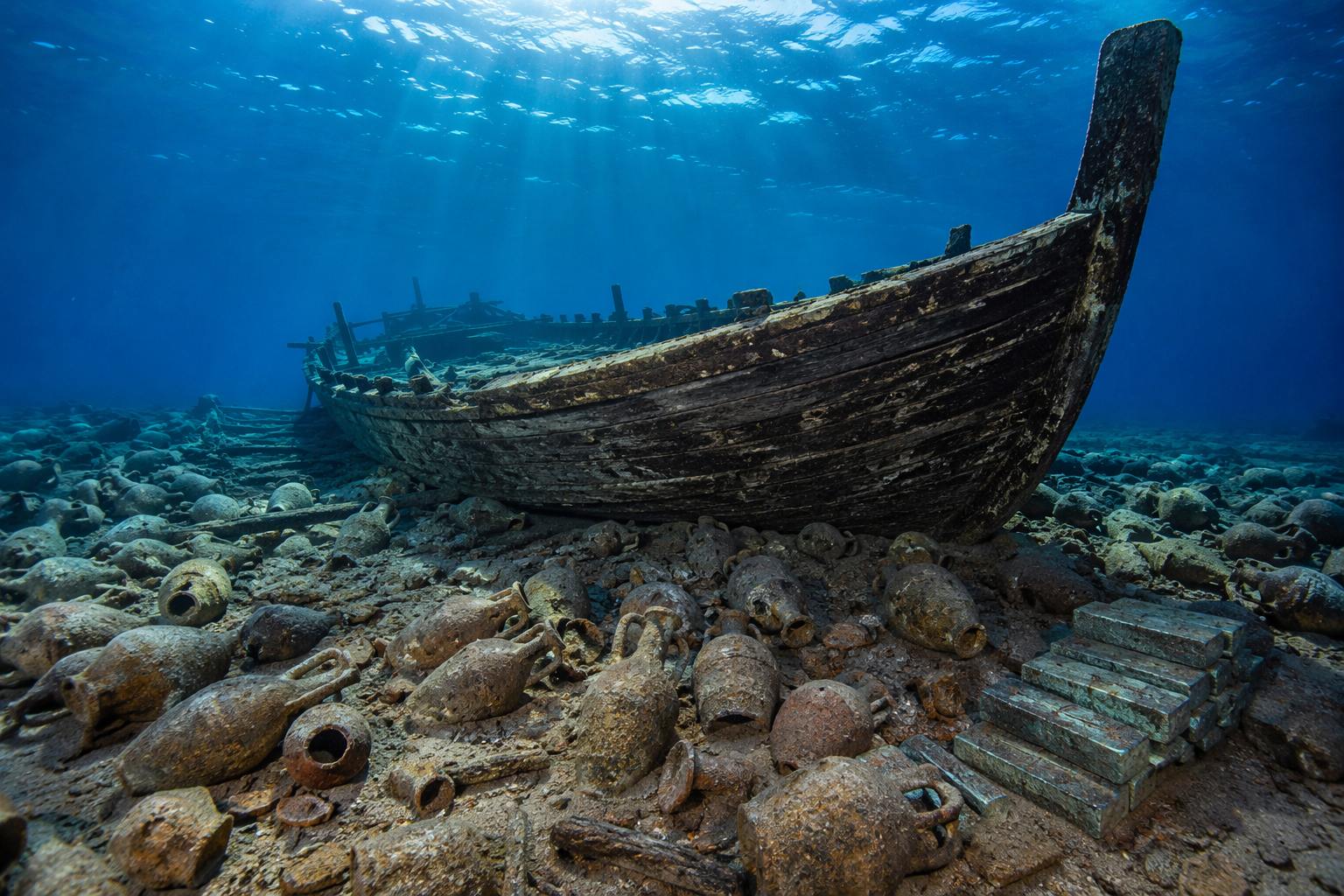
A Guide to Major Ancient Shipwreck Discoveries
The most significant ancient shipwreck discoveries, from the 8,000-year-old Pesse Canoe to the 2026 Byzantine wrecks off Turkey, reveal how each accidental time capsule reshaped scholarly understanding of ancient trade routes, seafaring, and technology — providing exam-ready insights for history and archaeology students.
Updated:
The oldest place to begin a guide to ancient shipwreck archaeological discoveries is not a wreck in the dramatic sense. It is the Pesse Canoe, a dugout boat usually dated to around 8000 BCE, and often described as the world’s oldest known boat.[1] That matters because it fixes the starting point of maritime history in worked wood, not in later myths about heroic voyages or tidy textbook maps. Before cargoes, anchors, amphorae, or naval battles, there was already the basic problem of shaping a hull that could move people across water.
A shipwreck is useful evidence because it usually preserves a single interrupted event. A port can accumulate centuries of rebuilding; a text can smooth over practical details; a wreck often keeps the cargo, hull, tools, and damage in the same archaeological frame. That does not make every wreck easy to interpret. Dates can be approximate, cargo can be displaced, and early identifications can change after conservation or later survey. But when the evidence is good, a wreck can force a more exact answer than a land site can.
From Boat To Trade Network
The Pesse Canoe gives students the earliest technological baseline: humans were making watercraft long before the Mediterranean shipwrecks that dominate ancient history courses. Its importance is modest but firm. It does not prove long-distance trade, naval organization, or open-sea navigation. It proves that water travel itself belongs very early in the human technical record.
The Uluburun shipwreck, discovered off Turkey in 1982 and dated to about 1320 BCE, changes the scale completely.[1] Here the evidence is not only a hull or a single object, but a cargo list turned into archaeology: copper and tin ingots, luxury goods, raw materials, and objects linked to at least seven cultural zones, including Cyprus, Turkey, Afghanistan, Africa, Italy, Canaan, and Egypt.[1]
The famous detail is the 10:1 ratio of copper to tin ingots, matching the standard bronze-making proportion.[1] That is the kind of number worth remembering because it is not decorative. It ties the wreck directly to production, metallurgy, and demand. The ship was not merely carrying exotic things; it was carrying the ingredients of a Bronze Age economy.
Uluburun also corrected an older habit of placing Mycenaean Greeks too comfortably at the center of Late Bronze Age Mediterranean exchange. The cargo pointed instead toward Syro-Canaanite or Phoenician traders as major actors in this network.[1] For an exam answer, that is the important move: the wreck does not just illustrate trade; it changes who appears to be organizing it.
The gold ring bearing Queen Nefertiti’s cartouche often attracts attention, but the more useful point is the whole assemblage.[1] A single prestigious object can travel as a gift, heirloom, or stolen item. A mixed cargo of metals, raw materials, and manufactured goods is stronger evidence for a connected exchange system. Uluburun lets students argue from pattern, not from one spectacular artifact.
The Deep-Sea Canaanite Wreck And The Sight-Of-Land Assumption
The 3,300-year-old Canaanite shipwreck reported in 2024 is important for a different reason: location. It was found about 55 miles off the coast of Israel at a depth of roughly 1.8 kilometers, spotted by an energy company’s remotely operated vehicle during a routine gas pipeline survey.[2][3] Those numbers are the argument. They place the ship far beyond the comfortable model in which Bronze Age sailors hugged the coastline and kept land in view.
Israel Antiquities Authority archaeologist Jacob Sharvit described the site plainly: “From this geographical point, only the horizon is visible all around.”[3] If the identification and dating continue to hold, the wreck is evidence for open-water navigation by celestial cues in the Late Bronze Age, not just cautious coastal hopping.[2][3]
This is where a student should be careful with language. The wreck does not prove that every Bronze Age voyage used open-ocean routes. It does show that at least some sailors could operate far from land, and that the older assumption was too narrow. That is a significant correction because navigation range affects how historians reconstruct trade routes, risk, scheduling, and maritime knowledge.
It also shows why discovery method matters. This was not a diver stumbling across amphorae in shallow water; it was a deep-sea find made by industrial survey equipment.[2][3] The depth helped preserve a site that ordinary ancient-history narratives had no reason to imagine. In that sense, the wreck is both ancient evidence and a reminder that modern search technology changes the archive historians can use.
Dor Lagoon After The Bronze Age Collapse
The Iron Age wrecks in Israel’s Dor Lagoon refine the story after the Late Bronze Age collapse. Three wrecks dated between the 11th and 7th centuries BCE were identified there, and they are described as the first Iron Age shipwrecks ever found in the region.[4] The point is not that Dor was the only port still active. The narrower, better-supported claim is that Dor remained a busy trade hub when many eastern Mediterranean ports had declined after about 1200 BCE.[4]
That matters because collapse narratives can become too clean. Land sites often show destruction, abandonment, or political reorganization. Shipwrecks can catch what continued: local exchange, coastal movement, and the smaller circuits that survived after palace economies weakened. Dor Lagoon does not erase the collapse; it complicates the map students draw after it.
Hull Evidence: The Black Sea Greek Ship And Kyrenia
Cargo explains exchange, but hulls explain how that exchange was physically possible. The 2,400-year-old Greek ship found in the Black Sea in 2018 is especially valuable because it is described as the oldest intact hull ever found, preserved by the Black Sea’s anoxic conditions.[5] An intact hull is a rare kind of evidence. It lets archaeologists study construction choices that are usually destroyed by worms, oxygen, waves, or salvage.
The preservation is the main discovery. Ancient shipbuilding is often reconstructed from fragments, iconography, and later parallels. A whole hull lets researchers test those reconstructions against the actual arrangement of wood, fastenings, shape, and design. For students, this is a reminder that “ship” is not a generic container for cargo. The vessel itself is technology.
The Kyrenia ship, discovered in 1965, serves a related but slightly different role. A full-scale seaworthy replica showed that ancient ships could be faster and more seaworthy than earlier models had suggested.[1] That is not as sweeping a revision as Uluburun or the deep-sea Canaanite wreck, but it is a useful correction to underestimating ancient performance. Experimental reconstruction turned a preserved ship into a testable sailing hypothesis.
War At Sea: The Aegates Rams
The Battle of the Aegates Islands in 241 BCE ended the First Punic War, but the underwater evidence matters because it gives physical confirmation and correction rather than just another retelling. Archaeologists have recovered 26 bronze warship rams from the battle site.[1] These are not symbolic objects; they were weapons fitted to the bows of warships and used in close naval combat.
The inscriptions on some rams named Roman officials, adding information about the Republic’s military bureaucracy.[1] That is the exam-worthy detail. The wreckage confirms ancient accounts of a major naval battle, but it also supplies administrative evidence that written narratives may not emphasize. A battlefield at sea can preserve paperwork’s metal equivalent.
The Antikythera Mechanism Was Cargo, Not A Footnote
The Antikythera shipwreck, found in 1901, is famous because of one object recovered from it: a shoebox-sized bronze geared astronomical computer dated to about 60 BCE.[1] The mechanism calculated positions of the sun, moon, and five planets, predicted eclipses, and tracked Olympic cycles.[1] Its importance is not that ancient people were “surprisingly smart,” a phrase that usually says more about modern expectations than ancient evidence. Its importance is mechanical specificity.

The device shows a level of geared technological sophistication not seen again until 14th-century European astronomical clocks.[1] That comparison is easy to misuse if it becomes a claim that the ancient world was on the verge of modern machinery. The better claim is sharper: at least one Hellenistic or Roman-era technical tradition could produce complex predictive gearing, and without the wreck, that tradition would be much harder to see.
This is one of the clearest examples of a shipwreck preserving technological ambition that land-based evidence had not made obvious enough. The sea did not preserve an abstract “level of civilization.” It preserved gears, inscriptions, and a transport context. That is better evidence.
Byzantine Wrecks Off The Datça Peninsula
The three Byzantine wrecks known as Knidos F, L, and N move the guide into the 10th to 13th centuries CE. Studied off Turkey’s Datça Peninsula in 2026, they were documented with the ROV Nautilus using non-invasive digital methods.[6] That method is not a side note. When a site is fragile, deep, or not ready for full excavation, high-resolution documentation can preserve information without immediately disturbing the wreck.
The earlier wrecks carried Günsenin Type I amphorae, a form associated with widespread Byzantine commerce.[6] Knidos N, dated to the 13th century, carried a previously unknown amphora type and has been interpreted as reflecting a maritime world increasingly shaped by Venice and Genoa.[6] The strongest conclusion is not that one wreck proves a complete transfer of Mediterranean power. It is that amphora forms, cargo patterns, and wreck dates provide material evidence for changing commercial systems in the later Byzantine world.
These finds are useful because they connect a broad historical process to ordinary containers. Political histories can describe crusades, treaties, dynastic pressure, or Italian maritime expansion. Amphorae show what moved, in what kinds of vessels, along which sea lanes, and during which centuries. The evidence is less glamorous than a palace inscription, but for trade history it can be more direct.
What To Remember For Essays And Exams
| Discovery | Best-supported student takeaway |
|---|---|
| Pesse Canoe | Early watercraft technology belongs deep in prehistory, before complex Mediterranean trade systems. |
| Uluburun shipwreck | Late Bronze Age trade was highly interconnected and involved Syro-Canaanite or Phoenician traders, not only Mycenaean Greeks. |
| Deep-sea Canaanite wreck | At least some Bronze Age sailors operated far from land, probably using celestial navigation. |
| Dor Lagoon wrecks | Some eastern Mediterranean trade hubs remained active after the Late Bronze Age collapse. |
| Black Sea Greek ship | Exceptional hull preservation can transform the study of ancient shipbuilding. |
| Kyrenia ship | Replica testing can correct assumptions about ancient ship speed and seaworthiness. |
| Aegates rams | Naval wreckage can confirm ancient accounts while adding administrative and military detail. |
| Antikythera mechanism | Shipwreck cargo can preserve complex technology otherwise poorly represented in the archaeological record. |
| Knidos Byzantine wrecks | Amphora types and wreck contexts help trace changes in late antique and medieval maritime commerce. |
The safest way to write about these discoveries is to ask what each wreck preserves that a land site or text would probably miss. Uluburun preserves a working cargo system. The deep-sea Canaanite wreck preserves navigational range. Dor Lagoon preserves continuity after disruption. The Black Sea ship preserves a hull. Aegates preserves naval hardware and official names. Antikythera preserves mechanical knowledge. Knidos preserves commercial change in ceramic form.
That is why ancient shipwrecks matter as historical evidence. They are not just dramatic underwater discoveries. They are compressed archaeological contexts in which trade networks, shipbuilding knowledge, daily life, warfare, and technological ambition can appear together. A good exam answer should not say simply that shipwrecks are “time capsules.” It should show what the capsule contained, how securely it is dated, and which older assumption it forces historians to revise.
References
- 32 haunting shipwrecks from the ancient world, LiveScience
- World's Oldest Deep-Sea Shipwreck Discovered a Mile Beneath the Mediterranean Sea, Smithsonian Magazine
- Newly discovered 3,300-year-old shipwreck 'changes the understanding' of sailing in ancient world, CNN
- Dor Lagoon Iron Age shipwrecks, January/February 2026 issue, Archaeology Magazine
- Ancient Shipwrecks of the Black Sea, National Geographic Education
- Three Byzantine shipwrecks found off Turkey reveal centuries of Mediterranean trade, Archaeology Magazine, 2026
Comments
Join the discussion with an anonymous comment.