
NCAA Eligibility Rules for Student-Athletes in 2026
A complete overview of NCAA eligibility requirements for high school student-athletes, covering academic minimums by division, the new age-based 5-year rule, and the most common mistakes that can derail eligibility.
Updated:
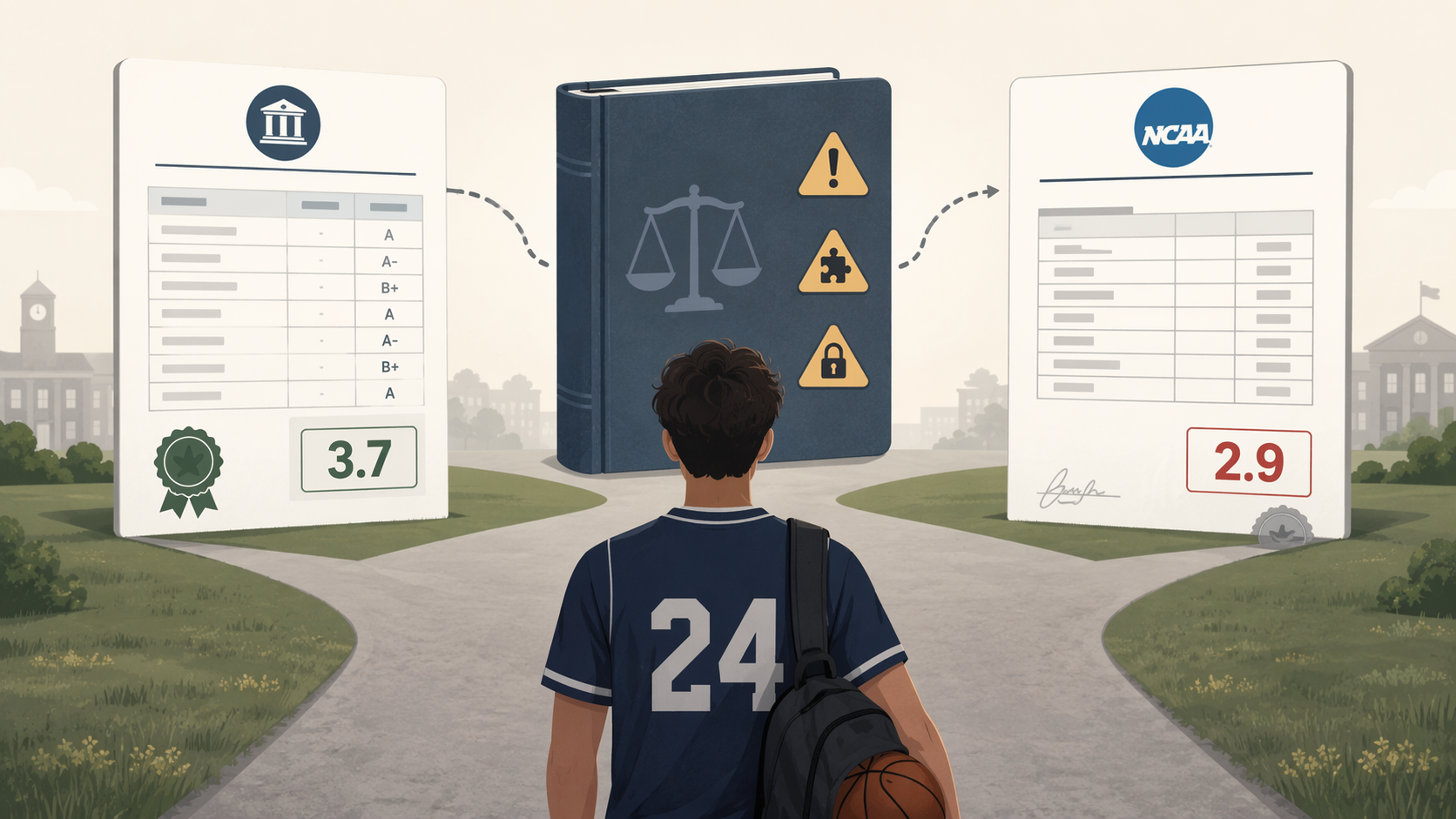
A strong high school transcript can still fail an NCAA eligibility check. That is the part families tend to learn late: the NCAA does not simply accept the GPA printed at the bottom of the school report card, and it does not treat every class on the transcript as equally useful for initial eligibility.
For a student-athlete trying to compete at an NCAA school, the first job is not to look recruited. It is to be certifiable. In 2026, understanding NCAA eligibility rules for student athletes means watching three places where otherwise prepared students can lose ground: the NCAA core GPA calculation, the Division I 10/7 rule, and the new age-based eligibility clock approved for Division I.
The GPA issue is not cosmetic. The NCAA recalculates GPA using only approved core courses on an unweighted 4.0 scale, stripping out electives, physical education, many career courses, and weighted bumps from honors or AP grading systems. One worked example shows a student with a 3.7 school GPA landing at a 2.9 NCAA core GPA after that recalculation.[1] That student may still qualify, depending on division and course pattern. The danger is that the family thought the 3.7 was the number that mattered.
The second trap is more rigid. For Division I, 10 of the 16 required core courses must be completed before the start of senior year, and 7 of those 10 must be in English, math, or natural/physical science. Once senior year begins, those 10 grades are locked for the 10/7 rule; domestic students cannot go back, retake one of those courses, and use the higher grade to fix that specific requirement.[2]
The third trap is new enough that families should treat casual summaries with caution. On June 23, 2026, Division I approved an age-based eligibility model. It gives student-athletes up to five years of eligibility within a single five-year clock that begins at the earlier of full-time enrollment or the academic year after the student’s 19th birthday. Full implementation begins in fall 2027, with transition treatment for fall 2026 enrollees using whichever rule is more favorable.[3] That is a planning rule, not a promise that every athlete gets five full seasons.
The Eligibility Center Is Checking A Different Transcript
The official checkpoint for initial eligibility is the NCAA Eligibility Center, the current name for what many families still call the NCAA Clearinghouse. A college coach can encourage a student, a high school coach can be confident, and a school counselor can send a transcript, but the certification still runs through the Eligibility Center.
For Division I and Division II, the academic review begins with 16 core courses. Those courses must come from approved academic areas, such as English, math, natural or physical science, social science, foreign language, comparative religion, or philosophy. The exact course list is not universal. Each high school has its own NCAA-approved course list, which means a course title that counts at one school may not count at another.
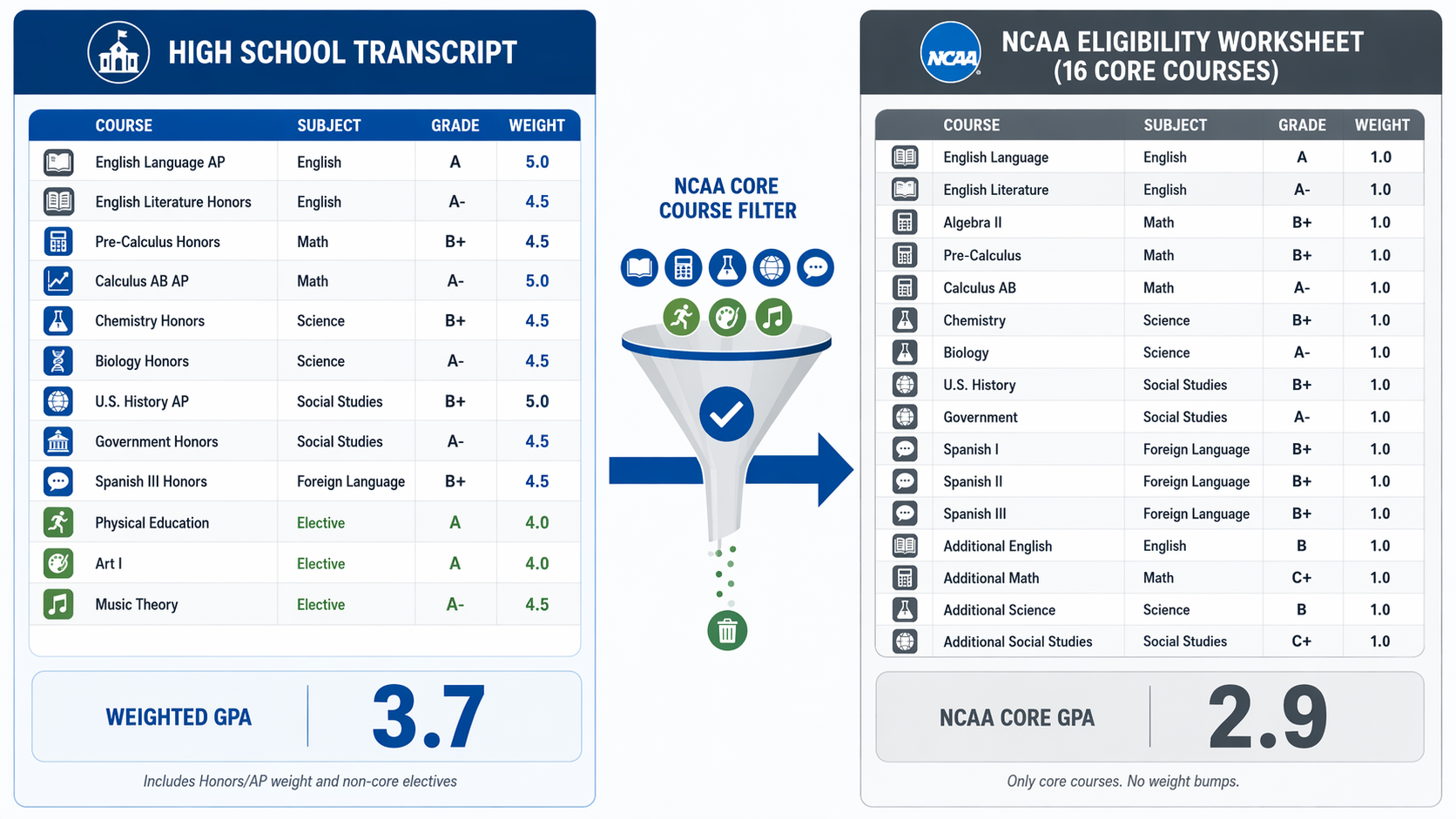
That one detail explains many spring-semester surprises. A student may have taken a demanding class, earned a good grade, and still receive no NCAA core-course credit if the course is not on that high school’s approved list. Difficulty is not the same thing as approval. A weighted GPA is not the same thing as an NCAA core GPA. A graduation requirement is not automatically an NCAA requirement.
The SAT and ACT no longer rescue or sink the academic calculation the way older recruiting advice sometimes suggests. As of January 2023, test scores are no longer part of the NCAA initial eligibility calculation, replacing the old sliding-scale model.[4] Test scores may still matter for college admission, scholarships, placement, or institutional requirements, but they are not part of the NCAA’s initial eligibility formula.
Division I: The Most Demanding Initial Eligibility Path
Division I receives the most attention here because it has the tightest combination of academic minimums, timing rules, and the new age-based model. To be a Division I qualifier, a student-athlete must complete 16 NCAA-approved core courses and earn at least a 2.3 core GPA.[5] The number is simple; getting the correct courses into the calculation is the harder part.
| Division I academic checkpoint | What the family must verify |
|---|---|
| 16 core courses | Courses must appear on the student’s own high school NCAA-approved course list |
| 2.3 minimum core GPA | Calculated only from approved core courses on an unweighted 4.0 scale |
| 10/7 rule | 10 core courses before senior year, including 7 in English, math, or natural/physical science |
| Final certification | Official transcript and amateurism certification through the NCAA Eligibility Center |
The 10/7 rule deserves its own attention because it punishes late discovery. If a junior finishes the year with only nine approved core courses, the problem is not solved by loading senior year with academic classes. Senior-year courses can help reach the total of 16, but they cannot create the 10 courses that had to be completed before the seventh semester.
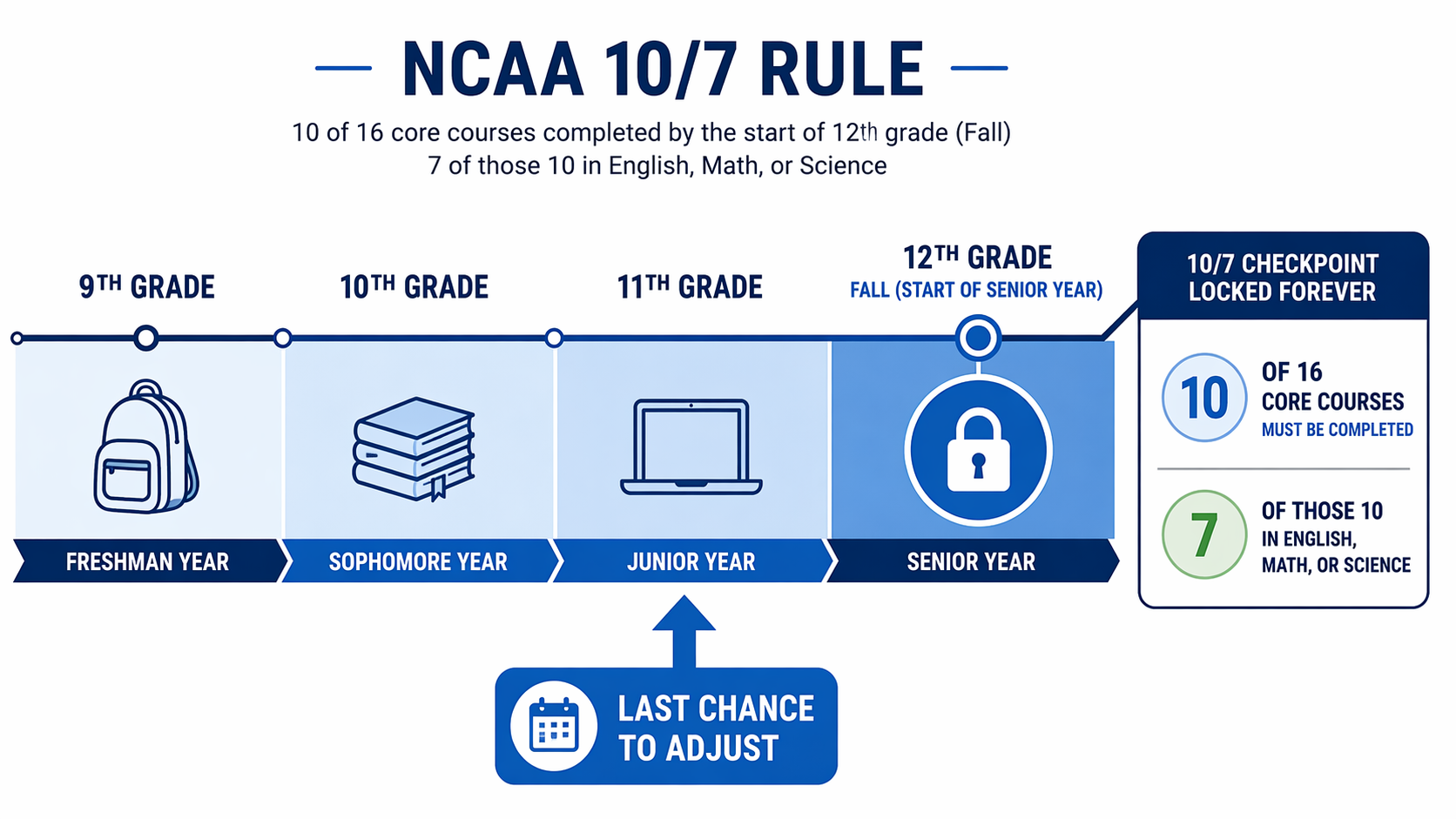
The grade lock is the part that families often miss. If one of the first 10 core courses is a low grade, a domestic student generally cannot retake it after senior year starts and use the improved grade for the 10/7 requirement.[2] That is why junior year is not merely a good time to check the transcript. It is the last practical time to fix some Division I problems before they become permanent.
International students, including Canadian students, are not covered by the 10/7 rule in the same way, and the rule does not apply to Division II or Division III. That boundary matters. Families should not borrow a Division II checklist for a Division I recruit, or panic over a Division I-only rule when the student’s realistic pathway is elsewhere.
Division II And Division III Are Different, Not Easier In The Same Way
Division II also requires 16 NCAA-approved core courses, but the minimum core GPA is 2.2, and the Division I 10/7 rule does not apply.[5] That gives families more room to repair course sequencing during senior year, but it does not remove the need to confirm approved courses or calculate the NCAA core GPA correctly.
Division III works differently. The NCAA does not set a division-wide academic minimum for Division III initial eligibility; individual schools set and apply their own admission and eligibility standards.[5] A student who wants Division III should still take the academic side seriously, but the question becomes institutional admission and school policy rather than a single NCAA core GPA threshold.
Amateurism remains a separate required checkpoint. Student-athletes must certify amateurism status through the Eligibility Center, and the review can involve issues such as pay, prize money, agents, professional teams, and certain benefits tied to athletic ability.[6] It should not be treated as an afterthought saved for the week a coach asks for final paperwork.
The New Division I Age-Based Clock, Current As Of July 2026
The age-based rule is the newest piece of the eligibility picture, and it should be read carefully because procedural details are still being added. Division I adopted the model on June 23, 2026, with full implementation scheduled for fall 2027. The NCAA has said the Eligibility Center plans to add age-based rule information to student accounts in early August 2026.[3]
Under the model, a Division I student-athlete has a five-year clock that starts at the earlier of two points: full-time collegiate enrollment or the academic year after the athlete turns 19. The rule also narrows waivers, with exceptions identified for pregnancy, active military service, and religious missions.[3]
The old shorthand that a college athlete has five years to play four seasons is no longer the right planning language for new Division I cases under this model. Some explainers describe the change as five seasons within a five-year clock, but the NCAA’s own framing is more cautious: the model does not guarantee five years for every student-athlete, especially for those who delay enrollment.[3][7]
For a traditional high school graduate who enrolls full time soon after graduation, the age-based rule may feel mostly procedural. For a student considering a gap year, delayed enrollment, post-graduate year, club competition after high school, missionary service, military service, or a later start, the rule belongs in the planning conversation before the decision is made, not after a roster spot appears.
What To Check By Grade Level
“Start early” is only useful if it means something concrete. The NCAA process is easiest when families treat eligibility as a transcript audit that begins before the transcript is already crowded with irreversible choices.
| School year | Eligibility work that should happen |
|---|---|
| Freshman year | Choose courses with the high school’s NCAA-approved core course list open, not just the graduation plan |
| Sophomore year | Create an NCAA Eligibility Center account and begin matching completed courses to NCAA core areas |
| Junior year | Upload or send transcripts as required, confirm core GPA, count approved courses, and fix D1 10/7 issues before senior year |
| Senior year | Complete the remaining core courses, request final certification, send final official transcripts, and complete amateurism certification |
This sequence matches the practical registration timeline recommended by recruiting and eligibility guidance: planning course selection in ninth grade, creating the Eligibility Center account in sophomore year, using junior year to confirm transcripts and core courses, and finalizing eligibility in senior year.[8]
Homeschooled student-athletes need the same seriousness about documentation, with additional attention to how courses, credits, grading, and proof of completion will be presented. If a family is still choosing a program, a broader homeschool curriculum comparison can help frame the academic decision, but NCAA approval and documentation have to be checked directly against NCAA requirements, not assumed from curriculum quality.
The Mistakes That Derail Otherwise Qualified Students
The national funnel is already narrow. Of roughly 8 million high school athletes, about 560,000 compete at NCAA schools, or around 7%, and less than 2% go on to professional sports.[9] But the most frustrating eligibility losses are not about national odds. They are the preventable ones, where the student did enough work but the record does not certify cleanly.
- Trusting the school GPA: weighted grades, electives, PE, arts courses, and non-approved classes may help graduation or class rank without helping NCAA core GPA.
- Assuming a course title is enough: the course must appear on that high school’s NCAA-approved list, not merely sound academic.
- Finding the 10/7 problem in senior year: for Division I domestic students, that is often after the useful repair window has closed.
- Using outdated SAT or ACT advice: test scores no longer determine NCAA initial eligibility, though colleges may still require or value them for other reasons.
- Waiting to create the Eligibility Center account: late registration compresses transcript review, amateurism certification, and final communication into the same stressful window.
- Treating the age-based rule as a rumor: for Division I students delaying enrollment or starting later, the clock can affect planning before college begins.
A clean NCAA plan does not require a family to become a compliance office. It does require them to verify the approved course list, calculate the unweighted core GPA early, respect the Division I 10/7 deadline, register with the Eligibility Center on time, complete amateurism certification, and treat the new age-based clock as a real planning rule while the NCAA continues adding account-level details.
References
- NCAA Eligibility GPA Requirements 2026, MyGrind, link
- What is the NCAA 10/7 Rule?, Honest Game, link
- Division I adopts age-based eligibility model, NCAA.org, June 23, 2026, link
- The NCAA Sliding Scale Is Gone: What Replaced It, Access Pathways, link
- Initial Eligibility Requirements, NCAA.org, link
- NCAA Amateurism Rules Explained, NCSA, link
- What is the NCAA 5-Year Eligibility Rule Change?, IMG Academy, link
- NCAA Eligibility Center Checklist: To-Do List by Grade Level, NCSA, link
- Probability of Competing Beyond High School, NCAA.org, link
Comments
Join the discussion with an anonymous comment.