

How to Study California Uninsured Motorist Law for the Bar Exam
This guide breaks down California's uninsured/underinsured motorist law for bar exam students, covering the statutory framework, key cases, waiver rules, and exam-specific fact patterns to help you answer questions correctly.
Updated:
A California bar question does not usually test uninsured motorist coverage by asking whether UM coverage is a good idea. It tests the one fact that changes the answer: the insured never signed the rejection, the hit-and-run car never touched the claimant’s car, the tortfeasor had the same liability limits as the insured’s UIM limits, the claimant waited too long to demand arbitration. That is why studying California uninsured motorist law has to start with Insurance Code §11580.2, not with ordinary tort instincts.
The exam version of this topic is narrow. You are not learning how to negotiate a claim. You are learning how California reads UM/UIM coverage into an auto policy, how an insurer can remove it, and which statutory switches decide whether the injured insured gets to arbitration at all.
Start With §11580.2, Because the Coverage Is the Default
Insurance Code §11580.2 requires California auto liability policies to include uninsured and underinsured motorist protection unless the named insured rejects that protection in writing. The statutory language is the center of the doctrine: UM/UIM coverage is not something the insured must prove was affirmatively added first; it is treated as part of the policy unless validly removed. [1]
For exam purposes, that default matters more than the policy declaration page. If the question says the policy is silent, or the insurer cannot produce a valid rejection, do not assume the absence of a printed UM line ends the issue. Daun v. USAA is the clean case move: California treats the required UM coverage as implied in law when the statute applies. [2]
That is the first answer-changing habit: ask whether the statute puts coverage into the policy before you ask whether the insured bought it as an optional add-on.
The Waiver Question Is Usually the Trap
A valid rejection must be explicit and written. Broad statements that the insured “declined optional coverage,” or forms that do not clearly identify the protection being rejected, are dangerous facts for the insurer. Smith v. State Farm is useful because it makes the written-rejection requirement exam-visible: the waiver has to do the statutory job, not merely suggest that the insured generally wanted a cheaper policy. [2]
Hartman v. Progressive adds the consequence students often miss. A defective waiver does not automatically end all factual inquiry in the insured’s favor, but it can create a rebuttable presumption of coverage. [2] That distinction is worth keeping. On a multiple-choice question, “coverage automatically wins no matter what” may overstate the rule; “defective rejection creates a presumption the insurer must overcome” is safer.
Use the waiver fact pattern this way: an insured had a policy with stated UM limits, later signed something the insurer calls a rejection, and then after an accident argues the waiver was defective. The exam is not inviting you to talk about consumer expectations. It is asking whether the rejection was explicit, written, and statutorily adequate. If not, the policy may carry UM/UIM coverage by operation of law, with the Hartman presumption doing the work.
| Exam fact | Move |
|---|---|
| No written rejection appears | Treat UM/UIM as included unless another valid statutory basis removes it. |
| Insured signed a vague or incomplete form | Test the waiver against the explicit written rejection requirement. |
| Insurer argues the insured wanted lower premiums | Do not substitute intent for statutory waiver formalities. |
| Defective waiver is shown | Remember rebuttable presumption, not necessarily an irrebuttable automatic win. |
UM and UIM Are Not Two Labels for the Same Accident
This is where students who understand tort liability still lose points. UM and UIM both concern an at-fault driver who cannot fully pay, but §11580.2 treats them differently. UM asks whether the responsible motorist is legally uninsured for the statutory category. UIM asks whether the responsible motorist has insurance, but not enough compared with the insured’s own underinsured motorist limits. [1]
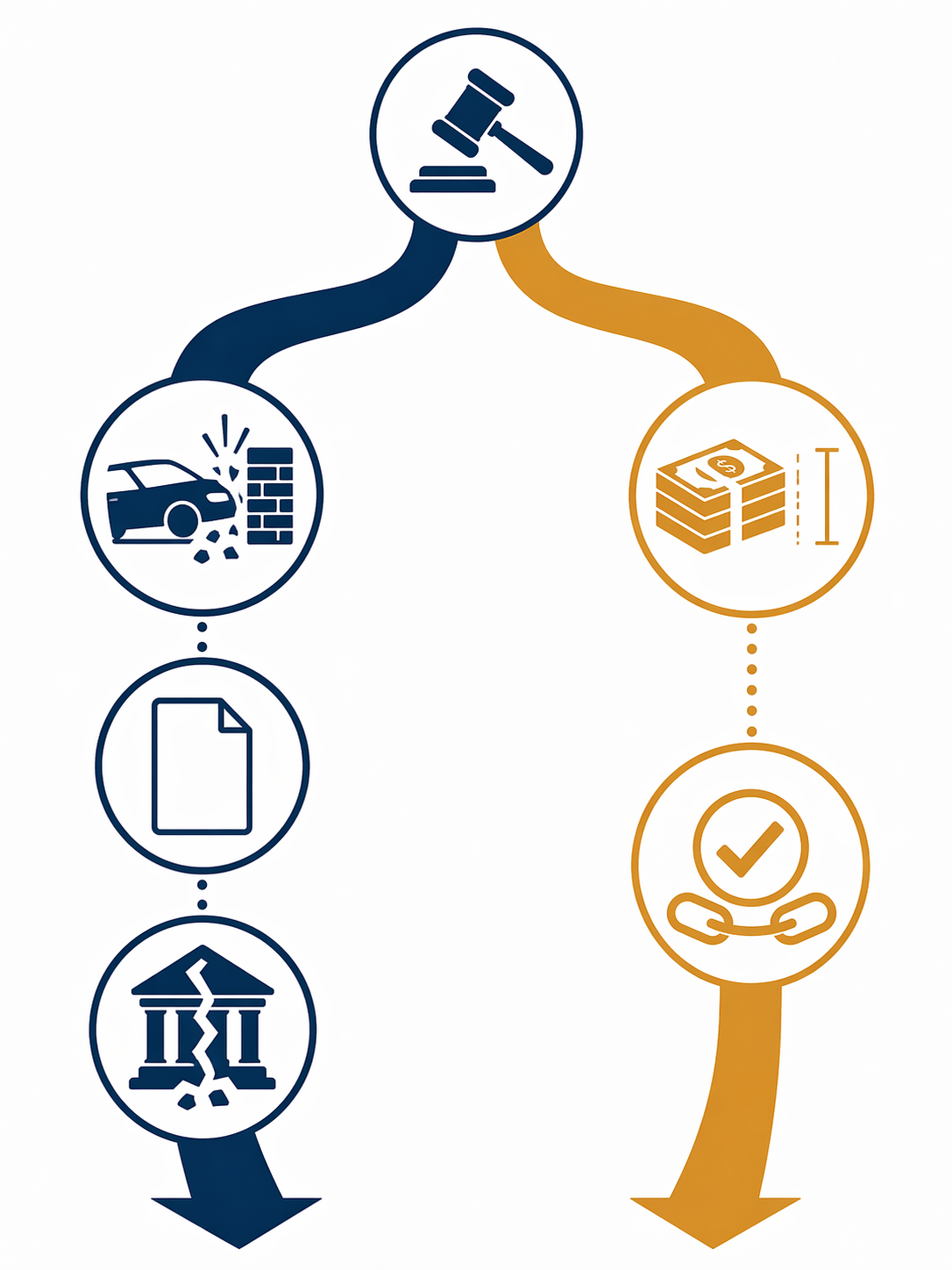
UM: no usable liability coverage on the other side
Uninsured motorist coverage covers categories such as a hit-and-run vehicle, a vehicle with no applicable liability policy, or a situation where the at-fault driver’s insurer is insolvent. For hit-and-run claims, California requires physical contact with the unknown vehicle under §11580.2(b)(2). [1][2]
So take the classic bar fact: a driver swerves to avoid an unidentified car, crashes, and the unidentified car leaves. If there is no physical contact, the absence of the other driver is not enough by itself. The physical-contact requirement is the switch. It is easy to think causation should be enough because that is how the torts part of your brain wants to answer. For UM hit-and-run coverage, the statute asks for more.
UIM: the tortfeasor has insurance, but the limits are too low
Underinsured motorist coverage is not triggered just because the injured insured’s damages exceed the tortfeasor’s liability coverage. The comparison is between the at-fault driver’s liability limits and the insured’s UIM limits. If the at-fault driver’s limits are not lower than the insured’s UIM limits, the driver is not underinsured for that coverage analysis. [2][3]
Now use the limits fact pattern. The insured has $15,000 in UM/UIM coverage, and the at-fault driver also has $15,000 in liability coverage. Even if the insured’s injuries are worth more than $15,000, the tortfeasor is not underinsured under the limits-comparison test because the at-fault limits are not lower than the insured’s UIM limits. The exam is testing the comparison of policies, not the size of the medical bills.
There is also an exhaustion requirement. Before pursuing UIM benefits, the insured must exhaust the at-fault driver’s liability limits. Section 11580.2(p)(4) supplies that sequencing rule, and bar questions like to bury it after several paragraphs of liability facts. [1][4]
| Question | UM answer path | UIM answer path |
|---|---|---|
| Does the at-fault driver have no applicable liability policy? | Likely UM issue. | Not the main UIM question. |
| Is it a hit-and-run? | Check physical contact. | Not UIM unless an identified insured driver exists with inadequate limits. |
| Does the at-fault driver have liability insurance? | Usually not UM on that fact alone. | Compare at-fault liability limits with insured’s UIM limits. |
| Have the at-fault limits been paid or otherwise exhausted? | Not the basic UM trigger. | Required before UIM pursuit. |
Covered Persons: Do Not Stop at the Named Insured
Coverage can extend beyond the person whose name appears on the declarations page. Exam-relevant covered persons include the named insured, resident relatives, and people occupying an insured vehicle. Daun is associated with resident-relative coverage, while Atlantic Mutual v. Ruiz is used for occupants of an insured vehicle. [2][3]
The move is simple: before denying coverage because the injured person did not personally buy the policy, identify the person’s relationship to the named insured or to the insured vehicle. A passenger fact is not filler. A household-residence fact is not filler. Those facts can decide whether the claimant is inside the statutory coverage class.
Current Limits Matter, but Only After You Know What They Are Doing
Older outlines can be quietly harmful here. California’s minimum auto liability limits changed for policies in 2025 and later: the former 15/30/5 baseline increased to 30/60/15, with a scheduled increase to 50/100/25 by 2035. [5][6] A question dated 2026 should not be answered with pre-2025 minimums unless the facts tell you an older policy period controls.
Do not let the numbers take over the doctrine. Minimum limits matter when the question asks you to classify coverage, compare limits, or calculate the available layer. They do not replace the threshold steps: valid waiver, UM category, UIM limits comparison, exhaustion, and timing.
Arbitration and Limitations Change the Procedural Instinct
UM/UIM disputes under §11580.2 are subject to arbitration. The arbitration award is generally binding unless it exceeds the policy limits. [1][2] That means a question asking whether the insured may simply proceed to a court trial is not testing ordinary civil procedure in isolation; it is testing the statutory arbitration route.
The limitations rule is just as exam-worthy. UM claims have a two-year limitations period under §11580.2(i)(1). The insured can satisfy that period by filing suit or by sending a formal arbitration demand. [1][2] That second path is the one students miss because it does not feel like the usual tort statute-of-limitations answer.
For UIM, the two-year period is tied to exhaustion of the tortfeasor’s liability limits rather than simply the accident date. [2] So if the facts give you a payment date from the at-fault insurer, do not ignore it. The exam may be handing you the trigger.
Anti-Stacking Is a Short Rule With a Long Consequence
California’s anti-stacking rule appears in §11580.2(q). UM/UIM coverage generally cannot be stacked across multiple policies unless the policy expressly allows stacking. [1][2] In the multiple-policy fact pattern, do not add the limits first and reason backward. First ask whether the statute and policy permit stacking at all.
That matters when one insured owns several vehicles or several policies. The existence of more than one premium does not automatically create a larger combined UM/UIM pool. If the facts do not give express stacking language, the safer exam answer is that stacking is barred.
A Compact Attack Method for Bar Questions
When a UM/UIM question appears, read it once for the accident and a second time for the statutory switches. The second read is where the points are.
- Find the policy and ask whether §11580.2 implies UM/UIM coverage into it.
- If the insurer relies on rejection, test whether the waiver was explicit, written, and valid.
- Classify the other driver: hit-and-run, no policy, insolvent insurer, or insured-but-low-limits.
- For hit-and-run UM, check physical contact.
- For UIM, compare the at-fault driver’s liability limits with the insured’s UIM limits, then check exhaustion.
- Check the claimant’s status: named insured, resident relative, or occupant.
- Check timing: two years, suit or formal arbitration demand for UM, and exhaustion-triggered timing for UIM.
- If multiple policies appear, apply the anti-stacking rule before adding limits.
- If the question gives a policy date, use the correct minimum limits for that date.
The useful study move is not to memorize a broad paragraph about uninsured motorist protection. Build your outline around the switches: implied coverage, waiver, UM category, physical contact, UIM limits comparison, exhaustion, covered person, arbitration demand, limitations, anti-stacking, and date-sensitive limits. Those are the facts a California bar question can change with one sentence.
References
- California Code, Insurance Code §11580.2, FindLaw
- Navigating the Maze of Uninsured and Underinsured Motorist Coverage, Advocate Magazine, 2015
- How Does Uninsured/Underinsured Motorist Coverage Work in California?, Chuck Geerhart Law
- Uninsured and Underinsured Motorist Coverage in California, Greene Broillet & Wheeler
- Do I Need Uninsured Motorist Coverage in California? (2026 Guide), Starwest Insurance, 2026
- California Automobile Insurance Form 101, California Department of Insurance, Rev. Feb. 2025
Comments
Join the discussion with an anonymous comment.