
Switched at Birth: Legal Steps and Study Guide for Torts
A case-based study guide for law students exploring how switched-at-birth litigation tests negligent infliction of emotional distress, the independent duty exception, multi-party standing, and statute-of-limitations issues across multiple jurisdictions.
Best for: law, torts, legal exams
A clean switched-at-birth torts answer does not begin with the most heartbreaking fact. It begins with the hinge: a hospital’s mistake at birth is discovered years, sometimes decades, later; several people suffer emotional injuries that are real but not always accompanied by physical impact; and the court has to decide whether negligence law recognizes both a duty and a remedy.
That is why switched-at-birth cases are useful for legal study. They force the same issues that make first-year torts exams difficult: negligent infliction of emotional distress, independent duties, foreseeability, standing, delayed discovery, statutes of limitation, and damages. If the facts are allowed to sprawl, the answer turns into a family tragedy summary. If the doctrine is handled too mechanically, the answer misses why courts struggle with these claims at all.

Start With Larsen, Because It Gives the Exam Rule
The leading teaching case is Larsen v. Banner Health System, decided by the Wyoming Supreme Court in 2003. The case involved two women switched at birth in 1943 at a hospital operated by the defendant’s predecessor. Decades later, blood testing and later DNA evidence revealed that each woman had been raised by the wrong family. The plaintiffs sought damages for emotional harm flowing from the switch and from the loss or disruption of biological family relationships.[1]
For exam purposes, the most important part of Larsen is not that the facts are unusual. It is that the court allowed recovery for purely emotional damages by using the independent duty exception. Wyoming generally treated negligent infliction of emotional distress cautiously, but the court recognized that some relationships create duties where emotional consequences are not incidental. The hospital-patient relationship at childbirth was one of them.[1]
The court described the birth of a child as a setting where the hospital’s service is closely tied to emotional expectations and family identity. A newborn is not ordinary property, and the injury is not simply the inconvenience of a clerical error. The hospital undertakes care in a relationship where mishandling identity can foreseeably produce severe emotional consequences. That relationship mattered because it supplied a duty independent of the usual impact or bystander categories.[1]
What the independent duty exception does
The independent duty exception is the doctrinal move students should name before they start discussing sympathy. It asks whether the defendant owed a duty that exists apart from a generalized obligation not to upset people. In Larsen, that duty came from a contractual hospital-patient relationship for obstetrical services. The emotional injury was not treated as legally free-floating; it was tied to the hospital’s undertaking to deliver, identify, and return the correct infant.[1]
That distinction keeps the case from becoming a broad rule that every emotional shock is compensable. The plaintiffs were not strangers distressed by bad news. They were people whose legally significant family relationships had been built around a hospital’s alleged failure in performing childbirth-related services. The duty analysis therefore carries the weight that an ordinary emotional-distress label cannot carry by itself.
In an exam answer, the better sequence is: identify the hospital-patient relationship, explain why childbirth services foreseeably involve emotional interests, then classify the damages as purely emotional but potentially recoverable under an independent duty theory. If the answer jumps straight to negligent infliction of emotional distress without explaining the independent duty, it misses the part of Larsen that actually changes the result.
The eight foreseeability and policy factors
The Wyoming court also used an eight-factor duty analysis that is tailor-made for a law school answer: foreseeability of harm, closeness of connection between conduct and injury, certainty of injury, moral blame attached to the conduct, policy of preventing future harm, burden on the defendant, consequences to the community, and availability of insurance.[1]
| Factor | How it works in a switched-at-birth answer |
|---|---|
| Foreseeability | A hospital can foresee severe emotional harm if parents take home the wrong newborn. |
| Closeness of connection | The mistake directly affects family identity, not merely a remote emotional reaction. |
| Certainty of injury | The plaintiff must show actual emotional harm, not only outrage at the event. |
| Moral blame | Blame grows stronger where facts suggest concealment, indifference, or avoidable identity failures. |
| Prevention policy | Liability may encourage careful infant-identification procedures. |
| Burden on defendant | The court asks whether recognizing the duty imposes manageable obligations on hospitals. |
| Community consequences | The court considers whether the rule opens claims too broadly. |
| Insurance availability | The court may consider whether the risk is one institutions can realistically insure against. |
The table is useful because it prevents the common exam mistake of treating foreseeability as the whole duty inquiry. In Larsen, foreseeability helped the plaintiffs, but the court still had to ask whether a compensable duty would create an acceptable boundary. Emotional devastation alone does not answer that policy question.
The dissent is not an afterthought
The dissent in Larsen objected that the independent duty exception was being expanded too far. That concern is not just a losing argument to mention in passing. It is the policy limit that should appear whenever a student argues for recognition of purely emotional damages. The dissent’s point was that a broad exception can swallow the restraint normally imposed on NIED claims.[1]
A strong answer can use the dissent this way: the plaintiffs have unusually strong facts because the hospital relationship, childbirth context, and identity injury narrow the claim; the defendant still has a serious argument that emotional-distress liability needs administrable limits. That is the tension. Courts are not simply deciding whether the facts are sad enough.
The Comparison Cases Show Why the Result Is Not Automatic
Once Larsen is understood, the next move is not to memorize every switched-at-birth case chronologically. The more useful move is comparison: what relationship did the plaintiff have to the injury, how immediate was the discovery, and what emotional-distress theory did the court accept or reject?
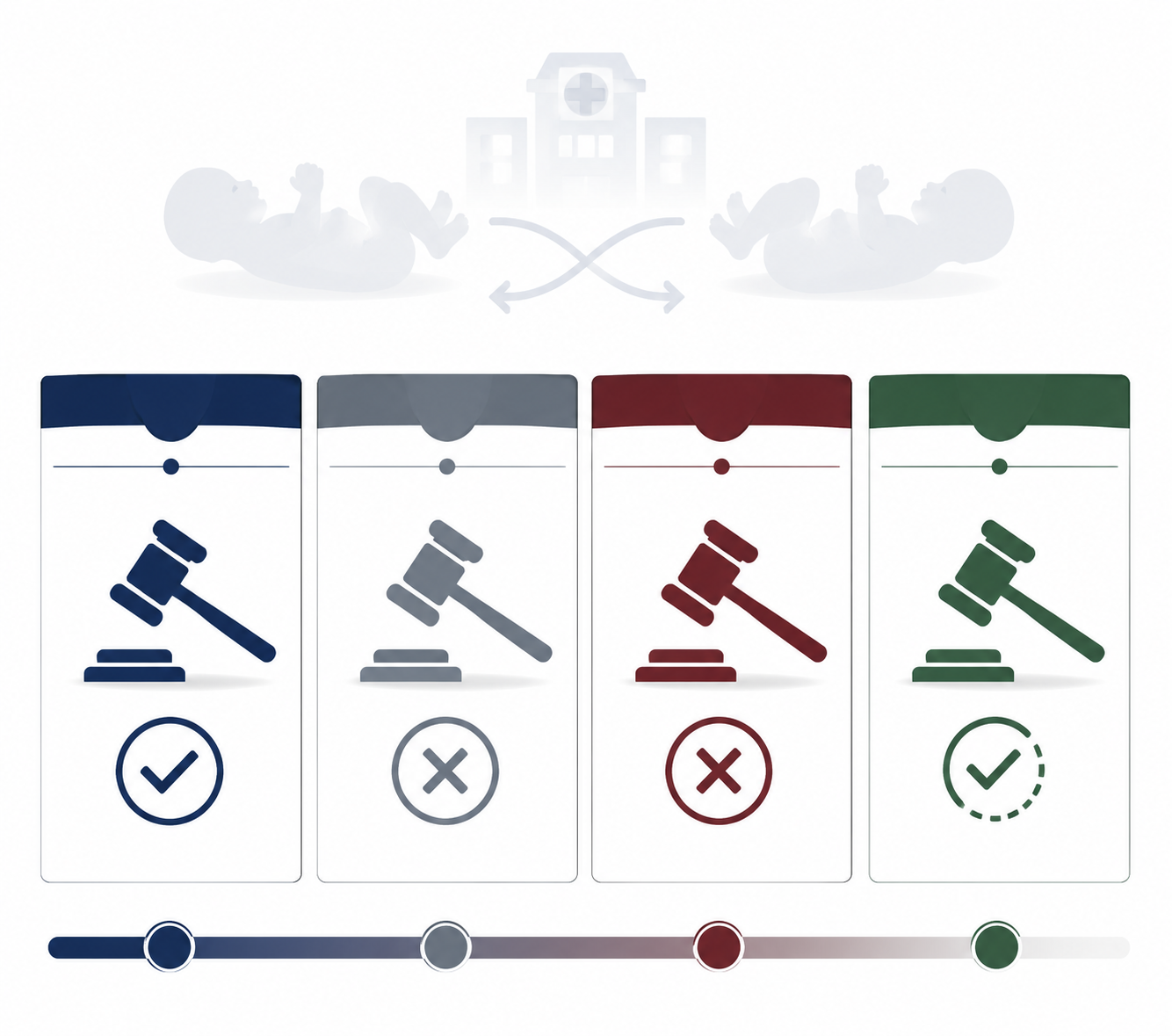
Twigg: a standalone NIED theory can fail
In Twigg v. Hospital District, a Florida federal court dismissed a standalone negligent infliction of emotional distress claim in a switched-at-birth dispute.[2] The point for a student is not that Florida is hostile to every possible claim on these facts. The narrower lesson is that pleading emotional distress as its own theory may fail if the jurisdiction’s NIED requirements are not satisfied.
That makes Twigg a useful counterweight to Larsen. A plaintiff-friendly emotional story still has to fit the state’s doctrinal gatekeeping. On an exam, this is where the answer should slow down and ask which version of NIED the professor has given: impact rule, zone of danger, bystander recovery, special relationship, or independent duty.
Wishard: same-day discovery changes the injury analysis
In Wishard Memorial Hospital v. Logwood, the Indiana court denied recovery where the baby switch was discovered the same day.[3] That timing matters. The plaintiffs could still describe fear, shock, and anger, but the court did not treat the brief interruption as the kind of compensable injury recognized in the longer-discovery cases.
For exam purposes, Wishard teaches that immediacy can cut against damages even when negligence seems easy to imagine. A hospital error and a compensable emotional-distress claim are not the same thing. The duration of the mistaken relationship, the nature of the emotional injury, and the jurisdiction’s threshold for recovery all have to be separated.
De Leon Lopez: standing may extend beyond parents and children
The Puerto Rico case De Leon Lopez is useful because it allowed a grandfather’s claim.[4] That changes the issue from whether emotional harm exists to who is legally entitled to recover for it. Switched-at-birth facts often produce concentric circles of injury: the switched children, the birth parents, the raising parents, siblings, grandparents, and sometimes later descendants.
A student should not assume every emotionally harmed relative has standing. The better method is claimant-by-claimant analysis. What relationship did this plaintiff have to the child? Was the injury direct or derivative? Does the jurisdiction recognize emotional-distress recovery for this category of family member? De Leon Lopez shows that the circle can be wider than the nuclear family, but it does not create a universal rule for every jurisdiction.
Current Fact Patterns: Discovery, Concealment, and Records
The 2024-2026 switched-at-birth stories are best used as modern hypotheticals, not as new doctrinal anchors. They show the facts professors now have available: at-home DNA testing, institutional admissions, alleged concealment, missing records, and people discovering identity errors after most ordinary filing periods would appear to have expired.
In Norway, CBS News reported a case involving women switched in 1965, with authorities discovering the error in 1985 but allegedly concealing it. Those facts are valuable because concealment changes the limitations discussion. A plaintiff facing an old injury may argue delayed discovery, fraudulent concealment, equitable tolling, or a separate wrong based on the cover-up, depending on the jurisdiction’s law.[5]
In the United Kingdom, Russell-Cooke described a 2024 matter as the first NHS baby-switch case in which liability was admitted. For U.S. torts study, the admission is not a transferable rule. It is a useful institutional-responsibility fact pattern: when an entity accepts fault, the exam energy shifts toward causation, claimant scope, limitations, and damages rather than breach.[6]
In New York, CBS New York reported a Jamaica Hospital case in which discovery allegedly came 64 years after birth. That is almost too tempting as a human-interest fact, but the exam issue is sharper: when does the claim accrue, and what did the plaintiff know or reasonably should have known? A 64-year delay does not answer those questions by itself.[7]
In North Dakota, CBS News reported a case in which the hospital defended in part on record-destruction grounds. That kind of fact belongs in the limitations and proof section of an answer. Old hospital records may be missing because of routine retention policies, not necessarily because of misconduct. The plaintiff still has to prove duty, breach, causation, and damages with admissible evidence.[8]
A Practical Torts Checklist for Switched-at-Birth Questions
A switched-at-birth exam answer should usually move in this order. The order matters because it keeps emotional-distress doctrine from swallowing every other issue.
- Identify the relationship creating duty: hospital-patient, parent-child, contractual undertaking, statutory duty, or another special relationship.
- Classify the emotional harm theory: ordinary negligence with emotional damages, NIED, bystander recovery, independent duty, or another jurisdiction-specific category.
- Apply foreseeability and policy limits: use factors like those in Larsen where the jurisdiction supports that approach.
- Separate each claimant’s standing: switched child, biological parents, raising parents, siblings, grandparents, and later generations may not stand in the same position.
- Locate discovery and limitations problems: birth date, discovery date, DNA testing date, institutional knowledge, concealment, and record retention all matter.
- Discuss damages carefully: emotional distress, lost family relationships, medical or genetic-information consequences, and jurisdictional limits should not be blended together.
The biggest grading trap is treating all claimants as if they suffered the same legal injury. A woman who discovers she was raised by the wrong parents may have a direct identity and family-relationship injury. A biological parent may frame the injury around loss of the opportunity to raise a child. A sibling may have a more difficult standing argument. A grandparent may or may not fit within the jurisdiction’s recognized family-injury framework. The emotional facts overlap; the legal theories do not.
The second trap is assuming that delayed discovery automatically saves an old claim. It might. It might not. A plaintiff will want to argue that the claim could not reasonably have been discovered earlier, especially where DNA testing triggered the revelation or where institutional concealment is alleged. A defendant will press repose, evidentiary prejudice, missing witnesses, destroyed records, and the statutory text. The exam answer should put both sides on the page before choosing a likely result.
Damages and Frequency Require Careful Language
Damages figures can give context, but they do not travel cleanly across jurisdictions. A French court awarded approximately €1.8 million in a switched-at-birth case reported in 2015, while a Japanese case produced an award of about $371,000. Those numbers are useful as examples of compensation, not as predictors of what a U.S. court would award today.[9][10]
Pending U.S. matters are even less useful as valuation guides. Complaints and news reports may describe severe harm and large claimed damages, but claimed damages, settlement pressure, and final judgments are different things. In a law school answer, damages should be linked to recognized injury categories and proof, not to the largest number visible in a headline.
Frequency claims also need discipline. A DNA Diagnostics Center blog has claimed that up to 500,000 babies per year may be at potential risk of being switched, while also noting only 8 documented U.S. incidents between 1995 and 2008. The source limitation matters: a DNA testing company’s discussion of potential risk is not the same as independent proof that switches occur at that scale.[11]
That contrast is exactly the kind of distinction a torts answer should preserve. Potential risk is not incidence. Documented incidents are not necessarily the full universe. Vendor disclosures are not the same as court findings. The legally useful point is modest: switched-at-birth cases are rare in documented litigation, but when they appear, they concentrate several hard negligence doctrines in one fact pattern.
How to Write the Exam Answer
If a professor gives a switched-at-birth hypothetical, resist the urge to write the answer in the order the family learned the facts. Write it in the order the court needs the issues resolved. Start with the defendant’s undertaking and the relationship creating duty. Then identify the emotional-distress theory and the jurisdiction’s limits on recovery. Use Larsen if the facts support an independent duty argument, but say expressly that Wyoming’s approach is persuasive outside Wyoming, not binding.
Then separate the plaintiffs. The switched child, the biological parents, the raising parents, and other relatives may have different injuries, different duty relationships, and different limitations problems. A single paragraph saying “the family suffered emotional distress” is too blunt for this subject.
Finally, handle time. State when the negligent act occurred, when the injury was discovered, whether the defendant allegedly knew earlier, and whether records now exist. In old-switch cases, limitations and proof are not procedural afterthoughts. They may decide whether the court ever reaches the emotional-distress theory.
The disciplined answer is not colder than the facts. It is fairer to them. These cases involve people learning that the family story they lived with was legally and biologically wrong. Tort law’s hard question is when that devastation becomes compensable without making emotional injury limitless. That is the question to keep on the page.
References
- Larsen v. Banner Health System, Wyoming Supreme Court, 2003.
- Twigg v. Hospital District, U.S. District Court for the Middle District of Florida.
- Wishard Memorial Hospital v. Logwood, Indiana Court of Appeals, 1987.
- De Leon Lopez switched-at-birth claim, Puerto Rico.
- Women switched at birth sue Norway, CBS News.
- Baby swap at birth: first NHS case admitted liability, Russell-Cooke, Nov. 2024.
- Long Island woman says DNA test revealed she was switched at birth 64 years ago, CBS New York.
- North Dakota switched-at-birth lawsuit, CBS News.
- French court awards damages to families of babies switched at birth, The Guardian, 2015.
- Japan baby switched at birth awarded damages, BBC News.
- How Often Are Babies Switched at Birth?, DNA Diagnostics Center.
Apply This Method
Related Methods
- How to Analyze a Settlement Case Study for Law Students
Most civil cases settle before trial, yet law school curricula focus almost exclusively on appellate opinions. A five-part framework for analyzing settlement case studies — covering negotiation dynamics, leverage, and economic incentives — gives law students a crucial advantage in exams and clinic preparation.
- Build One Statute of Limitations Chart for All 1L Exams
Law students often treat statute of limitations as four separate topics across Civil Procedure, Torts, Contracts, and Criminal Law. This guide shows how building a single cross-subject reference chart organized by cause of action replaces separate outlines and directly boosts exam performance.
- Where Students Can Watch the Perseid Meteor Shower in 2026
The 2026 Perseid meteor shower peaks on August 12–13 under a new moon, creating the best viewing conditions in years. This guide helps students find dark-sky spots near campus — on foot, by transit, or on a weekend trip — without expensive gear.
Comments
Join the discussion with an anonymous comment.