
Build One Statute of Limitations Chart for All 1L Exams
Law students often treat statute of limitations as four separate topics across Civil Procedure, Torts, Contracts, and Criminal Law. This guide shows how building a single cross-subject reference chart organized by cause of action replaces separate outlines and directly boosts exam performance.
Best for: Civil Procedure, Torts, Contracts, Criminal Law
Start statute of limitations studying with the thing students actually need under exam pressure: one chart. Not four mini-outlines. Not a stack of disconnected limitation periods. One cross-subject chart organized by cause of action, because the same basic questions keep coming back: what claim is this, when did the clock start, did anything pause or delay it, and whose law controls?
A statute of limitations is a law that sets the time within which a legal proceeding must be started, and the clock usually runs from accrual unless a rule such as discovery or tolling changes the timing.[1] That definition is enough to build the useful tool. The rest is classification.
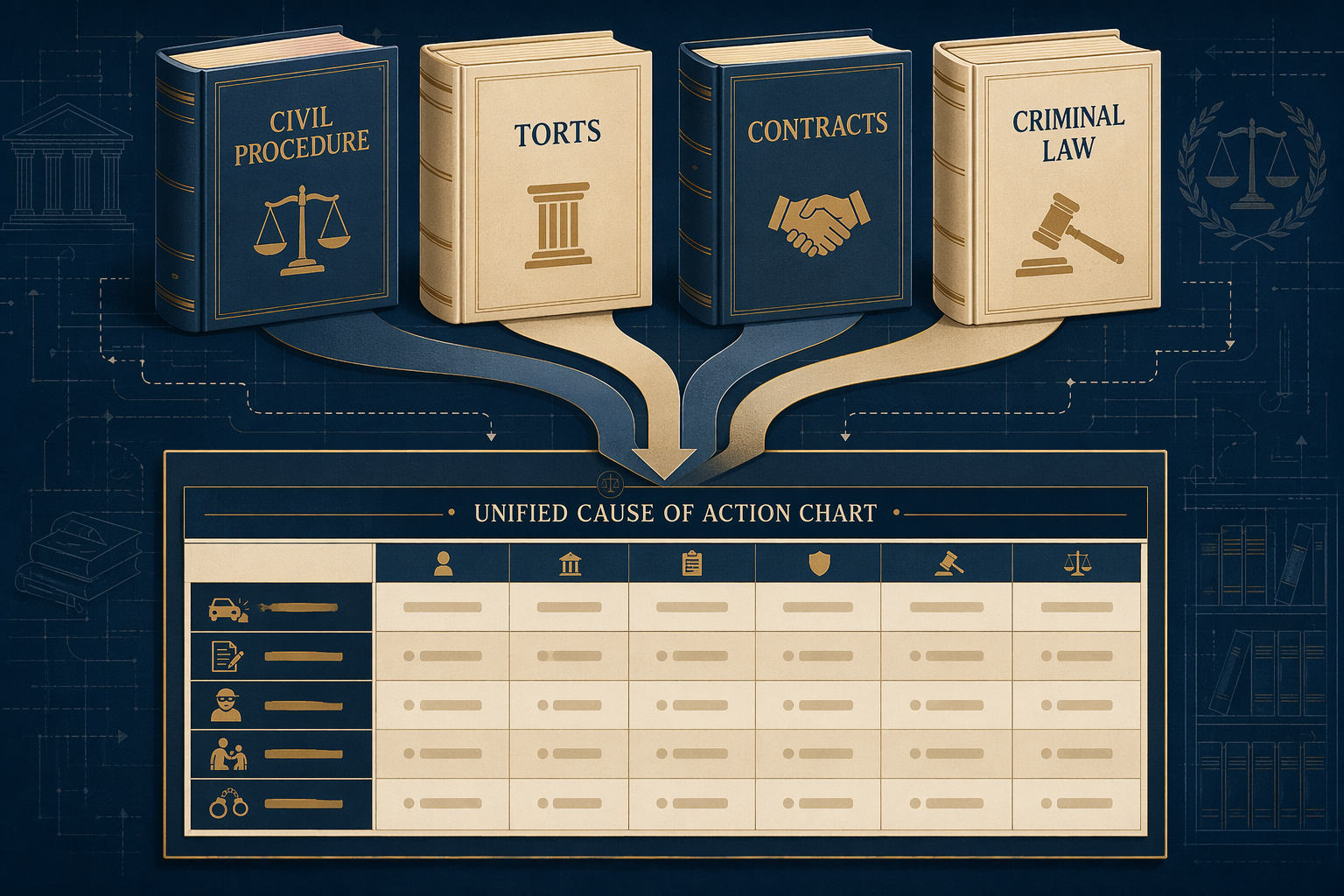
| Cause of action or charge | Where it appears in 1L courses | Baseline rule to know | Exam note |
|---|---|---|---|
| Personal injury | Torts; Civil Procedure when filing timing or Erie appears | State law controls the period. California, for example, generally uses a two-year period for personal injury actions.[3] | Use as a model for tort timing, not a national rule. Always verify the tested jurisdiction. |
| Written contract | Contracts; Civil Procedure if the case is in diversity | State contract periods vary. For sales of goods under UCC Article 2, the default period is four years.[2] | Do not treat every contract as UCC Article 2. First ask whether the transaction is a sale of goods. |
| Oral contract | Contracts; Civil Procedure | Often shorter than written-contract periods under state law. California, for example, treats oral contracts differently from written contracts.[3] | The exam issue is usually classification: written agreement, oral agreement, or Article 2 sale of goods. |
| Fraud | Torts; Contracts remedies; Civil Procedure | Jurisdictions often connect fraud timing to discovery or delayed discovery concepts.[1][3] | Separate the wrong from the clock. Fraud is where students most often forget to ask when the plaintiff reasonably discovered the problem. |
| Felony | Criminal Law; Criminal Procedure if charged later | Federal law has a general five-year limitation period for non-capital federal offenses, but criminal limits vary by jurisdiction and offense.[4] | Use the federal rule as a clean reference point, then check the statute if the exam gives state law. |
| Misdemeanor | Criminal Law | Usually governed by offense-specific state statutes; periods are commonly shorter than for serious felonies, but the exact rule varies.[4] | Do not invent a number. If the jurisdiction is not supplied, discuss the issue conditionally. |
| Murder | Criminal Law | Murder commonly has no statute of limitations, including under the federal pattern described by FindLaw.[4] | This is the contrast rule: some claims expire; murder often does not. |
Use the Chart in the Same Order the Exam Uses the Facts
The chart works because it refuses to organize statute of limitations by course. Exams do not hand you a clean label that says, “Now apply your Torts limitations rule.” They give you a car crash, a late-filed complaint, a contract dispute, a shipment of defective goods, a fraud discovery problem, or a stale criminal charge. The cause of action comes first. The course label is secondary.
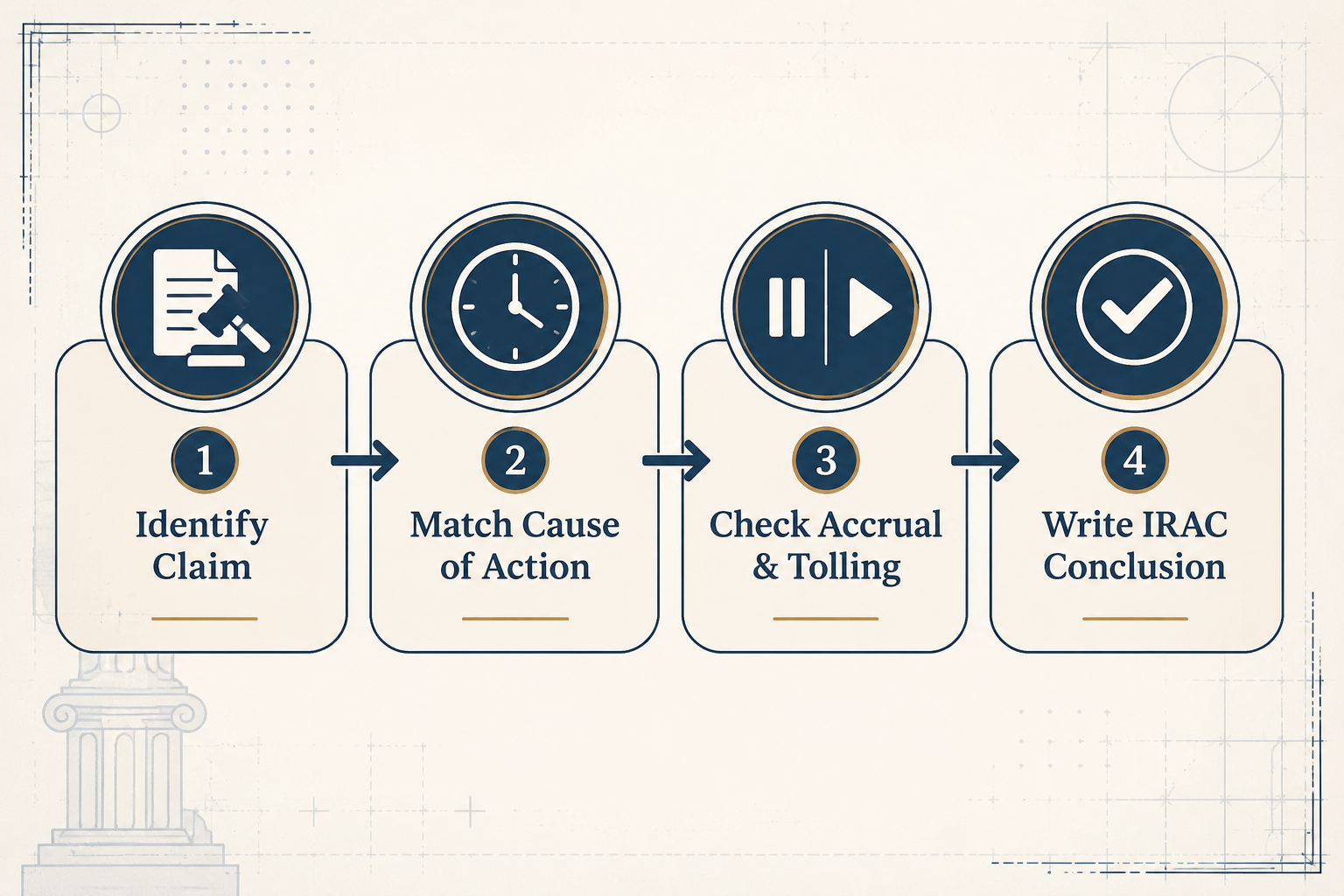
So the usable sequence is simple: identify the claim, match it to the cause of action row, check the governing limitations period, then ask whether accrual, discovery, tolling, or Erie changes the answer. That last part is where a lot of otherwise good outlines collapse, because they list the period but do not train the student to ask whether the period has actually started, paused, or been displaced by state law.
Torts: Personal Injury Is the Cleanest Starting Row
Personal injury is the easiest row to understand and one of the easiest to misstate. The category is familiar: negligence, car accidents, physical harm, and related tort claims. The trap is pretending there is one national personal-injury limitations period. There is not.
California is useful as a model because it gives students a concrete number: personal injury actions generally must be filed within two years.[3] That does not make California the answer for New York, Texas, Florida, or the jurisdiction on your exam. It gives you a template for the chart: “personal injury — state period — check accrual/discovery/tolling — verify jurisdiction.”
State-by-state personal injury tables show why this matters. Martinian Law’s survey of personal injury limitation periods lists different filing periods across states, which is exactly the kind of variation a student should expect instead of smoothing over.[7] If a professor gives you a statute, use it. If the facts identify a jurisdiction, check that jurisdiction. If the exam is testing general analysis, say the applicable state period controls and explain the effect conditionally.
This is also why state reforms matter. A torts timing rule can change because the legislature changes the statute, not because the common-law negligence framework suddenly became more interesting. For a concrete example of how state-specific timing changes can affect accident analysis, see New York's 2026 Car Accident Law Changes: A Bar Exam Study Guide.
Contracts: Do Not Lose the UCC Article 2 Rule
Contracts is where the chart saves the most repeat work. A general contracts outline may separate written contracts, oral contracts, and sale-of-goods contracts. That is fine doctrinally, but for statute of limitations purposes the student needs the row that answers the filing question.
For UCC Article 2 breach-of-contract claims, the baseline rule is four years. The parties may reduce the limitations period to not less than one year, but they may not extend it beyond the statutory period.[2] That shortening-but-not-extending point is exactly the sort of rule that disappears when students bury limitations in a general contract-formation outline.
The exam move is not “contracts equals four years.” The exam move is: first, classify the transaction. If it is a sale of goods, Article 2 may supply the four-year rule. If it is a services contract, real estate agreement, employment agreement, or another non-Article 2 contract, the UCC rule is not the shortcut. Then look to the applicable state contract limitations statute.
| Contract fact pattern | Chart row | What to check next |
|---|---|---|
| Seller ships allegedly defective equipment to buyer | UCC Article 2 sale of goods | Four-year default; any valid contractual reduction not below one year; no extension beyond the statutory period.[2] |
| Client says consultant breached a services agreement | Non-UCC contract | State limitations period for the relevant contract type. |
| Parties dispute an oral promise | Oral contract | State period for oral contracts; possible proof issues are separate from the limitations clock. |
| Signed agreement contains a shorter filing deadline | Written contract or UCC, depending on subject | Whether the contractual shortening is permitted under the governing law. |
Fraud and Discovery: Accrual Is Not the Same Thing as Tolling
If there is one distinction worth drilling until it becomes automatic, it is this: accrual asks when the claim comes into existence for limitations purposes; tolling asks whether the running clock is paused or extended after it would otherwise run. They are related, but they are not the same move.
Cornell Wex describes accrual as the point when the limitations period begins to run and identifies tolling as a doctrine that can suspend or extend the filing period in specified circumstances.[1] CEB’s California civil limitations overview gives practical examples of delayed discovery and tolling concepts, including situations where a plaintiff may not discover the injury or claim immediately and situations where legal rules pause the deadline.[3]
Fraud is the classic exam setting because the facts often hide the injury from the plaintiff. A buyer signs a contract after a false representation, but the falsity becomes clear later. A patient suffers harm but does not immediately know its cause. A business partner conceals records. The student who only memorized “fraud — X years” is stuck. The student with the chart knows to add a second line: when did the plaintiff discover, or reasonably should have discovered, the basis for the claim?
- Accrual question: When did the claim begin for limitations purposes?
- Discovery question: Did the plaintiff know, or should the plaintiff reasonably have known, the facts giving rise to the claim?
- Tolling question: Did a rule pause, suspend, or extend the running period?
- Conclusion question: After adjusting for those timing rules, was the filing timely?
Keep those as separate lines in the chart. If they sit in one cramped “exceptions” column, they become mush. On an exam, mush costs time.
Civil Procedure: The Erie Problem Is Why This Is Not Just Memorization
Civil Procedure adds the wrinkle that makes statute of limitations more than a deadline chart. In a diversity case, the federal court has to decide whether to apply state or federal law. Under Erie doctrine, federal courts sitting in diversity apply state substantive law and federal procedural law.[5]
The key limitations rule comes from Guaranty Trust Co. v. York: statutes of limitations are treated as substantive for Erie purposes, so a federal court sitting in diversity applies the state statute of limitations.[5] That one sentence explains why a filing deadline suddenly belongs in both the Torts or Contracts row and the Civil Procedure row.
This is the part students miss when each course keeps its own little island. A negligence claim filed in federal court under diversity jurisdiction is still a negligence claim, but the limitations issue now has a Civil Procedure frame. The answer should not say, vaguely, that federal court means federal timing law. The better answer asks whether the federal court is sitting in diversity and, if so, applies the relevant state limitations period as substantive law.
| Exam fact | Wrong shortcut | Better chart-driven move |
|---|---|---|
| Plaintiff files a state-law personal injury claim in federal court based on diversity | Federal court means federal limitations period | Apply Erie; statute of limitations is substantive for diversity purposes, so use the state period.[5] |
| Plaintiff files a UCC sales claim in federal diversity court | Contracts outline alone answers everything | Classify the contract under Article 2, then ask which state law supplies the limitations rule. |
| Defendant raises limitations as a defense | Treat it as a minor procedural objection | Analyze whether the governing limitations period bars the claim before reaching merits. |
Criminal Law: Learn the Contrast, Then Check the Statute
Criminal statute of limitations rules do not need the same amount of chart space as civil claims, but they do need their own rows. The main pattern is contrast: many offenses have filing deadlines, serious offenses may have longer periods, and murder often has no limitation period.
FindLaw identifies a general five-year federal statute of limitations for non-capital federal offenses and notes that murder has no time limit, while also emphasizing that state criminal limitation periods vary by offense and jurisdiction.[4] That is enough for a student chart. Put “felony,” “misdemeanor,” and “murder” in separate rows, because they do different work.
| Criminal category | What the chart should say | How to use it |
|---|---|---|
| Felony | Federal general reference point: five years for many non-capital federal offenses.[4] | Check whether the offense has a specific longer or shorter rule. |
| Misdemeanor | State and offense-specific rules vary.[4] | Do not assume the felony rule applies. |
| Murder | Often no statute of limitations; no federal time limit for murder.[4] | Use as the major exception to the ordinary deadline pattern. |
How to Turn the Chart Into an Exam Answer
The chart is not the answer. It is the intake form. Once the facts raise a timing problem, the answer still needs legal organization. JD Advising’s exam-writing guidance uses IRAC: issue, rule, analysis, conclusion.[6] For statute of limitations, that structure keeps the student from blurting out a period and forgetting the moving parts.
| IRAC part | What to write for a statute of limitations issue |
|---|---|
| Issue | State whether the claim or charge may be time-barred. |
| Rule | Give the governing limitations period and identify the source: state tort statute, UCC Article 2, criminal statute, or Erie-driven state law. |
| Analysis | Apply the filing date, accrual date, discovery rule, tolling facts, and any jurisdictional wrinkle. |
| Conclusion | Say whether the claim is timely, time-barred, or uncertain because the controlling jurisdictional statute must be verified. |
A clean limitations paragraph can be short. For example, in a hypothetical personal injury case: “The issue is whether the negligence claim is barred by the statute of limitations. The applicable state personal-injury period controls, and in a diversity case the federal court applies that state limitations period as substantive law. The injury occurred on Date A and the complaint was filed on Date B. Unless a discovery rule or tolling doctrine applies, the claim is untimely because filing occurred after the limitations period expired.”
That paragraph does not show off. Good. It does the job. It identifies the issue, states the rule, applies the clock, checks the exception, and reaches a conclusion. If the facts add fraud, delayed discovery, minority, concealment, or a contractual shortening clause, those facts go in the analysis rather than floating around as afterthoughts.
Build the Chart So It Stays Honest
The chart should be compact enough to use, but not so neat that it lies. The correct answer often depends on jurisdiction, claim classification, accrual, and statutory exceptions. If your chart gives one universal number for “torts” or “contracts,” it is making you faster at being wrong.
- Use rows for cause-of-action categories, not course names.
- Separate accrual, discovery, and tolling into different columns.
- Flag jurisdiction-specific rules instead of pretending one national period exists.
- Put UCC Article 2 in its own contracts row.
- Add an Erie note for state-law claims in federal diversity court.
- Verify the controlling code before treating any representative period as final.
That is the whole advantage: one chart, one mental model, and fewer missed points because you are no longer rebuilding statute of limitations from scratch in every class.
References
- statute of limitations — Cornell Wex
- Supply Chain Survival Series: Overview of the UCC's Statute of Limitations for Breach of Contract Claims — Quarles
- Understanding the Statute of Limitations in California Civil Cases — CEB
- Time Limits for Charges: State Criminal Statutes of Limitations — FindLaw
- Erie doctrine — Cornell Wex
- How to Answer Law School Exam Questions: An In-Depth Guide — JD Advising
- Personal Injury Statute of Limitations by State — Martinian Law
Apply This Method
Related Methods
- Switched at Birth: Legal Steps and Study Guide for Torts
A case-based study guide for law students exploring how switched-at-birth litigation tests negligent infliction of emotional distress, the independent duty exception, multi-party standing, and statute-of-limitations issues across multiple jurisdictions.
- The Student Impact of Provo Canyon School's License Revocation
Utah's revocation of Provo Canyon School's license forces both campuses to close within weeks, leaving nearly 200 students facing urgent questions about credits, transcripts, and re-enrollment. This article outlines the key educational risks and what families should know to navigate the transition.
- Provo Canyon School Abuse Allegations: A Student Safety Checklist
After the Provo Canyon School abuse allegations, this checklist helps parents identify warning signs in residential treatment programs—from licensing actions to communication restrictions—so they can make safer decisions for their child.
Comments
Join the discussion with an anonymous comment.