
Student placement options after Provo Canyon School closes
With Provo Canyon School's campuses closing in August 2026, families need clear guidance on the three main placement pathways — transfer to another licensed residential program, return to a home school district, or step-down to outpatient care. This article documents the exact steps for transferring academic records, preserving credits, and reactivating IEPs or 504 plans.
Families affected by the Provo Canyon School closure are working against two different August deadlines. Utah officials revoked the Springville girls campus license on July 6, 2026, with operations set to end August 6; the Provo boys campus license was revoked July 17, with operations set to end August 16.[1][2] Utah DHHS has said it is “working to move teens either back home or to another treatment program,” which is the practical frame families now have to use.[3]
There are three real placement pathways after Provo Canyon School closes: transfer to another licensed residential treatment program, return to the home school district, or step down to outpatient care while living at home. The first path may be the academically cleanest when the receiving program has an accredited on-site school and can accept credits without interruption. It is not, however, the path every family can assume will be available. DHHS transfer arrangements are confidential, there is no public list of open beds, and close to half of Utah teens experiencing major depression cannot access mental health services.[1]
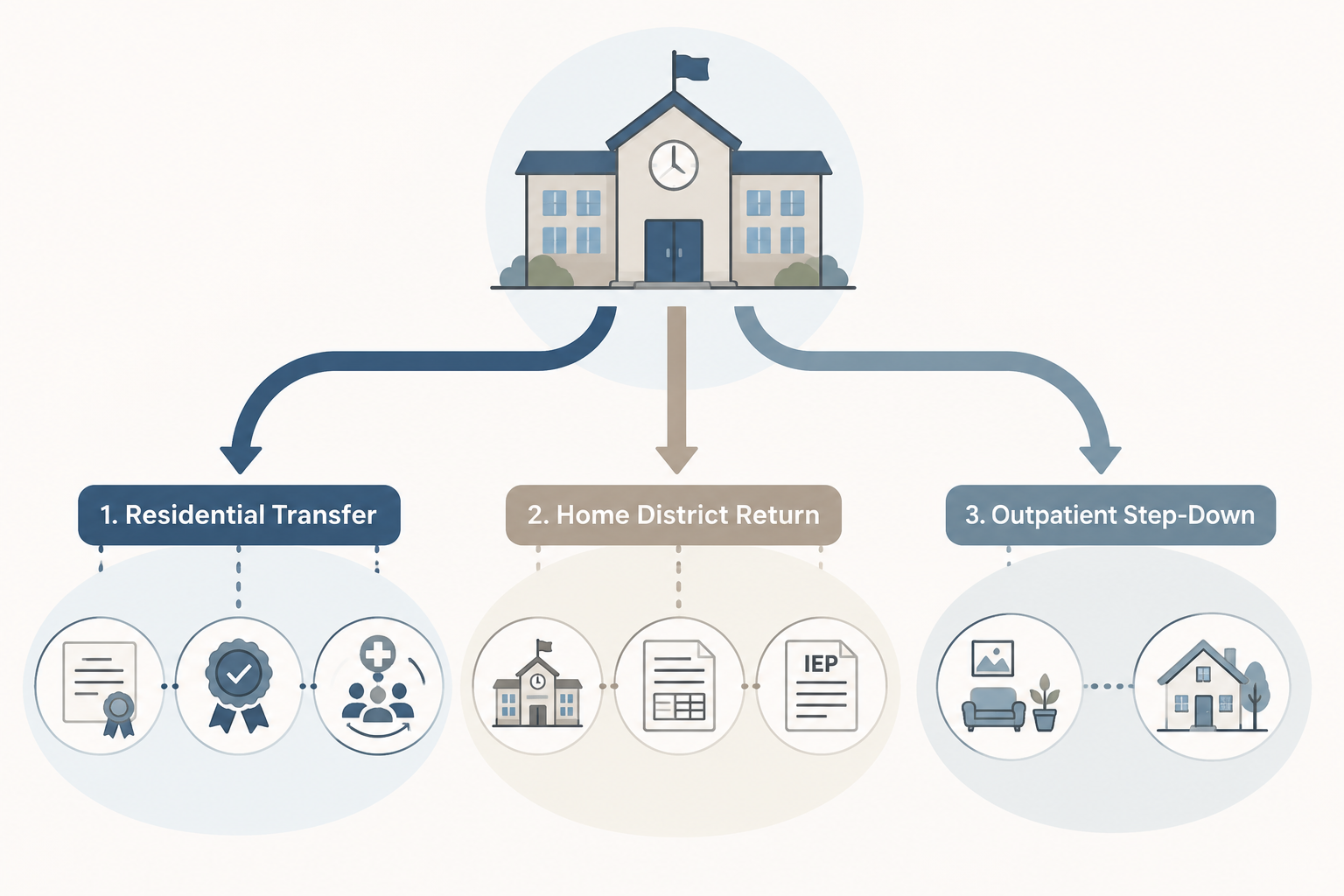
That means many parents should prepare for home district re-entry even while pursuing a residential transfer. This is not a judgment about the right clinical setting for a particular teen. It is a way to protect school credit, graduation progress, and special education supports before records become harder to retrieve.
The clock families should use
| Campus | Revocation date | Operations end date | Immediate implication |
|---|---|---|---|
| Springville girls campus | July 6, 2026 | August 6, 2026 | Request academic and special education records now; do not wait for a final placement decision. |
| Provo boys campus | July 17, 2026 | August 16, 2026 | Begin district re-enrollment and credit review while any residential transfer is being explored. |
PCS had 15 days from each revocation notice to request an administrative hearing, with the Springville deadline falling July 21 and the Provo deadline falling August 1.[1][2] An appeal could complicate timing, but families should not build an academic plan around a delayed closure. Universal Health Services also cannot reapply for a new license for five years, which makes a quick reopening an unsafe assumption for placement planning.[4]
The most important parent action is not choosing the perfect next school on the first phone call. It is getting a complete record packet before the campus stops normal operations. Phone numbers, registrar procedures, and staff availability often become less reliable after a closure date, even when legal record-retention duties remain.
The three placement pathways, compared by what can go wrong academically
The useful question is not simply where a student can sleep next week. It is where school responsibility will sit, who will accept credits, and who will reactivate supports if the student has an IEP or 504 plan.
| Pathway | Who usually coordinates it | Documents needed this week | Main academic risk | Parent action now |
|---|---|---|---|---|
| Transfer to another licensed residential program | DHHS, current treatment team, parent or guardian, receiving program admissions staff | Transcript, current courses, credits earned, course descriptions, IEP or 504 plan, evaluation records, immunization and discharge documents | A bed may not be available; the receiving school may not match courses or accept partial credits cleanly. | Ask whether the program has an on-site accredited school, which credits it will accept, and whether it can enroll the student before the PCS end date. |
| Return to home school district | Parent or guardian, district registrar, school counselor, special education or 504 coordinator | Official transcript, attendance, grade reports, course descriptions, withdrawal date, IEP or 504 records, behavior and support plans if relevant | Credits may sit unposted while the district evaluates them; services may pause if the IEP or 504 process is not reopened. | Send records to the district in writing and request a written credit evaluation and enrollment meeting. |
| Outpatient step-down while living at home | Parent or guardian, outpatient provider, home district, insurer if applicable | Same school records as district return, plus provider availability and school re-entry plan | Treatment may shift faster than the school schedule; attendance and workload may need a ramp-up plan. | Treat this as a district return with added treatment coordination, not as a substitute for school enrollment. |
A residential transfer is the cleanest only when it is real: a confirmed opening, an appropriate age and gender fit, a licensed treatment setting, an accredited school, and a clear answer on credit acceptance. A district return is less specialized, but it is the pathway parents can usually start without waiting for a private admissions decision. Outpatient step-down can work only if school re-entry is handled as deliberately as treatment follow-up.
Why PCS credits should not be treated as informal coursework
PCS was not just a treatment setting with school-like activities. Its academic profile included 5.5 hours of school per day, reported student-to-teacher ratios of 8:1 for boys and 6:1 for girls, and accreditation through Cognia, including NCA CASI, NWAC, and SACS CASI.[5] That matters because families should be asking receiving schools to evaluate transferable credit, not starting from the assumption that the semester has disappeared.
A receiving district may still need course descriptions, grade cutoffs, attendance records, or evidence of seat time before posting credit. That is normal. What is not acceptable is letting the conversation stay vague. Parents should ask for a written review of each course against graduation requirements, including whether the district will award full credit, partial credit, elective credit, or require makeup work.
If your child returns to the home district, start with records
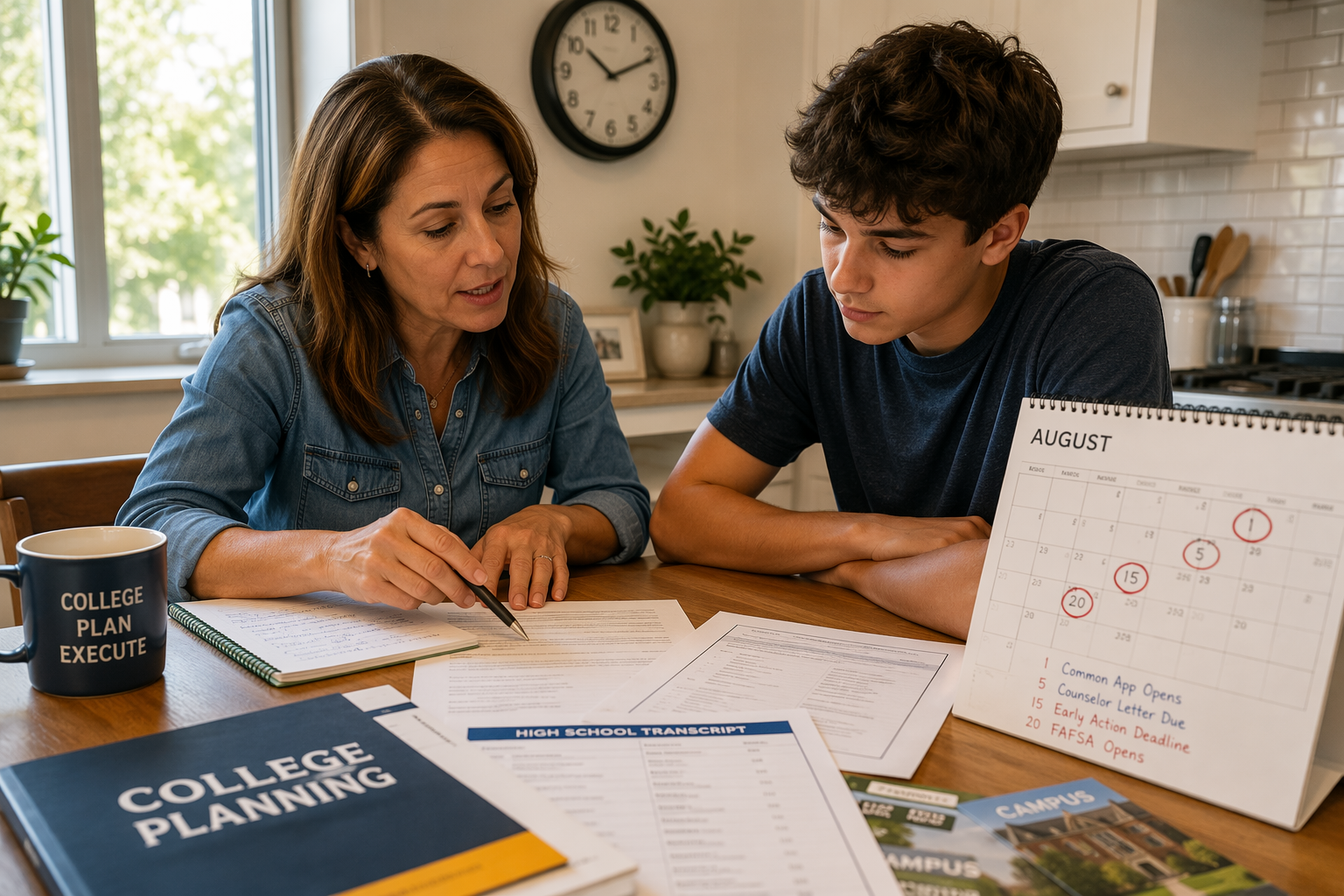
The home district route has the most moving parts, but it is also the route most families can begin today. Do not wait until a discharge summary is complete or until every treatment decision is settled. School records and enrollment can move on a parallel track.
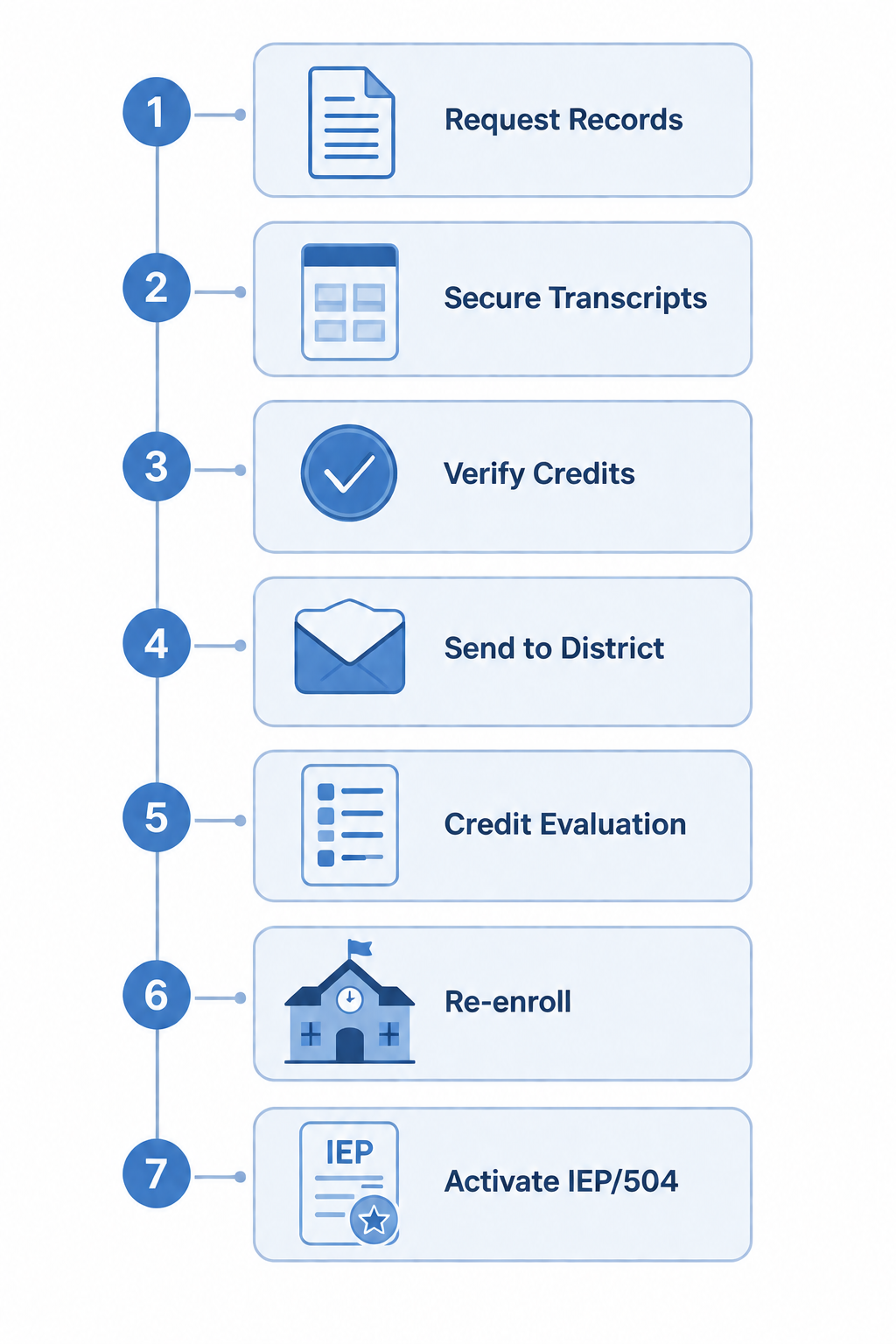
1. Request the complete PCS academic file immediately
Ask PCS for the official transcript, unofficial transcript if the official version will take longer, current grade report, course schedule, course descriptions or syllabi, attendance record, withdrawal date, credits attempted, credits earned, and any documentation needed to show the school’s accreditation status during the student’s enrollment. Make the request in writing and keep a copy.
If your child is near the end of a grading period, ask whether teachers can finalize grades early or document current progress. Partial credit can be difficult to reconstruct later if the receiving school gets only a transcript line with no course detail.
2. Request the special education or 504 file separately
Academic records and disability-support records do not always travel together. If the student has an IEP, request the current IEP, most recent evaluation or reevaluation, prior written notices, progress reports on goals, behavior intervention plan if one exists, and related-service documentation. If the student has a 504 plan, request the plan, eligibility documentation, accommodation history, and any recent review notes.
The receiving district should not have to guess which supports were in place. A dormant IEP or 504 plan can become the quietest loss in a rushed transition: the student is enrolled, classes begin, and the adults assume someone else has the paperwork.
3. Send records to the district before asking for placement advice
Contact the district registrar or enrollment office for the student’s home address and ask where transfer records should be sent. Then contact the high school counselor, graduation specialist if the district uses one, and special education or 504 coordinator. Send the same packet to each appropriate contact, noting that the student is being displaced by the PCS closure and needs credit evaluation before the new term.
Use plain written requests: “Please evaluate these PCS credits against graduation requirements,” “Please confirm which credits will post,” and “Please schedule an IEP or 504 re-entry meeting.” A phone call can open the door, but a written request creates a trail if the review stalls.
4. Map every PCS course against graduation requirements
Do not stop at “the district accepted the transcript.” Ask how each course will appear: English, math, science, social studies, world language, health, physical education, fine arts, career and technical education, elective, or local equivalent. For high school students, the question is not only whether credits transfer. It is whether they satisfy the right requirement for graduation.
If the district awards elective credit for a course the family expected to count as a core requirement, ask what evidence would be needed for reconsideration. Course descriptions, syllabi, textbooks, teacher credentials, or assessment records may matter. If reconsideration is denied, ask what makeup option is least disruptive: credit recovery, summer coursework, an online district course, or a schedule adjustment.
5. Re-enroll even if the final treatment plan is unsettled
A family can continue exploring residential treatment while also opening district enrollment. The district cannot evaluate credits, schedule classes, or convene school-support meetings for a student it does not know is returning. If a residential placement later becomes available, the family can update the district. If no placement opens, the student is not starting from zero in late August.
6. Ask for an IEP or 504 re-entry meeting
For an IEP, contact the district special education office and the school’s special education case manager or department chair. For a 504 plan, contact the school’s 504 coordinator or administrator assigned to accommodations. The first meeting should address current eligibility records, immediate accommodations, service minutes if applicable, transportation if relevant, safety planning, attendance expectations, and whether updated evaluations are needed.
Do not assume a PCS support plan automatically becomes the district’s operating plan on the first day of school. The district must review what it has, determine what is needed in the public school setting, and document services or accommodations. Parents should ask what will be in place on day one while any longer review continues.
7. Build a school re-entry rhythm
A structured re-entry plan can include a gradual attendance ramp-up, predictable check-ins, and communication between school staff and treatment providers. BlueRock Behavioral Health’s school re-entry guide describes that kind of model, although it is written for a North Carolina context rather than Utah-specific policy.[6] Families can still use the framework as a conversation starter with a Utah district: who checks in, how often, what happens after an absence, and how school staff receive treatment-related updates with proper consent.
The plan should be concrete enough that a teenager does not have to explain the entire PCS closure story to every adult in the building. A counselor, case manager, or administrator should know the student is returning from residential treatment, which classes are provisional pending credit review, and whom to contact if attendance or workload starts to unravel.
What to ask before accepting another residential placement
Some students will still need a residential setting. In that case, the school question belongs in the first admissions conversation, not after clinical acceptance. A receiving program that cannot explain enrollment, accreditation, transcripts, partial credits, and IEP or 504 coordination may create a second disruption immediately after the first one.
| Program example | Placement facts supplied by public materials | Academic question to ask |
|---|---|---|
| Huntsman Mental Health Institute Youth Residential Treatment | Girls ages 12-17; DBT-based; Cognia-accredited on-site school; typical stays of 1-3 months.[7] | Can the on-site school accept PCS credits and issue a transcript for a short stay? |
| Youth Care Treatment Center | Residential program in Draper for ages 11-17; public materials describe a 30-year track record.[8] | What school provides instruction, and is it accredited for transferable high school credit? |
| Newport Academy Oakley | Teen residential program for ages 13-17; public materials describe gender-responsive care and CBT, DBT, and EMDR.[9] | How are current courses continued, and who sends records to the next district or school? |
| Discovery Ranch | Program name families may encounter when searching Utah residential options. | Verify age and gender fit, licensing, school accreditation, credit transfer, and current availability directly before treating it as an option. |
The point is not to rank programs from a distance. It is to avoid a vague promise that “school is included.” Ask for the name of the school, accreditation status, daily instructional schedule, transcript process, special education contact, and how the program handles a student who arrives mid-course from PCS.
- Ask whether there is a confirmed opening for your child’s age, gender, needs, and expected admission date.
- Ask whether the school is accredited and whether credits transfer to Utah public schools.
- Ask who evaluates PCS credits before enrollment and who produces the next transcript.
- Ask whether the program can implement or coordinate an existing IEP or 504 plan.
- Ask what happens if the stay is short and the student returns to the home district after only a few weeks.
When outpatient step-down is the next move
Outpatient care may be appropriate for some students returning home, but it does not replace school placement. The family still needs district enrollment, transcript evaluation, and IEP or 504 follow-up. The outpatient provider can support the transition by communicating attendance limits, stress points, safety planning needs, and recommended school-day adjustments when the family has signed the necessary releases.
This is where parents should be careful with timing. A therapy appointment on the calendar is not the same as a school re-entry plan. If the first school day arrives before credits are posted or accommodations are active, the student may be placed in an improvised schedule that is hard to unwind.
What the broader PCS history changes, and what it does not
The closure is not happening in a vacuum. Provo Canyon School has been the subject of survivor advocacy and public scrutiny, and Universal Health Services was cited in a 2024 U.S. Senate report concerning facilities described as “warehouses of neglect.”[10] Survivor networks also track closed programs and institutional histories for families trying to understand the larger landscape.[11]
That history may matter deeply to a family’s treatment decisions. For the school transition, it changes the urgency more than the paperwork. Students still need transcripts. Districts still need course information. IEP and 504 teams still need records. A teenager should not lose credit because adults are still sorting through licensing orders, appeals, or allegations.
A practical order of operations for this week
- Request the full academic record and the IEP or 504 file from PCS in writing.
- Ask for current grades and partial-credit documentation before the campus operations end.
- Send the records to the home district registrar, school counselor, and special education or 504 contact.
- Request a written credit evaluation showing how each PCS course applies to graduation requirements.
- Start enrollment with the home district even if a residential transfer is still being pursued.
- If considering another residential program, require a confirmed slot and clear school-credit process before relying on it.
- Schedule an IEP or 504 re-entry meeting and ask what supports will be active on the first day.
Families do not need to know today whether the final answer is residential treatment, home district return, or outpatient step-down. They do need to act as if the August dates hold. Request the records now, protect the transcript, make the district evaluate credits in writing, and reopen the IEP or 504 process before the student is sitting in a new classroom without the supports and credits already earned.
References
- Utah officials shut down embattled Provo residential treatment facility, Deseret News
- State revokes license of Provo Canyon School's Provo campus, KSL.com
- Utah Pulls Provo Canyon School's License After Yearslong Campaign, The Imprint
- Provo campus of Provo Canyon School has license revoked by state, FOX13
- Provo Canyon School, Wikipedia
- Guide: School Re-Entry After Residential Treatment - Parent & Teacher Toolkit, BlueRock Behavioral Health
- Youth Residential Treatment, Huntsman Mental Health Institute
- Residential Treatment Program, Youth Care Treatment Center
- Teen Residential Treatment Centers in Utah, Newport Academy
- How Utah became the leading place to send the nation's troubled teens, APM Reports
- Closed Programs, Unsilenced
Apply This Method
Related Methods
- The Student Impact of Provo Canyon School's License Revocation
Utah's revocation of Provo Canyon School's license forces both campuses to close within weeks, leaving nearly 200 students facing urgent questions about credits, transcripts, and re-enrollment. This article outlines the key educational risks and what families should know to navigate the transition.
- Provo Canyon School Abuse Allegations: A Student Safety Checklist
After the Provo Canyon School abuse allegations, this checklist helps parents identify warning signs in residential treatment programs—from licensing actions to communication restrictions—so they can make safer decisions for their child.
- How to Analyze a Settlement Case Study for Law Students
Most civil cases settle before trial, yet law school curricula focus almost exclusively on appellate opinions. A five-part framework for analyzing settlement case studies — covering negotiation dynamics, leverage, and economic incentives — gives law students a crucial advantage in exams and clinic preparation.
Comments
Join the discussion with an anonymous comment.