
The Student Impact of Provo Canyon School's License Revocation
Utah's revocation of Provo Canyon School's license forces both campuses to close within weeks, leaving nearly 200 students facing urgent questions about credits, transcripts, and re-enrollment. This article outlines the key educational risks and what families should know to navigate the transition.
The immediate student impact of Provo Canyon School's license revocation is not abstract. Utah's action puts both campuses on a short closure track in August 2026: the Springville girls campus by Aug. 6 and the Provo boys campus by Aug. 16, unless the appeal process changes those dates.[1][2] For the roughly 195 children reported as enrolled across the two campuses, the urgent question is not only where they will sleep next. It is whether their school records, credits, grade placement, and re-enrollment can move fast enough to keep an already-disrupted education from becoming harder to repair.[3][4]
KSL reported that the license revocations came after Utah officials cited Provo Canyon School for 31 total noncompliance findings across the two campuses.[1][2] ABC4 reported that the Utah Department of Health and Human Services said it would be "incredibly unsafe" to simply lock the doors, because children in residential treatment settings require a transition rather than an abrupt physical shutdown.[3] That same logic applies to school records. A transcript cannot be reconstructed well if families wait until after a student has already arrived somewhere else.
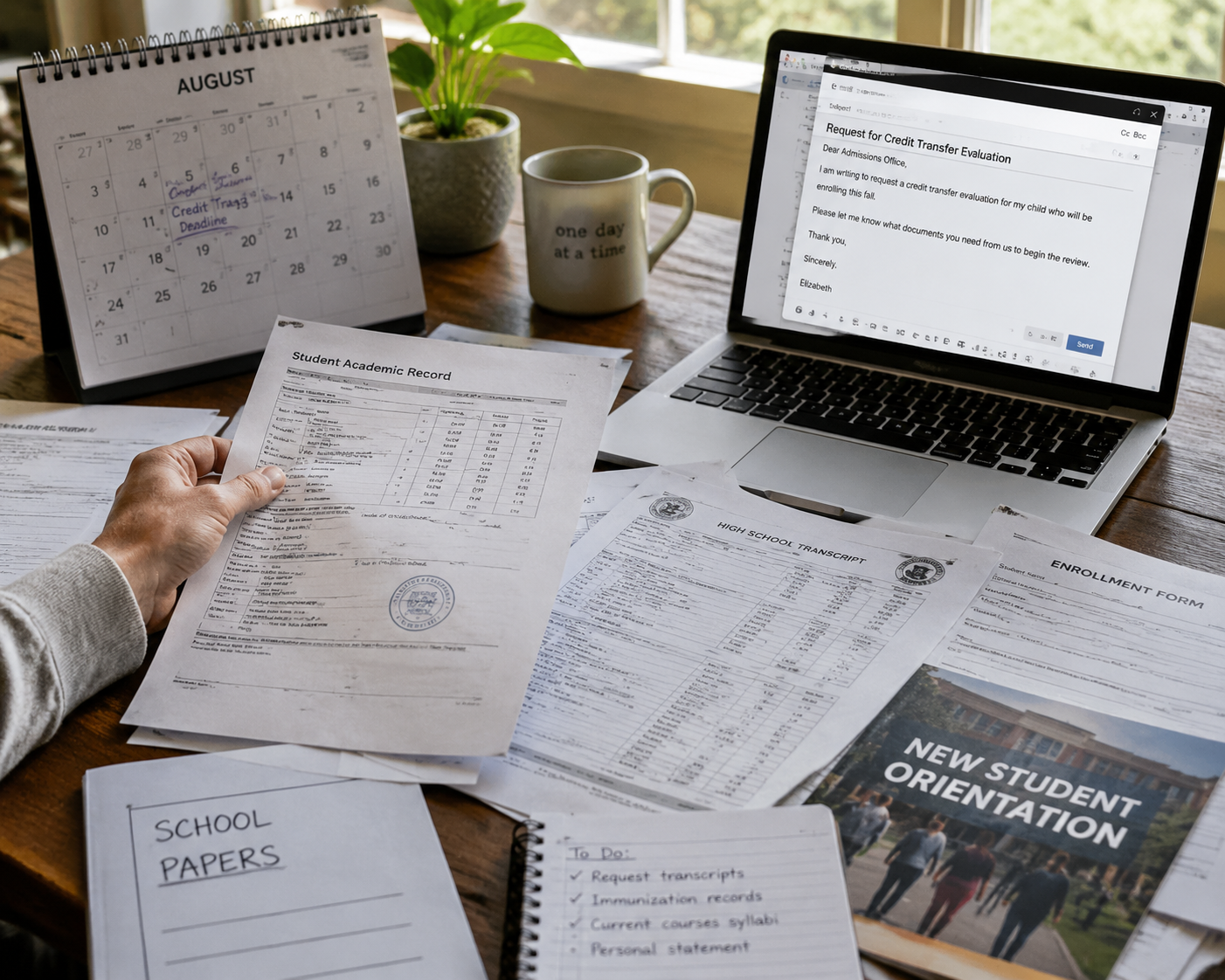
The timeline is long enough for confusion and short enough for lasting mistakes. A receiving school may need to decide whether a student completed Algebra II, whether a science course satisfies a graduation requirement, whether a younger child should return to the same grade, or whether a credit from a year-round residential program can be entered as semester credit. Those decisions usually depend less on a program brochure than on documents: transcript, course title, dates of enrollment, grades to date, attendance, credits attempted, credits earned, learning plans, special education records if they exist, and the name of someone authorized to answer follow-up questions.
What the Closure Timeline Means for School Continuity
The closure orders affect two different campuses on two different dates. KSL reported that Utah revoked the Springville campus license first, with a closure deadline of Aug. 6, 2026, and later revoked the Provo campus license, with a closure deadline of Aug. 16, 2026.[1][2] The school has 15 days to appeal each revocation, so the dates could shift, but families should not treat that uncertainty as extra time.[1][2]
The reported enrollment figure is also imperfect. Wikipedia lists about 195 students, divided as 97 boys and 98 girls, and describes the school as serving students ages 8 to 17 in grades 3 through 12.[4] KSL reported that DHHS was not able to say how many children were affected at the time of the revocation.[2] For planning purposes, the important point is narrower: a substantial group of school-age children is leaving a residential treatment school under state pressure, and the number may not match any public snapshot by the time each student actually exits.
Because Provo Canyon operated year-round, the academic calendar may not line up cleanly with a neighborhood school's semester. A student may be halfway through a course, near completion of a credit, or working on remediation that does not show up neatly on a standard transcript. The receiving school will still have to place the student somewhere on a schedule. If the records arrive late or vague, the default placement may be conservative, and that can cost a student time.
The Record Workflow Families Should Start Immediately
The first task is to confirm the student's current academic status, not just the placement in treatment. Families should ask for the student's enrolled grade level, expected graduation cohort if the student is in high school, current course schedule, course start dates, and the name of the school official responsible for records. If a student has recently moved between campuses, programs, or levels of care, the family should ask whether the academic file contains the full enrollment history or only the current placement.
- Request an official transcript and an unofficial copy immediately, because receiving schools can often begin review from an unofficial document while waiting for the official version.
- Ask for current-course progress, including grades to date, assignments completed, seat-time or attendance records where applicable, and whether any course is close to credit completion.
- Get course descriptions or syllabi for any class whose title may not be obvious to a public school registrar, especially electives, recovery courses, and online or individualized coursework.
- Request special education documents, Section 504 plans, learning plans, behavior plans, evaluations, or accommodation records if the student has them.
- Identify the receiving school before discharge when possible, so the registrar or counselor can ask Provo Canyon directly about credits while staff are still available.
For high school students, partial credit is the most fragile part of the file. A student who leaves a course after several weeks may have done real academic work without having earned a clean semester credit. The family should ask the sending program to state, in writing, how much of the course was completed and what evidence supports that progress. That does not force the receiving school to award credit, but it gives the registrar something concrete to evaluate.
For elementary and middle school students, the question is less likely to be credits and more likely to be placement. A receiving school may need reading and math levels, curriculum used, attendance, and any interventions that were in place. If those records are missing, the child can be placed by age and then reassessed, but that means the first weeks after transition become a diagnostic period rather than a stable return to school.
| Document or decision | Why it matters during transfer |
|---|---|
| Official transcript | Allows the receiving school to enter completed credits and verify grade history. |
| Current course list | Shows what the student was taking when the closure timeline interrupted instruction. |
| Partial-credit evidence | Helps a registrar decide whether work in progress can count, continue, or must restart. |
| Course descriptions | Helps translate residential-program course names into local graduation requirements. |
| IEP, 504 plan, or learning plan | Prevents accommodations and services from disappearing during re-enrollment. |
| Attendance and enrollment dates | Helps distinguish academic gaps from documented participation in a year-round program. |
Accreditation Helps, but It Does Not Finish the Credit Decision
Provo Canyon School has been described as accredited through Cognia, formerly connected with NCA CASI, and as offering instruction across grades 3 through 12.[4] Those details matter. Accreditation can make a receiving school more willing to review credits seriously, and it gives families a starting point when a registrar asks whether the sending school was recognized by an external accreditor.
But accreditation is not the same thing as automatic transfer. A public school district, charter school, private school, or out-of-state registrar may still examine whether a course matches local standards, whether the student completed enough work, and whether the grade represents a final credit or only progress to date. If the record says only "English" or "Math" without a course level, term, credit value, or completion status, the receiving school may have to slow down and ask for clarification.
Families should also be careful with academic claims that originate in school marketing. The available description of the academic program includes 120 semester course offerings and student-teacher ratios of 6:1 to 8:1, but those figures should be treated as program claims rather than proof that any particular student's course was delivered in a way another school will accept without review. They may be useful as supporting material; they are not a substitute for the student's own transcript, grades, and course evidence.
That caution is reinforced by broader federal scrutiny of residential treatment education. The U.S. Senate Finance Committee's 2024 report, covered by The Imprint, found that education in for-profit residential treatment facilities was often inadequate, including accounts of teachers relying on movies and free worksheets, and of children being overmedicated.[5] That finding should not be stretched into a specific conclusion about every Provo Canyon classroom. It does explain why receiving schools and advocates should verify the academic record instead of assuming that a course catalog tells the whole story.

What Receiving Schools Need to Decide Quickly
A receiving school does not have to resolve every disputed credit on the first day, but it does need a provisional plan. The student needs a schedule, a grade placement, a special education or accommodation review if applicable, and a timeline for transcript evaluation. If the student is near graduation age, someone should calculate credits twice: once using only fully documented credits and once including credits that may be awarded after clarification. That gap shows what is at stake.
Registrars and counselors should ask whether the exiting student was working in a standard class, credit recovery, online coursework, independent study, or another instructional format. The label matters because local policies often treat those formats differently. A course that appears transferable in title may still need documentation showing the provider, curriculum, grading scale, and completion threshold.
Absences are another avoidable problem. A student leaving a residential program under a state closure order should not be allowed to drift for weeks while adults debate paperwork. Families should begin enrollment with the next school as soon as the likely placement is known, even if the academic file is incomplete. The receiving school can flag the transcript as pending; it cannot recover lost instructional time as easily.
Why the Revocation Happened Still Matters
The academic transition cannot be separated from the reason it is happening. KSL's reports tied the shutdown to Utah's findings of noncompliance at both campuses.[1][2] The Imprint described the action in the context of a yearslong survivor-advocacy campaign, including public pressure from Paris Hilton, who has spoken about her own time at Provo Canyon School.[6] Wikipedia describes Provo Canyon School as having operated for about 55 years, which is part of why the closure has drawn attention beyond the families currently trying to move records.[4]
The abuse history is not just background noise. Unsilenced's timeline includes severe documented allegations and findings, including a 14-year-old foster child injected with Haldol 17 times and restrained more than 30 times in three months, and a 13-year-old with a brain injury and broken jaw whose 911 call was delayed by more than an hour.[7] Those incidents do not describe every student's academic experience, and they should not be used that way. They do show why state oversight and survivor accounts have become central to the public understanding of the school.
For current students, that history has a practical consequence: adults may be understandably focused on safety, discharge location, clinical continuity, and accountability. Those are urgent. But the school file must move at the same time. If academic records are treated as a secondary administrative issue, students can lose credits or repeat work even after the immediate placement crisis is solved.
What Is Known, and What Families Should Not Assume
Several facts are clear enough for planning. Both campuses are under license revocation orders with August 2026 closure deadlines, the state identified 31 total noncompliance citations, DHHS recognized that an immediate lockout would be unsafe, and public enrollment estimates point to nearly 200 school-age students affected.[1][2][3][4]
Several other points remain uncertain. The exact number of affected students may differ from the public estimate. Appeals could alter the timing. Publicly available academic descriptions do not prove the quality or transferability of each student's coursework. The Senate Finance Committee's findings concern the broader for-profit residential treatment sector, not a course-by-course audit of Provo Canyon School.[5]
That uncertainty is exactly why families should preserve more, not less. Save emails. Download portals if access exists. Ask for names, dates, and written explanations. Keep copies of discharge papers separate from school records. If a staff member gives an answer by phone, follow up with a short email confirming what was said. The goal is not to create a perfect archive; it is to give the next school enough evidence to make a fair placement and credit decision.
The Academic Risk Is Manageable Only If the Paper Trail Moves First
The closure of Provo Canyon School's campuses is academically serious because it compresses enrollment, credit review, grade placement, and special-record transfer into a matter of weeks. It is not automatically academically ruinous. Students can land in new schools with usable credits and appropriate placements if families, caseworkers, advocates, and registrars treat the transition as urgent educational stabilization rather than routine enrollment paperwork.
The safest assumption is that every student needs a records check now: what has been earned, what is in progress, what services or accommodations must follow, and who at the next school is responsible for making the first placement decision. Waiting for the institutional dispute to finish may feel orderly, but students do not get those weeks back.
References
- Utah revokes Springville's Provo Canyon School license, KSL
- State revokes license of Provo Canyon School's Provo campus, KSL
- DHHS: Provo Canyon School license revoked, campus to close, ABC4
- Provo Canyon School, Wikipedia
- Senate Investigation Slams Residential Treatment Centers, The Imprint, 2024
- Utah Pulls Provo Canyon School's License, The Imprint
- Provo Canyon School Timeline, Unsilenced
Apply This Method
Related Methods
- Student placement options after Provo Canyon School closes
With Provo Canyon School's campuses closing in August 2026, families need clear guidance on the three main placement pathways — transfer to another licensed residential program, return to a home school district, or step-down to outpatient care. This article documents the exact steps for transferring academic records, preserving credits, and reactivating IEPs or 504 plans.
- Provo Canyon School Abuse Allegations: A Student Safety Checklist
After the Provo Canyon School abuse allegations, this checklist helps parents identify warning signs in residential treatment programs—from licensing actions to communication restrictions—so they can make safer decisions for their child.
- Where Students Can Watch the Perseid Meteor Shower in 2026
The 2026 Perseid meteor shower peaks on August 12–13 under a new moon, creating the best viewing conditions in years. This guide helps students find dark-sky spots near campus — on foot, by transit, or on a weekend trip — without expensive gear.
Comments
Join the discussion with an anonymous comment.